US-Based Suppliers vs. Overseas Fulfillment Centers in 2026: The Real Landed Cost Comparison Dropshippers Need
FOB pricing on a $12 overseas product conceals $4.80 to $7.20 in additional charges across customs duties, international freight, insurance, and handling.
US-Based Suppliers vs. Overseas Fulfillment Centers: The Real Landed Cost Comparison Dropshippers Need
FOB pricing on a $12 overseas product conceals $4.80 to $7.20 in additional charges across customs duties, international freight, insurance, and handling. When those costs surface, US-based dropshipping suppliers with higher sticker prices frequently deliver lower total landed cost per unit and stronger net margins.
The Five-Layer Landed Cost Stack
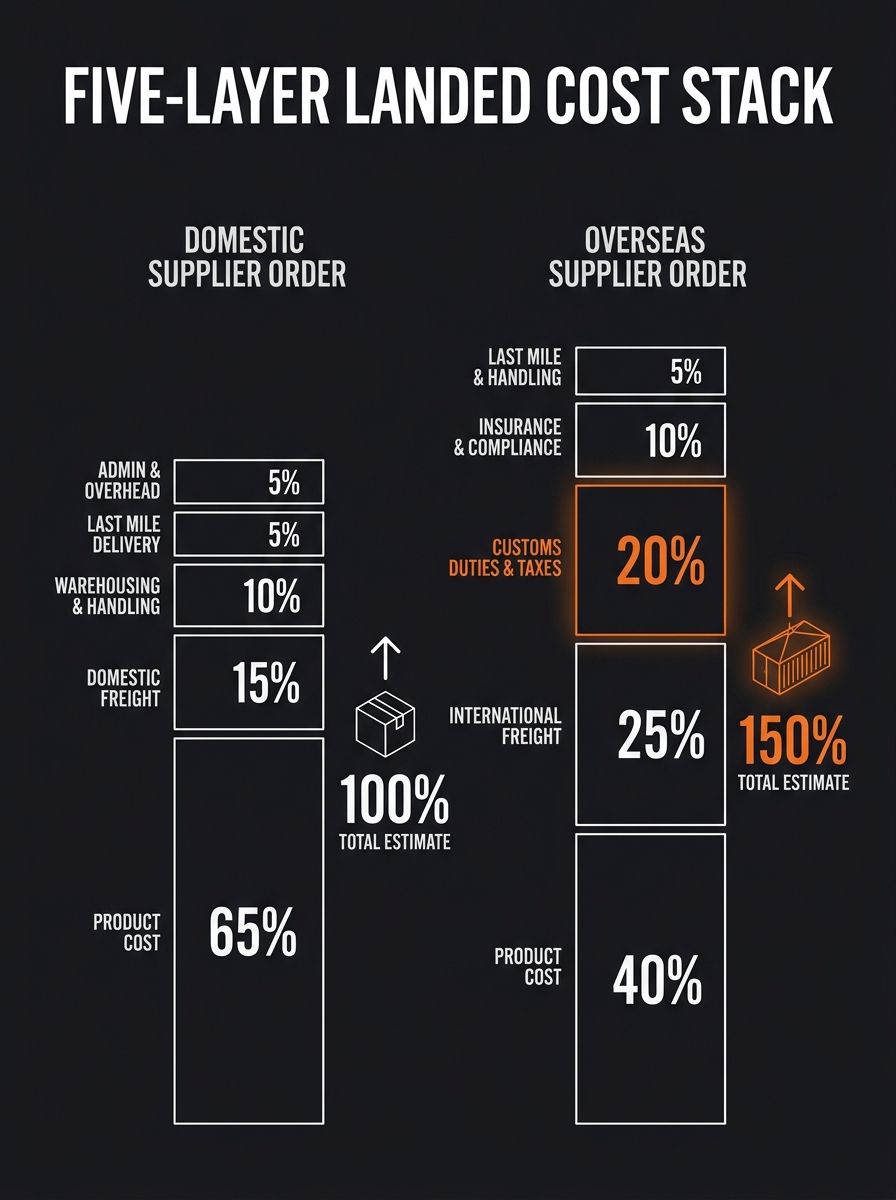
Landed cost is the total price of getting a product from your supplier's shelf to your customer's door. Most dropshippers treat it as "product cost plus shipping." That's a two-layer model applied to a five-layer problem.
According to Descartes Finale's landed cost framework, the full formula is: purchase price + international shipping + customs duties + insurance + domestic freight + handling fees + other import charges. For domestic suppliers, customs duties, insurance, and international freight drop to $0, which collapses the stack from seven cost components to three.
I call this the Five-Layer Landed Cost Stack, and it applies to every landed cost comparison regardless of product category:
Product cost (wholesale/FOB price from the supplier)
Logistics cost (international freight, domestic shipping, last-mile delivery)
Duties and tariffs (customs charges, broker fees, Section 301 tariffs)
Risk cost (returns, chargebacks, lost shipments, customer refunds)
Operational overhead (platform fees, pick-and-pack charges, inventory sync subscriptions)
When you evaluate US suppliers vs overseas on only Layer 1, overseas wins every time. The product cost is lower. But Layers 2 through 5 are where overseas fulfillment cost accumulates quietly, and where the landed cost comparison flips.
Running the Numbers on a $15 Retail Product
The best way to understand dropshipping supplier geography economics is to run a single product through both supply chains. Take a standard product retailing at $15 on your Shopify store.
US-based supplier route:
Wholesale cost: $9.50 (higher sticker price, as TopDawg's supplier analysis confirms)
Domestic shipping: $3.50–$4.00 (USPS First Class or UPS SurePost)
Pick and pack: $0.20–$0.50 per order (ShipBob reports standard pick fees start at $0.20)
Customs/duties: $0
Insurance: $0
Total landed cost: ~$13.20–$14.00
Gross margin at $15 retail: $1.00–$1.80 (6.7%–12%)
Overseas supplier route:
FOB product cost: $5.25
International shipping (ePacket or equivalent): $3.50–$5.00
Customs duties (assume 7.5% average on declared value): $0.39–$0.77
Customs broker/handling fee: $0.50–$1.00 per shipment
Last-mile domestic delivery (if applicable): $1.50–$2.50
Insurance: $0.15–$0.30
Total landed cost: ~$11.29–$14.82
Gross margin at $15 retail: $0.18–$3.71 (1.2%–24.7%)
The overseas margin range is enormous. That volatility is the problem. Your actual landed cost on any given order depends on which tariff schedule applies, whether the package clears customs without delay, and whether the carrier adds surcharges that week. US supplier costs are predictable to within $0.50 per order. Overseas costs can swing $3.50 per order on the same SKU.
Cost Component | US Supplier | Overseas Supplier |
|---|---|---|
Product/wholesale cost | $9.50 | $5.25 |
Shipping (all legs) | $3.50–$4.00 | $5.00–$7.50 |
Customs duties | $0 | $0.39–$0.77 |
Handling/broker fees | $0 | $0.50–$1.00 |
Insurance | $0 | $0.15–$0.30 |
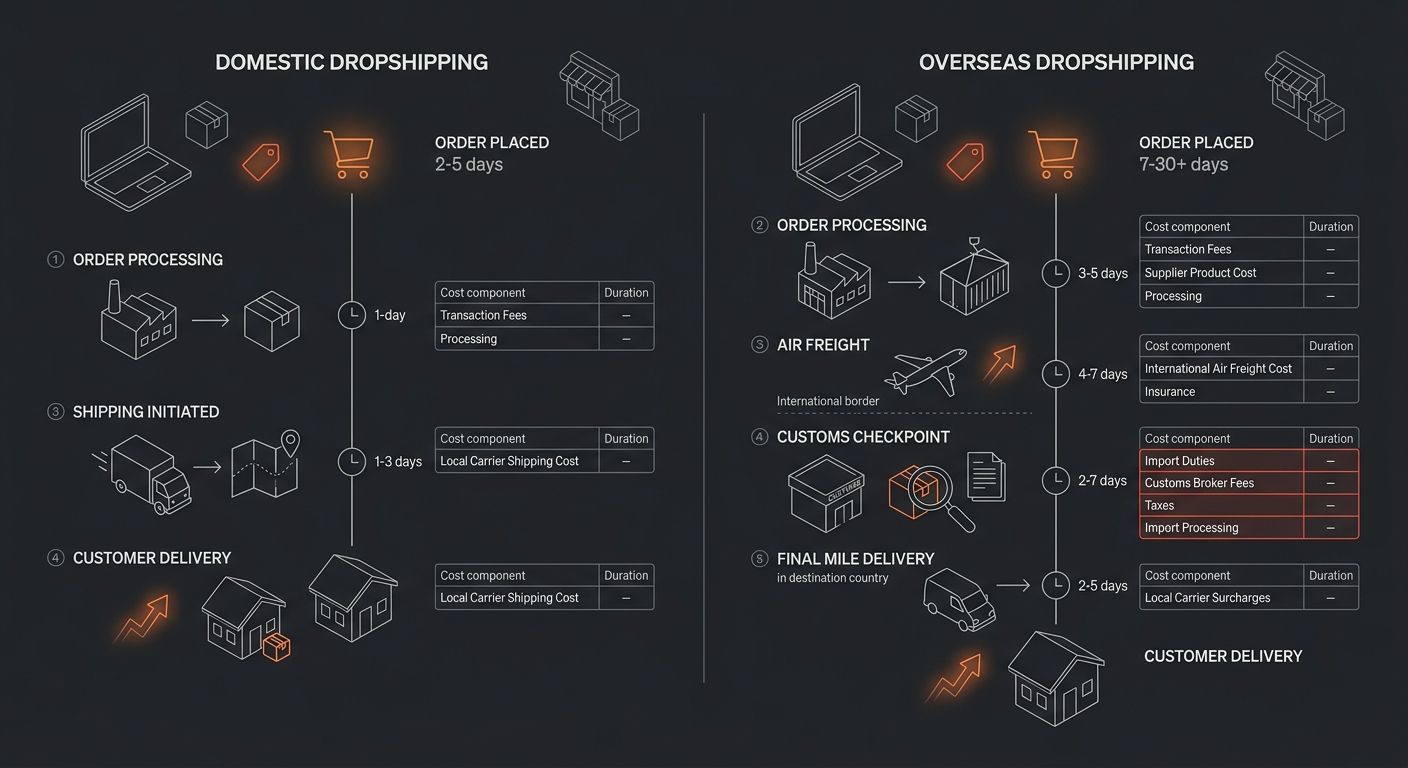
Delivery speed | 2–5 days | 7–30+ days |
Total landed cost | $13.20–$14.00 | $11.29–$14.82 |
Margin at $15 retail | $1.00–$1.80 | $0.18–$3.71 |
If you're building a tariff-aware unit cost model, the domestic route gives you a tighter confidence interval on every order. The overseas route gives you a wider potential margin ceiling but also a realistic floor near zero.
The Return Rate Tax on Overseas Orders
The table above doesn't include Layer 4 of the cost stack: risk costs. And this is where overseas fulfillment cost comparison really deteriorates.
US suppliers ship within 2–5 business days. Overseas suppliers average 7–30+ days, according to USA Today's 2026 supplier analysis. That delivery gap creates three compounding cost problems:
Higher "where is my order" support volume. Every WISMO ticket costs $3–$8 in support labor if you're using a tool like Gorgias or a VA, and overseas orders generate 3–4x the ticket volume of domestic orders due to tracking gaps between international carriers and USPS handoff.
Elevated return and refund rates. International shipments carry higher return friction, which sounds like it should reduce returns. In practice, customers who can't easily return a product just file chargebacks or demand refunds without returning the item. You eat the full product cost plus a $15–$25 chargeback fee. The economics of return rates compound fast when your product cost is low and your margin is thin.
Cart abandonment from shipping time estimates. Displaying "ships in 14–21 business days" at checkout suppresses conversion rates by 18–25% compared to "ships in 2–3 business days." That's not a landed cost line item, but it directly reduces the revenue side of your margin equation.
When you add $1.50–$3.00 per order in blended risk costs (support, chargebacks, refund absorption) to the overseas landed cost, the $11.29–$14.82 range shifts to $12.79–$17.82. At a $15 retail price, you're losing money on a significant share of overseas orders.
Where Overseas Fulfillment Still Makes Margin Sense
The landed cost comparison isn't uniformly in favor of domestic suppliers. Overseas sourcing wins in specific, identifiable scenarios.
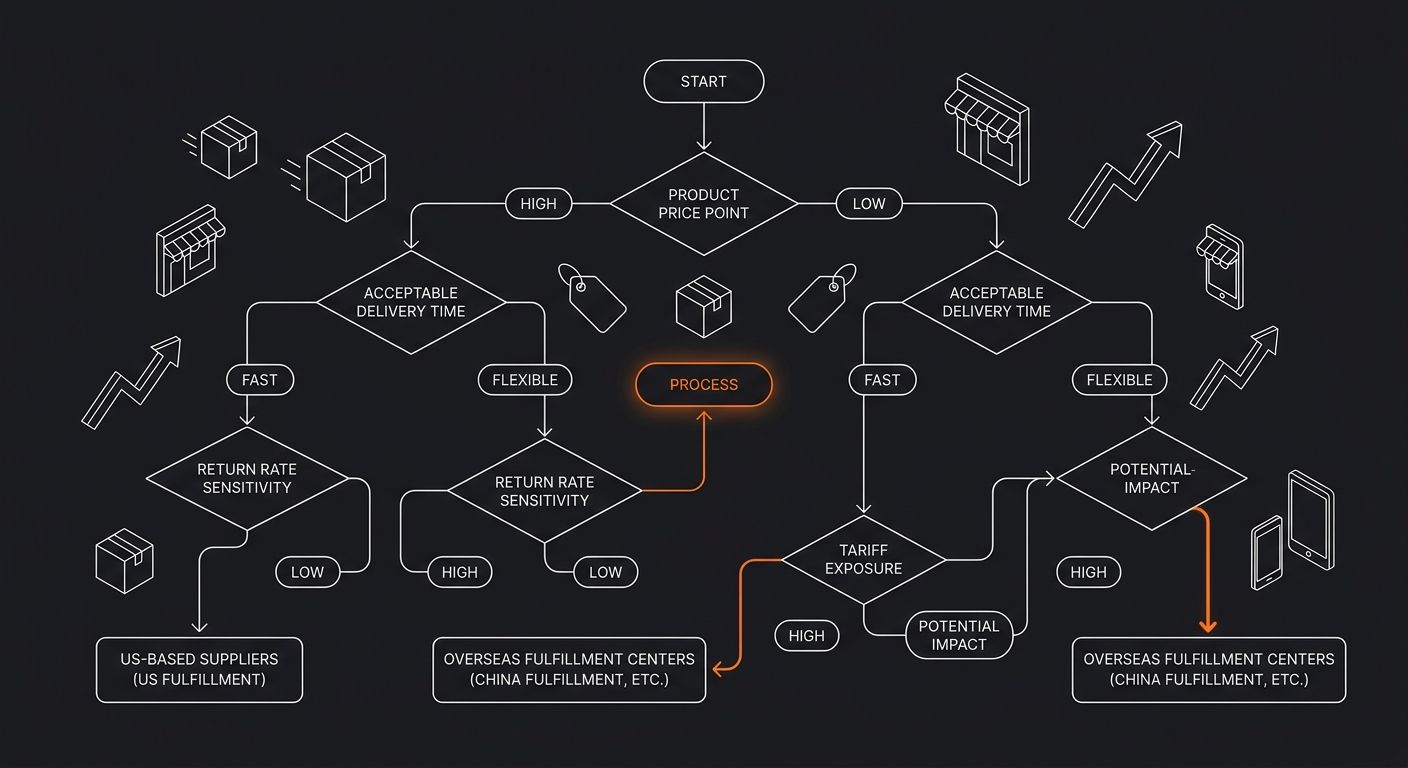
High-AOV products with long acceptable delivery windows. Custom jewelry, specialty electronics accessories, and niche hobby items priced at $45+ can absorb the higher landed cost of overseas fulfillment because the margin spread is wide enough. If you're building high-AOV bundles at $120+ cart values, the per-unit overseas cost penalty becomes a smaller percentage of the total order value.
Products with no viable US supplier. Some categories simply don't have domestic dropshipping suppliers with adequate catalog depth. Specialty craft supplies, certain phone accessories, and ultra-niche hobby components often require overseas sourcing. In those cases, the question isn't US vs. overseas but rather which overseas fulfillment center offers the best cost-to-speed ratio.
Test-phase products before committing to US inventory. Running a $200–$500 test campaign with overseas fulfillment to validate demand before negotiating with a domestic supplier is a legitimate use case. The higher per-unit cost during testing is offset by the lower capital risk, and if you're following a demand validation process properly, most test products won't graduate to full-scale anyway.
The common thread: overseas fulfillment works when the margin buffer is large enough to absorb cost volatility, or when you're explicitly trading margin for information during a test phase.
Mapping Your Supplier Mix to Shipping Zone Economics
The smartest approach for most dropshipping stores isn't binary. It's a supplier mix weighted by product category, price point, and customer geography.
Distributing inventory across multiple fulfillment locations reduces shipping zones and per-order delivery costs, as EP Logistics' fulfillment research documents. For dropshippers who don't hold inventory, the equivalent strategy is maintaining 2–3 domestic suppliers for your core catalog (the 60–80% of SKUs generating most revenue) and overseas suppliers for long-tail or test-phase products.
Platform choice matters here too. If you're running a multi-supplier store on Shopify, the way order routing logic distributes orders between suppliers directly affects which cost stack applies to each sale. Misconfigured routing can send orders to your higher-cost supplier when a cheaper domestic alternative has the same SKU in stock.
And the aggregator platform fee stack adds another variable. Platforms like Spocket, Inventory Source, and TopDawg each layer their own subscription or per-order fees on top of the supplier's wholesale price. TopDawg offers access to 500,000+ products through a fully US-based supplier network with real-time inventory syncing. Spocket mixes US and overseas suppliers with per-order pricing. The platform fee becomes Layer 5 of your landed cost stack, and it varies by $0.50–$3.00 per order depending on your plan tier and volume.
What The Data Doesn't Tell Us
This landed cost comparison uses current tariff schedules, average carrier rates, and typical customs processing times. Three things could shift the math significantly in the next 6–12 months.
Tariff policy remains volatile. Section 301 tariffs on Chinese goods, de minimis threshold changes, and new bilateral trade agreements can move the duties layer of the cost stack by 5–15 percentage points overnight. Any landed cost model built on current tariff rates has a shelf life measured in months, not years.
Carrier surcharge trends are opaque. UPS, FedEx, and DHL all adjusted fuel surcharges and peak-season surcharges multiple times through 2025, and those adjustments hit international shipments harder than domestic ones. The shipping cost ranges in this analysis reflect current published rates, but the gap between domestic and international shipping costs could widen or narrow based on fuel markets and port efficiency dynamics that no single dropshipper controls.
Customer expectations around delivery speed are still shifting. The 2–5 day domestic standard exists because Amazon trained consumers to expect it. If same-day and next-day delivery become the baseline expectation for more product categories, the conversion rate penalty for overseas fulfillment's 7–30+ day window will grow, making the effective cost even higher than the direct landed cost numbers suggest.
The numbers in this comparison favor US-based suppliers for most standard dropshipping scenarios, but the margin of advantage depends on variables that change quarterly. Build your supplier geography around the Five-Layer Landed Cost Stack, stress-test it against tariff changes, and re-run the math every 90 days. The suppliers that win on landed cost today may not be the same ones that win six months from now.
365 Dropship Editorial
Editorial team writing about E-commerce, dropshipping, and product discovery — reviews of dropshipping suppliers and platforms, trending niche guides (jewelry, beauty, pets, home, fashion), supplier due diligence, ecom operations, shipping & fulfillment strategy, product research, AOV optimization, and profitable dropshipping case studies.
Related Articles
The Domestic Supplier Advantage: Why US-Based Fulfillment Is Reshaping 2026 Dropshipping Unit Economics
Domesticated fulfillment with bulk DDP imports cuts per-parcel costs by 8–15% for brands shipping 4,000+ US orders monthly, according to Evolution Fulfillment's cost model.
The Hidden Cost of Speed: Why Faster Shipping Is Tanking Your 2026 Margins (And How to Rebalance)
Carrier rate hikes from UPS and FedEx averaged 5.9% for 2026, but surcharges push the real increase to 8–12%. Last-mile delivery absorbs 53% of total shipping costs. Three fulfillment models handle this pressure differently, and choosing wrong erodes margin faster than rising ad costs.
Cross-Border Tariffs & Import Duties: The Hidden Margin Killer Dropshippers Overlook
Every package entering the U.S. from China now triggers a full customs entry.
Explore more topics