Building a Tariff-Aware Unit Cost Model: The Step-by-Step Framework for Cross-Border Dropshipping Math
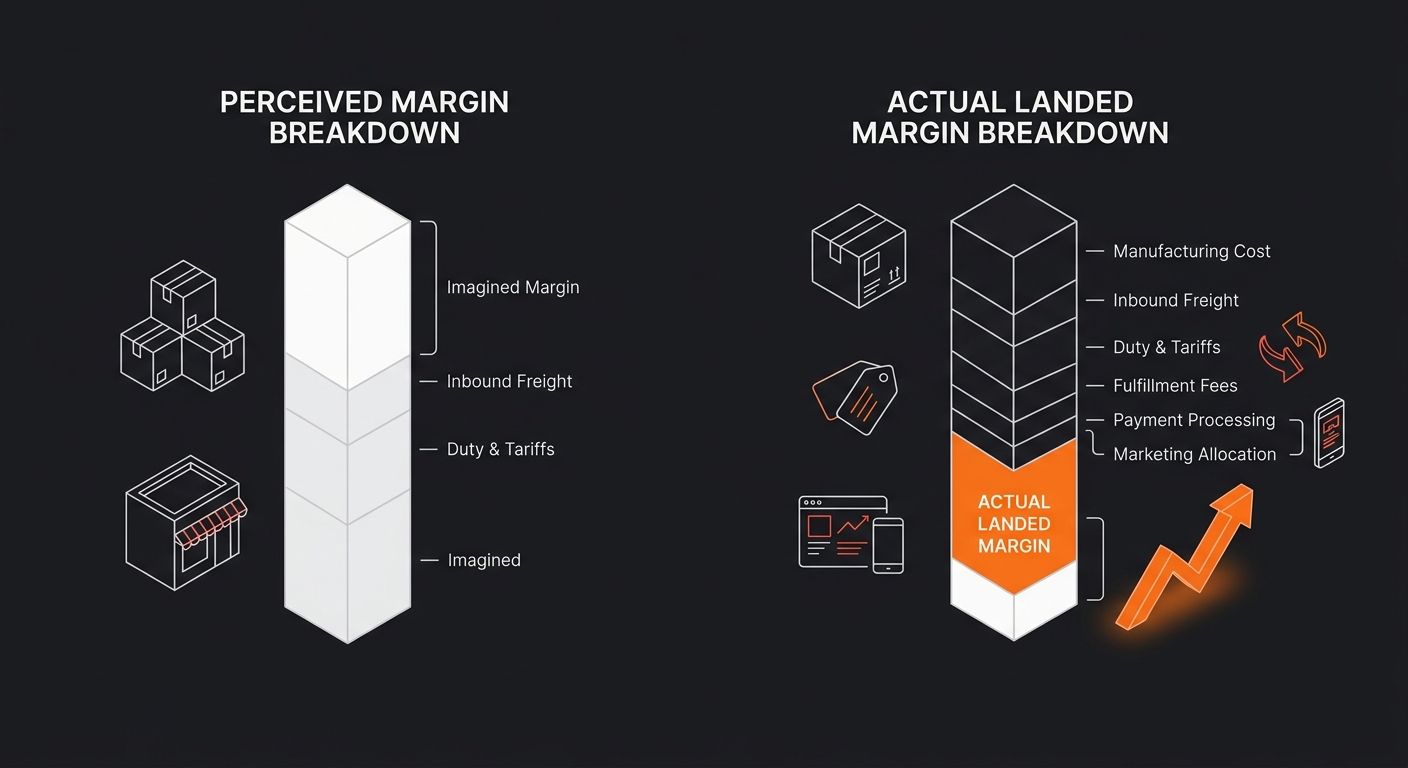
A silicone kitchen spatula sourced from Guangdong at $4.50 per unit, with $4.80 in shipping, doesn't land in a U.S. customer's hands at $9.30. After a 28.4% combined duty rate, insurance, and processing fees, the true landed cost hits $12.94, slashing a perceived 60% gross margin to roughly 48%.
Building a Tariff-Aware Unit Cost Model: The Step-by-Step Framework for Cross-Border Dropshipping Math
A silicone kitchen spatula sourced from Guangdong at $4.50 per unit, with $4.80 in shipping, doesn't land in a U.S. customer's hands at $9.30. After a 28.4% combined duty rate, insurance, and processing fees, the true landed cost hits $12.94, slashing a perceived 60% gross margin to roughly 48%.
The Five-Layer Landed Cost Stack
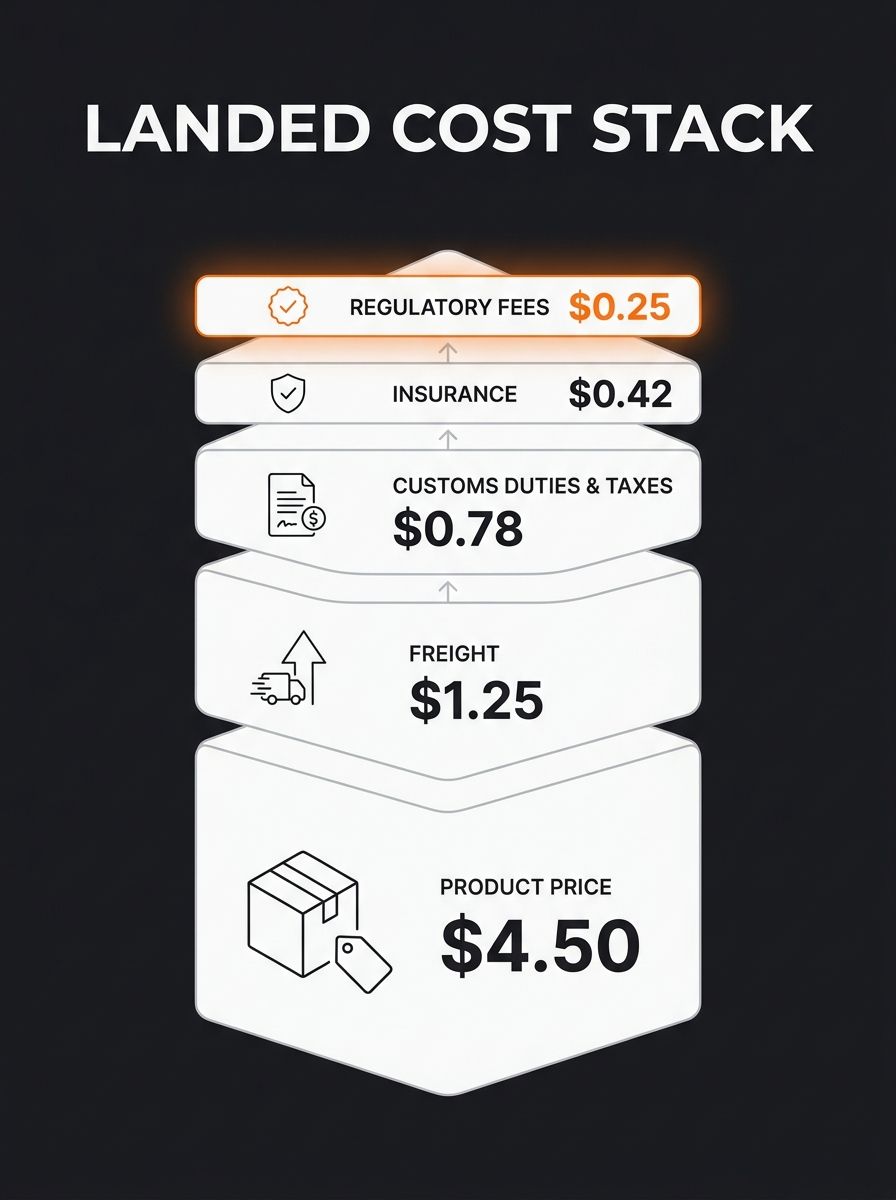
The landed cost formula that DHL, FedEx, and customs brokers all reference follows the same anatomy: Product Price + Freight Cost + Customs Duties & Taxes + Insurance Cost + Regulatory Fees. Each layer introduces its own variable cost that shifts with origin country, HS code classification, and current trade policy.
Here's what each layer contains:
Product price: the per-unit cost on your supplier invoice (the FOB or EXW price).
Freight cost: carrier charges from origin to destination, including fuel surcharges and last-mile delivery. Cross-border shipping fees frequently exceed the product cost itself. BuckyDrop's pricing data shows a cross-border shipping fee of roughly $8 per unit on items with purchase prices under $4.
Customs duties and taxes: import duty rates determined by HS code, plus any Section 301 tariffs (up to 25% on Chinese goods), plus the 20% baseline IEEPA tariff that was in effect through early 2026.
Insurance: typically 1-3% of CIF value, often bundled into freight quotes but sometimes billed separately.
Regulatory fees: Merchandise Processing Fee (MPF) of 0.3464% on most U.S. imports, Harbor Maintenance Fee (HMF) of 0.125% on ocean freight shipments, and any country-specific compliance costs.
When you're doing supplier margin modeling, ignoring even one of these layers creates a gap between your spreadsheet margin and your actual bank deposit. The gap compounds across hundreds of orders per month.
De Minimis Is Gone for Chinese Imports
The U.S. $800 de minimis exemption, which allowed low-value shipments to enter duty-free, was suspended for Chinese imports in 2025. This change hit direct-to-consumer ecommerce hardest. Every parcel from Chinese suppliers now faces full tariff liability regardless of declared value, according to Red Stag Fulfillment's 2026 tariff analysis. Small-package importers who previously paid zero duties on sub-$800 shipments saw their international shipping cost structure change overnight.
For context, Canada's de minimis threshold sits at just $20, as noted in r/dropship discussions on import duty dropshipping. If you ship to Canadian customers, you've been dealing with duty exposure on virtually every order already. The U.S. change brought American-bound shipments to the same reality.
The U.S. Supreme Court complicated things further. On February 20, 2026, the Court ruled that tariffs issued under IEEPA were unlawful, creating uncertainty about refunds on previously collected duties. FedEx stated they are "committed to helping our customers navigate the regulatory environment and providing updates when we have them." Section 301 tariffs and standard HTS duty rates remain in effect, but the IEEPA-specific rates are now in legal limbo.
This is why your cross-border tariff calculator needs to be a living document, not a one-time setup.
Running the Numbers on a Real SKU
Here's how the math works on a concrete product. Take a stainless steel insulated tumbler sourced from a Guangdong supplier:
Supplier unit cost (FOB): $4.50
Freight (ePacket/YunExpress to U.S.): $4.80
Insurance (2% of CIF value): $0.19
CIF value: $4.50 + $4.80 + $0.19 = $9.49
Section 301 duty rate for HS 7323 (stainless steel table/kitchen articles): 25%
Duty owed: $9.49 × 0.25 = $2.37
MPF (0.3464% of CIF): $0.03
Total landed cost: $9.49 + $2.37 + $0.03 = $11.89
If you sell that tumbler for $24.99, your gross margin is 52.4%. Without the duty calculation, you'd have estimated gross margin at 62.0%. That 9.6 percentage point gap represents real money vanishing from your P&L on every single order.
And the math gets worse when you layer in currency conversion. The 2-3% spread between payment processor exchange rates and mid-market rates adds another $0.09–$0.14 per unit on a $4.50 product. Small individually, painful across 2,000+ monthly orders.
Where Currency Conversion Bleeds Margin
Currency conversion spreads are the quietest cost in cross-border dropshipping. Your payment gateway, whether it's Payoneer, Wise, or a standard bank wire, adds a markup over the mid-market exchange rate. That markup typically runs 2-3% on each supplier payment.
On a $4.50 product, 2.5% costs you $0.11 per unit. Scale that to 3,000 orders per month and you're losing $330 monthly to conversion alone. Over a year, that's $3,960 in margin leak that never shows up as a line item in your cost of goods.
The fix is straightforward: pay suppliers in their local currency using a multi-currency account (Wise Business or Payoneer) that offers spreads under 0.5%. The difference between a 2.5% spread and a 0.4% spread on $13,500 in monthly supplier payments is $283.50/month. That saving goes straight to your bottom line.
DDP Pricing Prevents Cart Abandonment
Surprise customs fees at the door cause 55-70% cart abandonment on international orders. When a customer orders a $24.99 tumbler and gets hit with a $6 customs charge on delivery, they refuse the package, you eat the return shipping, and your margin goes negative on that order.
DDP (Delivered Duty Paid) pricing solves this by baking all duties and taxes into the checkout price. The customer sees one final number. You absorb the duty cost upfront and build it into your retail price. Your product page might show $29.99 instead of $24.99, but conversion rates improve because there are zero surprises.
Zonos automates this by calculating duties and taxes at checkout in real time, then displaying the total landed cost to the buyer before they complete payment. If you're selling into multiple countries, automated DDP pricing is the difference between sustainable international sales and a customer service nightmare.
This ties directly into how you model your international shipping cost structure. When freight costs shift due to port disruptions or bunker fuel price spikes, your DDP price needs to adjust accordingly.
Calculator Tools for Cross-Border Tariff Modeling
Three tools dominate the import duty dropshipping calculation space. Here's how they compare:
Feature | Zonos | TariffDutyCalculator.com | ToolcR |
|---|---|---|---|
HS code automation | Automated AI classification | Manual lookup required | Manual entry only |
API integration | Full REST API for checkout | None | None |
Duty + VAT/GST | Both calculated | Both calculated | Duty + basic tax |
Real-time rate updates | Yes, policy changes reflected | Periodic updates | Static rates |
Free tier | Free trial available | Free calculator | Free calculator |
Checkout integration | Native Shopify/WooCommerce | Standalone only | Standalone only |
Multi-country support | 200+ countries | Major markets | U.S.-focused |
For one-off calculations while evaluating a new SKU, TariffDutyCalculator.com and ToolcR work fine. For live checkout integration where you need real-time landed cost displayed to customers across multiple destination countries, Zonos is the most complete option.
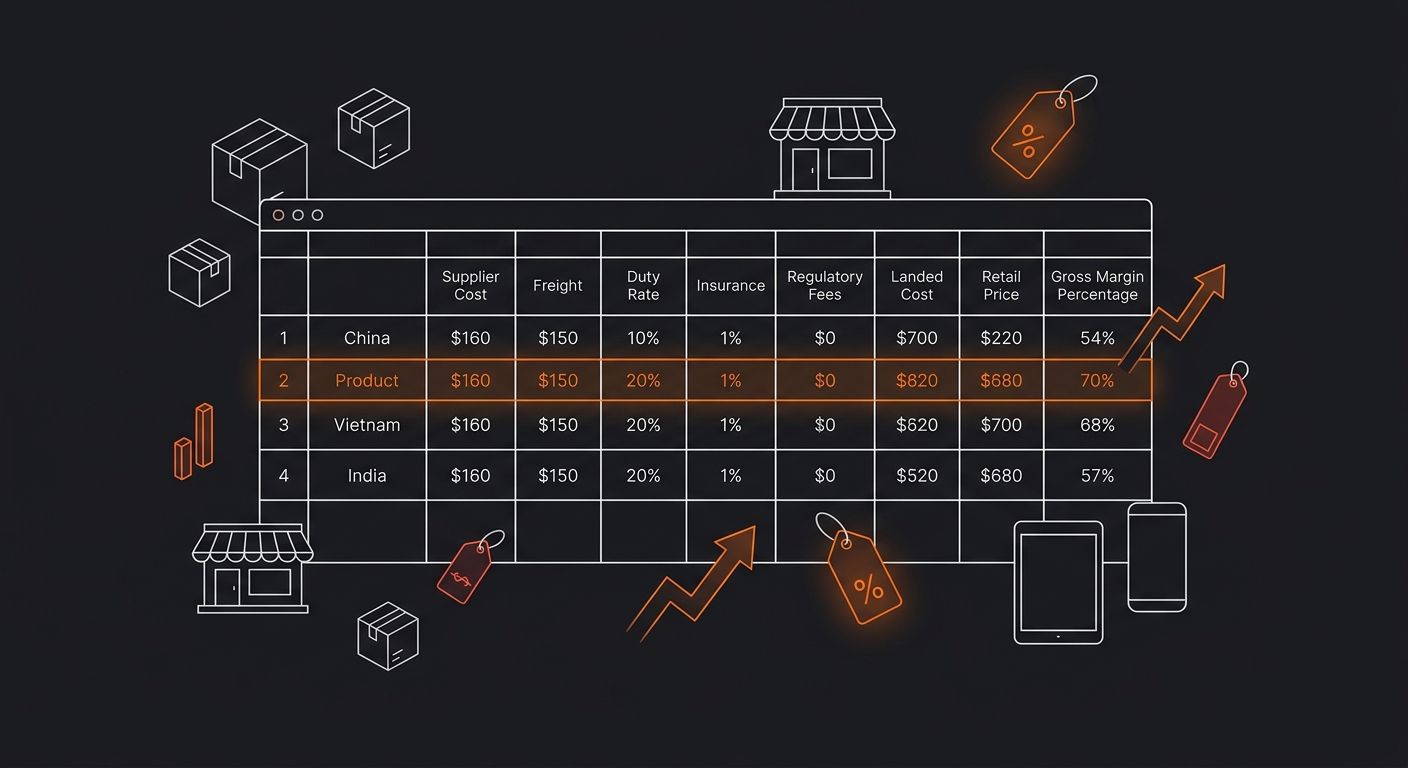
Your cross-border tariff calculator should also be stress-tested against your backup supplier network. A supplier in Vietnam or India carries different HS code classifications and duty rates than one in China. Running the landed cost formula for the same product across two or three origin countries shows you exactly where geographic diversification saves or costs money.
Adjusting the Model When Trade Policy Shifts
The February 2026 Supreme Court ruling on IEEPA tariffs demonstrated how fast the ground moves. Dropshippers who built static margin models around fixed duty rates found those models invalidated within a single news cycle. The question of whether CBP will refund previously collected IEEPA tariffs remains open as of mid-2026, and Section 301 tariffs (the 25% rate on many Chinese goods) continue to apply regardless of the IEEPA outcome.
Your unit cost model needs a "tariff sensitivity" column. For each SKU, calculate your margin at three duty rates: the current rate, a rate 10 percentage points higher, and a rate 10 percentage points lower. If a 10-point increase pushes your gross margin below 20%, that SKU is too tariff-sensitive to carry without a backup sourcing plan.
This is the same principle behind supplier diversification strategies that protect against geopolitical disruption. The math is the insurance policy.
What Remains Unsettled
Several open questions make tariff-aware unit cost modeling a moving target rather than a solved problem. The IEEPA tariff refund process has no published timeline. Section 301 tariff reviews could increase or decrease rates on specific HS codes in the next 12 months. And new trade agreements with Vietnam, India, and other alternative sourcing countries may introduce preferential duty rates that don't exist today.
The de minimis exemption for Chinese goods could theoretically be reinstated, though no legislative movement suggests that's likely in the near term. Canadian sellers face their own uncertainty as discussions around raising the $20 CAD threshold continue without resolution.
What you can control is the structure of your model. Build it with all five layers, update the duty rate inputs monthly, and run the sensitivity analysis before committing ad spend to any SKU. The dropshippers who treated their margin spreadsheets as static documents in 2025 learned the cost of that assumption when every parcel from China suddenly carried a duty bill they hadn't priced in. The ones who built flexibility into their models absorbed the change and kept selling.
365 Dropship Editorial
Editorial team writing about E-commerce, dropshipping, and product discovery — reviews of dropshipping suppliers and platforms, trending niche guides (jewelry, beauty, pets, home, fashion), supplier due diligence, ecom operations, shipping & fulfillment strategy, product research, AOV optimization, and profitable dropshipping case studies.
Related Articles
Cross-Border Tariffs & Import Duties: The Hidden Margin Killer Dropshippers Overlook
Every package entering the U.S. from China now triggers a full customs entry.
The Cross-Border Tariff Calculator: Building Your True Unit Cost Model Before Supplier Selection
A silicone kitchen spatula classified under HTS 3924.10 costs $4.50 from a Guangdong supplier on AliExpress, with $4.80 shipping via ePacket. That $9.30 declared value now triggers a 3.4% base duty plus a 25% Section 301 tariff — roughly $2.64 in combined duties — plus a $0.
Container Freight Surges and Dropshipping Unit Economics: Why Port Efficiency Losses Are Reshaping Your 2026 Supplier Costs
Landed cost calculators take your product cost, layer on freight, duties, insurance, and port fees, then output the true per-unit cost of getting inventory to a customer's door.
Explore more topics