Inside the Supplier Markup Stack: How Aggregator Platforms Layer Fees Between Factory Price and Your Cost of Goods
Three to seven distinct fee layers sit between a product's factory price and the number aggregator platforms display as your "supplier cost." Fulfillment surcharges, payment processing cuts, per-order fees, and shipping markups each compound silently.
Inside the Supplier Markup Stack: How Aggregator Platforms Layer Fees Between Factory Price and Your Cost of Goods
Three to seven distinct fee layers sit between a product's factory price and the number aggregator platforms display as your "supplier cost." Fulfillment surcharges, payment processing cuts, per-order fees, and shipping markups each compound silently. According to Qogita's 2026 pricing research, retailers then apply an additional 50-100% markup on top of an already-inflated base.
The rules below break down exactly where aggregator platform fees hide, how each layer compounds against your cost of goods in dropshipping, and when direct sourcing becomes the rational move. They apply whether you're running Spocket, CJ Dropshipping, Zendrop, DSers, or any platform that sits between you and a factory.
Map every fee layer before you set a single price
Why does this matter first? Because most dropshippers calculate margin using only the price they see in the aggregator dashboard. That number has already absorbed multiple markups you never approved.
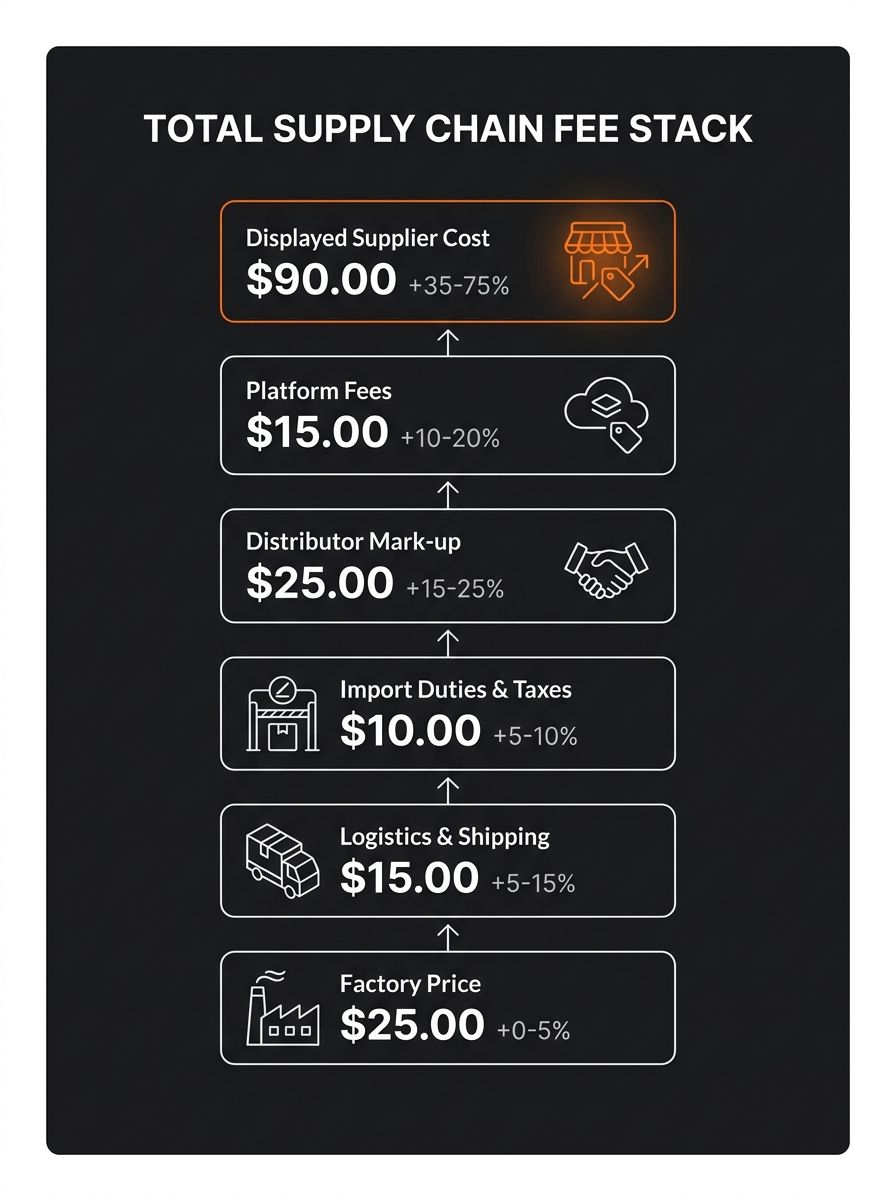
A typical aggregator fee stack on a $6.00 factory-price item looks something like this:
Fee Layer | Typical Range | Example on $6 Item |
|---|---|---|
Factory base cost | — | $6.00 |
Aggregator product markup | 15-40% | $1.20 |
Per-order fulfillment fee | $1.00-$2.50 flat | $1.50 |
Payment processing | 2.9% + $0.30 | $0.54 |
Shipping markup over carrier rate | 20-60% of label cost | $1.80 |
Platform subscription (amortized) | Varies by volume | $0.25 |
Your displayed "supplier cost" | $11.29 |
That $6.00 factory item becomes $11.29 before you add your own margin, ad spend, or return costs. The supplier markup alone (the aggregator's product-level cut) accounts for 15-40% of the inflation, but shipping markup and fulfillment fees together often exceed the product markup itself.
As Shopify's 2026 cost guide notes, some suppliers add "a dropship fee, such as $1 for the first order and 25¢ for each additional one" on top of everything else. Those small fixed fees crush margin on items under $15.
Calculate landed cost per unit, not the number in your supplier dashboard
Landed cost includes every expense incurred to get a product from a factory to your customer's door. The aggregator's displayed price covers their fees, but it rarely includes customs duties, insurance, or last-mile delivery surcharges that hit your account separately.
ERPAG's landed cost framework spells it out cleanly: "$100 (supplier purchase price) + $10 (shipping) + $11 (customs and import duties) = $121 stock price." That's a 21% increase from duties and freight alone, on top of whatever markup the aggregator already baked in.
For cross-border dropshipping, a worked example from Crimson Logic's import guide shows a $10,000 product shipment reaching $14,050 after adding $3,300 in transportation, $500 in customs duty, and $250 in insurance. That's a 40.5% cost increase before any retail margin enters the picture. If you've been building a tariff-aware unit cost model, you already know these numbers shift constantly with trade policy changes.
When the difference between factory price vs retail spans 40-120% in aggregator-mediated supply chains, every untracked fee point compresses the margin you thought you had.
Benchmark aggregator platform fees against direct-sourcing breakeven
Aggregators earn their cut by consolidating fragmented supply. A Substack analysis of platform economics explains that the aggregator model "is a take-rate on the infrastructure it provides, including monthly subscriptions plus payment processing fees." You're paying for convenience, supplier vetting, and order routing. The question is whether that convenience costs more than doing it yourself.
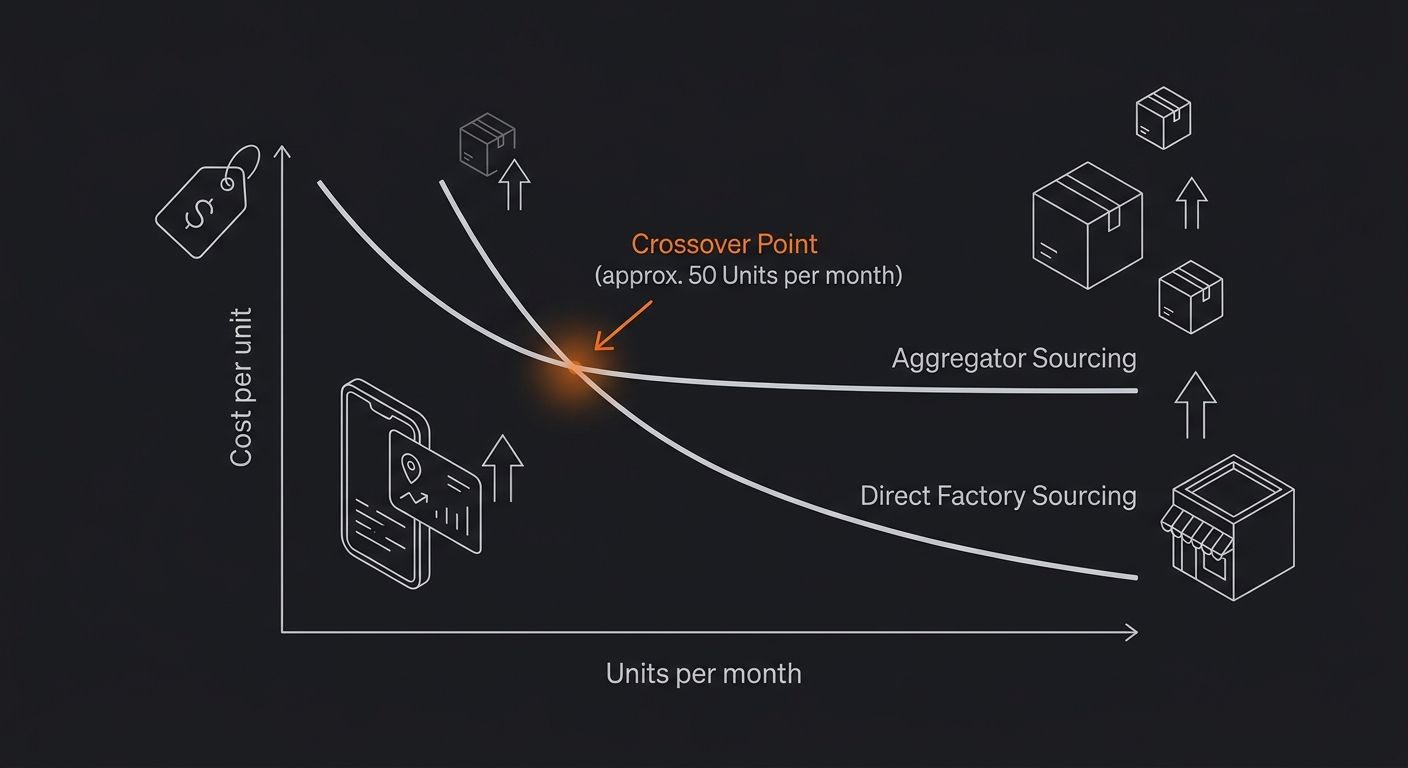
Here's when the math tips: if you're ordering 50+ units per month of a single SKU, contacting the manufacturer on 1688.com or through a sourcing agent typically saves 25-45% on the per-unit product cost. The aggregator's 15-40% product markup disappears. Their per-order fulfillment fee disappears. You replace it with your own freight forwarding costs, which at volume are significantly lower per unit.
Below 50 monthly units on a given SKU, aggregator convenience usually wins. You avoid minimum order quantities, warehousing, and quality inspection logistics. The fee stack is the price of not managing your own supply chain. But once you're scaling a proven winner and your demand validation data confirms sustained volume, running that same SKU through an aggregator becomes an expensive habit.
Audit payment processing as a separate margin drain
Payment processing fees sit outside the aggregator's displayed supplier cost, but they hit your margin twice: once when your customer pays you (Shopify Payments takes 2.9% + $0.30 per transaction on the Basic plan), and once when you pay the aggregator. The aggregator's payment processor takes its own cut from your order payment, and that cost is embedded in the price you see.
On a $30 retail item where you pay $11.29 to the aggregator, your Shopify payment processing fee is $1.17. The aggregator's processor already took roughly $0.63 from the transaction on their end (folded into your cost). Total payment processing friction across both sides: $1.80, or 6% of retail price. On low-ticket items under $15, this percentage climbs fast because the $0.30 fixed component represents a larger share.
Auditing your checkout flow for margin leaks catches some of this, but the aggregator-side processing fee is invisible to most sellers. You can't negotiate it away. You can only account for it in your cost model.
According to Altosight's markup pricing guide, a 40% markup on total costs yields very different profit dollars depending on which costs you actually include in "total." Miss payment processing on both sides and your 40% markup is functionally 28-32%.
Run margin math at the SKU level, never the store average
Store-level averages disguise the SKUs that are bleeding cash. A product with a $4 factory cost might carry a 35% margin through the aggregator stack, while another at $22 factory cost barely clears 12% after the same platform applies identical percentage-based and flat fees.
Wholesalers typically operate on 20-40% margins, while retailers aim for 50% or higher. Aggregator-mediated dropshipping sits awkwardly between these two models. You carry no inventory (wholesaler behavior) but sell at retail prices. The aggregator's fee stack eats into the gap, and that gap varies wildly by price point.
Run this exercise for every SKU generating more than 10 orders per month: take the factory price (ask your aggregator's support team or cross-reference on 1688/Alibaba), add each fee layer from the table in rule one, add your own payment processing, add your actual average shipping cost to your primary markets, add your return rate cost per unit. That final number is your true cost of goods in dropshipping. Compare it to your retail price. If the gap is under 25%, you're working for the aggregator, not for yourself.
Pressure-test your numbers at the quantity you'll actually sell
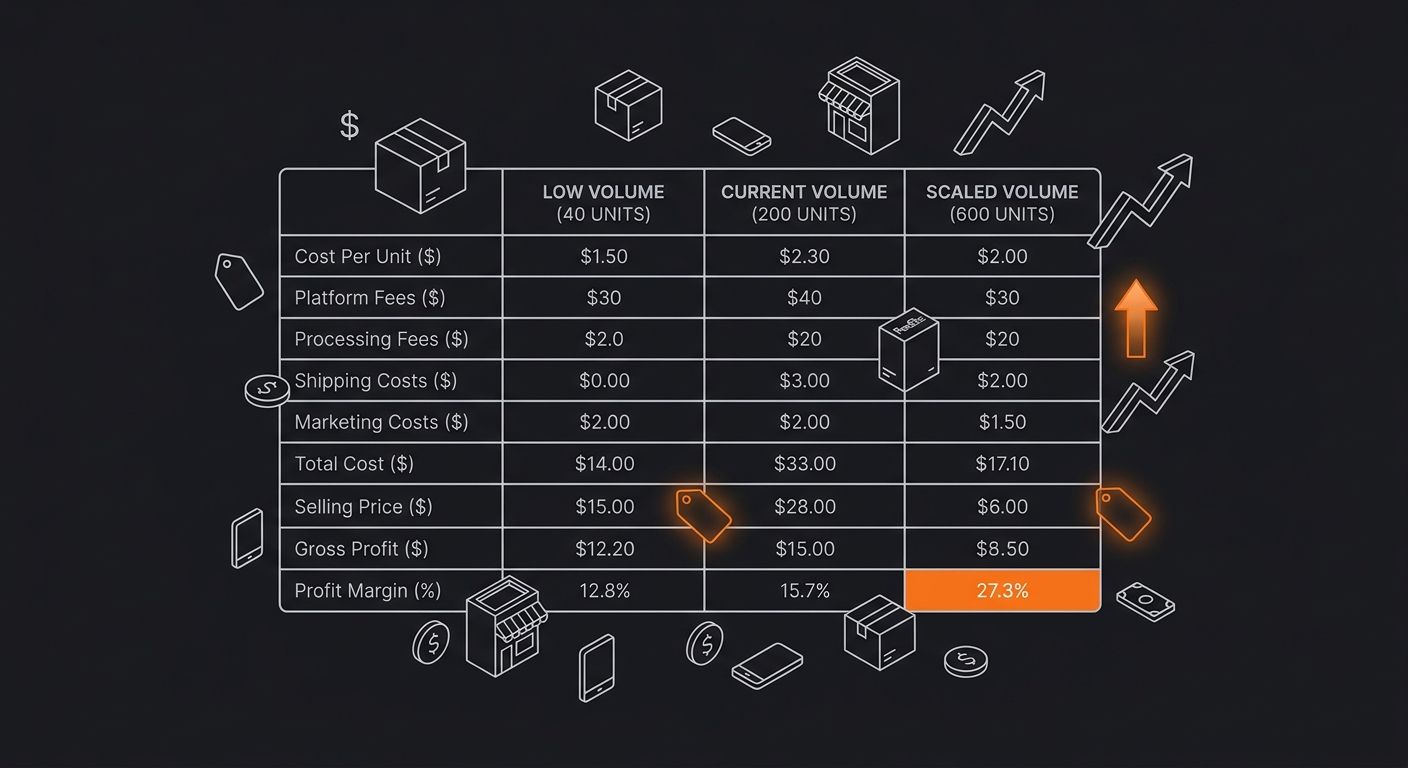
Projected margin at 500 units per month means nothing if you sell 40. Aggregator fee structures contain volume-dependent components that shift your per-unit cost significantly at different scales.
Shopify's data shows retailers apply markups between 35% and 65% when reselling wholesale items. But those markup percentages assume stable input costs. With aggregators, your input cost changes based on which subscription tier you're on (Spocket's paid plans reduce per-item costs by roughly 10-15% versus the free tier), whether you qualify for shipping discounts at volume, and how the platform's dynamic pricing algorithms adjust supplier margins seasonally.
Build three cost models: one at your current monthly volume, one at 3x, one at 0.5x. If the margin at 0.5x drops below 15%, your cost of goods structure can't survive a slow month. If the margin at 3x doesn't improve meaningfully, the aggregator's percentage-based fees are scaling linearly against you and direct sourcing becomes the obvious next step.
This is also where building a supplier scorecard pays off. Track per-unit true cost across aggregators over 60-90 day windows, and you'll spot fee creep (small increases in fulfillment surcharges or shipping markups) that compounds into significant margin erosion before you notice it in monthly P&L reports.
When These Rules Collapse
These rules assume you have access to factory pricing data, enough volume to run meaningful SKU-level analysis, and the operational bandwidth to audit fee layers regularly. Three situations break the model.
First, when you're testing a brand-new niche with under 20 orders per month, SKU-level margin math is noise. You don't have enough data. Aggregator convenience is worth the markup because speed to market matters more than per-unit optimization at the validation stage.
Second, when your aggregator is the only reliable source for a product category (common in specialized niches like medical-adjacent wellness products, where launch capital requirements already constrain sourcing options), the fee stack is the cost of access. You can't benchmark against a direct-sourcing alternative that doesn't functionally exist for your order volume.
Third, when exchange rate volatility or tariff shifts change landed cost faster than you can renegotiate. A platform fee research paper published on ResearchGate confirms that "the efficient platform fee equals the platform's marginal cost plus the difference between suppliers' markups on the direct channel", meaning aggregator fees partially reflect what suppliers would charge you directly anyway. In unstable trade environments, the aggregator's pooled negotiating power on shipping and customs brokerage can occasionally produce lower landed costs than solo importers achieve.
Know which situation you're in. The fee stack is always there. Whether it's worth dismantling depends on whether your volume, niche, and operational capacity justify the effort.
365 Dropship Editorial
Editorial team writing about E-commerce, dropshipping, and product discovery — reviews of dropshipping suppliers and platforms, trending niche guides (jewelry, beauty, pets, home, fashion), supplier due diligence, ecom operations, shipping & fulfillment strategy, product research, AOV optimization, and profitable dropshipping case studies.
Related Articles
Cutting Out the Middleman: When to Source Directly from Suppliers vs. Platform Aggregators in 2026
The per-unit cost gap between buying through a platform aggregator like Spocket or CJ Dropshipping and sourcing the same product directly from its manufacturer typically runs $3–$7 per item, according to current pricing across major supplier directories.
The Post-Sale Audit Framework: How to Diagnose Which Dropshipping Mistakes Are Actually Costing You Margin
Theoretical margin on a $34.99 pet grooming kit sold through Shopify: 42%. Actual margin after pulling the last 100 fulfilled orders, tallying refund shipping labels, Facebook ad spend allocated per unit, and three chargebacks at $22 each: 19%.
Profit Margin Calculator Guide
Multiplying your product cost by 1.30 does not give you a 30% profit margin. It gives you a 23% margin, and that seven-point gap is where thousands of ecommerce operators silently lose money every month.
Explore more topics