The Hidden Cost of Speed: Why Faster Shipping Is Tanking Your 2026 Margins (And How to Rebalance)
Carrier rate hikes from UPS and FedEx averaged 5.9% for 2026, but surcharges push the real increase to 8–12%. Last-mile delivery absorbs 53% of total shipping costs. Three fulfillment models handle this pressure differently, and choosing wrong erodes margin faster than rising ad costs.
The Hidden Cost of Speed: Why Faster Shipping Is Tanking Your 2026 Margins (And How to Rebalance)
Carrier rate hikes from UPS and FedEx averaged 5.9% for 2026, but surcharges push the real increase to 8–12%. Last-mile delivery absorbs 53% of total shipping costs. Three fulfillment models handle this pressure differently, and choosing wrong erodes margin faster than rising ad costs.
The Speed Premium That Eats Your Unit Economics
Fast shipping is baseline expectation in 2026, according to ShipLab. Brands that miss delivery windows lose trust, repeat purchases, and review scores. But meeting that expectation at any cost is where operators quietly bleed out.
Here's the tension. Offering 2-day delivery improves conversion rates by 15-25%, which lowers your effective customer acquisition cost. When customers perceive high value in speed, they're more willing to pay a premium, reducing the pressure to compete on price alone. That's the customer acquisition speed premium: you spend more on fulfillment, but your ad dollars convert harder.
The problem is where the crossover lives. On a $35 order with $8.50 in domestic shipping costs, $7 in product cost, and $6 in ad spend, you're looking at $13.50 gross before platform fees and payment processing chew another $4-5. Net margin: roughly $8.50, or 24%. Switch that same product to an international supplier with $3 shipping and $4 product cost, and your net margin jumps to $18, or 51%. But your conversion rate drops because delivery takes 12-18 days instead of 3, your return rate climbs from 10% toward 20%, and your CAC rises because fewer visitors convert.
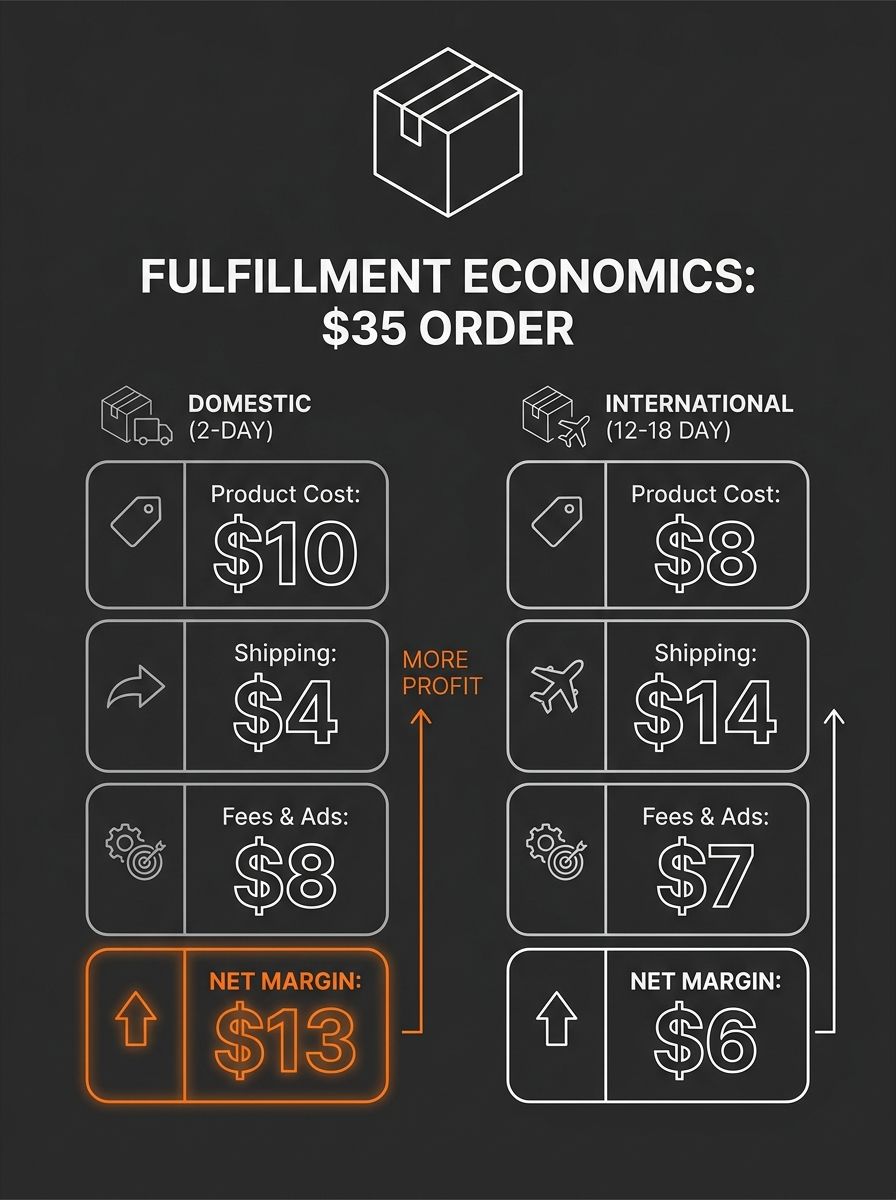
So the real question in 2026 dropshipping unit economics isn't "how fast can I ship?" The question is which fulfillment architecture gives you the best ratio of speed-driven conversion lift to fulfillment cost per order. Three models compete for your answer.
All-Domestic Fulfillment: Maximum Speed, Maximum Overhead
Domestic fulfillment through US-based suppliers or 3PLs like ShipBob, ShipMonk, or Deliverr gives you 2-5 day delivery with zero customs exposure. No tariff surprises. No EU per-item duty fees hitting your European customers. And as Encore Fulfillment documents in their shipping comparison, domestic shipments require only a simple shipping label versus the complex paperwork of international orders, freeing operational bandwidth.
The conversion lift is real. Stores displaying "Ships from USA" badges consistently see higher add-to-cart rates, and the shorter delivery window reduces buyer anxiety on first purchases. If you're running paid acquisition in competitive niches where luxury goods brands face CAC of $120 to $400 per customer, that conversion boost matters enormously.
But domestic suppliers charge 40-60% more for equivalent products. A silicone kitchen utensil set that costs $4.20 from a Guangzhou supplier runs $7.50-9.00 from a US-based wholesaler. Domestic shipping via USPS Priority or UPS Ground adds $6-12 per order depending on weight and zone, versus $2-4 through ePacket or CJ Packet. And DCL Logistics flags that 3PL providers are battling rising labor costs alongside the technology investments needed to maintain speed, which means warehousing fees climb too.
If you're curious how domestic fulfillment reshapes dropshipping economics, the math favors this model primarily for stores with AOV above $50. Below that threshold, the speed premium devours your margin on every order.
Hybrid Split: Domestic Fast-Movers, International Long Tail
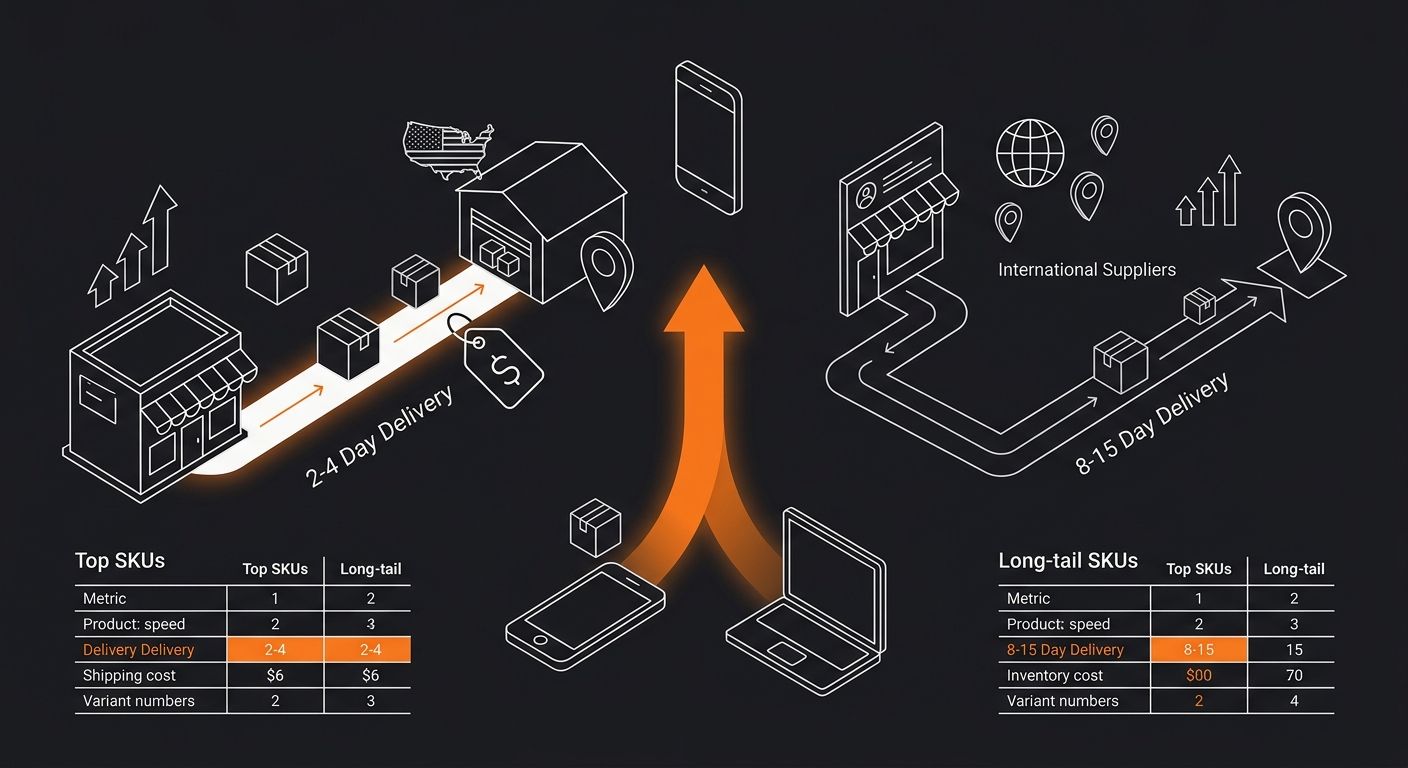
The hybrid model stocks your top 5-10 SKUs (the products driving 60-80% of revenue) at a domestic 3PL while sourcing long-tail catalog items from international suppliers. Your bestsellers ship in 2-4 days. Everything else ships in 8-15 days with clear communication on the product page.
This approach directly addresses the shipping speed profitability tradeoff by concentrating your domestic spending where it generates the most conversion lift. Your hero products, the ones you're running ads against, arrive fast. That protects your paid acquisition efficiency. The secondary catalog items that customers discover through browse behavior or upsells carry lower speed expectations because the customer is already bought in.
The operational complexity is real, though. You're managing two supply chains, two sets of shipping timelines, two inventory systems. Platform fees, support overhead, and logistics complexity increase as order volume grows, according to Scaleorder, placing downward pressure on net margins as you scale. Advertising still accounts for 20-30% of revenue at growth stage, and layering dual fulfillment operations on top of that requires tight tracking to avoid synchronization failures between your domestic and international pipelines.
Blended shipping cost per order for a well-run hybrid model lands around $4-8, with delivery averaging 4-7 days across all orders. Net margin on a $40 AOV typically sits at 28-35%, assuming 25% of orders flow through the more expensive domestic channel.
The setup cost is the barrier. You need a domestic 3PL relationship (minimum monthly commitments of $500-2,000 at most providers), separate supplier agreements, and inventory forecasting for your top SKUs. Operators below 50 orders/day rarely generate enough volume to justify the overhead. And you need to audit suppliers on both sides carefully, because quality inconsistency between your domestic and international products creates a brand coherence problem that shows up in reviews.
International-Only With Managed Expectations
The international-only model keeps COGS at their absolute lowest: $2-6 product cost, $1-4 shipping through AliExpress Standard, CJ Packet, or Yuntrack. Total landed cost on a $30 product can sit below $8, leaving massive gross margin room even after ad spend.
The challenge is conversion. Delivery windows of 10-25 days suppress impulse buying and drive up cart abandonment. Return rates climb toward 15-25% because extended shipping increases buyer's remorse, damage risk, and the odds that a customer simply forgets what they ordered. And the customs landscape has shifted dramatically: the EU eliminated its €150 duty exemption and implemented a €3 per-item fee effective July 1, 2026, which directly impacts every dropshipper selling into European markets from Chinese suppliers.
Geopolitical risk compounds the problem. Container News surveyed industry readers who identified continued geopolitical instability in the Red Sea, Black Sea, and Taiwan Strait as the dominant factor affecting container shipping profitability in 2026. These disruptions create unpredictable transit delays that you can't control and can't easily communicate to customers.
You can partially offset the speed disadvantage through expectation management: prominent delivery timeline badges, post-purchase drip emails with tracking updates, and product page copy that frames the wait positively ("handcrafted," "made-to-order," "specialty item"). Some operators report that transparent communication about shipping timelines reduces refund requests by 30-40%.
International-only still makes sense for two specific scenarios. First, during the testing phase, when you're validating product-market fit and can't justify domestic inventory commitments. Second, for genuinely low-ticket impulse products ($8-15 range) where the margin math on domestic fulfillment is simply impossible.
The Side-by-Side Numbers
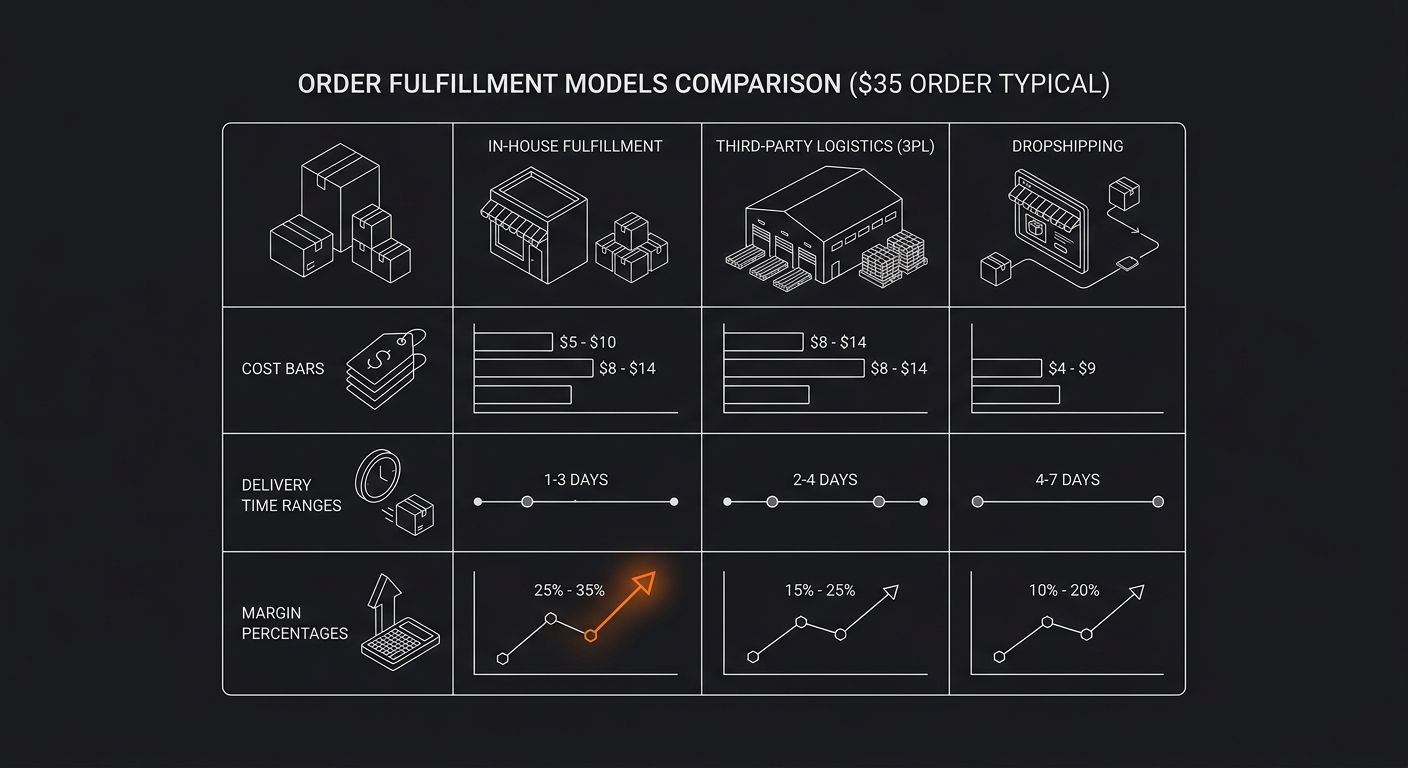
Attribute | All-Domestic | Hybrid Split | International-Only |
|---|---|---|---|
Avg shipping cost/order | $6-12 | $4-8 (blended) | $1-4 |
Delivery window | 2-5 days | 4-7 days (blended) | 10-25 days |
Product cost vs. international | 40-60% higher | 15-25% higher | Baseline |
Customs/duties exposure | None | Partial | Full |
Return rate range | 8-12% | 10-15% | 15-25% |
Estimated net margin ($35 AOV) | 18-24% | 28-35% | 35-50%* |
Minimum viable order volume | 20/day | 50/day | Any |
Operational complexity | Low | High | Low |
*International net margin before accounting for higher refund rates and chargeback costs, which can reduce effective margin by 5-12 points.
Who Should Pick Which
The answer depends on three variables: your AOV, your daily order volume, and your tolerance for operational complexity.
AOV above $50, any volume: All-domestic is your strongest option. The fulfillment premium represents under 20% of revenue, the conversion lift from fast shipping pays for itself through lower CAC, and your exit valuation benefits from the cleaner supply chain. Buyers evaluating your store see domestic fulfillment as a de-risked operation.
AOV $30-50, 50+ orders/day: The hybrid model wins. You have enough volume to negotiate reasonable 3PL rates for your top SKUs, and the blended margin across domestic and international channels gives you room to absorb freight rate inflation without restructuring your pricing every quarter.
AOV under $30, or testing phase: International-only, with obsessive expectation management. Your margin math doesn't support domestic fulfillment costs, and your priority should be validating which products actually sell before committing to warehousing. Run your margin calculations on each SKU individually, and graduate your winners to domestic fulfillment once you have 90 days of conversion data.
The broader trend in domestic vs international fulfillment costs is clear: the gap is narrowing as international shipping gets more expensive through new tariffs, duty changes, and carrier surcharges, while domestic 3PL competition slowly pushes US warehousing costs down. Operators who build toward a hybrid model now will be better positioned as that convergence continues through the back half of 2026 and into 2027. The stores that keep defaulting to whichever option was cheapest when they launched will keep watching their margins compress, order by order, until the math no longer works at all.
365 Dropship Editorial
Editorial team writing about E-commerce, dropshipping, and product discovery — reviews of dropshipping suppliers and platforms, trending niche guides (jewelry, beauty, pets, home, fashion), supplier due diligence, ecom operations, shipping & fulfillment strategy, product research, AOV optimization, and profitable dropshipping case studies.
Related Articles
The Domestic Supplier Advantage: Why US-Based Fulfillment Is Reshaping 2026 Dropshipping Unit Economics
Domesticated fulfillment with bulk DDP imports cuts per-parcel costs by 8–15% for brands shipping 4,000+ US orders monthly, according to Evolution Fulfillment's cost model.
US-Based Suppliers vs. Overseas Fulfillment Centers in 2026: The Real Landed Cost Comparison Dropshippers Need
FOB pricing on a $12 overseas product conceals $4.80 to $7.20 in additional charges across customs duties, international freight, insurance, and handling.
From Pandemic Pivot to Profitable Store: The Untold Operations Lessons Behind 2020-2026 Dropshipping Success Stories
COVID-era ecommerce operators who survived past 2022 share a pattern that has nothing to do with finding the right product or running the right ad. The pattern is operational: supplier onboarding speed, cash flow reinvestment discipline, and fulfillment consolidation.
Explore more topics