The Anatomy of a High-AOV Product Bundle: How Profitable Dropshippers Engineer $120+ Cart Values Without Discounting
Customers who purchase bundles carry 2.7x higher lifetime value and show 40% better retention than single-item buyers, per cross-industry ecommerce data tracked through early 2026. The path from a typical $48 single-item cart to $120+ average order value doesn't run through discounts.
The Anatomy of a High-AOV Product Bundle: How Profitable Dropshippers Engineer $120+ Cart Values Without Discounting
Customers who purchase bundles carry 2.7x higher lifetime value and show 40% better retention than single-item buyers, per cross-industry ecommerce data tracked through early 2026. The path from a typical $48 single-item cart to $120+ average order value doesn't run through discounts. It runs through deliberate bundle engineering: margin blending, complementary SKU stacking, and threshold psychology applied in sequence.
The Single-SKU Ceiling
Bundled products now account for 10-30% of total ecommerce revenue, and the stores capturing the upper end of that range didn't get there by accident. They got there because single-product stores hit a hard ceiling, usually somewhere between $40 and $65 average order value, where the only growth lever left is driving more traffic. That's expensive. Bundle-based upselling is 68% more effective than new customer acquisition at moving revenue, which means every dollar you spend engineering a better cart value optimization strategy returns more than another dollar in ad spend.
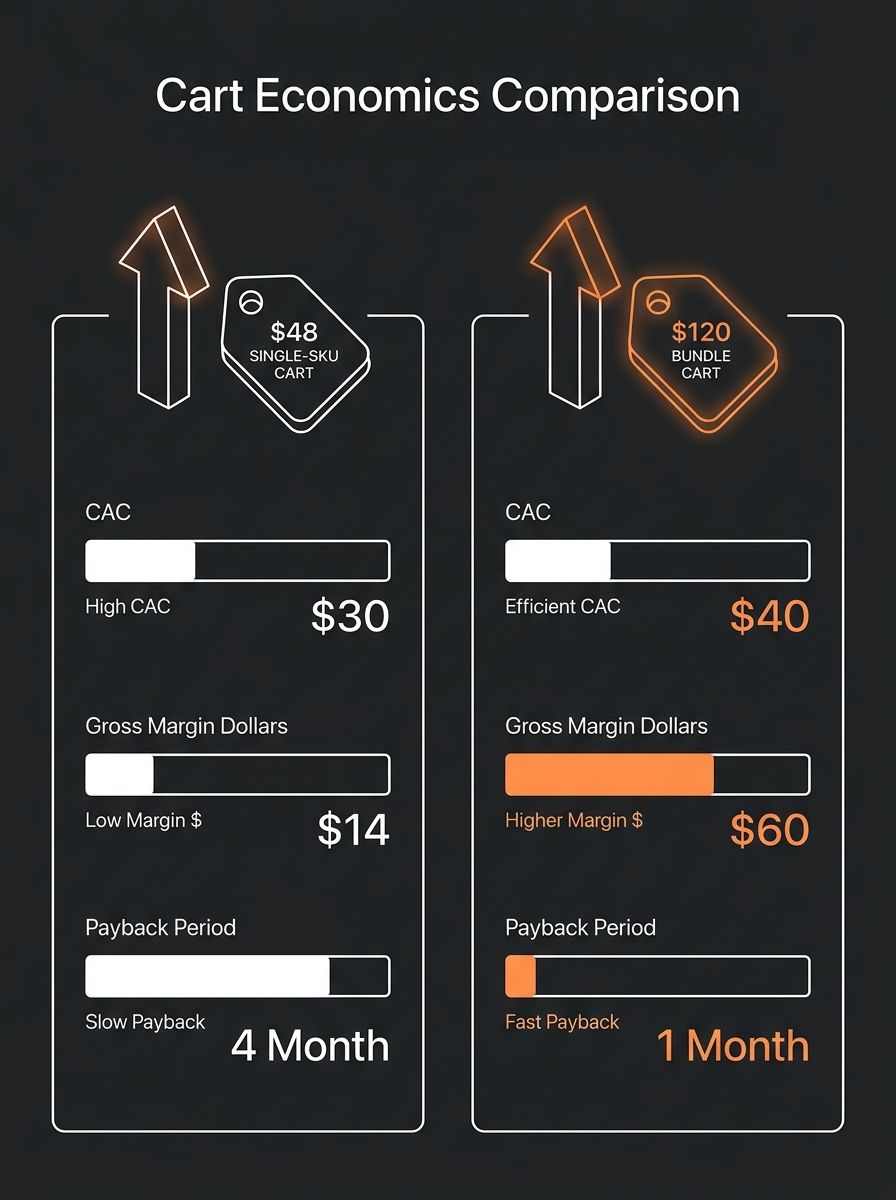
The math is straightforward. If your cost per click runs $1.50 and your conversion rate sits at 2.5%, you're paying $60 to acquire a customer. A $48 AOV with a 30% gross margin leaves $14.40 in gross profit. You're losing $45.60 on the first order before you even touch operational costs. Stores running high AOV dropshipping bundles at $120+ with the same margin profile generate $36 in gross profit per order. The CAC payback math shifts entirely. If you're still calculating whether your CAC payback period justifies scaling, bundles are the fastest structural fix.
The Discount Bundle Trap
The first instinct most store owners follow when building bundles is price reduction. Buy three, save 20%. Bundle and save. The logic feels sound because conventional bundle pricing packages multiple products at a price lower than the sum of individual prices. And the approach does move volume.
The problem is where it moves your margins.
A product bundle strategy built on straight percentage discounts compresses the exact metric you're trying to grow. If your hero product sells at $39.99 with $12 landed cost (30% margin), bundling three units at 20% off drops your per-unit revenue to $32 while your COGS stays fixed. You've increased cart size but cratered contribution profit per order. Worse, you've trained your customer to expect discounts on repeat purchases. And when you factor in how aggregator platforms layer their own fees between factory price and your landed cost, that 30% gross margin was probably 22-24% net before you started discounting.
Mixed bundling, which offers both bundled and individual purchasing options, generates 25-35% more revenue than pure bundling. The distinction matters because it preserves full-price anchoring. Your individual product page still shows the standalone price, and the bundle page shows the combined value. The customer perceives savings without you actually cutting into margin.
The Margin-Blend Pivot
The shift that separates profitable bundle operators from discount-dependent ones happened when stores started pairing SKUs by margin profile instead of by product similarity. A margin-blend bundle combines one anchor product (your bestseller, typically carrying 25-35% margins) with one or two complementary items running 55-70% margins. The blended contribution profit per bundle exceeds what any single product generates alone.
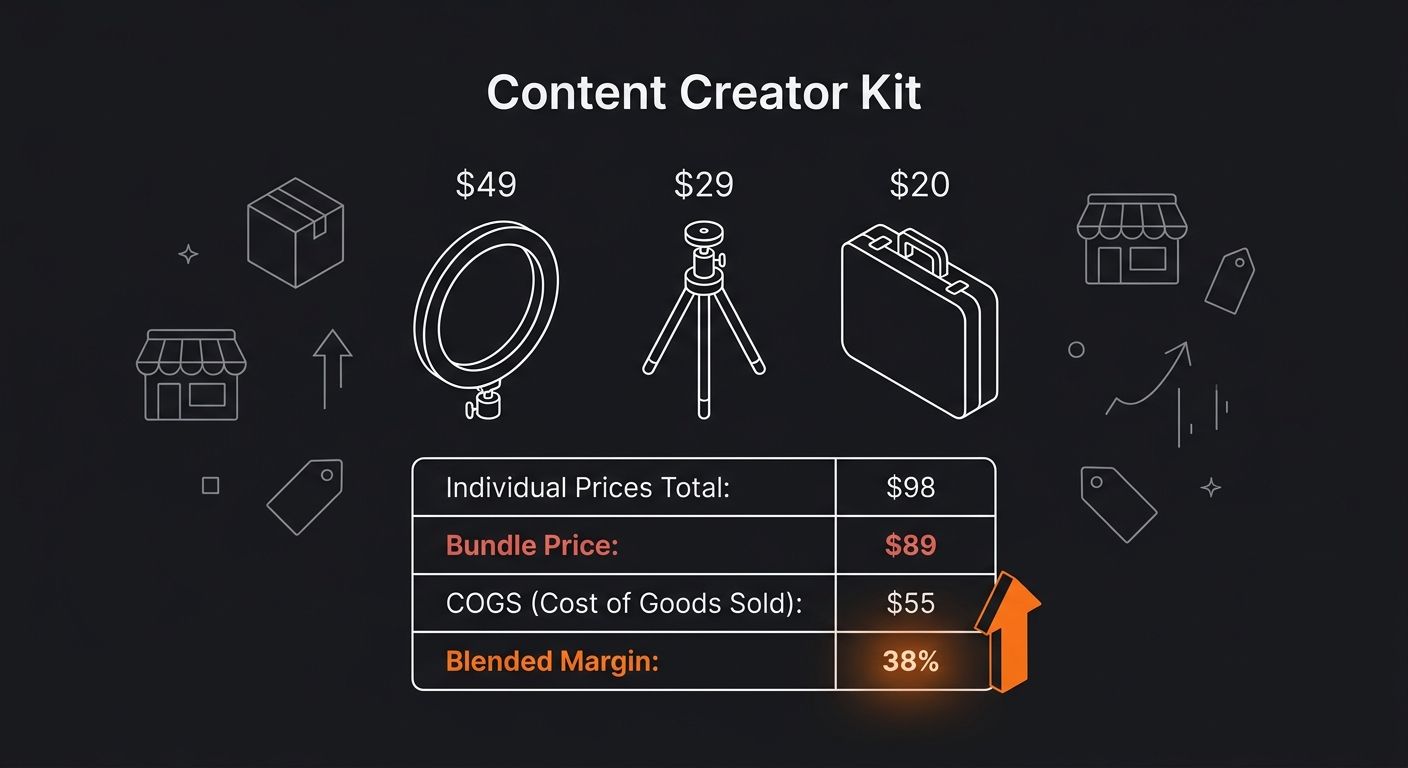
Here's a concrete example. Suppose you sell LED ring lights (hero SKU, $42 retail, $18 landed cost, 57% gross margin). Pair it with a phone tripod mount ($14 retail, $3.20 landed, 77% margin) and a carrying case ($18 retail, $4.50 landed, 75% margin). Individual purchases of all three total $74. Your bundle lists at $69.99, presenting a visible $4 savings. Your total COGS on the bundle is $25.70, giving you $44.29 gross profit at a 63.3% blended margin. The customer sees a deal. You see higher absolute margin dollars per order than selling the ring light alone.
Stacking Complements, Not Duplicates
The psychological research on why bundled discounts work points to perceived value creation and reduced decision friction. Customers who see a curated solution (camera + mount + case) process the bundle as a single purchase decision, not three separate ones. Stacking three of the same item triggers a different mental calculation, one centered on "do I need this many?" rather than "does this solve my problem?"
Cross-selling through complementary products provides value by enhancing the customer's experience or solving a related problem. GoPro applies this by bundling camera purchases with media mods, remotes, and tripods, all positioned as value-added suggestions rather than upsell pressure. The accessories carry significantly higher margins than the camera itself.
For dropshippers, this principle translates directly. If you're selling in the home fitness niche, a resistance band set ($34 retail) bundled with a door anchor ($9 retail) and a printed workout guide ($7 digital/print-on-demand) creates a "starter kit" at $44.99 with COGS potentially under $11. That's a 75%+ blended margin. And the bundle narrative ("everything you need to start") eliminates the research burden for the buyer. Strategic bundling at this level improves conversion rates by 15-25%, with best implementations pushing 40%.
If you've already gone through the process of validating demand in your niche, you know which products your audience is already searching for together. Bundle those products before a competitor does.
The Threshold Layer That Pushes Past $120
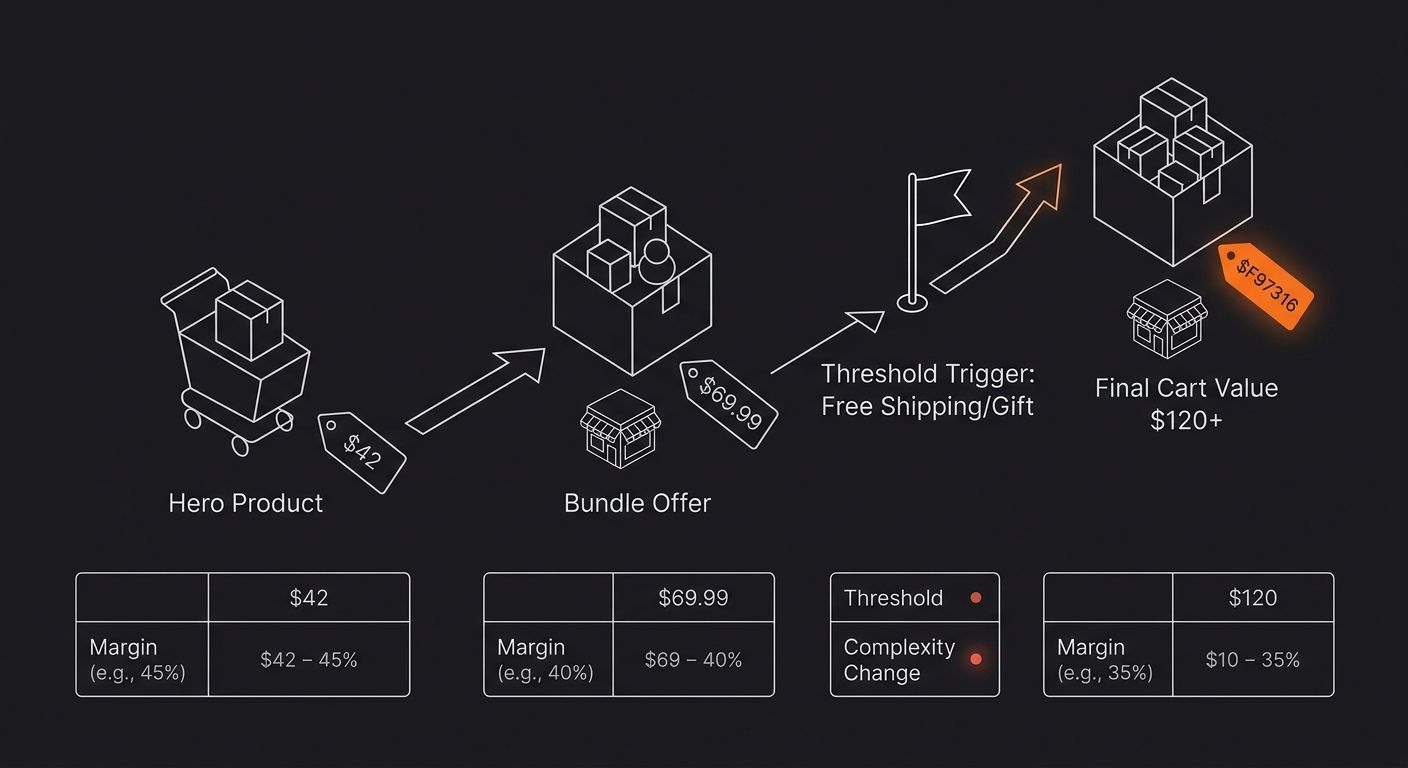
Cart value optimization at the $120+ mark typically requires one more structural element beyond the core bundle: a spending threshold. Setting your free shipping trigger or bonus-item unlock 10-50% above your modal order value nudges customers to add one more item without triggering abandonment. If your primary bundle lands at $69.99, a free shipping threshold at $89 or a "free gift with orders over $99" prompt pulls the average cart upward.
The data supports this. 80% of consumers compare prices before purchasing, and visible savings (strikethrough pricing, displayed bundle value vs. individual sum) reduce decision friction. Pair your $69.99 bundle with a suggested add-on at $24.99 ("customers who bought this kit also added...") and you're at $94.98 before the free shipping nudge pushes them to grab one more accessory at $12-15. Cart total: $107-$110. Two bundles in the cart, and you're well past $120.
66% of shoppers prefer BOGO offers over percentage discounts. Framing your threshold reward as a free item ("add $15 more and get a free travel pouch") outperforms "spend $99, save 10%" because the customer perceives the free item as a concrete gain rather than an abstract percentage. This distinction matters for high AOV dropshipping stores targeting the $120+ range, where percentage discounts on a $120 cart (say, 10% off = $12 saved) feel less compelling than receiving a tangible product.
You'll also want to confirm that your checkout flow doesn't leak margin at this stage. Stores optimizing cart values lose the gains when payment processing fees, app surcharges, or poorly configured shipping rules eat into the higher order total.
Where the Numbers Land Today
Stores applying layered product bundle strategy (margin blending, complementary stacking, and threshold triggers in sequence) report 20-30% AOV increases as a baseline, with some implementations reaching 55% lifts. Bundle customers show 40% higher retention, which compounds the lifetime value advantage across repeat purchases.
The operational requirements are real. You need suppliers who can reliably ship complementary items together or, at minimum, fulfill split shipments without doubling your logistics costs across shipping zones. You need landing pages or product pages that display bundle savings transparently. And you need margin tracking at the bundle level, not the SKU level, to confirm that your blended contribution profit actually exceeds your single-product baseline.
Bundle Component | Example SKU | Retail Price | Landed Cost | Gross Margin |
|---|---|---|---|---|
Hero / Anchor | LED Ring Light | $42.00 | $18.00 | 57.1% |
High-Margin Add-On #1 | Phone Tripod Mount | $14.00 | $3.20 | 77.1% |
High-Margin Add-On #2 | Carrying Case | $18.00 | $4.50 | 75.0% |
Bundle Total | "Creator Kit" | $69.99 | $25.70 | 63.3% |
Threshold Add-On | Lens Cleaning Kit | $14.99 | $2.80 | 81.3% |
Cart After Threshold | $84.98 | $28.50 | 66.5% |
The stores consistently hitting $120+ carts run two bundles per collection (a "starter" and a "pro" tier), set their threshold trigger between the two price points, and track profit per order weekly. Bundle engineering at this level is an ongoing optimization process driven by supplier cost changes, conversion data, and seasonal demand shifts. The ones doing it well treat bundles as their primary margin architecture, not an afterthought bolted onto a product page.
365 Dropship Editorial
Editorial team writing about E-commerce, dropshipping, and product discovery — reviews of dropshipping suppliers and platforms, trending niche guides (jewelry, beauty, pets, home, fashion), supplier due diligence, ecom operations, shipping & fulfillment strategy, product research, AOV optimization, and profitable dropshipping case studies.
Related Articles
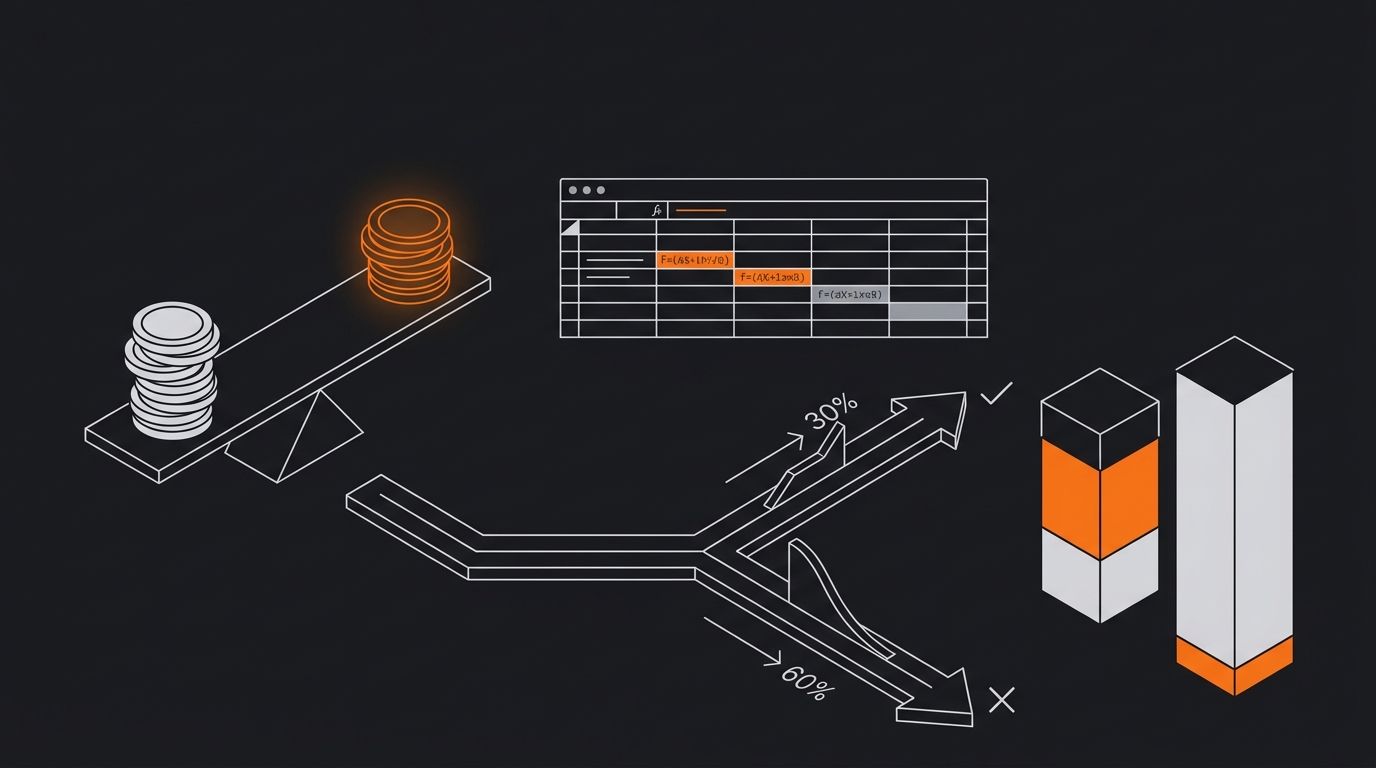
Stop Chasing 60% Margins: Why a Disciplined 30% Gross Margin Business Outperforms Most 'High-Margin' Dropshipping Stores
A 60% gross margin on a $50 dropshipped product leaves $30 before costs. After $12 in ad spend, $2 in payment processing, $1 in platform fees, and $3 in return-related losses, that $30 becomes $12 — a 24% net margin.
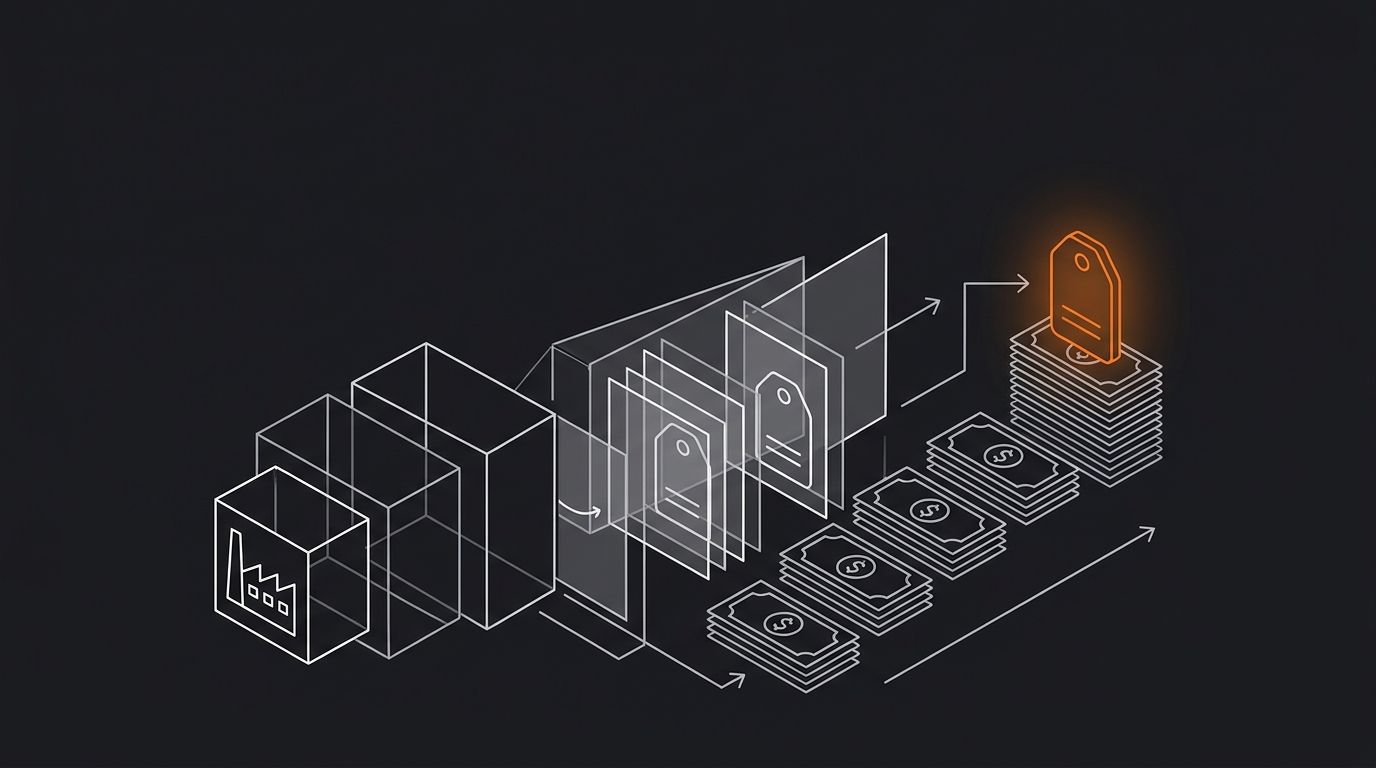
Inside the Supplier Markup Stack: How Aggregator Platforms Layer Fees Between Factory Price and Your Cost of Goods
Three to seven distinct fee layers sit between a product's factory price and the number aggregator platforms display as your "supplier cost." Fulfillment surcharges, payment processing cuts, per-order fees, and shipping markups each compound silently.
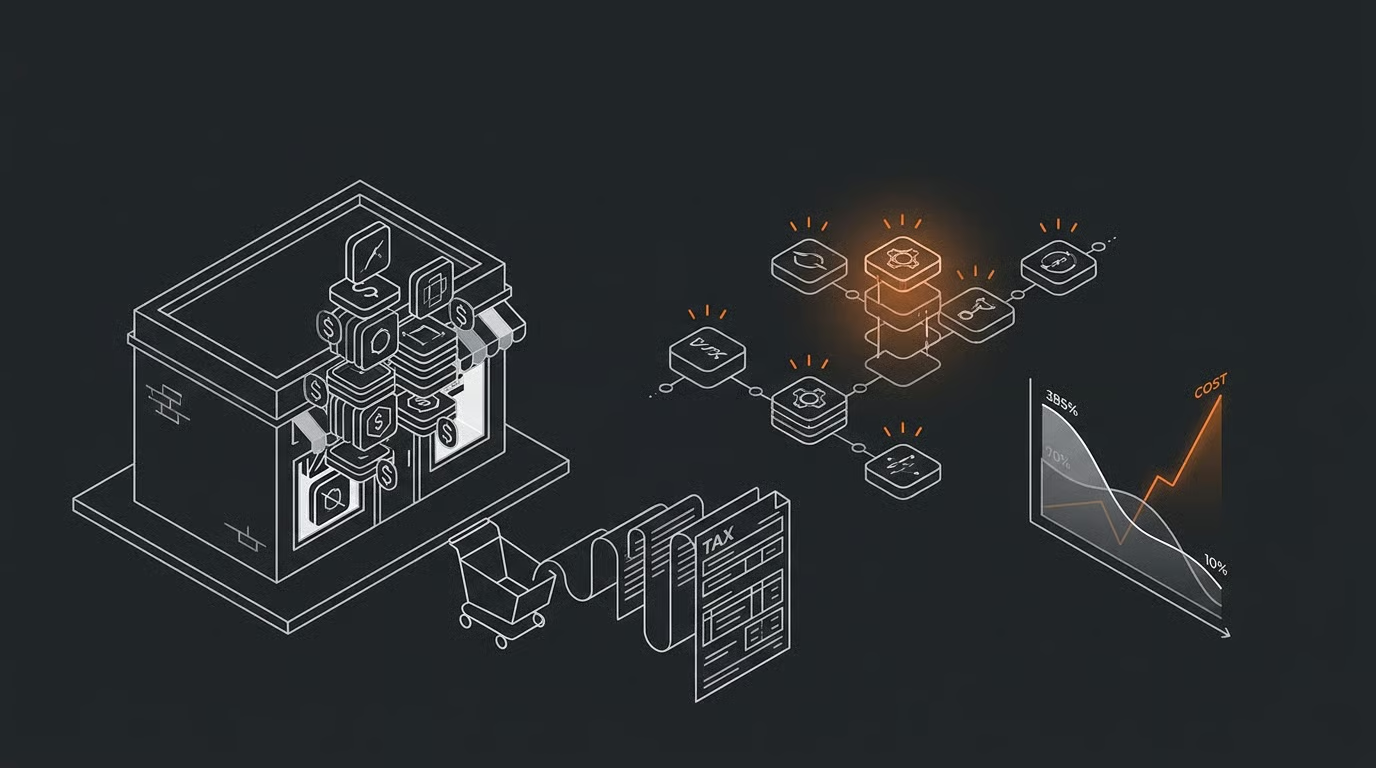
The Shopify App Store Is a Margin Tax: Why Most Operators Install 3x More Tools Than They Need
Eight JavaScript-heavy Shopify apps add 1-2 full seconds of page load time and produce a 7-14% conversion rate drop, according to App Store Research performance benchmarks.
Explore more topics