TikTok Shop vs. Shopify DTC: Where Independent Dropshippers Actually Keep More Margin in 2026
TikTok Shop's total cost of selling runs 35–55% of revenue when you stack referral fees, affiliate commissions, transaction fees, and returns. Shopify DTC's all-in platform cost sits closer to 5–8% of revenue at equivalent volume, but every visitor arrives on your dime.
TikTok Shop vs. Shopify DTC: Where Independent Dropshippers Actually Keep More Margin in 2026
TikTok Shop's total cost of selling runs 35–55% of revenue when you stack referral fees, affiliate commissions, transaction fees, and returns. Shopify DTC's all-in platform cost sits closer to 5–8% of revenue at equivalent volume, but every visitor arrives on your dime. The margin question between these two channels comes down to which cost stack eats more of your dollar: the platform's rake or your customer acquisition bill.
The Fee Stack: What Each Platform Deducts Per Order
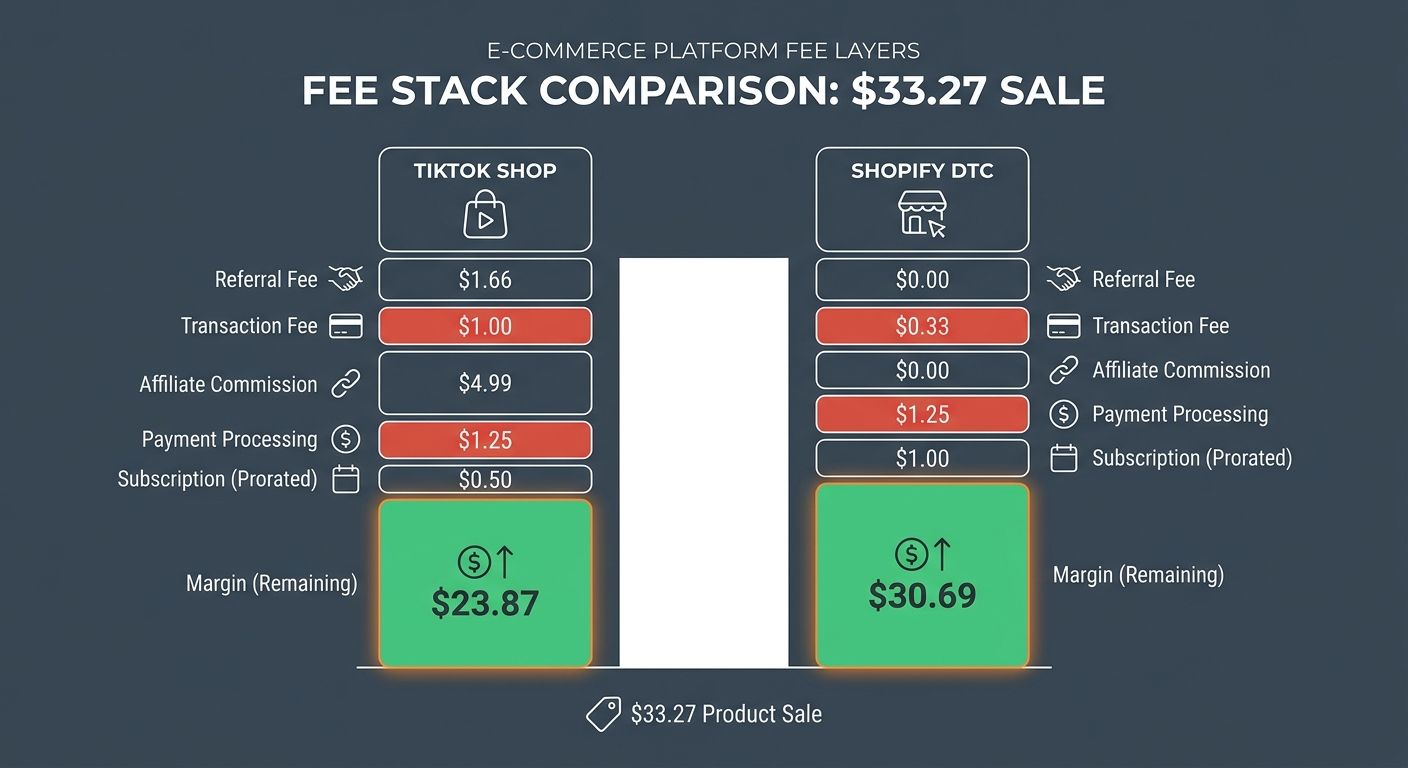
TikTok Shop's published rates look modest at 7% combined (6% referral plus 1% transaction). That 7% is the floor. The real cost structure breaks into base commission (5–8%), payment processing (2.9% + $0.30), and affiliate payouts (10–25% when applicable), according to a fee analysis from Communipass. A beauty product selling at $33.27 retail leaves you $20.02 after all platform deductions, before you even subtract COGS. If that product costs $10 to source, your actual profit per sale is $10.02, a roughly 30% net margin on the sale price.
Shopify's fee structure operates on a different axis entirely. You pay a fixed $39/month subscription (Basic plan) plus 2.9% + $0.30 per transaction through Shopify Payments. No referral fee. No affiliate commission baked into the platform. On that same $33.27 product, Shopify deducts about $1.26 in processing fees. Your pre-COGS remainder is $31.71 compared to $20.02 on TikTok Shop. That's $11.69 more per unit to cover your cost of goods, shipping, and acquisition costs.
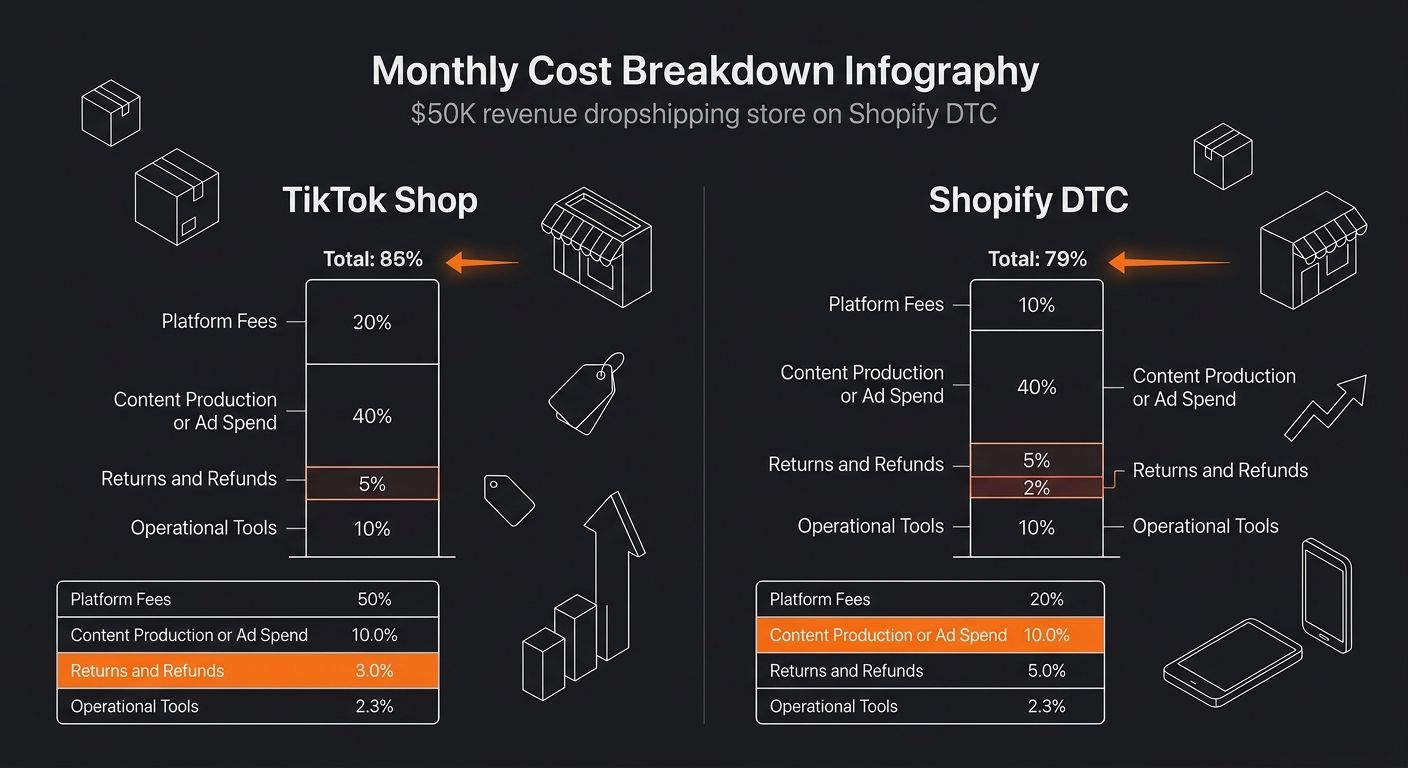
The gap widens at scale. When you run the total cost of ownership math on a store doing $50,000/month in revenue, TikTok Shop's stacked fees consume $17,500–$27,500 depending on your affiliate commission rates and category. Shopify's platform costs on the same revenue: roughly $1,750–$2,500. The delta is $15,000–$25,000 in per-month platform fees alone.
Where TikTok's Hidden Costs Compound
The affiliate commission layer fundamentally changes TikTok Shop's economics compared to any DTC channel. When creators promote your product, they take 10–25% of the sale price. At scale, this becomes your single largest cost line, often bigger than COGS.
On $100K in gross merchandise value through TikTok Shop with a 15% average affiliate payout, you're sending $15,000 to creators before you've covered a single dollar of product cost. Add the 6% referral fee ($6,000), 1% transaction fee ($1,000), and estimated returns at 8–12% of GMV ($8,000–$12,000), and your net revenue lands between $66,000 and $70,000. Dark Room Agency's complete seller cost breakdown confirms the total cost of selling on TikTok Shop runs 35–55% of revenue depending on category and scale.
Returns deserve special attention here. TikTok Shop's return rates run 8–12%, compared to 5–7% on Shopify DTC stores. The gap comes from purchase context: TikTok buyers make impulse decisions mid-scroll, while Shopify DTC buyers arrive after searching, reading product pages, and comparing options. That 3–5 percentage point difference translates directly into lost margin because you eat shipping costs both ways, lose the affiliate commission (TikTok retains a 20% refund admin fee), and frequently can't resell returned inventory in a dropshipping model. Understanding return rate economics is the difference between a store that scales and one that bleeds cash as volume increases.
Shopify DTC's Real Cost: The Traffic Bill
Why does Shopify look cheap on paper but still challenge dropshippers' margins? Because the platform doesn't bring you a single customer. You own the entire traffic engine, and that engine runs on cash.
Independent website operators have an average sales cost ratio 18–25% lower than platform sellers, according to McKinsey's Global E-commerce Cost White Paper. But that advantage only materializes after you've built a functioning acquisition system. For a Shopify DTC dropshipper spending on Meta, Google, or TikTok ads (as a traffic source, distinct from TikTok Shop), customer acquisition cost typically ranges from $12–$35 per customer depending on niche. At a $45 AOV with 30% COGS and $1.60 in Shopify processing fees, your contribution margin per order is roughly $17.85 before ad spend. If your CAC sits at $20, you're underwater on the first purchase.
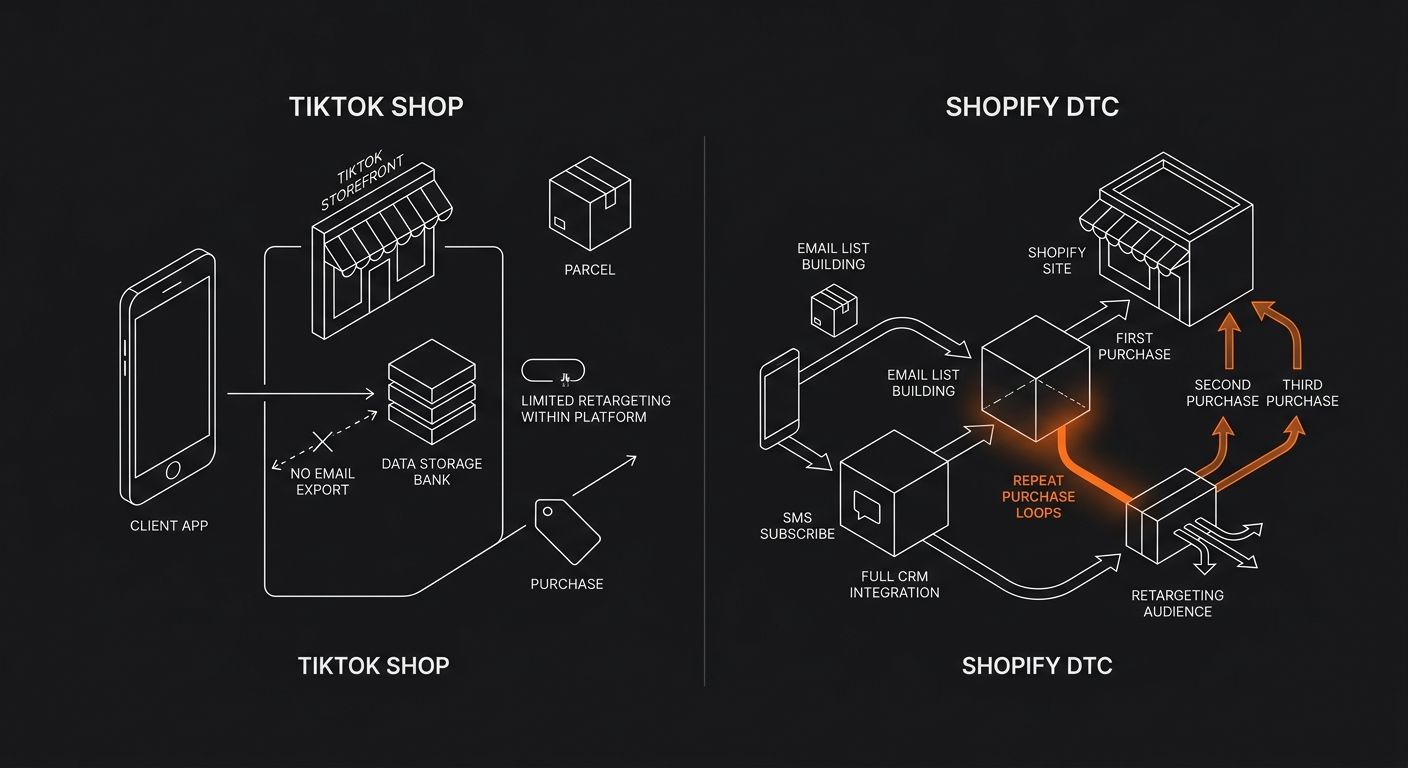
This is where Shopify's structural advantage activates: you own the customer data. You can retarget through Klaviyo or Postscript flows, as ESEOSpace's platform comparison notes. On TikTok, customer relationships exist entirely within TikTok's ecosystem. You can run TikTok retargeting ads, but you can't export buyer data into your own CRM.
The payback math shifts decisively in Shopify's favor when repeat purchase rates cross 25–30%. A customer who buys three times over six months turns that initial $20 CAC into a $6.67 effective cost per order. Calculating your true CAC payback period before scaling ad spend is the single most important exercise for any DTC dropshipper weighing these platforms.
The AOV Threshold Where Economics Flip
TikTok Shop and Shopify DTC don't compete on the same products. The platforms favor different price points, and the margin mechanics explain why.
Metric | TikTok Shop | Shopify DTC |
|---|---|---|
Typical AOV range | $20–$80 | $50–$500+ |
Platform fee layer | 7% + affiliates (17–33% total) | ~3.2% per transaction |
Return rate | 8–12% | 5–7% |
Customer data ownership | Platform-controlled | Seller-owned |
CAC responsibility | Shared with creators | 100% seller-funded |
Profitable floor AOV | $30–$40 minimum | $35–$50 minimum (CAC-dependent) |
Products under $20 rarely survive TikTok Shop's fee stack. The 20% refund admin fee on a $15 product costs $3, and when you add the referral fee, transaction fee, and creator commission on the original sale, you've consumed almost the entire margin before COGS. The practical AOV floor on TikTok Shop sits around $30–$40 for products to maintain positive contribution margin.
Shopify DTC's floor is set by CAC math. A $35 product with a $15 CAC and 30% COGS ($10.50) leaves $8.49 after Shopify processing, which is barely viable on a single purchase. But Shopify sellers can architect high-AOV product bundles that push average cart values above $120, a strategy nearly impossible on TikTok Shop where impulse pricing dominates. The crossover for most categories: products above $80 AOV generate meaningfully better contribution margin on Shopify DTC.
The Content Production Tax
TikTok Shop sellers face an expense that doesn't appear in any fee schedule: content production. The platform runs on short-form video, and your sales volume correlates directly with your content output. Sellers who post 3–5 videos per week and run 2–3 live sessions see dramatically different GMV than those posting sporadically.
This content tax is real labor cost. Whether you're filming yourself, hiring a content team, or paying creators through TikTok's affiliate program (which shows up as the 10–25% commission), someone is spending hours producing, editing, and posting video. At $50K/month revenue, the content production overhead typically runs $5,000–$12,000/month in time or direct creator payments.
Shopify DTC sellers spend that equivalent budget on ad creative and campaign management. The key difference: ad creative has measurable, immediate ROI through ROAS tracking, and you can pause a campaign that isn't performing within hours. TikTok content has a longer, less predictable payback curve. A single video might drive $15,000 in sales; the next 20 might generate nothing. Understanding how trending niches follow different demand curves is particularly critical on TikTok Shop, where viral product cycles compress into weeks instead of months and the algorithm amplifies winners aggressively while your cost to produce content stays fixed.
Why the Hybrid Model Dominates
The strongest independent dropshippers in 2026 aren't choosing one platform. They're running TikTok Shop for customer acquisition and Shopify DTC for retention and higher-margin sales. TikTok handles discovery for impulse-friendly products priced under $50. Shopify captures email and SMS lists, sells higher-value bundles, and generates repeat purchases with zero incremental platform fees beyond the 2.9% + $0.30 processing cost.
This approach works because TikTok's share of product discovery traffic gives sellers access to an audience they'd spend $20,000+ per month in Meta ads to reach. You accept TikTok's steeper fee stack as a customer acquisition cost, then migrate those buyers to your Shopify store for everything after the first purchase. The math: if TikTok's total cost per acquired customer (including fees and affiliate commissions) lands at $14–$18, and that customer makes two additional purchases on your Shopify store over six months, your blended CAC drops to $5–$6 per order.
The execution gap is in the handoff. You can't export TikTok customer emails directly, so sellers use insert cards, QR codes in packaging, and post-purchase TikTok retargeting to drive Shopify store visits. Conversion rates on this bridge typically run 8–15%, meaning roughly 1 in 8 TikTok customers migrates to your owned channel.
Where The Model Breaks
Both platforms' margin advantages collapse under specific conditions. TikTok Shop's economics fall apart when return rates exceed 15%, common in apparel, electronics accessories, and fragile categories. At that point, the combination of lost affiliate commissions, refund admin fees, and two-way shipping costs pushes total selling costs above 60% of revenue. The 2.25% net margin scenario documented by Dark Room Agency reflects exactly this kind of category-cost compression at $50,000 in revenue.
Shopify DTC's model breaks when customer acquisition costs exceed your first-order contribution margin and repeat purchase rates stay below 15%. This happens frequently in trending product categories where the audience has no brand loyalty and competition drives CPMs higher every week. A Shopify store selling a viral product with a $28 CAC, $45 AOV, and 12% repeat rate will burn through cash faster than a TikTok Shop seller moving the same product at lower per-unit margin but zero ad spend.
The DTC margin comparison also depends on your operational infrastructure. TikTok Shop requires dispatch within 2 days, so sellers using traditional AliExpress dropshipping with 10–15 day shipping times get suspended. Shopify DTC gives you more fulfillment flexibility, but the hidden costs of multi-supplier routing introduce their own margin drag at scale.
Neither platform solves the fundamental dropshipping challenge: your COGS floor is set by someone else's pricing. The platform that preserves more margin on top of that floor depends on three variables: your product's return profile, your content production capability, and whether you can build a business that generates repeat orders. No amount of fee optimization fixes a product that returns at 20% or a store where every customer buys exactly once.
365 Dropship Editorial
Editorial team writing about E-commerce, dropshipping, and product discovery — reviews of dropshipping suppliers and platforms, trending niche guides (jewelry, beauty, pets, home, fashion), supplier due diligence, ecom operations, shipping & fulfillment strategy, product research, AOV optimization, and profitable dropshipping case studies.
Related Articles
TikTok Shop, Amazon, and Shopify Deliver Different Profit Profiles for DTC Brands, Avenue Z Analysis Finds
Avenue Z's June 10 platform analysis concludes that no single eCommerce channel delivers universal profitability for DTC brands, positioning TikTok Shop for low-acquisition trendy products, Amazon for high-intent search volume, and Shopify for margin control and customer data ownership, according to

Avenue Z Breaks Down TikTok Shop Fulfillment Models by Cost and Algorithm Impact
Avenue Z published a TikTok Shop fulfillment model comparison June 18 analyzing cost and speed tradeoffs across three operational paths—Fulfilled by TikTok (FBT), third-party logistics (3PL), and in-house fulfillment—with explicit guidance tying each model to order volume and the platform's algorith
TikTok Shop High-Ticket Sales Surge as Above-Ground Pools Climb 125% Year-Over-Year
Above-ground pools and spas sold through TikTok Shop posted 125% year-over-year growth in the past 12 months, five times the rate of other marketplaces, according to data shared by Spreetail, a multi-brand seller and fulfillment partner on the platform.
Explore more topics