How Shopify's Order Routing Logic Works (And Why It's Costing Multi-Supplier Stores Money)
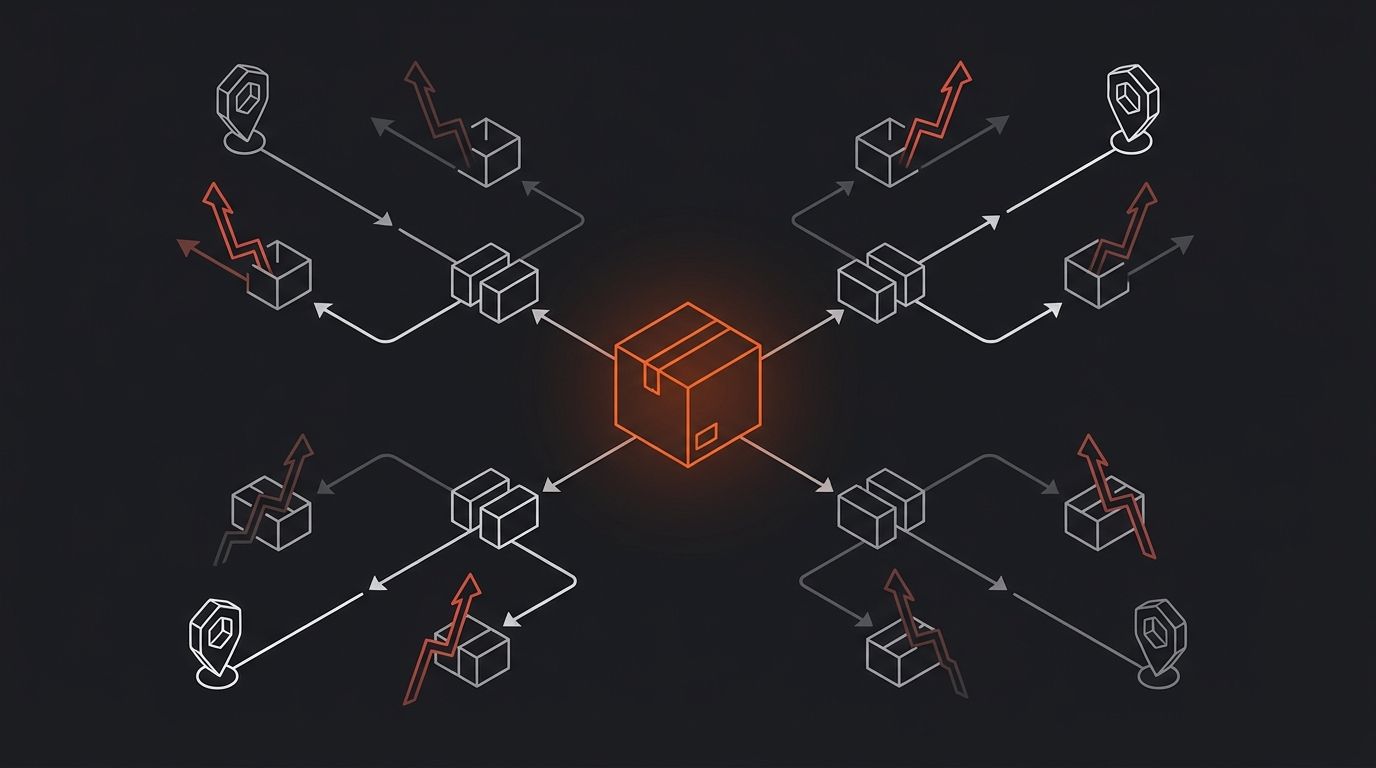
Shopify's order routing system processes every incoming order through a sequential rule stack, checking inventory availability at each configured location from top to bottom.
How Shopify's Order Routing Logic Works (And Why It's Costing Multi-Supplier Stores Money)
Shopify's order routing system processes every incoming order through a sequential rule stack, checking inventory availability at each configured location from top to bottom. The core problem for multi-supplier dropshipping stores: this fulfillment logic was designed for brands with owned warehouses, not sellers routing orders across independent suppliers with different processing speeds, shipping origins, and cost structures.
The Sequential Rule Stack
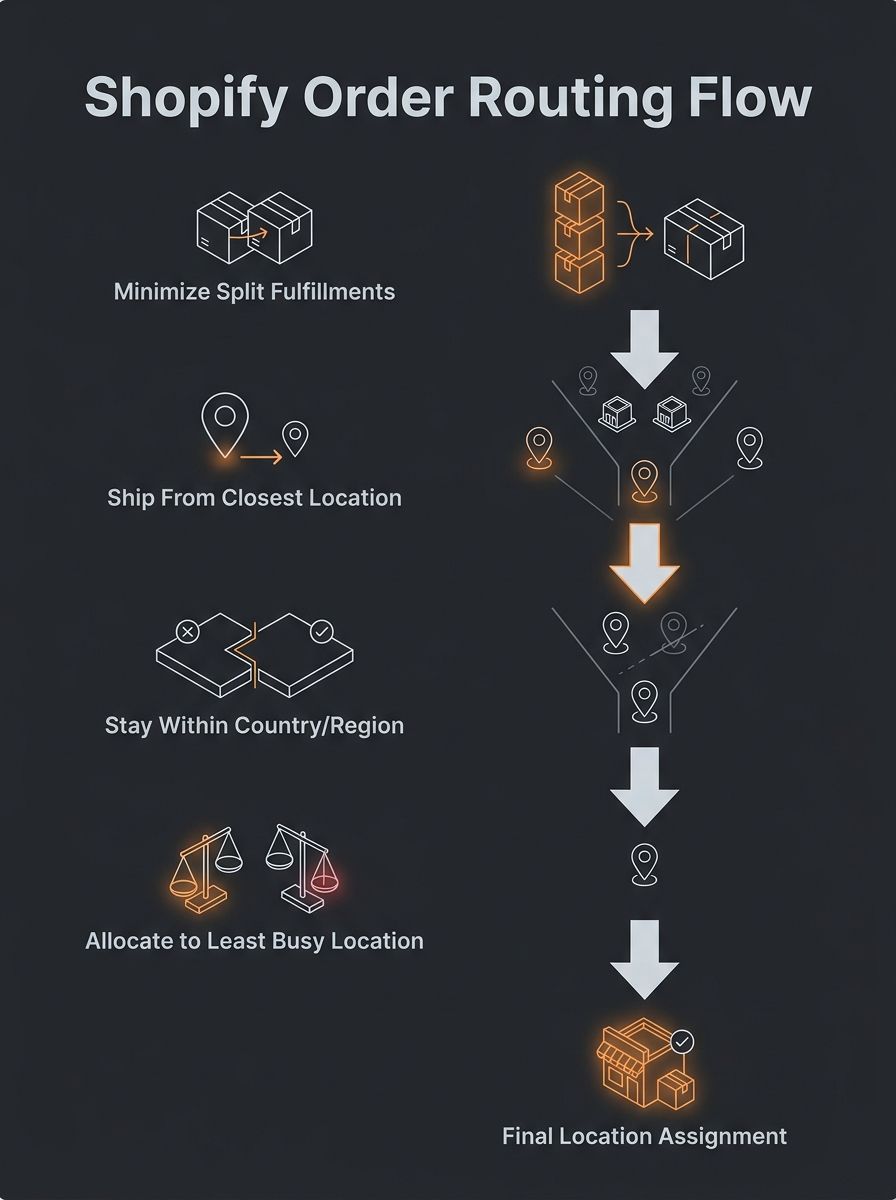
Shopify's order routing operates on four core default rules, applied in a fixed sequence. According to Shopify's routing documentation, "rules run from top to bottom, and each rule is applied to the results of the previous rule." The final output determines which location fulfills each line item.
The four default rules are:
Minimize split fulfillments - groups as many line items as possible into a single shipment
Ship from closest location - uses the customer's shipping address to select the nearest fulfillment point
Stay within destination market - prioritizes locations in the same country or market as the buyer
Use ranked location priority - falls back to your manually configured location ranking
The sequence of these rules matters enormously. If "minimize splits" sits at position one, Shopify sacrifices shipping proximity to keep the order in a single package. If "closest location" sits at position one, you get faster delivery but more split shipments. For a store with 2 locations, this distinction might save or cost $3-5 per order. For a store with 5-7 supplier locations, the math compounds into thousands of dollars monthly.
Shopify Plus merchants ($2,300/month starting price) can extend this logic using Shopify Functions to write custom routing code. Standard plan merchants are locked into the four rules above, reorderable but not expandable. That constraint defines the ceiling for native multi-supplier Shopify routing on lower-tier plans.
How Location Assignment Actually Happens
When an order hits your store, Shopify "automatically checks which fulfillment locations have that inventory available, then applies the order routing logic set to determine the location that orders get sent to for fulfillment," as described in Shopify's smart routing overview. The system uses what Shopify internally calls a "Reducer" to break ties when multiple locations pass all rule filters, ensuring deterministic assignment without manual intervention.
Here's where multi-supplier Shopify stores run into trouble. Each supplier is registered as a separate "location" in Shopify's system. Shopify supports up to 1,000 locations per store, which sounds generous until you realize each location is treated as a generic fulfillment point. The system doesn't know that Location A is a domestic supplier with 2-day processing and Location B is a Chinese manufacturer with 12-day lead times. It doesn't factor in per-supplier shipping rates, reliability scores, or return handling differences.
The routing logic treats a $4.50 domestic shipment and a $14.80 international shipment as equivalent, because shipping cost isn't one of the four default routing parameters. Your rule stack can only optimize for proximity, market, split minimization, or manual rank. Cost optimization requires either Shopify Plus with custom Functions or third-party dropshipping automation middleware.
If you've built a supplier scorecard tracking system in metafields, you already have the data to inform better routing decisions. The gap is that Shopify's native routing engine can't read your metafields during the assignment process.
When Orders Split (And What Each Split Actually Costs)
Why does Shopify split orders in the first place? Because no single location stocks all line items in the cart. According to Prediko's 2026 warehouse management guide, Shopify "splits the order and allocates line items across locations based on your fulfillment priority." Third-party WMS platforms like PULPO then import these as multiple sub-orders for processing.
The cost impact of split inventory is well-documented. Research from Cahoot's fulfillment analysis found that a single warehouse storing 1,000 cubic feet costs $750 monthly, while splitting that same inventory across two warehouses runs $1,275, a 70% increase driven by higher per-unit storage rates and duplicated overhead. eFulfillment Service's analysis confirmed that "splitting inventory increases their overall fulfillment cost structure" for smaller e-commerce businesses once warehousing, transportation, and minimum quantity requirements are fully accounted for.
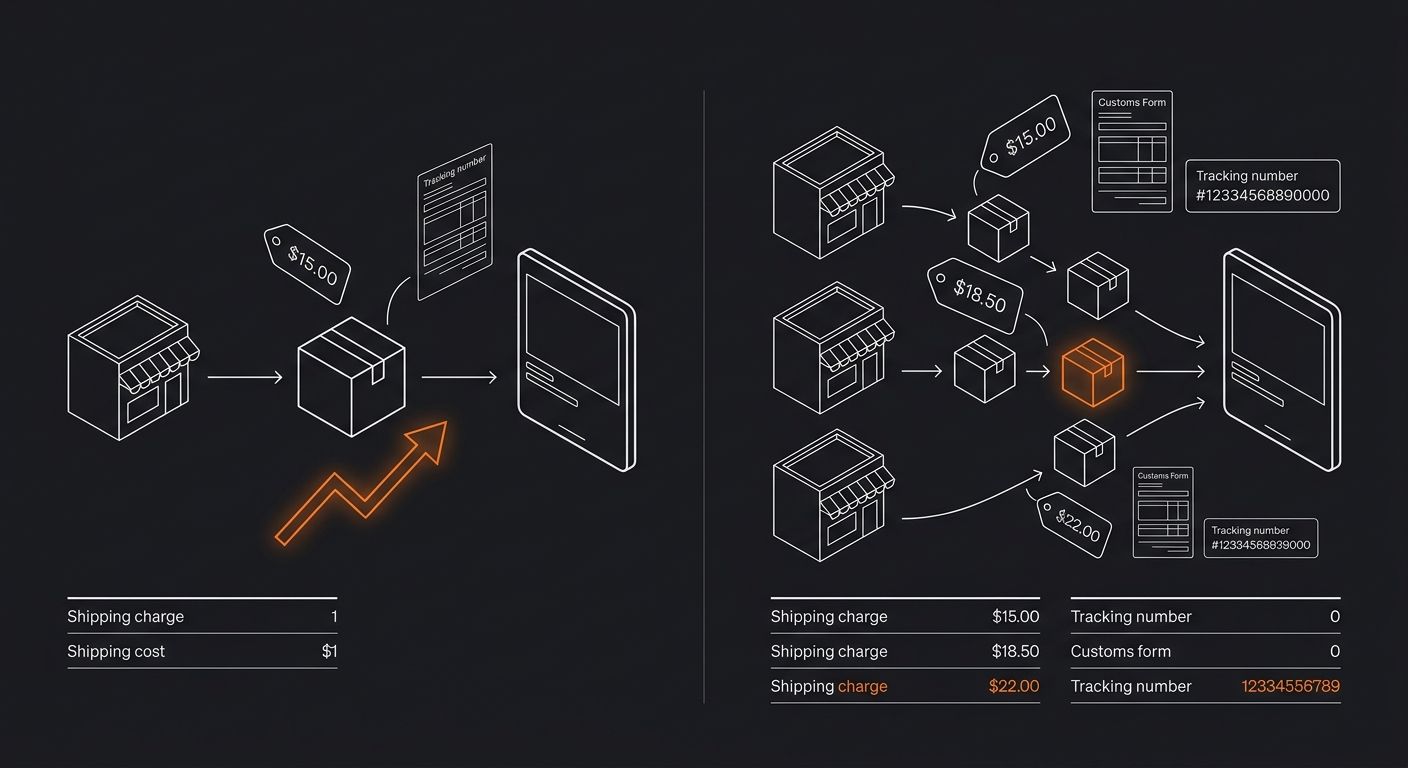
For dropshippers, each split order generates:
A separate shipping charge from each supplier (often $4-8 per additional package domestically, $8-15 internationally)
A separate tracking number, complicating customer communication
A separate customs declaration for cross-border splits, each potentially triggering de minimis threshold issues
Higher return complexity, since the customer received one "order" in multiple packages
A store processing 500 orders per month with a 30% split rate at $6 average additional shipping cost per split is bleeding $900/month in unnecessary fulfillment spend. That's $10,800 annually before accounting for the customer service overhead of explaining why one order arrived in three packages.
If your checkout flow audit revealed margin leaks at the payment stage, order splits are compounding those losses downstream where they're harder to see.
The Inventory Sync Bottleneck
Routing logic is only as good as the inventory data feeding it. Shopify's routing engine checks inventory levels at the moment of order placement, and for the fulfillment logic to work reliably, inventory accuracy must exceed 95% across all locations. Drop below that threshold and orders route to suppliers who are actually out of stock, triggering cancellations, manual reassignment, and refunds.
The AutoDS team put it directly in their workflow analysis: "While Shopify is an absolute king when it comes to hosting an online business, relying solely on its native features for dropshipping is a recipe for burnout." That burnout hits hardest in inventory synchronization, where supplier stock levels change hourly, and Shopify's location inventory updates depend entirely on your sync pipeline's speed.
Standard sync intervals for popular dropshipping tools range from every 15 minutes (DSers, CJ Dropshipping) to every 1-4 hours (some Spocket and Zendrop configurations). A 4-hour sync window means your routing engine makes fulfillment decisions based on inventory snapshots that could be 4 hours stale. For high-velocity SKUs selling 20+ units per day across your supplier network, that lag introduces a meaningful error rate.
If you've experienced tracking sync failures between Shopify and your fulfillment pipeline, the root cause is often the same infrastructure gap that causes inventory misrouting.
Standard Plans vs. Plus vs. Third-Party Automation
Standard Shopify plans restrict you to the four default routing rules. Shopify Plus opens access to Shopify Functions for custom routing code. And third-party tools add routing-adjacent logic outside Shopify's native stack entirely. Here's how the three approaches compare for multi-supplier stores:
Capability | Standard Plans | Shopify Plus | Third-Party Tools (DSers, AutoDS, CJ) |
|---|---|---|---|
Default routing rules | 4 rules, reorderable | 4 rules + custom Functions | Supplier priority per product |
Cost-based routing | Not available | Buildable via Functions | Varies by platform |
Supplier speed tiers | Manual rank only | Programmable per SKU | Manual configuration |
API rate limits | 2 calls/second | 20 calls/second | Dependent on app tier |
Custom split logic | Not available | Full control | Limited or none |
Monthly cost | $39-399 | $2,300+ | $20-50/month typical |
For a store doing $50,000/month in revenue with 4+ suppliers, the routing improvements from Plus can realistically save $1,200-2,500/month in reduced splits, smarter supplier selection, and fewer manual reassignments. That makes the Plus fee roughly break-even on routing alone.
For stores under $30,000/month, third-party dropshipping automation tools are the more practical path. But OCNJ Daily's analysis noted that "one of the biggest reasons most Shopify dropshipping apps fail is outdated product research logic," and a similar critique applies to fulfillment routing in many of these tools. When evaluating which automation tool actually drives profit, routing capability should be a primary filter.
Where Shipping Zone Placement Fits
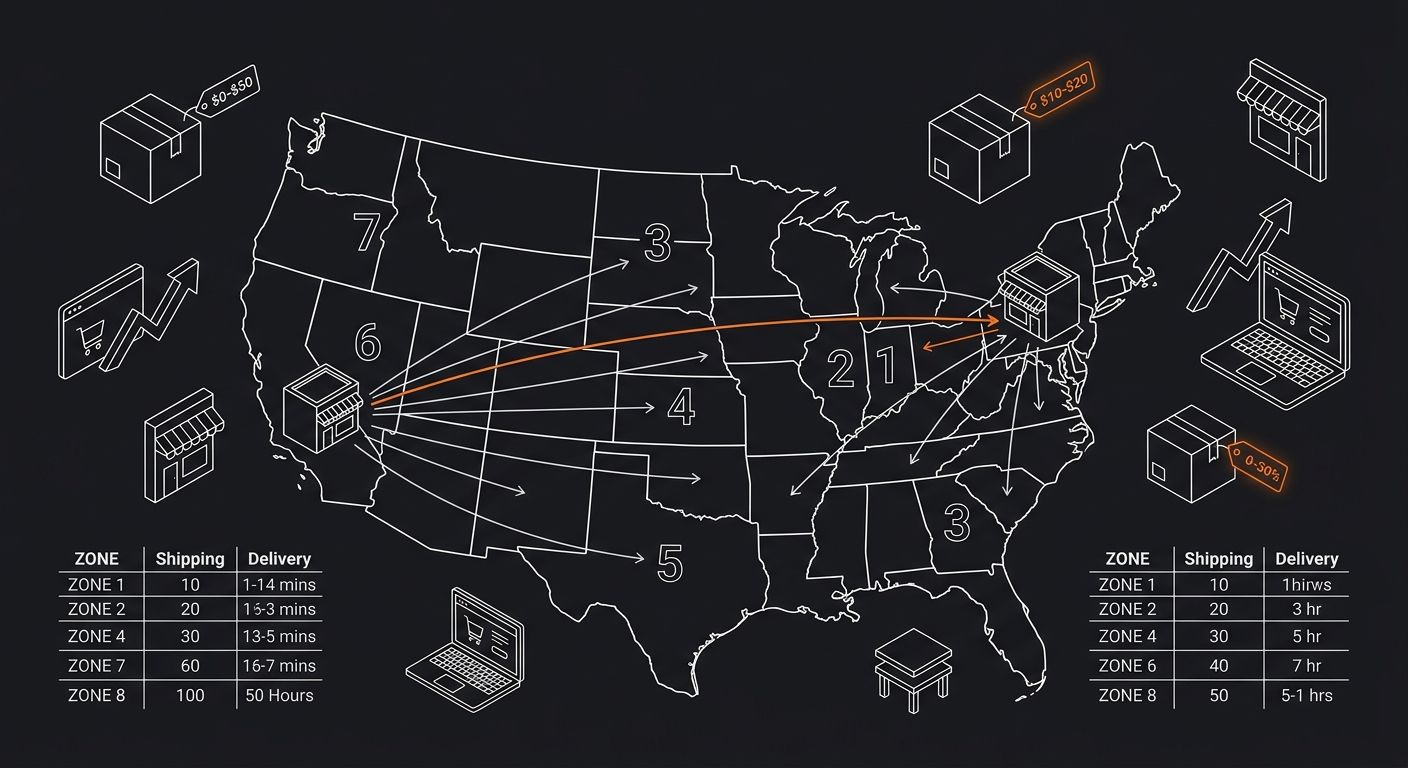
Shopify's routing updates in 2025 integrated shipping zone mapping and Shopify Markets for cross-border logic. The "stay within destination market" rule now accounts for zone-level granularity, not just country-level matching. For multi-supplier stores selling into the US with one supplier shipping from a West Coast warehouse and another from the East Coast, the routing engine can factor zone proximity more precisely.
The economics of strategic shipping zone placement show 15-25% cost reductions when inventory is distributed across zones matching your customer density. But dropshippers don't control where suppliers warehouse their goods. Your routing optimization is constrained by your suppliers' existing locations, making supplier selection itself a de facto routing decision. Choosing a supplier in Zone 4 relative to 60% of your customer base means every order to those customers carries a zone premium that no routing rule can eliminate.
Where The Model Breaks
Shopify's Shopify order routing was built for a specific fulfillment model: a brand with 2-5 owned or contracted warehouses, stocking its own inventory, shipping via integrated carriers. The sequential rule stack works well in that context because all locations share the same operational standards, carrier contracts, and return policies.
Multi-supplier dropshipping stores violate every assumption in that model. Your "locations" are independent businesses with their own priorities, inventory management practices, and shipping timelines. The routing system can't account for Supplier A's tendency to ship 48 hours late, Supplier B's 12% defect rate on a specific SKU, or Supplier C's refusal to process returns. These variables actually determine per-order profitability, and none of them exist in the routing logic.
A store that routes orders to the "closest" supplier saves $2 on shipping but loses $14 when that supplier's higher defect rate generates a return. Understanding how return rates silently destroy margins in specific niches makes this tradeoff visible.
Three structural gaps define where the model fails for multi-supplier stores:
No cost input. Routing rules cannot reference shipping cost, supplier pricing, or landed cost data. Every routing decision is cost-blind unless you build custom Functions on Plus.
No performance feedback loop. The system doesn't learn from past supplier performance. A location with a 40% late-shipment rate gets the same routing priority as one with 98% on-time fulfillment.
No dynamic rebalancing. If a supplier's inventory drops to 3 units, the system still routes orders there until inventory hits zero. There's no safety stock threshold or capacity-aware routing without custom development.
These gaps don't make Shopify's routing useless for multi-supplier stores. They make it a foundation that requires supplemental logic from automation tools, custom Functions, or deliberate manual oversight. The stores that lose money are the ones that configure four rules, set their location priority list, and assume the system is optimizing fulfillment. The system is following a fixed decision tree with no awareness of the variables that actually drive dropshipping profitability. Knowing that, and layering cost-aware logic on top of it, is where the margin recovery starts.
365 Dropship Editorial
Editorial team writing about E-commerce, dropshipping, and product discovery — reviews of dropshipping suppliers and platforms, trending niche guides (jewelry, beauty, pets, home, fashion), supplier due diligence, ecom operations, shipping & fulfillment strategy, product research, AOV optimization, and profitable dropshipping case studies.
Related Articles
From Order to Tracking: Building Automated Supplier Sync Systems That Actually Work
Spark Shipping's documentation lists six distinct protocols for routing purchase orders to suppliers: email, EDI, FTP, CSV, XML, and direct API. Duoplane, built for mid-market and enterprise operations, supports a nearly identical set — EDI, email, API, and vendor portal.
How to Start Dropshipping: A Beginner's Guide
Starting a dropshipping store requires three connected layers: a storefront platform (Shopify leads), a supplier automation app (DSers, Spocket, or Zendrop), and a payment-plus-shipping configuration.
The Supplier Tracking Sync Failure Matrix: Debugging When Orders Disappear Between Shopify and Fulfillment
Shopify-supplier integration failures fall into three distinct zones: API callback misconfigurations, middleware polling gaps, and fulfillment-side acknowledgment drops.
Explore more topics