Paid Traffic vs. Organic SEO for Dropshipping Stores: Where to Allocate Your First $5,000 in Marketing Spend
Stores relying primarily on organic traffic report 28% average net margins compared to 17% for paid-traffic-dependent operations.
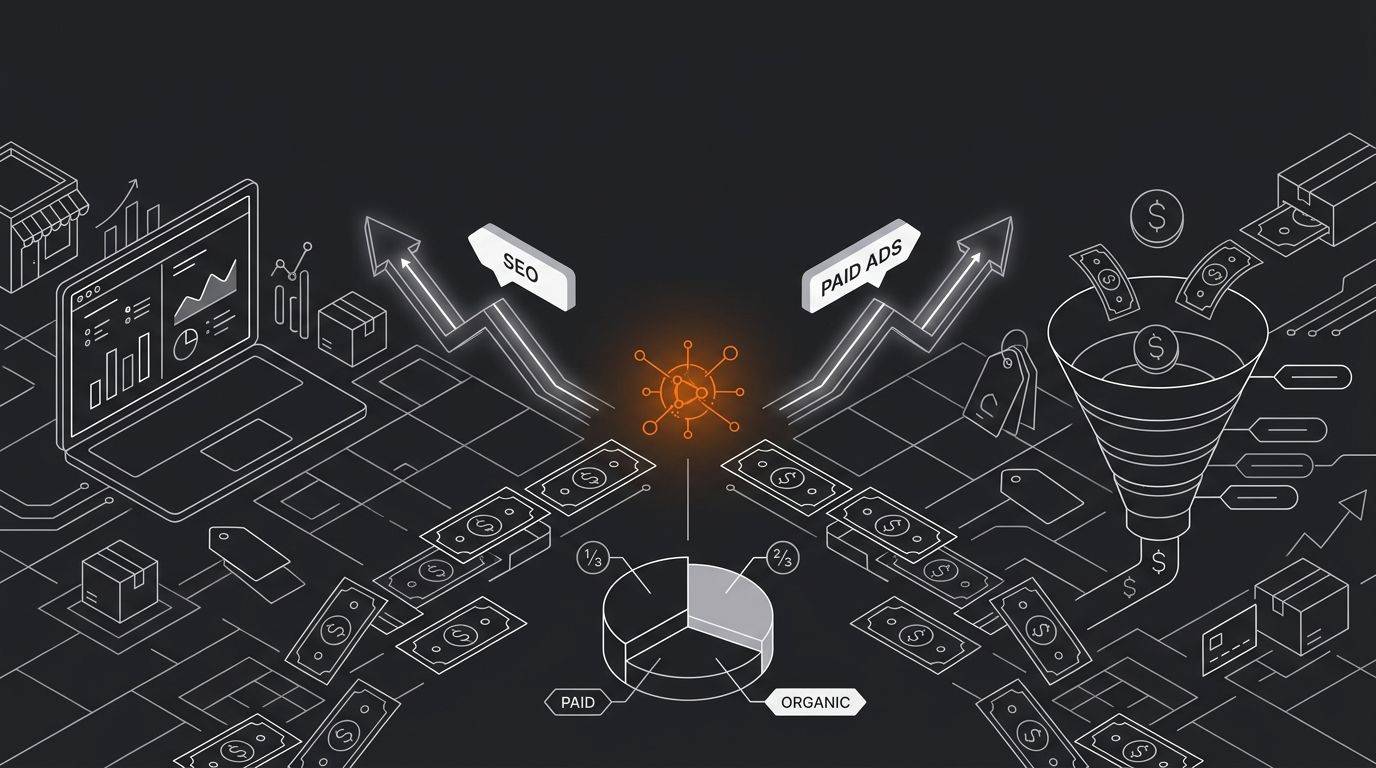
Paid Traffic vs. Organic SEO for Dropshipping Stores: Where to Allocate Your First $5,000
Stores relying primarily on organic traffic report 28% average net margins compared to 17% for paid-traffic-dependent operations. Your first $5,000 in marketing budget allocation splits three ways: Facebook/TikTok ads for speed, Google Ads for intent capture, and SEO content that compounds over 6–12 months. Each channel carries a different CAC comparison profile, risk curve, and payoff timeline.
The Tradeoff Table
Before digging into each channel, here's where the numbers land across the metrics that actually matter to a store spending its first $5,000:
Metric | Facebook/TikTok Ads | Google Ads | Organic SEO |
|---|---|---|---|
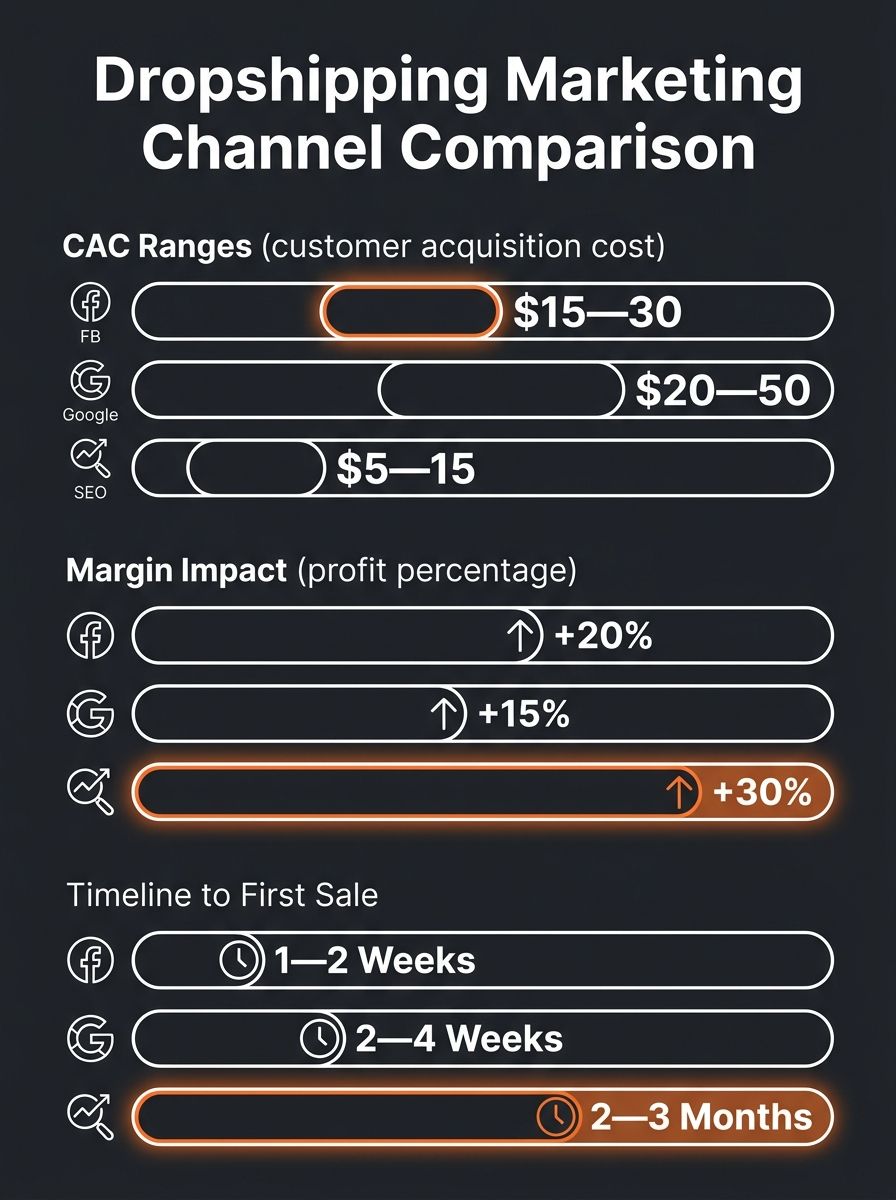
Time to first sale | 24–72 hours | 48–96 hours | 8–16 weeks |
Avg. CAC range | $15–$45 | $25–$65 | $3–$12 (after ramp) |
Net margin impact | 17% avg. | 19–22% avg. | 28% avg. |
Revenue when you stop spending | $0 | $0 | Continues months+ |
Best use of $1,000 | Product validation | Capturing purchase-ready traffic | 8–12 optimized pages |
Skill floor | Low (visual creative) | Medium (keyword bidding) | High (content + technical) |
That margin gap between 17% and 28% is the core tension. Paid traffic dropshipping gives you speed and data. Organic gives you margin. The question is how to balance both when $5,000 is all you've got.
Facebook and TikTok Ads Give You Data in 48 Hours
A $5-per-day Facebook campaign testing three creatives against a cold audience will tell you within two days whether a product generates clicks, add-to-carts, and purchases. No other channel delivers product-market signal that fast. For dropshippers running the demand validation stack before sourcing, paid social is the final confirmation step.
The cost reality, though, is punishing at small scale. SellTheTrend's analysis of dropshipping ad performance found that "if you are low on budget, Facebook ads are your best bet" for initial testing because CPMs run 40–60% lower than Google's search CPCs. That's true. But "best bet" at low budget and "profitable at scale" are different conversations.
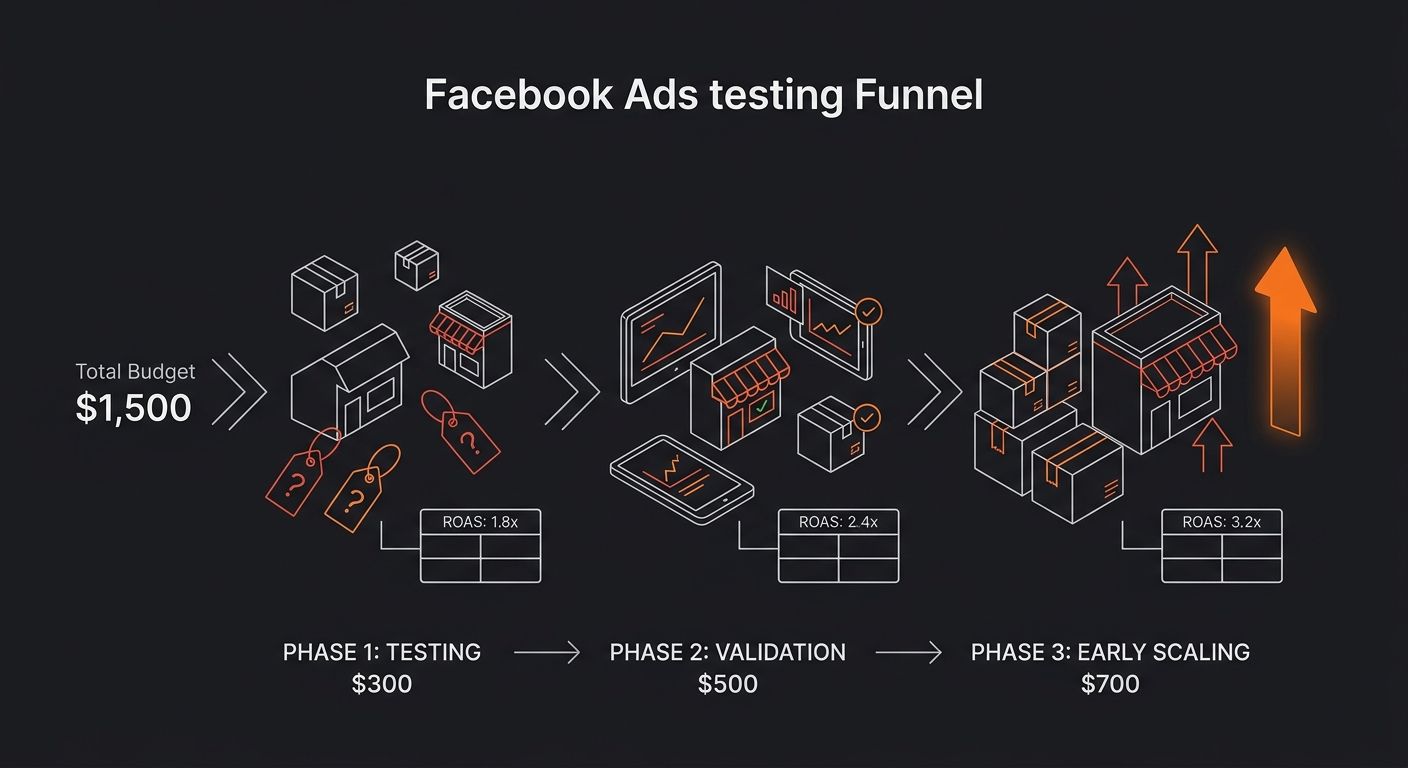
Here's what $1,500 in Facebook/TikTok spend typically looks like for a new dropshipping store:
Testing phase (days 1–7): $300 across 6 ad sets, 3 creatives each. You're buying data, not revenue. Expect $0–$200 back in sales.
Validation phase (days 8–14): $500 concentrated on 1–2 winning ad sets. CPA should drop 30–50% from testing. If it doesn't, the product isn't viable on this channel.
Early scaling (days 15–30): $700 expanding lookalike audiences. Profitable stores see 1.5–2.5x ROAS here. Below 1.5x, you're subsidizing Meta's revenue.
The structural problem: paid social contributes only 0.9% of organic social traffic share, meaning the moment you pause spend, traffic drops to near-zero. BrandsGateway's research on paid versus organic dropshipping states plainly that "unlike paid ads, which will stop driving traffic to your online store once you stop paying, a well-SEO-optimized website can continue to attract visitors for a long period of time." Every dollar here is rented reach.
And paid amplifies mistakes. A bad product page, weak offer, or slow-loading checkout doesn't just cost you the click. It costs you the click plus the $1.20–$3.50 CPC you paid to send someone there. If your checkout flow has margin leaks, you're literally paying to lose money faster.
Google Ads Capture Buyers With Intent Already Formed
Why does Google Ads carry a higher average CPA than Facebook for dropshipping? Because the traffic is warmer. Spocket's comparison guide explains that "Google Ads is about intent-driven searches, connecting your products with people actively looking for them," while Facebook excels at sparking interest in visually appealing products people didn't know they wanted.
That intent difference changes the math. Google Shopping campaigns for a $35 product in the home goods niche typically run $1.80–$4.50 per click, but conversion rates sit 2–4x higher than cold Facebook traffic. You pay more per visitor and get more buyers per hundred visitors.
For a $1,500 Google Ads allocation within your first $5,000 budget, the split looks different than Facebook:
Google Shopping (60% of spend, ~$900): Product listing ads with images, prices, and reviews visible in search results. These convert at 1.8–3.2% for established product categories. You need strong product images and competitive pricing since shoppers compare listings side by side.
Branded search (15% of spend, ~$225): Bidding on your own store name protects against competitors stealing branded clicks. Cheap CPCs ($0.30–$0.80), high conversion (8–15%).
Commercial-intent keywords (25% of spend, ~$375): Phrases like "best [product] for [use case]" pull in research-phase buyers. Lower conversion (0.8–1.5%) but these shoppers purchase within 7–14 days.
Ecommerce companies generating under $1 million in revenue allocate 35% of their total marketing budget to paid search, per Smart Insights data. That percentage is high partly because these stores lack organic visibility and have no other reliable traffic source. It's a dependency, not a strategy.
The real risk with Google at the $5,000 total budget level: your CAC payback period on a first purchase often exceeds the margin on that order. If your product costs $12 from the supplier, sells for $35, and Google charges $28 in clicks to generate one sale, you're making $-5 on the first transaction. You need repeat purchases or higher AOV through product bundling strategies to make Google Ads work at thin-margin dropshipping economics.
SEO for Dropshipping Builds the Asset That Compounds
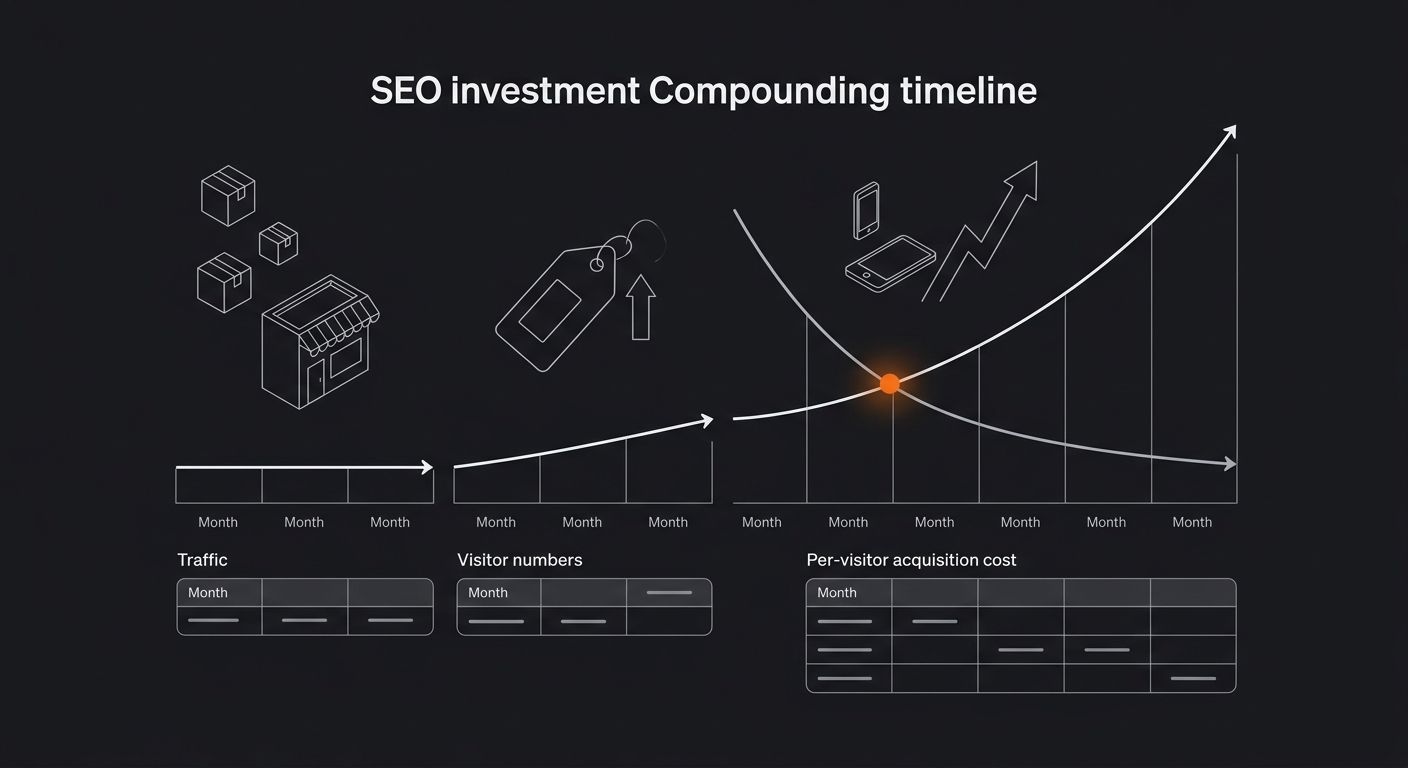
Organic search drives 53% of all website traffic. Organic results generate a 70% higher click-through rate than paid ads, per Zero Limit Web data, because searchers trust earned rankings more than sponsored placements. And the CAC comparison is stark: once content ranks, each incremental visitor costs you nothing in ad spend. Organic CAC drops toward $3–$12 after the initial 3–6 month ramp period, compared to the $15–$65 range you're paying on paid channels.
The catch is timing and labor. Traffic Masters' 2026 analysis of combined channel investment puts total Year 1 SEO costs at $5,000–$15,000 depending on competitiveness, with expected Year 1 revenue of $50,000–$100,000 at a 2% conversion rate and $100 AOV. That's a 3–15x ROI range. Paid channels in the same study delivered $1,800–$3,600 in Year 1 spend, but with far lower compounding potential in Year 2 and beyond.
Here's what $2,000 of SEO investment buys a new dropshipping store:
10–15 long-tail blog posts ($800–$1,200): Target commercial-investigation queries like "best [product] for [use case]" and "[product A] vs [product B]." These pages rank faster than category pages because competition is lower. Budget $60–$100 per 1,500-word article if you're hiring writers.
Technical SEO fixes ($300–$400): Site speed optimization (target under 2.5 seconds), schema markup for products, fixing crawl errors, and cleaning up duplicate content from supplier descriptions. This is the unsexy work that makes everything else rank.
Category page optimization ($300–$500): Rewriting the default Shopify collection descriptions with 300–500 words of unique content, internal linking between related products, and adding FAQ sections that capture featured snippet opportunities.
The total cost of platform ownership matters here because Shopify and WooCommerce handle technical SEO differently. Shopify's URL structure and limited access to robots.txt create constraints that WooCommerce doesn't have. Factor platform choice into your SEO budget allocation.
How to Split $5,000 Across All Three
The honest answer is that the right split depends on one variable: how quickly you need to prove a product works.
If you're testing a new niche with no validated product yet, go heavy on paid:
$2,500 Facebook/TikTok ads (product validation)
$1,000 Google Shopping (intent-capture test)
$1,500 SEO foundation (technical fixes + 8–10 blog posts)
This approach burns through the paid budget in 30–45 days, gives you clear product-market data, and leaves an SEO foundation building in the background. Your paid traffic dropshipping spend is buying information, not long-term growth.
If you've already validated a product through organic signals (Amazon BSR trends, Reddit discussion volume, trending niche demand curves), flip the ratio:
$1,000 Facebook/TikTok ads (creative testing only)
$500 Google Shopping (branded defense)
$3,500 SEO content (20+ articles, technical optimization, category pages)
This second allocation sacrifices speed for the 28% margin advantage that organic-first stores carry. The first 8 weeks will feel slow. By month 4, your per-acquisition cost starts dropping every week while paid-only competitors keep paying the same CPCs.
The split nobody talks about: whichever direction you lean, reserve 10% ($500) for retargeting. A Reddit user in r/dropship summarized the real-world experience bluntly: "test cheap on Facebook, scale smart on Google, and always retarget." Retargeting warm visitors converts at 3–5x the rate of cold traffic and runs CPAs 60–70% lower. That $500 in retargeting often outperforms $2,000 in cold prospecting.
The stores that make $5,000 stretch farthest treat paid and organic as sequential phases rather than competing line items. Paid channels generate data and initial revenue. SEO converts that data into a durable traffic asset that widens margins every month it compounds. Spend accordingly.
365 Dropship Editorial
Editorial team writing about E-commerce, dropshipping, and product discovery — reviews of dropshipping suppliers and platforms, trending niche guides (jewelry, beauty, pets, home, fashion), supplier due diligence, ecom operations, shipping & fulfillment strategy, product research, AOV optimization, and profitable dropshipping case studies.
Related Articles
Complete Guide to Starting a Dropshipping Business
Every dropshipping business built on Shopify, Amazon, Etsy, eBay, or Walmart faces the same registration requirement: formal business filing, a dedicated bank account, and a sales tax permit.
What is Dropshipping: Complete Beginner's Guide
The global dropshipping market is projected to hit $537.8 billion in 2026, expanding at a 23.6% compound annual growth rate through 2032. Dropshipping is an ecommerce fulfillment model where you sell products online without purchasing or storing inventory.
How to Do Dropshipping: Complete Beginner's Guide
This guide walks you through how to do dropshipping from zero to first sale in under a week. Seven steps cover niche selection, business registration, store setup, supplier vetting, product pricing, test orders, and ad launch, with specific costs and timelines at each stage.
Explore more topics