How to Build a Niche Demand Validation Stack Using Google Trends, Reddit, and Amazon BSR Before You Source a Single Product
Novadata's 2026 Amazon BSR guide identifies subcategory rank, not main-category rank, as the actionable metric for niche competitive analysis.
How to Build a Niche Demand Validation Stack Using Google Trends, Reddit, and Amazon BSR Before You Source a Single Product
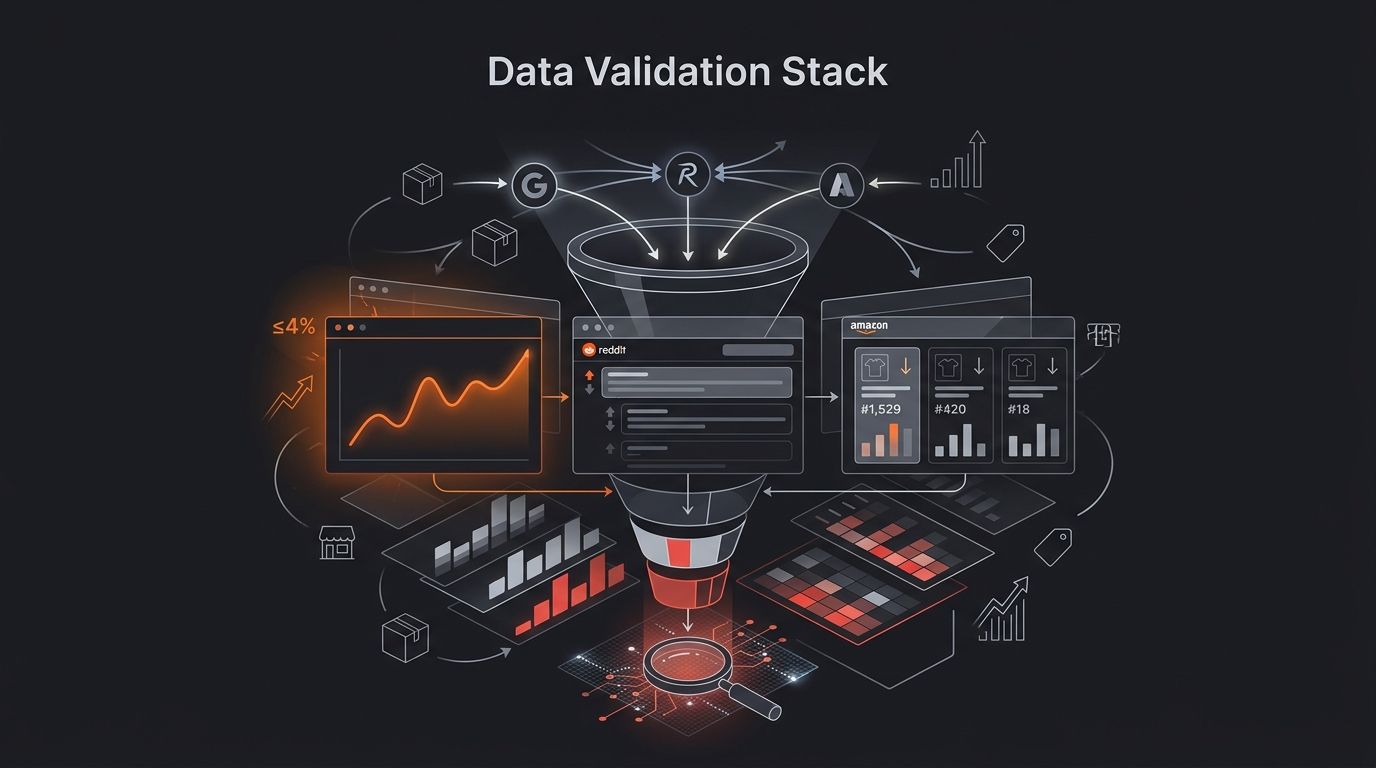
Novadata's 2026 Amazon BSR guide identifies subcategory rank, not main-category rank, as the actionable metric for niche competitive analysis. Cross-referencing subcategory BSR with 5-year Google Trends data and Reddit complaint threads creates a free pre-source validation stack that filters niche candidates in under 90 minutes.
Google Trends Defaults Will Mislead You
Dropified's niche validation guide states plainly that default Google Trends settings produce misleading results for product research. The platform loads with a 12-month window and nationwide geographic scope, which hides the information you actually need: multi-year demand direction and regional concentration.
Set the timeframe to "Past 5 years" for every niche candidate. You're looking for a stable or gently rising curve, not a spike. A product that jumped from an interest score of 15 to 90 in three months and then dropped back to 20 is a fad. A product that moved from 25 to 55 over 36 months with seasonal bumps is a business.
One r/dropshipping community member described the standard simply: "We want at least a stable curve slightly growing from the last 5 years."
The geographic filter matters more than most operators realize. Dropified's step-by-step guide recommends you cross-reference Google Trends data by country, state, or metro area to align product selection with regions where you can fulfill orders profitably. A product trending in Northern Europe won't help your U.S.-focused store with 7–12 day domestic shipping from a CJ Dropshipping warehouse in California.
Two features inside Google Trends deserve attention after you've confirmed a stable trajectory: Related Queries and Breakout Topics. Breakout queries are terms with search growth above 5,000% relative to the prior period. These reveal sub-niches and product variations your competitors haven't indexed yet. If you're validating "posture corrector" and you see a breakout query for "posture corrector for desk workers with lumbar support," that's a product angle worth investigating further.
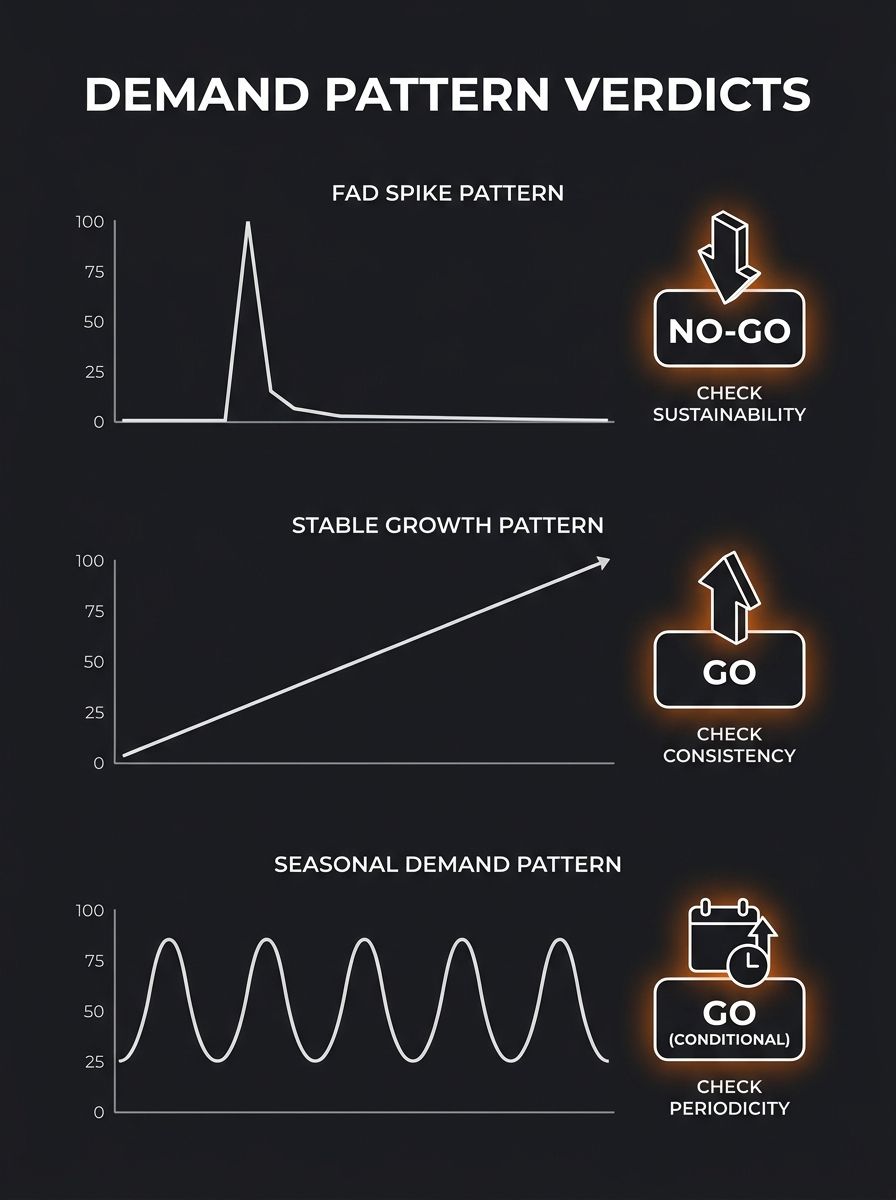
The time investment here is roughly 15–20 minutes per niche candidate. If a keyword shows declining interest over 5 years, kill it immediately. No amount of good marketing fixes shrinking demand. And if you've been relying on spy tools alone for niche selection, this step catches the niches those tools surface after the demand window has already peaked.
Reddit Threads Reveal What Search Data Can't
Google Trends tells you whether people search for something. Reddit tells you why they're unhappy with what exists. That gap between demand and satisfaction is where profitable dropshipping niches live.
Search Reddit for your product category plus words like "disappointed," "returned," "broke," "alternative to," or "wish there was." Subreddits like r/BuyItForLife, r/findaproduce, and niche-specific communities (r/homegym, r/SkincareAddiction, r/CampingGear) contain complaint threads that function as free focus groups. You're looking for recurring pain points about existing products on Amazon.
A self-described product executive with 15 years of experience posted on r/smallbusiness that "one of the best methods I've seen for validating an idea is to build up a landing page that sells the idea and takes pre-orders." But before you get to that stage, Reddit complaint mining costs $0 and tells you whether the gap is real.
Here's what makes Reddit product research different from keyword research: you're gathering qualitative data about specific failures. If 14 people in r/homegym threads complain that resistance bands snap at the handle attachment point after 3 months, you now know the exact product improvement to source. That level of specificity is invisible in search volume data and Amazon reviews (which are often gamed or incentivized).
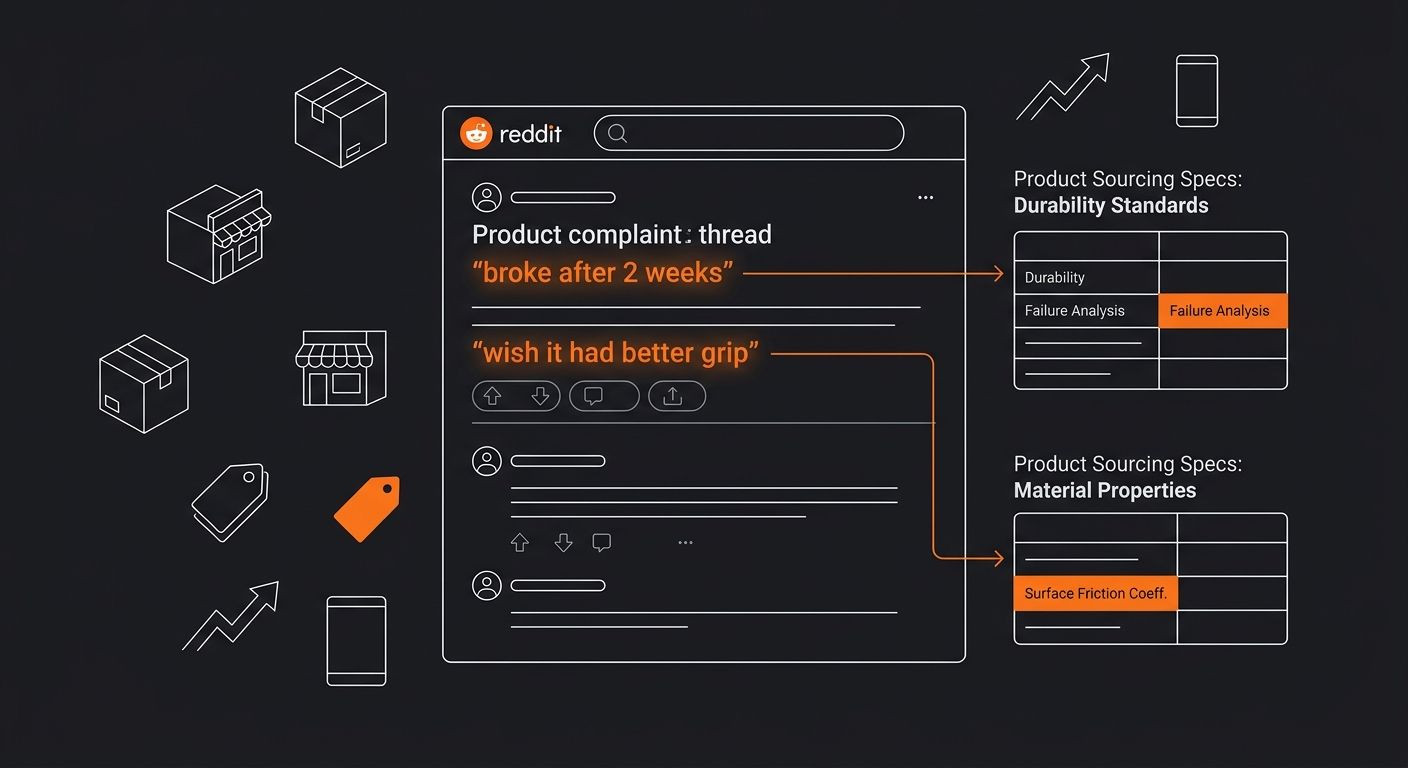
Spend 20–30 minutes per niche candidate reading complaint threads. If you find fewer than 5 distinct complaint threads about existing products in a niche, the market either has strong incumbents satisfying customers or the niche is too small to generate community discussion. Both scenarios are red flags. This qualitative signal is what separates pre-source validation from pure data analysis, and it connects directly to how you'd later run test order audits against the specific weaknesses you've identified.
How Subcategory BSR Exposes Real Sales Velocity
Amazon's Best Seller Rank updates hourly based on recent sales velocity, but the number that matters for niche validation is the subcategory BSR, which ranks products within specific niches like "Silicone Baking Mats" rather than across the entire marketplace. As KDP Niche Hunter's BSR analysis explains, a product selling 10 copies per day might hold a BSR of 8,000 in one category and 45,000 in another, depending on category size. This is why you always evaluate BSR within the subcategory.
The validation thresholds are specific:
Subcategory BSR between 5,000 and 50,000 on top-selling products indicates consistent sales without a single dominant seller controlling the category
Fewer than 300 reviews on the top 3 listings signals an accessible market where new entrants can compete
90-day BSR consistency separates products with steady demand from those riding a single promotional push
Stable or rising price floors across the top 10 listings indicate healthy margins; declining prices signal a race to the bottom
A product with a BSR of 80,000 in a broad category translates to roughly 1–3 daily sales and can still rank in the top 30 within a tight subcategory. That's meaningful signal for a dropshipper evaluating whether a niche can sustain $30–50 daily revenue per SKU before scaling.
You can pull BSR data manually (Amazon product pages show it under "Product Information") or use tools like Keepa for historical BSR charts. The manual approach takes about 25 minutes per niche if you're checking 10 products. When you later calculate your true CAC payback period, the BSR data gives you a realistic baseline for expected unit velocity.
The Three-Signal Go/No-Go Framework
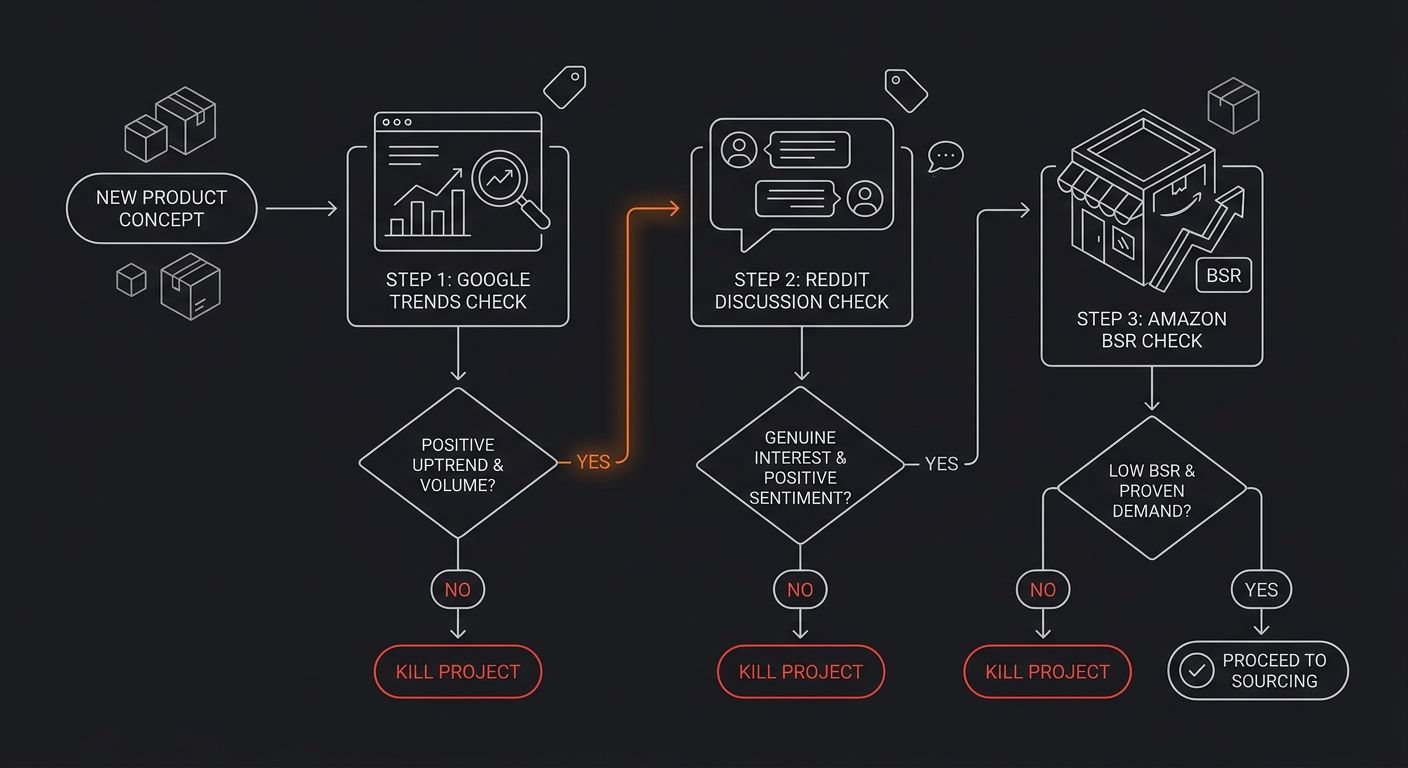
Each signal answers a different question. Google Trends answers "is demand growing?" Reddit answers "are buyers frustrated with current options?" Amazon BSR answers "can a new seller actually compete here?" All three need to pass their thresholds before you move to sourcing.
Signal | Tool | Green Light | Red Flag | Time Required |
|---|---|---|---|---|
Trend trajectory | Google Trends (5-year) | Stable or rising curve, breakout sub-queries present | Declining curve or single spike pattern | 15–20 min |
Buyer frustration | Reddit complaint threads | 5+ distinct complaint threads about existing products | Fewer than 5 threads, or complaints about price only | 20–30 min |
Competitive accessibility | Amazon subcategory BSR | BSR 5,000–50,000, under 300 reviews on top 3 | BSR under 2,000 or 1,000+ reviews on top listings | 20–25 min |
The framework kills a niche candidate the moment any single signal shows red. You don't average across signals or make exceptions because one metric looks great. A trending product with no Reddit complaints might mean incumbents already satisfy the market. A product with angry Reddit threads but declining Google Trends is a shrinking niche with known problems nobody's fixing because the economics don't justify it.
One critical addition to this stack: search volume validation. Target keywords with 1,000–10,000 monthly searches. Below 1,000, the niche may be too small to sustain paid acquisition. Above 10,000, you're competing against established brands with deep ad budgets. Tools like Google Keyword Planner or Ubersuggest give you this number in under 5 minutes per keyword.
After a niche passes all three signals, your next steps involve building a tariff-aware unit cost model and running supplier test orders. But those steps come after validation, never before. The entire three-signal process costs $0 in tools and under 90 minutes per candidate. Compare that to the $200–500 most operators lose on test orders for niches they should have killed at the Google Trends stage.
Questions The Numbers Still Can't Answer
This stack validates demand signals and competitive accessibility, but it has blind spots. Google Trends can't tell you whether the demand is coming from buyers who'd purchase from a Shopify store versus buyers who'd only buy on Amazon Prime. Reddit complaints skew toward enthusiast buyers who may not represent the median customer. And Amazon BSR says nothing about what your true landed cost will be after tariffs, packaging, and shipping eat into the margin your spreadsheet projected at 40%.
The framework also can't measure timing risk. Viral social media trends typically saturate a niche within 6–18 months, and BSR data by itself won't tell you whether you're catching a niche at month 3 or month 15. Cross-referencing TikTok search volume against your Google Trends data helps here, since TikTok content typically leads Amazon demand spikes by 60–90 days, but this adds complexity and judgment calls that no automated threshold can fully resolve.
What the three-signal stack does accomplish is systematic elimination. Instead of guessing which niches deserve your sourcing budget and ad dollars, you're running candidates through a repeatable filter with documented thresholds. The niches that survive all three signals aren't guaranteed winners. They're candidates that haven't failed any provable test yet, which puts you ahead of every operator who sources first and validates never.
365 Dropship Editorial
Editorial team writing about E-commerce, dropshipping, and product discovery — reviews of dropshipping suppliers and platforms, trending niche guides (jewelry, beauty, pets, home, fashion), supplier due diligence, ecom operations, shipping & fulfillment strategy, product research, AOV optimization, and profitable dropshipping case studies.
Related Articles
When Spy Tools Become a Liability: How Competitive Intelligence Blinds You to Sustainable Niche Selection
Spy tools trained you to pick niches your competitors already validated, which means every product you launch enters a market where margins are compressing in real time.
Why Your Product Research Is Producing Low-Margin Losers: 6 Validation Mistakes and How to Correct Them
80/20 Sourcing's product selection analysis names tool-dependent research as the top mistake that sinks ecommerce businesses before they ship a first order.
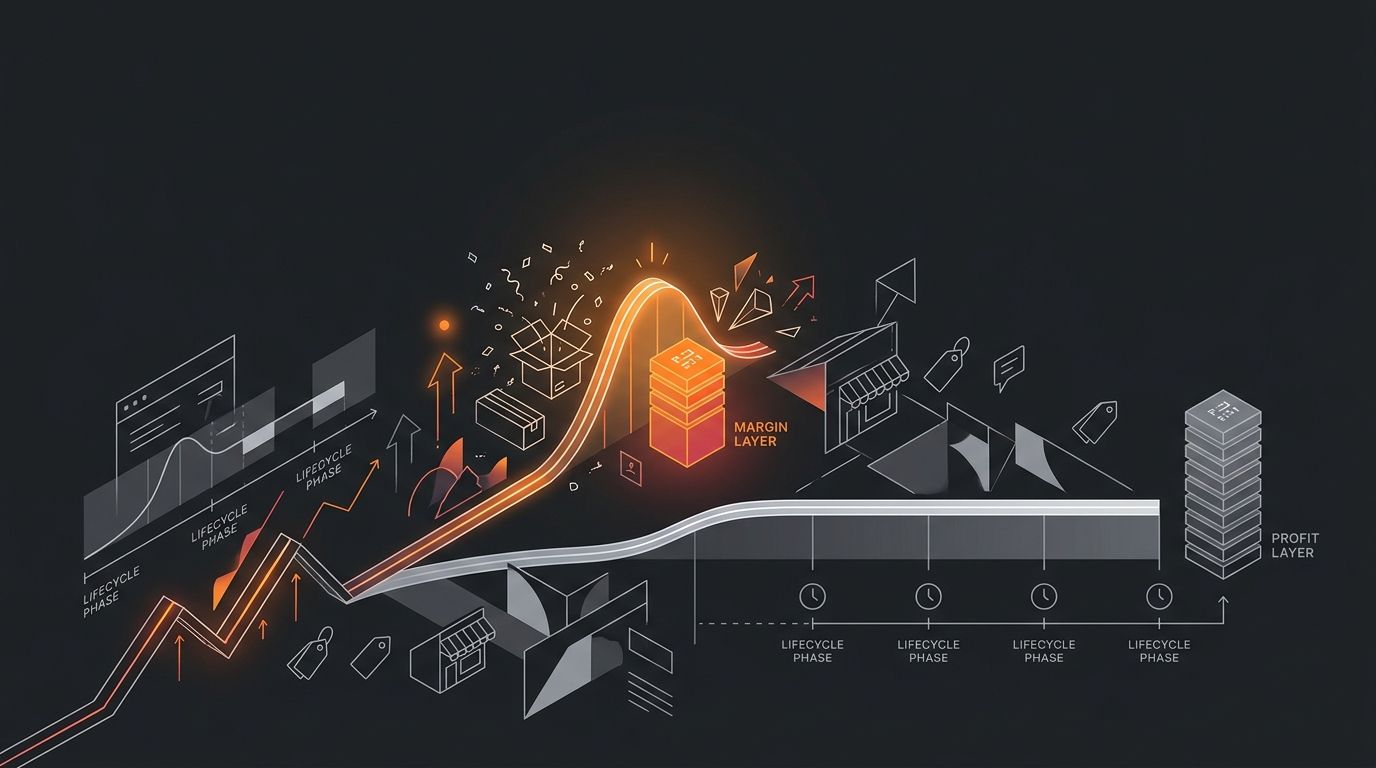
The Demand Curve Mechanics of Trending Niches: Why Viral Products Have a Different Margin Profile Than Evergreen Categories
Viral products follow a spike-crash demand curve that compresses margins through a predictable four-stage sequence: rising CPMs, supplier price hikes, competitor flooding, and demand collapse.
Explore more topics