The Automation Tool Selection Trap: Why Feature Parity Doesn't Equal Profit Growth for Your Dropshipping Store
Feature parity — when two automation platforms check the same boxes on a comparison chart — tells you almost nothing about which tool will grow your store's contribution margin.
The Automation Tool Selection Trap: Why Feature Parity Doesn't Equal Profit Growth for Your Dropshipping Store
Feature parity — when two automation platforms check the same boxes on a comparison chart — tells you almost nothing about which tool will grow your store's contribution margin. The profit difference between competing tools lives in implementation mechanics: sync frequency, order routing logic, and per-task cost structures that feature lists never surface.
The Feature Checklist Illusion
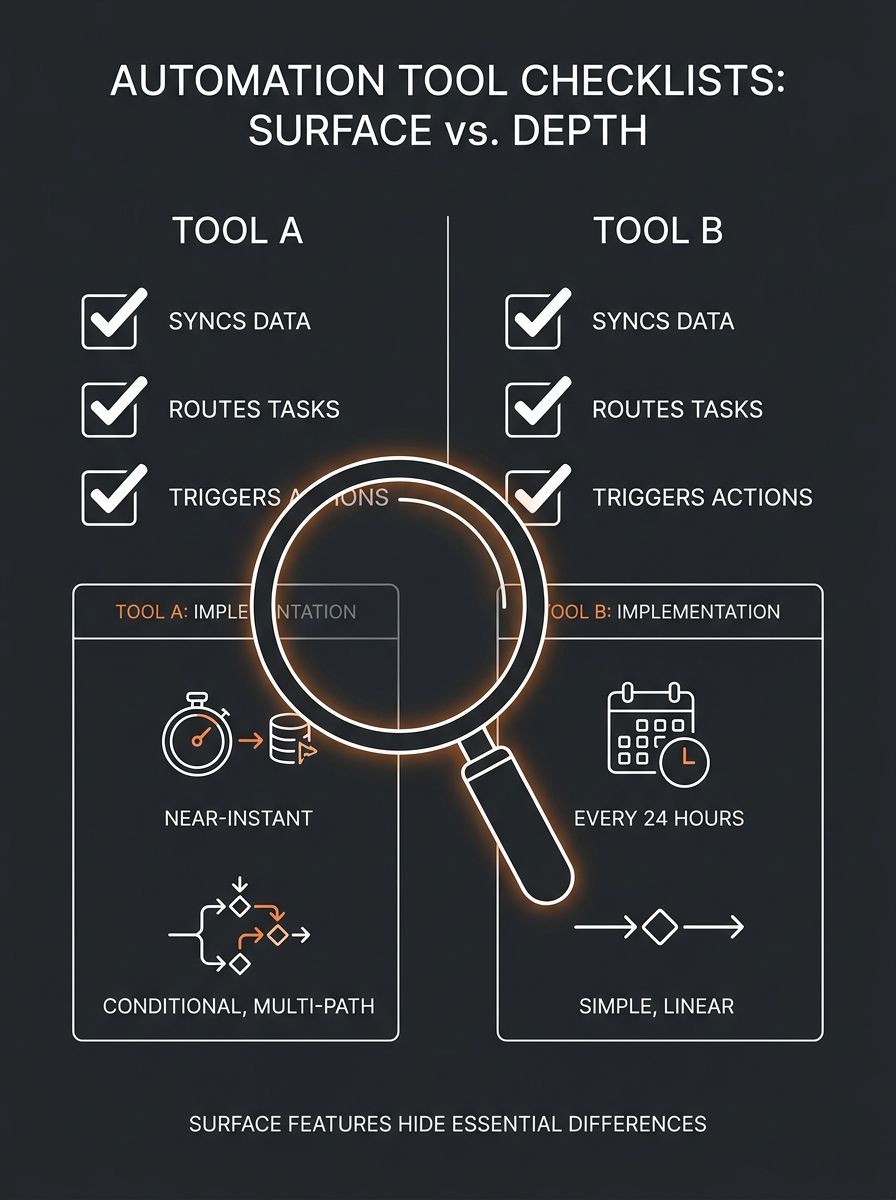
Every order fulfillment software comparison you've seen follows the same format: a grid with tool names across the top and features down the side. Auto-order forwarding? Check. Inventory sync? Check. Bulk listing? Check. Two tools with identical checkmarks appear interchangeable.
They aren't. According to Daylily's analysis of automation impact, automation can boost dropshipping profits by up to 40%, but that figure assumes the tool's execution matches your store's operational bottleneck. A store processing 15 orders per day has fundamentally different automation needs than one processing 300. The 15-order store needs accuracy and low fixed cost. The 300-order store needs throughput and intelligent routing.
The problem with feature parity as an automation tool selection criterion is that it treats every check mark as equal. Auto-order forwarding on Platform A might mean a single-supplier push with manual tracking entry. On Platform B, it could mean multi-supplier routing with carrier-specific tracking propagation back to your storefront. Same feature name. Wildly different profit impact.
Sync Frequency Is Where Margin Leaks Hide
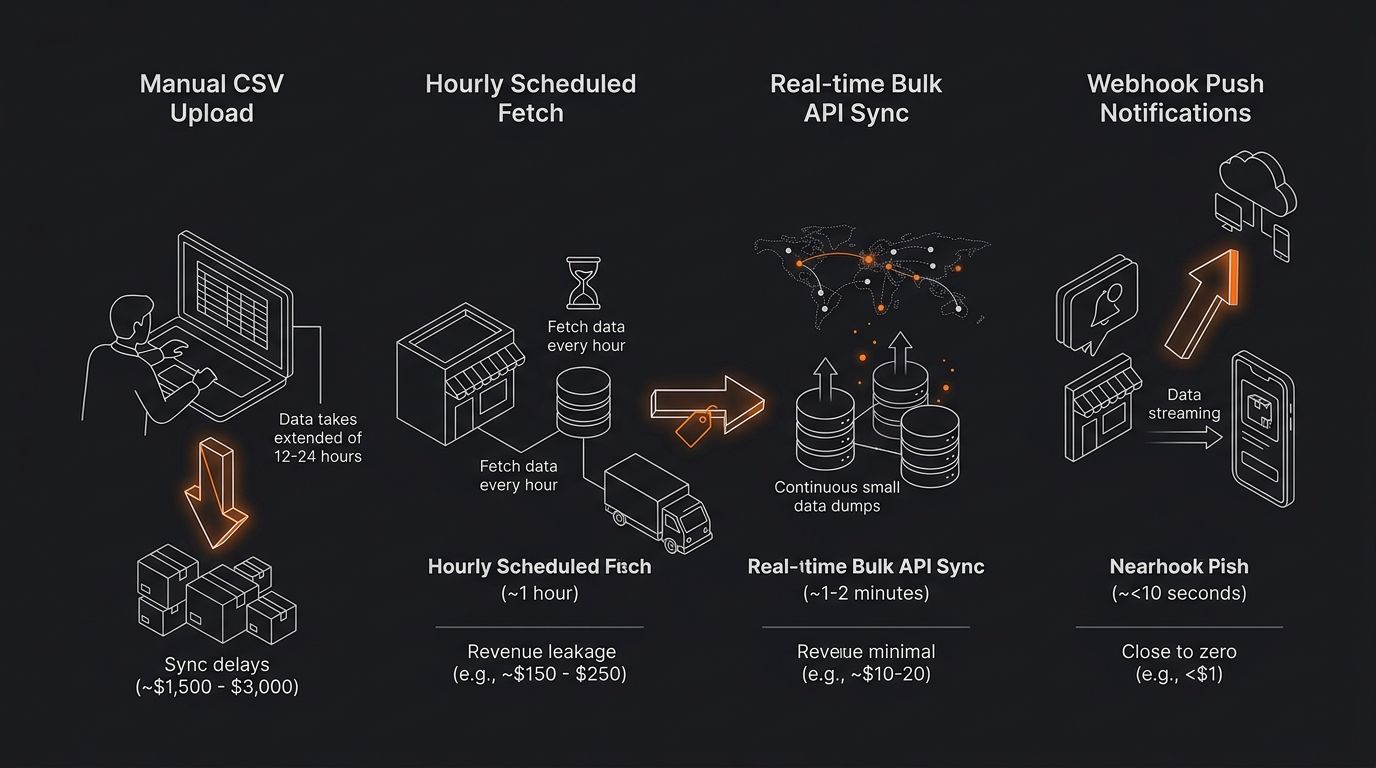
Why does inventory sync timing matter so much for dropshipping automation ROI? Because every minute your stock count is out of date, you're exposed to overselling (refunds, chargebacks, angry customers) or underselling (missed revenue on items that were actually available).
The spread between tools is dramatic. Zoho Inventory's free plan updates stock levels every 4 hours. Paid alternatives like Sumtracker and Syncio offer real-time updates. For a store selling across Shopify and eBay simultaneously, a 4-hour lag during a product going viral on TikTok means dozens of orders for items your supplier already sold out.
Nicole Pascoe, Co-founder of Craftybase, puts it plainly: "Inventory sync software keeps your stock levels consistent across every sales channel." Consistency sounds boring until you quantify the alternative. Inventory distortion costs retailers $1.73 trillion annually worldwide. Your slice of that loss depends entirely on how often your inventory sync tools actually sync.
Shipturtle's webhook-based Vendor Sync approach claims to eliminate overselling and deliver up to a 5% revenue boost compared to API-polling methods. That 5% comes from two places: fewer refunded out-of-stock orders and more captured sales on items that API polling would have marked unavailable during the lag window.
If you've dealt with sync failures between Shopify and your fulfillment pipeline, you already know the cost of these gaps. The fix starts with understanding that "inventory sync" as a feature tells you nothing about the sync architecture underneath it.
Sync Method | Update Frequency | Oversell Risk | Typical Monthly Cost | Best For |
|---|---|---|---|---|
Manual CSV upload | 1-2x daily | Very High | $0 | Fewer than 10 orders/day |
API polling (free tier) | Every 4 hours | High | $0-29 | Single-channel, low volume |
API polling (paid) | Every 15-60 min | Moderate | $29-99 | Multi-channel, moderate volume |
Webhook push | Real-time | Low | $49-149 | High volume, multi-supplier |
Direct platform integration | Near real-time | Low | Varies by platform | Platform-native sellers |
Order Routing vs. Order Forwarding
The distinction between order routing and order forwarding is the single most misunderstood mechanism in dropshipping automation. Both appear as "auto-order processing" on a feature list. They work in fundamentally different ways.
Order forwarding takes a customer's order and pushes it to a pre-assigned supplier. One order, one destination, every time. This is what most entry-level tools (and many mid-tier ones) actually do. Industry data shows 79% of successful dropshippers use automated order processing, and for a single-supplier store doing under $5K/month, forwarding is fine.
Order routing evaluates each order against multiple variables before deciding where to send it: supplier stock levels, shipping origin proximity to the customer, current supplier pricing, and fulfillment speed commitments. The tool makes a per-order decision, every time. Platforms like AutoDS and Flxpoint build their automation ROI pitch around this distinction, and it matters enormously once you're working with two or more suppliers.
The margin impact of automation compounds here. If you're running a multi-supplier setup to reduce concentration risk, routing can automatically shift orders to the supplier with lower current COGS or faster fulfillment. That per-order optimization can swing contribution margin by 3-8 percentage points on routed orders compared to static forwarding. And AI-powered pricing adjustments within these routing systems are driving an average 23% increase in profit margins for stores that use dynamic repricing alongside routing.
Understanding how data flows between your order system and suppliers makes this distinction much clearer in practice.
The Three-Layer Tool Fit Model
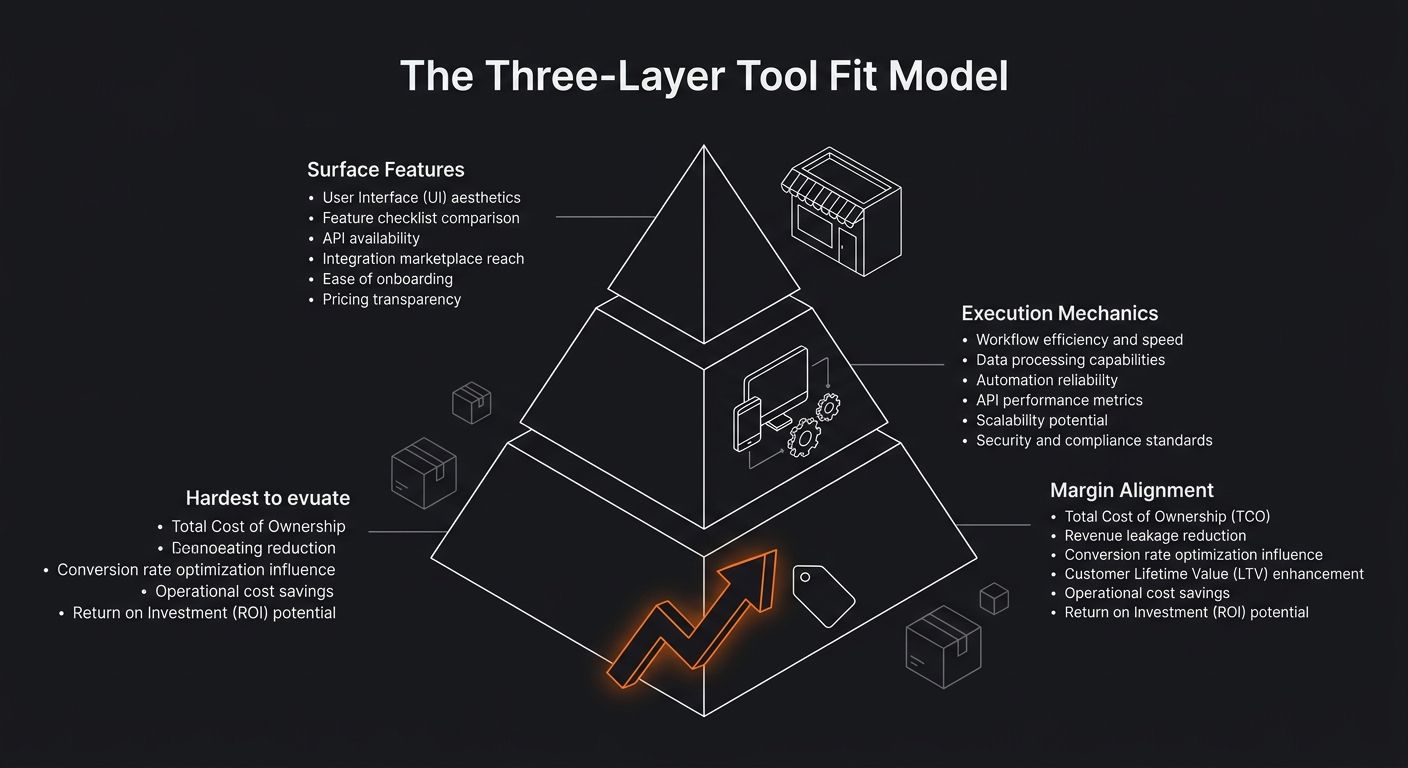
Evaluating automation tools through feature parity fails because it only measures one dimension. A more useful framework evaluates tools across three layers, each of which contributes independently to your dropshipping automation ROI.
Layer 1: Surface Features. This is the checkbox layer. Does the tool auto-forward orders? Sync inventory? Support bulk listing? Every tool comparison already covers this. Necessary, but insufficient on its own.
Layer 2: Execution Mechanics. How does each feature actually work? Webhook sync or API polling? Static forwarding or dynamic routing? Single-carrier tracking or multi-carrier propagation? This layer requires testing. A $49/month tool that saves you five hours monthly through superior execution mechanics beats a $149/month tool with the same feature list but clunky implementation, according to total cost of ownership analysis for small business tools.
Layer 3: Margin Alignment. Does the tool's cost structure match your unit economics? A tool charging $0.50 per order processed makes sense at 200 orders/month ($100 total) but becomes painful at 2,000 orders/month ($1,000 total). Meanwhile, a flat-rate $79/month tool with the same feature set becomes cheaper per order as you scale. Your contribution margin has to absorb the tool's cost, and that cost needs to shrink as a percentage of revenue as you grow.
Running test orders through your automation pipeline before committing to an annual plan reveals Layer 2 and Layer 3 problems that no feature grid will show you.
Where the Model Breaks
The three-layer model has clear limitations. It assumes you know your current bottleneck, and many store owners don't. If your actual profit drain is ad spend misallocation rather than fulfillment friction, upgrading your automation stack won't move the needle regardless of which tool you pick.
The model also assumes stable supplier relationships. Automation built around a specific supplier's API or data format breaks when you switch suppliers or when a supplier changes their system. Those AI-powered pricing tools delivering 23% margin improvements? Those results come from stores that had the rest of their operations dialed in first. Predictive analytics cutting ad spend by 31% follow the same pattern. The automation amplified existing operational health rather than creating it.
And there's the sheer pace of platform evolution. Tools like AI-powered sourcing platforms are collapsing the gap between routing, pricing, and product research into single interfaces. A tool that wins on Layer 2 execution mechanics today might lose to a platform that didn't exist when you signed your annual contract. The 40% profit boost from automation that industry benchmarks cite comes with an asterisk: it requires ongoing evaluation against actual cost-per-order-fulfilled data and contribution margin trends, not a one-time selection decision.
The stores getting the most from automation treat tool selection as a recurring operations question, re-evaluated quarterly against real numbers. Feature parity tells you two tools can do the same things. It tells you nothing about whether either of them will make you more money.
365 Dropship Editorial
Editorial team writing about E-commerce, dropshipping, and product discovery — reviews of dropshipping suppliers and platforms, trending niche guides (jewelry, beauty, pets, home, fashion), supplier due diligence, ecom operations, shipping & fulfillment strategy, product research, AOV optimization, and profitable dropshipping case studies.
Related Articles
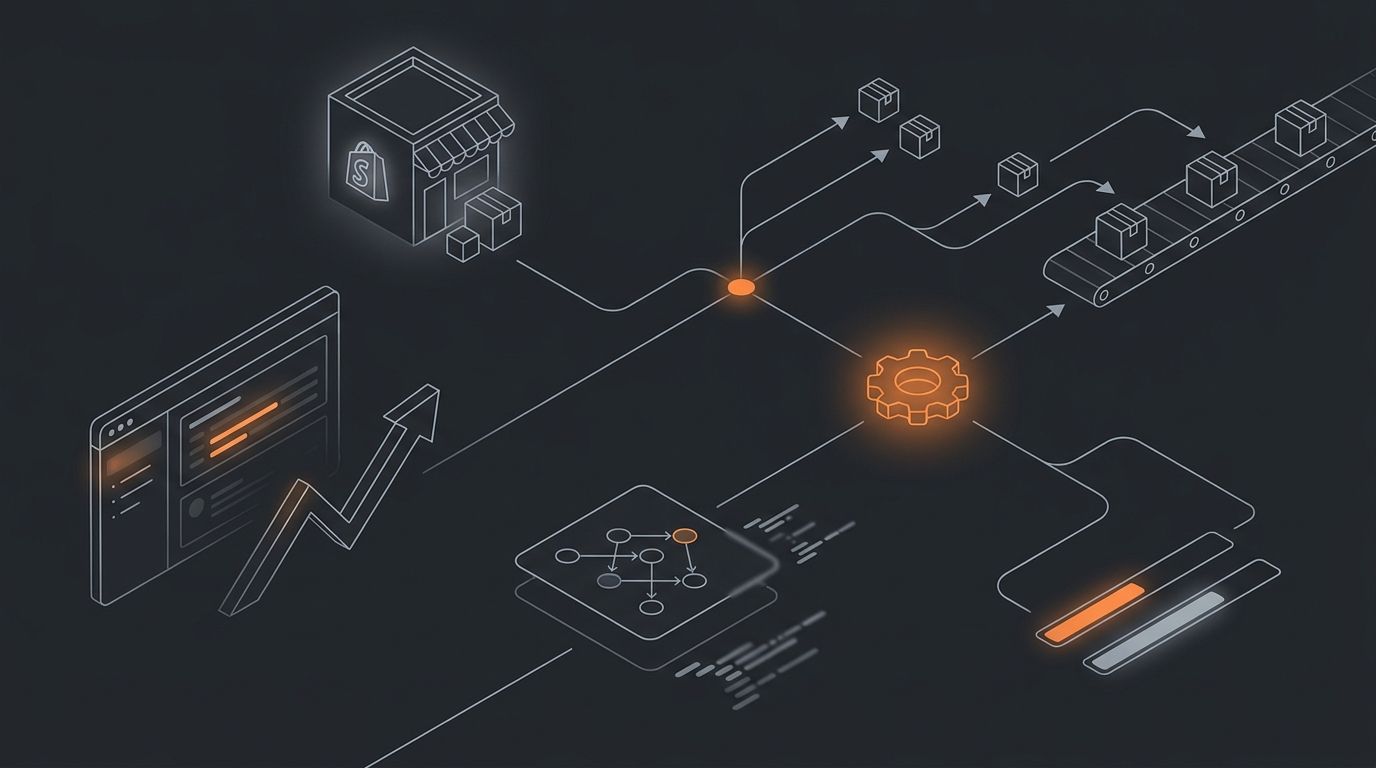
From Order to Tracking: Building Automated Supplier Sync Systems That Actually Work
Spark Shipping's documentation lists six distinct protocols for routing purchase orders to suppliers: email, EDI, FTP, CSV, XML, and direct API. Duoplane, built for mid-market and enterprise operations, supports a nearly identical set — EDI, email, API, and vendor portal.

AI-Powered Dropshipping: Automate Your Store
Artificial intelligence dropshipping tools can save operators 8 to 20 hours per week on inventory sync, customer support, and pricing adjustments. But the operators who profit from AI follow specific rules about where automation belongs and where it destroys value.
AI Store Builders vs. Manual Shopify Setup: The 2026 Speed-to-Profit Tradeoff for Dropshippers
Atlas AI Store Builder generates a fully functional Shopify store in under two minutes, according to a Dropmagic comparison of seven AI tools. Manual Shopify configuration typically requires 15 to 40 hours of theme work, copywriting, image editing, and SEO.
Explore more topics