AI-Assisted Supplier Vetting in 2026: How Doba Pilot and Automation Tools Are Reshaping Product Sourcing Speed
Doba Pilot's May 22 upgrade, DSers' Supplier Optimizer, and TeemDrop's fulfillment-routing engine represent three competing visions of AI dropshipping sourcing.
AI-Assisted Supplier Vetting in 2026: How Doba Pilot, DSers, and TeemDrop Are Competing to Own Your Product Sourcing Workflow
Doba Pilot's May 22 upgrade, DSers' Supplier Optimizer, and TeemDrop's fulfillment-routing engine represent three competing visions of AI dropshipping sourcing. Each tool cuts supplier vetting workflows from hours to minutes, but they attack different bottlenecks: product discovery, reliability scoring, and shipping performance, respectively.
Why This Comparison Matters Right Now
Forty percent of enterprise applications now embed AI agents, according to Find My Factory's 2026 sourcing analysis. That stat comes from the B2B manufacturing world, but the ripple effect has hit dropshipping hard. Procurement AI startup Pivot just raised $40 million in Series B funding on May 21, 2026, to replace legacy sourcing software with an AI operating system. Shopify's own blog now lists AI-powered sourcing apps as a primary category for dropshipping tools.
For operators running stores between $5K and $50K monthly revenue, the question isn't whether to use AI-assisted product sourcing. The question is which flavor of AI solves the problem you actually have. The three tools below take radically different approaches, and picking the wrong one wastes both your subscription fee and the 10-20 hours per week you'd otherwise spend on manual supplier due diligence.
Doba Pilot After the May 22 Upgrade
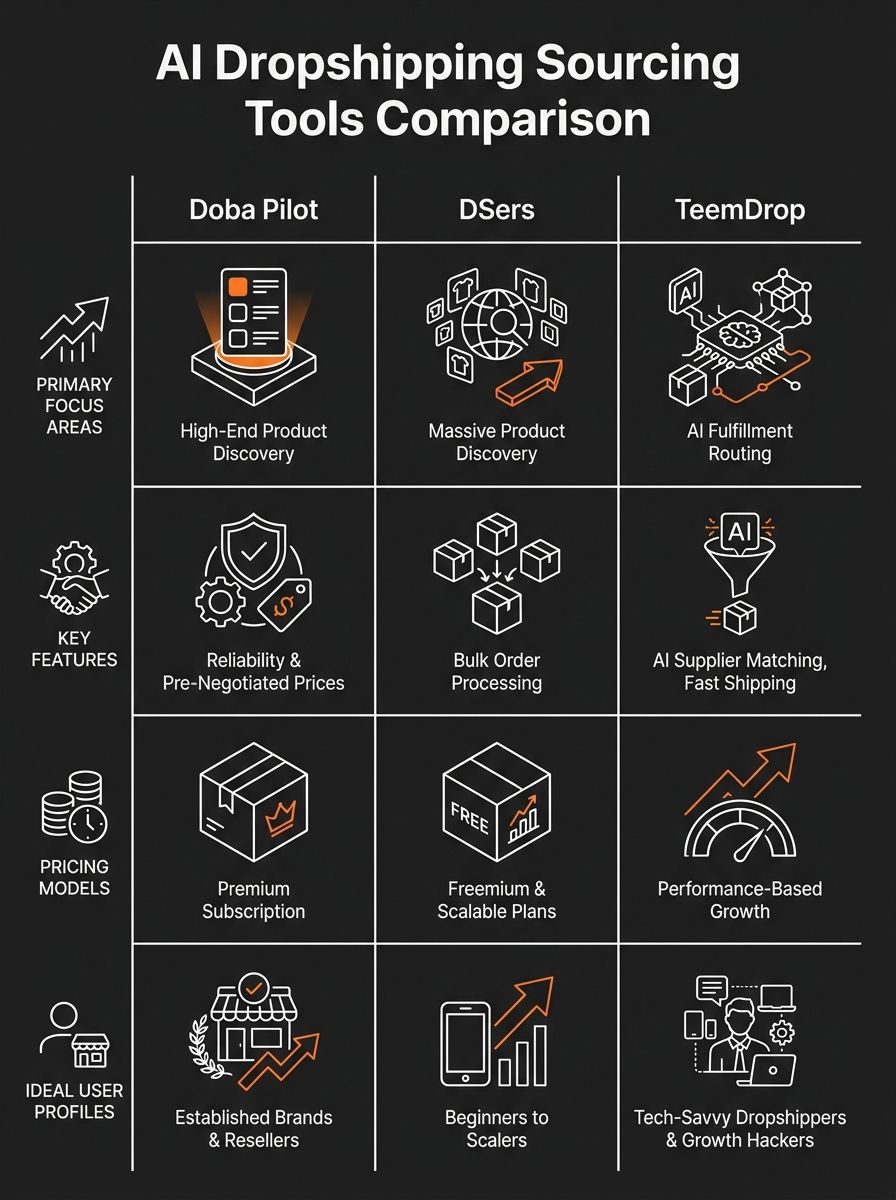
Doba announced a significant expansion to Doba Pilot on May 22, 2026, adding three capabilities that change how the tool competes. Market Scout pulls Amazon marketplace data and Google Trends into a single analysis layer. Smart Product Sourcing lets you filter across 1 million+ SKUs using pricing goals, inventory availability, and market signals simultaneously. And a Full-Scenario Knowledge Q&A system answers platform-specific questions in real time, so you're not Googling "how does Doba handle backorders" at 11 PM.
Mandy Ji, CEO of Doba, described the upgrade as positioning Doba Pilot as a "workflow-oriented AI assistant" that provides structured support from product discovery through store execution. The tool uses natural language commands, meaning you type something like "find kitchen gadgets under $8 with US-based suppliers and at least 40% margin potential" and Doba Pilot returns filtered results.
Here's what makes the Doba Pilot automation approach distinct: it tries to own the entire funnel. Shopify store setup, product syncing, pricing configuration, listing optimization, and inventory management all happen inside the same conversational interface. If you've read our breakdown of AI store builders vs. manual Shopify setup, you'll recognize this as the maximalist version of that trend.
The tradeoff: Doba Pilot locks you into Doba's supplier catalog. That catalog skews heavily toward US-based suppliers, which is great for 3-5 day domestic shipping but limits you on price competitiveness compared to direct China sourcing. If your margin math requires sub-$3 COGS on lightweight items, Doba's supplier pool may not get you there. And because the AI handles so much of the workflow, you're building significant platform dependency. If Doba changes pricing, adjusts catalog access, or sunsets features, your entire sourcing infrastructure moves with it.
Best fit: Beginners and intermediate sellers who want a single tool for product sourcing efficiency and don't want to manage 4-5 separate apps. Also strong for anyone whose primary bottleneck is the research-to-listing pipeline rather than post-order fulfillment.
DSers and the Supplier Optimizer Algorithm
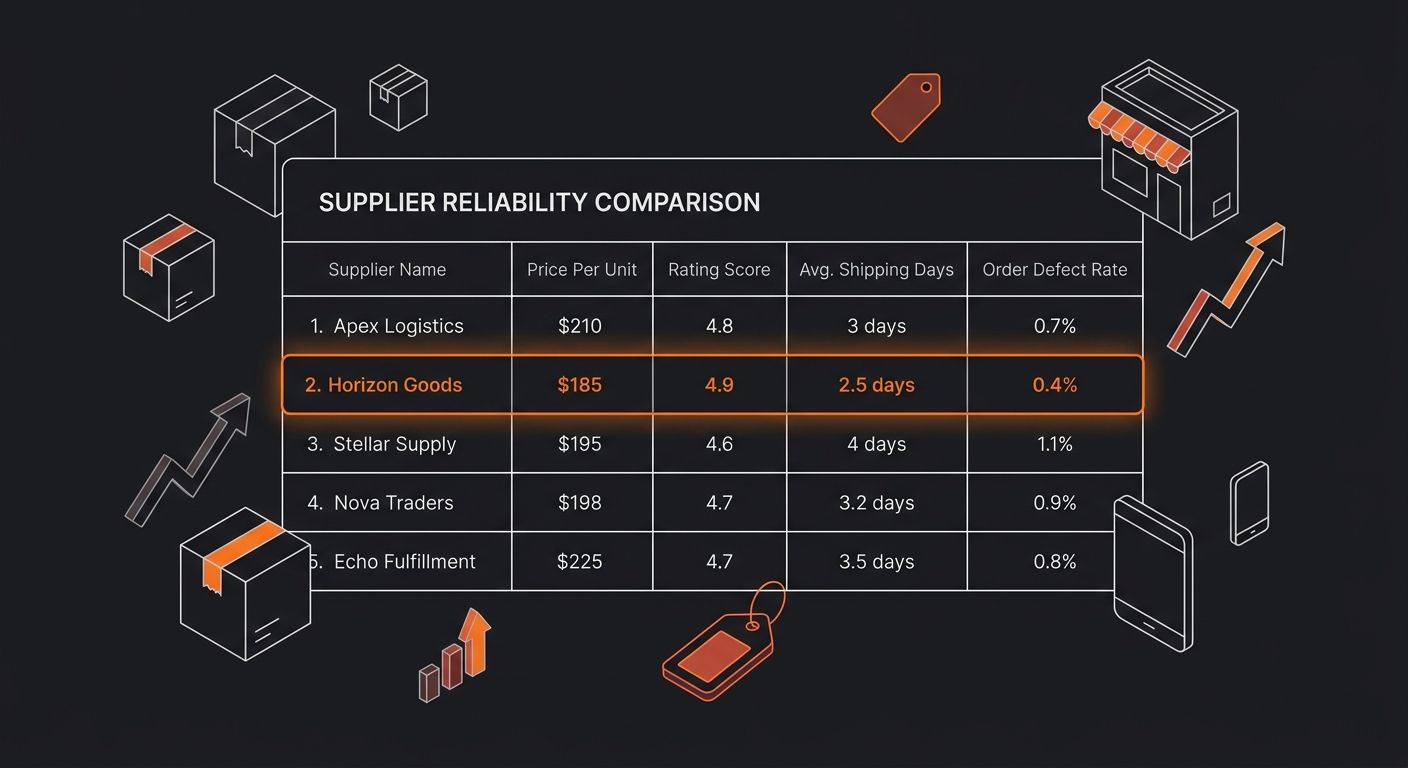
DSers approaches supplier vetting from the opposite direction. Instead of conversational AI, it runs algorithmic reliability analysis on suppliers for products you've already identified. The Supplier Optimizer feature scans for the exact same product across multiple vendors, then ranks alternatives by ratings, price, and historical performance data.
This is a fundamentally different bet. Where Doba Pilot says "let AI find products for you," DSers says "you found the product, now let AI find the best vendor for it." According to coverage of DSers' automation features, the algorithm analyzes supplier reliability scores and surfaces cheaper sources that carry identical SKUs. For a store doing $15K-$30K/month across 50-100 active products, this kind of supplier vetting workflow can compress a 2-hour weekly vendor audit into about 15 minutes.
The Supplier Optimizer works well alongside AliExpress and is tightly integrated with Shopify's order management. If you're already using DSers for bulk order processing, the optimizer is an incremental feature rather than a new tool to onboard. The learning curve is shallow because the AI operates behind the scenes; you get a ranked list and make the call.
The tradeoff: DSers doesn't do product discovery. You still need a separate tool or manual process for identifying what to sell. The AI doesn't evaluate market demand, trend data, or competitive saturation. It also relies heavily on AliExpress supplier data, which means you're mostly working within that ecosystem. If you're building a backup supplier network across multiple sourcing platforms, DSers' optimizer only covers one slice of your vendor landscape.
Additionally, the reliability scoring is backward-looking. It uses historical data on supplier delays and ratings, which Spendflo's procurement ML research confirms is standard for predictive vendor models. But backward-looking models miss sudden supplier quality drops. A factory that scored 98% reliability for 18 months can crater after a management change or raw material shortage, and the algorithm won't flag the risk until after multiple late shipments have already hit your customers.
Best fit: Operators running 50+ SKUs who already know their niche and need to optimize vendor costs and reliability across existing product lines. Particularly valuable if your primary sourcing channel is AliExpress and your pain point is paying too much per unit.
TeemDrop's Fulfillment-First Bet
TeemDrop reframes the supplier vetting question entirely. Its AI doesn't focus on finding products or ranking vendors by price. Instead, it optimizes around delivery performance: routing orders through supplier networks to hit specific shipping speed and damage-rate targets.
The numbers backing this approach are specific: TeemDrop claims 98.5% on-time delivery and 99.2% damage-free rates across its fulfillment network. Those figures matter because, for stores where shipping complaints drive 30-40% of refund requests, improving fulfillment reliability directly protects your net margin. TeemDrop integrates with Shopify, WooCommerce, and Etsy through one-click setup, and the AI optimizes shipping routes dynamically rather than assigning static supplier preferences.
Where Doba Pilot talks to you and DSers scores vendors for you, TeemDrop makes routing decisions for you. The AI picks which supplier ships each order based on real-time variables like geographic proximity to the customer, current inventory levels, and carrier performance data.
The tradeoff: You're giving up granular control over which specific supplier fulfills each order. If you care about product sourcing from a specific factory because of quality consistency or brand relationship, TeemDrop's routing AI may override that preference in favor of speed. The platform also doesn't offer the market research or trend analysis features that Doba Pilot provides, so it fills a narrower role in your overall stack.
Pricing transparency is another consideration. TeemDrop's fulfillment fees are baked into the routing optimization, which makes it harder to do clean unit-cost math compared to DSers, where you see the raw supplier price and can calculate your own margin. If you're building accurate unit cost models that account for tariffs, shipping, and platform fees, TeemDrop adds a layer of abstraction that can obscure your true COGS.
Best fit: Sellers prioritizing delivery speed and customer experience over absolute lowest product cost. Strong for US-domestic operations where 2-5 day shipping is a competitive requirement, and for stores where returns and refund rates are the primary margin leak.
How They Stack Up
Feature | Doba Pilot | DSers Supplier Optimizer | TeemDrop |
|---|---|---|---|
Primary AI function | Conversational product discovery + store management | Supplier reliability scoring + cost optimization | Fulfillment routing + delivery optimization |
Product catalog size | 1 million+ SKUs | AliExpress full catalog | Curated fulfillment network |
Supplier geography | US-heavy | Global (AliExpress-centric) | US + international |
Store integrations | Shopify (primary) | Shopify, WooCommerce | Shopify, WooCommerce, Etsy |
Market research built in | Yes (Market Scout, Google Trends, Amazon data) | No | No |
Natural language interface | Yes | No | No |
On-time delivery claim | Not published | Varies by supplier | 98.5% |
Best for monthly revenue | $0-$15K (ramp-up phase) | $10K-$50K (optimization phase) | $10K-$40K (fulfillment-sensitive) |
Biggest weakness | Platform lock-in | No product discovery | Opaque unit cost structure |
Who Should Pick Which
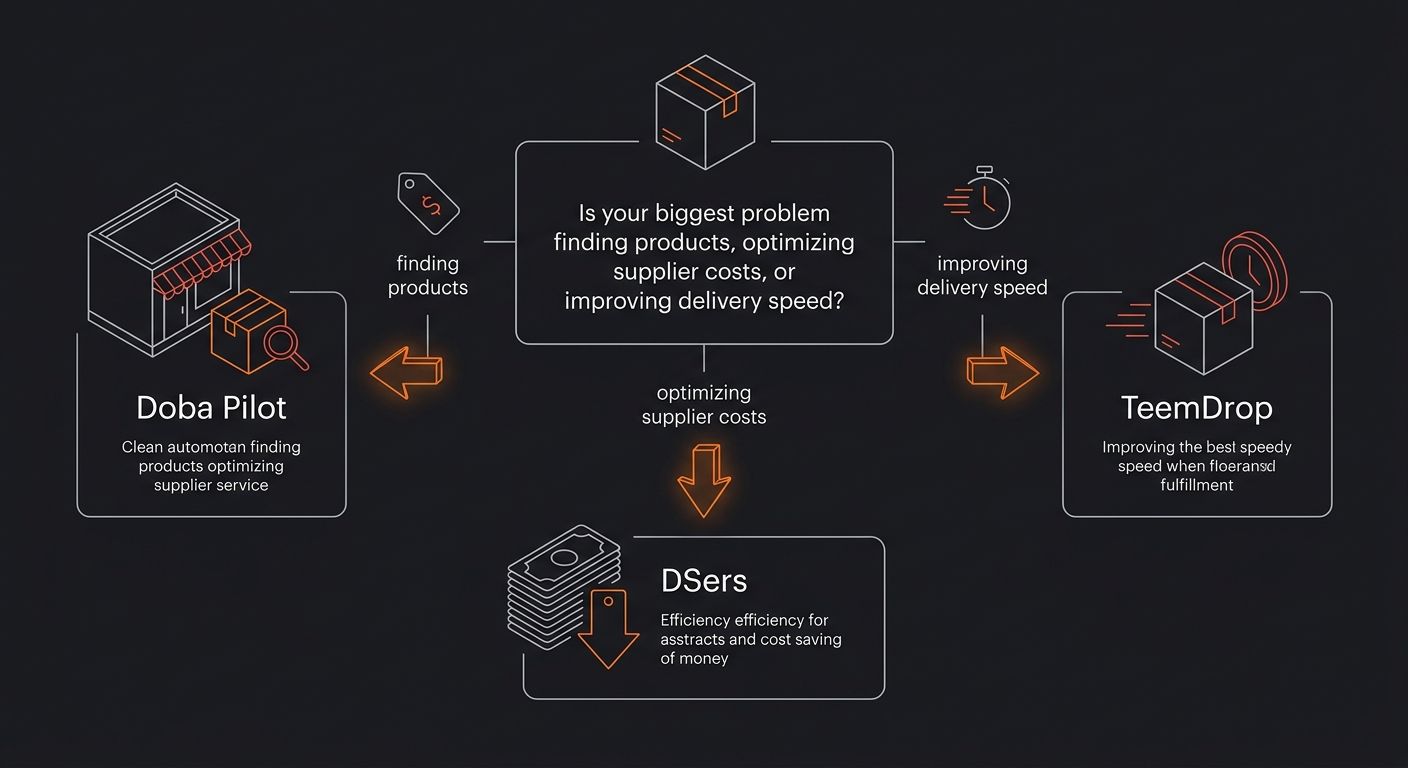
The honest answer depends on where your operation bleeds time and money right now.
If you're spending 10+ hours a week on product research and you haven't yet built a catalog of 30+ validated products, Doba Pilot's conversational AI and integrated Market Scout give you the highest return on time invested. The May 22 upgrade specifically targets the research-to-listing pipeline, and for stores in the $0-$15K monthly revenue range, that pipeline is usually the constraint.
If you've already found your products and your margin is getting squeezed by supplier costs, DSers' Supplier Optimizer does the specific thing you need: it finds the same SKU from a cheaper, equally reliable vendor. At $20K+/month with 50+ active products, even a $1.50 reduction in average COGS adds $900/month to your bottom line on 600 orders.
If your customer reviews consistently mention slow shipping or damaged items, TeemDrop's fulfillment-routing AI addresses the problem that's actually costing you money. A 98.5% on-time rate, if it holds at scale for your product categories, eliminates the operational drag that turns a 35% gross margin into a 22% net margin after refunds and replacement shipments.
And none of these tools eliminate the need for human judgment on supplier quality. ML models trained on historical data predict future delivery risks well, but they can't evaluate whether a supplier's product photos match the actual item in hand. That part still requires ordering samples, inspecting them, and running the kind of structured review protocol that builds real customer trust. AI speeds up the vetting funnel. It doesn't replace the final check.
365 Dropship Editorial
Editorial team writing about E-commerce, dropshipping, and product discovery — reviews of dropshipping suppliers and platforms, trending niche guides (jewelry, beauty, pets, home, fashion), supplier due diligence, ecom operations, shipping & fulfillment strategy, product research, AOV optimization, and profitable dropshipping case studies.
Related Articles
dropshipping io Review: Features & Pricing
Dropship.io, AutoDS, and SaleHoo attack the same problem from three different angles: finding products worth selling on Shopify. Dropship.io bets on competitor intelligence and sales tracking at $39–$99/month. AutoDS wraps product research inside full-store automation.
Spocket vs. AutoDS in 2026: Which Dropshipping Automation Platform Actually Delivers Margin at Scale
AutoDS outperforms Spocket for margin at scale when stores cross the 200-weekly-order threshold, driven by end-to-end fulfillment automation, access to 500M+ products across 25+ global suppliers, and AI-powered repricing that Spocket's curated US/EU catalog can't match at volume.
Best AliExpress Dropshipping Suppliers 2024
Three sourcing paths dominate the AliExpress dropshipping supplier landscape: manual vetting directly on the platform, automation tools like DSers and AutoDS layered on top of AliExpress, and hybrid fulfillment services such as CJDropshipping, Spocket, and Zendrop that pull from AliExpress catalogs
Explore more topics