The Supplier Tracking Sync Failure Matrix: Debugging When Orders Disappear Between Shopify and Fulfillment
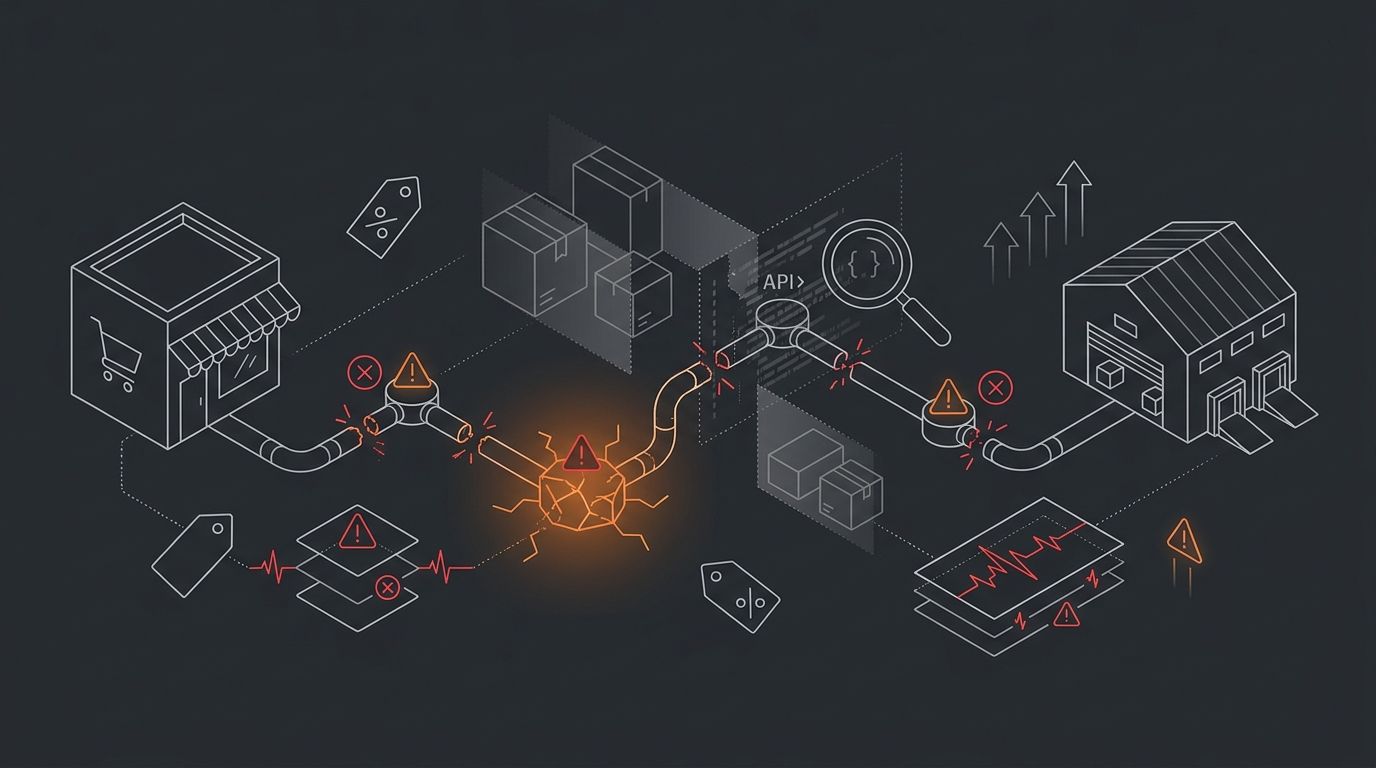
Shopify-supplier integration failures fall into three distinct zones: API callback misconfigurations, middleware polling gaps, and fulfillment-side acknowledgment drops.
The Supplier Tracking Sync Failure Matrix: Debugging When Orders Disappear Between Shopify and Fulfillment
Shopify-supplier integration failures fall into three distinct zones: API callback misconfigurations, middleware polling gaps, and fulfillment-side acknowledgment drops. Each zone requires a different debugging approach, and picking the wrong one wastes days while customers file chargebacks on orders stuck in limbo.
Where Orders Vanish in the Shopify-to-Fulfillment Pipeline
A July 2025 Bridgital report found that 34% of eCommerce businesses struggle with managing inventory and orders across multiple sales channels, with sync lag as the primary driver of fulfillment delays. That 34% maps directly to three breakage points dropshippers hit when orders go missing.
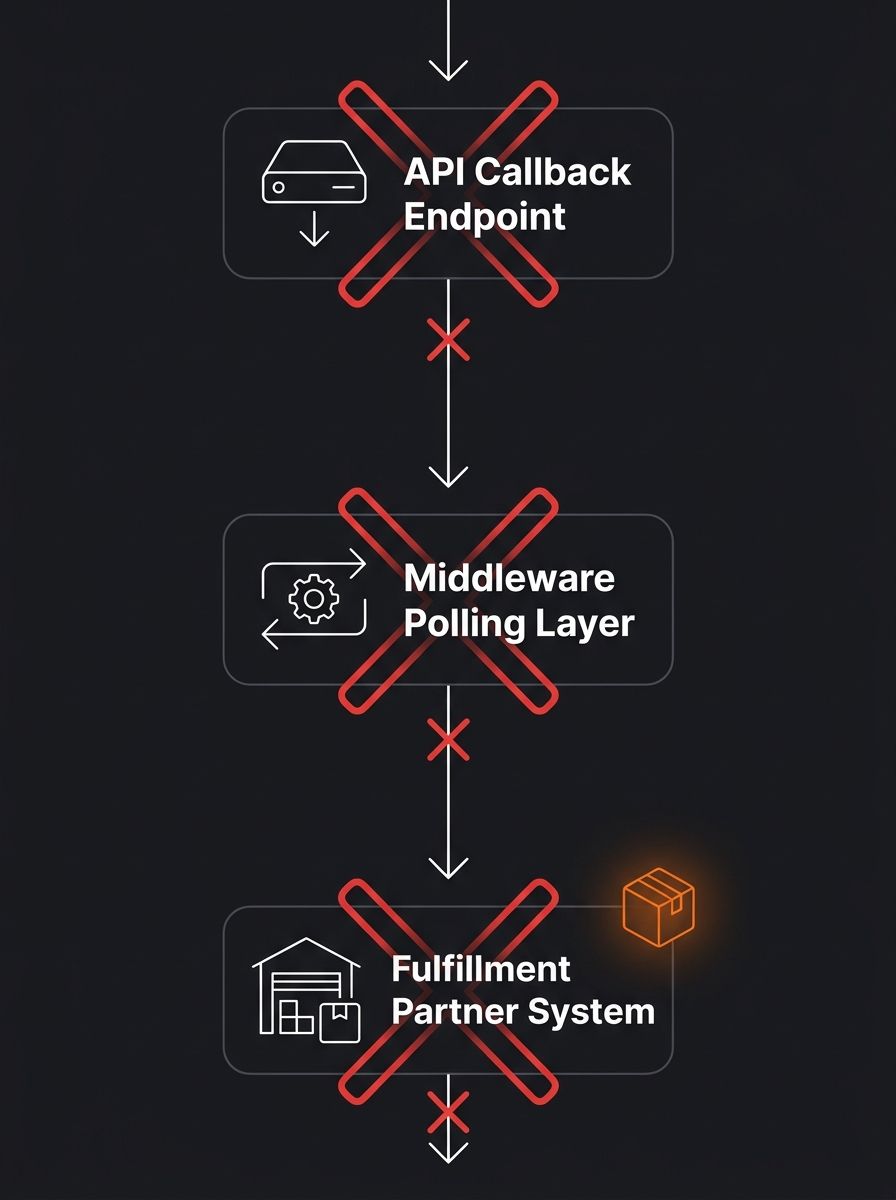
The first failure zone is the handoff between Shopify and your fulfillment service's callback endpoint. Shopify sends POST requests to your fulfillment service's callback_url/fulfillment_order_notification endpoint to notify it about new fulfillment requests. If that endpoint returns anything other than a 200 response, the order enters a retry queue and can silently expire. The second zone is the middleware layer (DSers, AutoDS, Spark Shipping) where polling intervals create windows of invisibility. The third is the fulfillment partner's own system, where tracking number generation and writeback to Shopify can fail without triggering any alert on your end.
Understanding which zone your orders are dying in determines whether you need to audit API logs, reconfigure a sync app, or invest in a visibility platform.
Manual Log Auditing Through Shopify's API Endpoints
This approach works best when you're running fewer than 200 orders per month and your fulfillment integration is direct, with no middleware app in between. The debugging loop is straightforward: you query Shopify's FulfillmentOrder API for each "missing" order and check its status field against what your supplier reports.
Start by pulling the fulfillment order status. A status of "closed" with no tracking number typically means one of three things: the destination location has never stocked the requested inventory item, the API client doesn't have correct permissions, or the fulfillment request was silently rejected. Shopify's FulfillmentOrder documentation confirms these as the primary close-without-fulfillment scenarios.
Tracking number delays are the most common symptom in this zone. Shopify's REST API allows only one tracking number and one tracking URL per fulfillment object. If your supplier ships multi-parcel orders, the second and third tracking numbers have nowhere to go unless you switch to the GraphQL fulfillmentTrackingInfoUpdate mutation, which supports multiple tracking entries. And here's a detail that trips up even experienced operators: XPO's carrier documentation states that "Unable to Track" statuses "often occur if the PRO number was recently generated", recommending a 2-3 hour wait "for the system to sync with the driver's handheld device." That same delay propagates to Shopify when suppliers push tracking numbers before the carrier's system has registered them.
The cost of this approach is time. You're manually cross-referencing order IDs, checking API response logs, and contacting suppliers when statuses don't match. For stores processing 50-150 orders monthly, the labor runs about 3-5 hours per week. If you've already built some of this operational muscle, you'll recognize the debugging patterns from building automated supplier sync systems that hold up under volume. Above 200 orders, the manual method breaks down and error rates climb fast.
Middleware Sync Apps with Automated Retry Logic
The middleware layer (DSers, AutoDS, Spark Shipping, Duoplane) sits between Shopify and your supplier, handling order routing and tracking number writeback. When orders disappear at this layer, the root cause is almost always one of four things: polling interval gaps, API rate limit collisions, app permission conflicts, or SKU mapping mismatches.
Polling interval gaps deserve special attention. Supply chain consultants documented a case where a brand called GreenSprout, operating three warehouses, used a sync app with a 45-minute polling interval. During flash sales, that 45-minute window allowed dozens of orders to be oversold before inventory counts caught up. The fix was switching to webhook-driven sync (where Shopify pushes updates in real time) rather than relying on the app to pull data on a schedule.
API connectivity troubleshooting at this layer requires checking three specific things. First, verify the app's OAuth scopes include write_fulfillments and read_fulfillment_orders. Second, confirm no other installed app is competing for the same fulfillment assignment, since Shopify assigns fulfillment orders to one service at a time. Third, check that your supplier's SKU codes match exactly across both systems. Brahmin Solutions, a Shopify consultancy, advises that merchants seeing 5% or more regular inventory discrepancies have outgrown Shopify's native capabilities and need dedicated middleware or ERP integration.
As DSers documents in their tracking sync guide, automated tracking number sync enables dropshippers to proactively contact carriers about delays rather than discovering problems after customer complaints arrive. That shift from reactive to proactive is where middleware earns its keep.
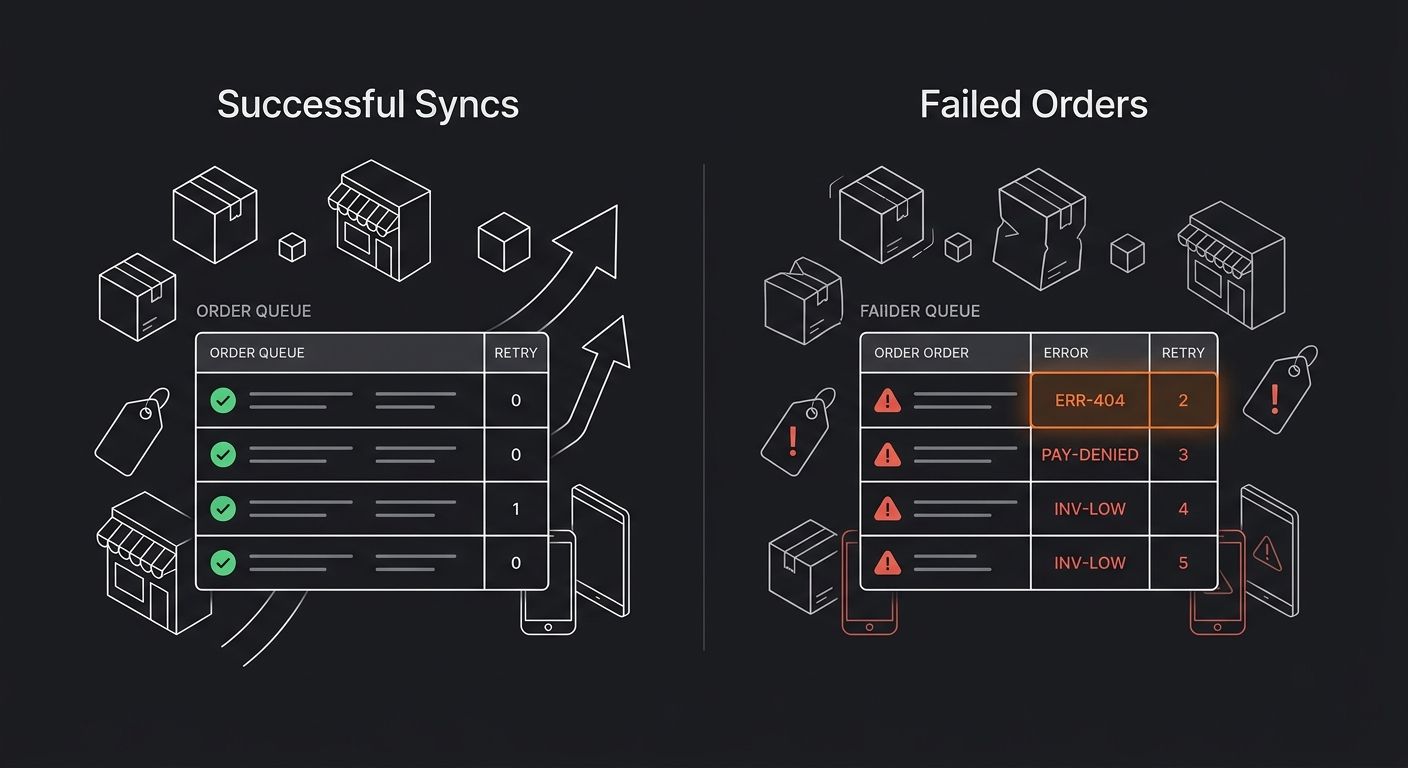
The cost here is the app subscription ($29-$299/month depending on tier and provider) plus 1-3 days of configuration time. But the payoff is real: each lost order typically costs $25-50 in refunds, reshipping, and customer service time. For stores processing 200-2,000 orders monthly, even a 2% failure rate means 10+ orders disappearing monthly, burning $250+ in direct losses before you factor in the customer lifetime value damage.
Centralized Visibility Platforms for Multi-Channel Scale
When your store exceeds roughly 2,000 orders per month across multiple sales channels, individual sync apps start creating their own visibility problems. Each app generates its own logs, its own error codes, its own notification system. Order visibility breakage at this scale usually means you have four or five disconnected dashboards and no single view of where a given order actually sits.
Platforms like project44 and CSCS solve this by creating what CSCS calls "a unified visibility layer across your entire e-commerce ecosystem," connecting directly to marketplaces, carriers, and fulfillment systems in a single dashboard. Project44 connects to carriers, forwarders, and facilities across all shipping modes, specifically targeting the visibility gaps that simple tracking and single-mode solutions leave open. Osa Commerce reports their consolidated platform speeds up fulfillment processes by at least 4x compared to fragmented tracking, per their platform documentation.
The tradeoff is cost and complexity. These platforms are built for operations doing $500K+ in monthly GMV, and pricing typically starts at $1,000-$3,000 per month. Integration takes 2-6 weeks, requires dedicated technical resources, and may force you to restructure how your inventory data flows. You'll need to designate a single system of record for inventory (usually an ERP like NetSuite or the visibility platform itself) and configure every other system to sync from that source.
For dropshippers who have scaled into multi-supplier operations with complex margin structures, the visibility platform approach eliminates an entire category of operational firefighting. But for stores under $100K monthly GMV, the ROI math rarely works. The platform costs eat 1-3% of revenue, and the debugging problems they solve can usually be handled by properly configured middleware.
Side-by-Side Comparison
Attribute | Manual API Auditing | Middleware Sync Apps | Centralized Visibility Platforms |
|---|---|---|---|
Best for order volume | Under 200/month | 200-2,000/month | 2,000+/month |
Monthly cost | $0 (your time: 3-5 hrs/wk) | $29-$299/month | $1,000-$3,000+/month |
Setup time | Immediate | 1-3 days | 2-6 weeks |
Tracking number handling | Manual cross-reference | Auto-sync with retry | Real-time multi-carrier |
Failure detection speed | Hours to days | Minutes to hours | Near real-time |
Multi-channel support | No | Limited | Full |
Technical skill required | API familiarity | App configuration | ERP/integration expertise |
These cost thresholds shift upward if you're dealing with cross-border tariffs and import duties on top of sync failures, since each misrouted international order compounds the financial damage with carrier correction fees, customs holds, and return shipping costs.
How To Choose Between These Three
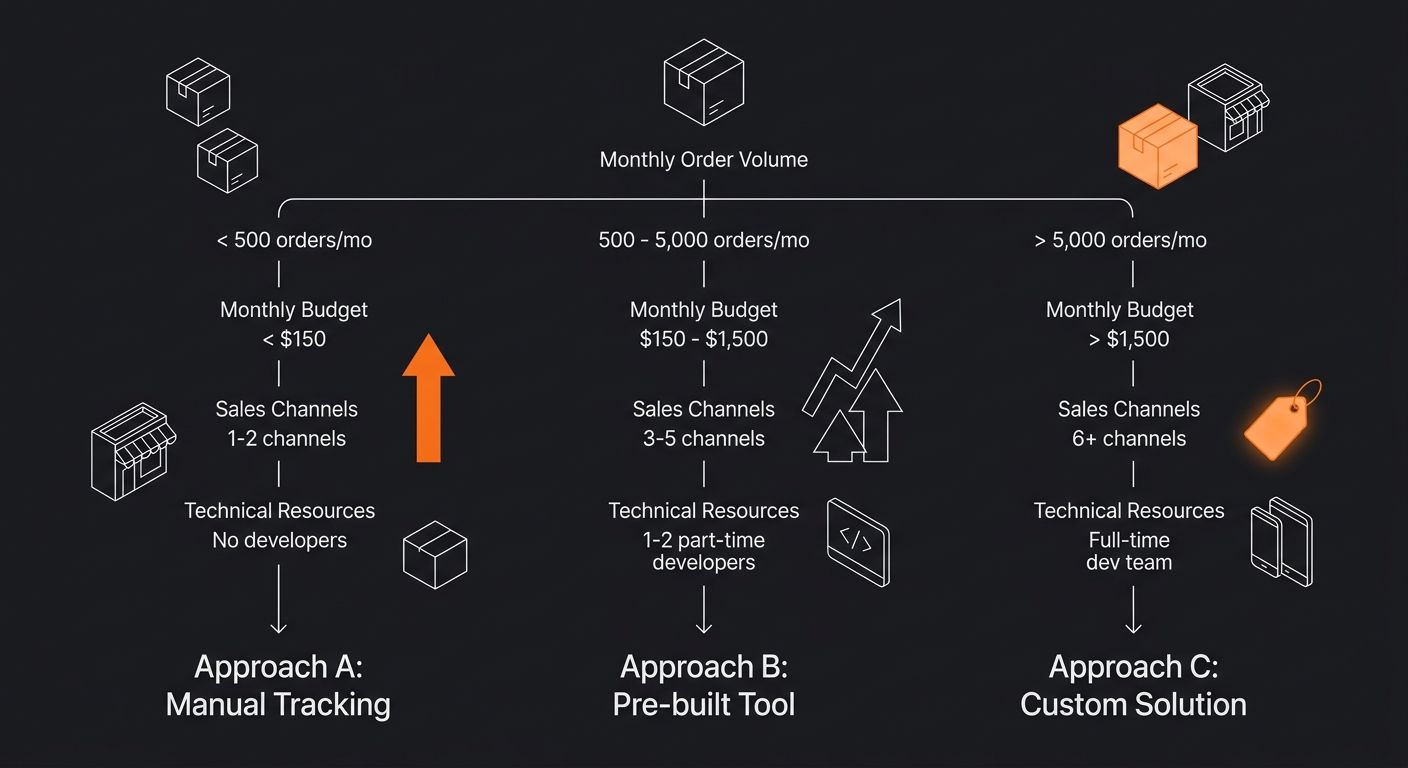
The decision tree is simpler than it looks. Count your monthly orders and multiply by the percentage that currently fail to sync. If you're at 150 orders with a 3% failure rate (roughly 4-5 broken orders per month), manual auditing costs you 3-5 hours weekly but saves you $200-300/month in middleware fees. The math favors manual work at that scale.
At 500+ orders per month, even a 2% failure rate means 10+ orders disappearing monthly. At an average recovery cost of $25.50 per failed order in carrier correction fees alone (before refund and CS costs), you're burning $255/month in direct losses. A $49/month middleware app with automated retry logic pays for itself five times over, and the operational lessons from stores that scaled past this inflection point consistently point to middleware as the highest-ROI investment in the 200-2,000 order range.
The jump to a centralized visibility platform should happen when you're running three or more sales channels (Shopify plus Amazon plus Walmart, for example) and spending more than 15 hours per week on order status reconciliation across systems. At that point, the labor savings alone justify the $1,000+ monthly platform cost, and the reduction in order visibility breakage typically cuts customer service tickets by 20-35%.
One pattern worth watching: stores that skip the middleware stage and jump straight from manual debugging to a visibility platform almost always regret it. The platform exposes problems you haven't built the operational discipline to fix, and you end up paying enterprise pricing for capabilities a $99/month sync app handles perfectly well. Scale your supplier sync debugging infrastructure the same way you scale your store. Match each tool to the actual failure volume you're experiencing, fix the specific breakage zone that's costing you money this month, and upgrade only when the math on the next tier makes sense.
365 Dropship Editorial
Editorial team writing about E-commerce, dropshipping, and product discovery — reviews of dropshipping suppliers and platforms, trending niche guides (jewelry, beauty, pets, home, fashion), supplier due diligence, ecom operations, shipping & fulfillment strategy, product research, AOV optimization, and profitable dropshipping case studies.
Frequently Asked Questions
- Why are my Shopify orders disappearing before reaching my supplier?
- Orders vanish in three specific zones: API callback misconfigurations where Shopify sends POST requests that fail to return a 200 response, middleware polling gaps that create windows where orders go unsynced, and fulfillment partner systems where tracking number generation fails without triggering alerts on your end.
- How do I fix missing tracking numbers in Shopify?
- Shopify's REST API supports only one tracking number per fulfillment object, so multi-parcel orders need the GraphQL fulfillmentTrackingInfoUpdate mutation to add multiple tracking entries. Additionally, carrier systems like XPO often show 'Unable to Track' status for 2-3 hours after the tracking number is generated while the system syncs with driver devices.
- What order volume should I use manual API auditing versus a sync app?
- Use manual API auditing for fewer than 200 orders per month, which costs 3-5 hours weekly but saves middleware fees. Switch to a middleware sync app at 200-2,000 orders monthly, where even a 2% failure rate costs $250+ monthly in refunds and reshipping compared to a $29-$299 app subscription.
- What causes orders to disappear in middleware sync apps?
- Root causes include polling interval gaps that create inventory overselling windows, API rate limit collisions during traffic spikes, app permission conflicts, and SKU mapping mismatches between Shopify and your supplier. Switching from polling intervals to webhook-driven sync eliminates the timing gaps.
- When should I invest in a centralized visibility platform?
- Invest in a centralized visibility platform when processing 2,000+ orders monthly across three or more sales channels and spending over 15 hours per week on order reconciliation. These platforms cost $1,000-$3,000+ monthly but reduce customer service tickets by 20-35% and require 2-6 weeks to integrate.
- What OAuth scopes do I need for Shopify fulfillment sync apps?
- Middleware apps must have write_fulfillments and read_fulfillment_orders OAuth scopes to sync properly. Additionally, verify that no other installed app is competing for fulfillment assignment, since Shopify assigns fulfillment orders to only one service at a time.
- How much does a failed order cost in direct losses?
- Each failed order typically costs $25-50 in refunds, reshipping, and customer service time. At 500+ orders monthly with a 2% failure rate, this equals $255+ in monthly losses from carrier corrections alone, before accounting for refund and support costs.
- Why do dropshippers fail at multi-channel order sync?
- Multi-channel operations create visibility breakage because each sales channel and sync app generates its own logs, error codes, and notifications, resulting in four or five disconnected dashboards with no single view of order status across the entire ecosystem.
Related Articles
From Order to Tracking: Building Automated Supplier Sync Systems That Actually Work
Spark Shipping's documentation lists six distinct protocols for routing purchase orders to suppliers: email, EDI, FTP, CSV, XML, and direct API. Duoplane, built for mid-market and enterprise operations, supports a nearly identical set — EDI, email, API, and vendor portal.
Why Your Supplier Is Handling More Than You Think: The Hidden Data Flow Between Order and Fulfillment
Between your customer's checkout click and the tracking email that arrives hours later, six to twelve discrete data transfers fire across your store, middleware, supplier systems, and shipping carriers.
Inventory Sync Errors Are Killing Your Conversion Rate: How to Diagnose and Fix Oversell Events Before They Compound
Shopify's Admin API version 2026-04 now requires idempotency keys for every inventory mutation call.
Explore more topics