Why Marketing Failures Masquerade as Supplier Problems: How to Audit Your Ad Spend Before Blaming Your Dropshipping Partner
Break-even ROAS for a typical dropshipping campaign sits around 1.95x, meaning for every dollar you spend on Facebook or TikTok ads, you need $1.95 back in revenue just to cover product cost, shipping, and platform fees.
Why Marketing Failures Masquerade as Supplier Problems: How to Audit Your Ad Spend Before Blaming Your Dropshipping Partner
Break-even ROAS for a typical dropshipping campaign sits around 1.95x, meaning for every dollar you spend on Facebook or TikTok ads, you need $1.95 back in revenue just to cover product cost, shipping, and platform fees. Below that line, you're losing money regardless of how fast your supplier ships or how good the packaging looks.
This number matters because the supplier vs marketing problems distinction in dropshipping is almost always diagnosed backwards. When margins collapse, the default reaction is to fire off an angry email to CJ Dropshipping or Zendrop about shipping times. The ad account, which is often the actual source of the bleed, goes unexamined for weeks.
The Math That Exposes the Real Problem
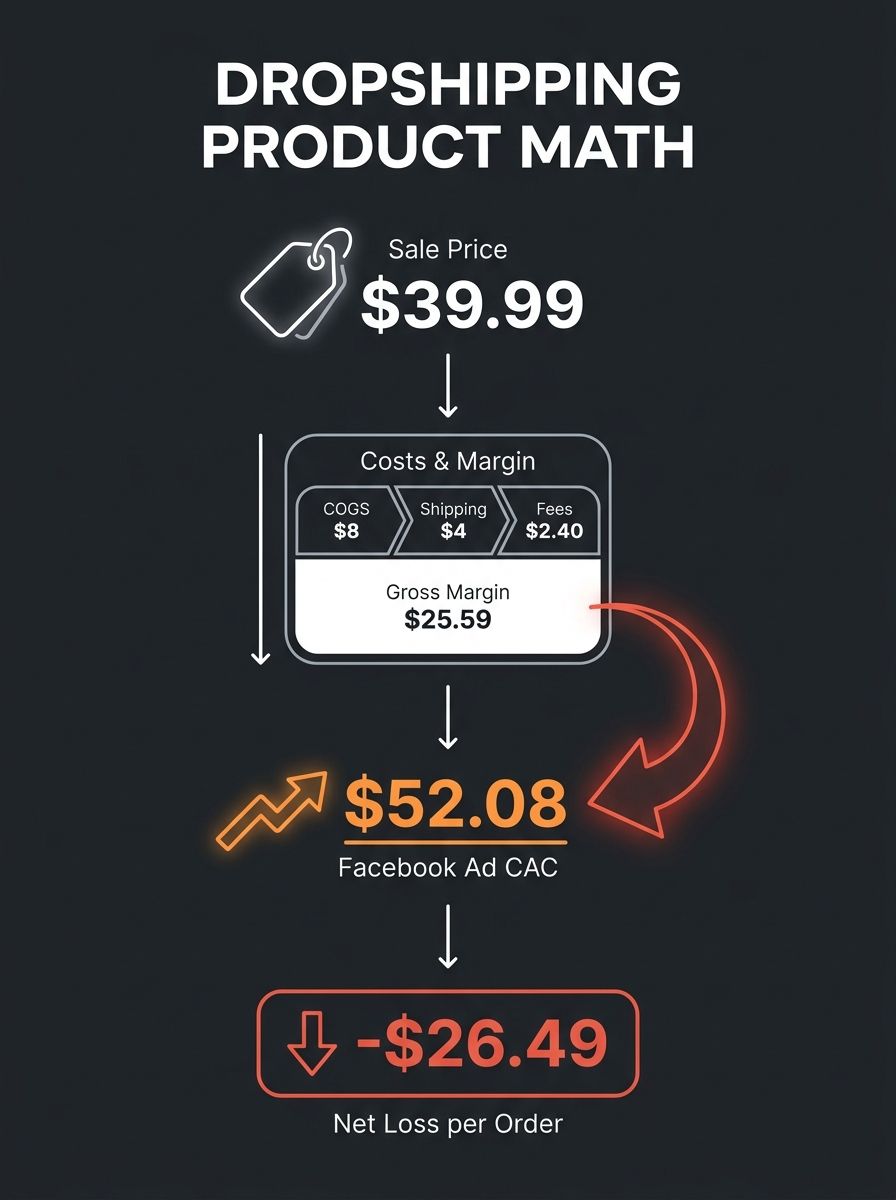
Here's how the misdiagnosis works in practice. Say you're selling a $39.99 product. Your COGS from your supplier is $8, shipping runs $4, and Shopify plus payment processing takes roughly $2.40 (assuming about 6% combined). Your gross margin before ads is $25.59, or about 64%.
Sounds healthy. But you're running Facebook ads at a $30 CPM to an in-market audience (which costs 10–25% more per impression than broad interest targeting), your click-through rate is 1.2%, and your landing page converts at 2.1%. Run those numbers: you're paying $2.50 per click, getting roughly 48 conversions per 1,000 clicks, and your customer acquisition cost lands at $52.08.
You just spent $52 to make $25.59 in gross margin. You lost $26.49 per order. And the supplier shipped the product in five days with zero complaints.
The supplier didn't cause this. A proper dropshipping ad spend analysis would have caught it before you scaled.
How to Run a Customer Acquisition Cost Audit
A proper customer acquisition cost audit takes about 30 minutes and requires three data sources: your ad platform dashboard (Meta, Google, or TikTok), your Shopify analytics, and a spreadsheet. The formula itself is simple — total ad spend divided by total new customers acquired. But most operators make two critical mistakes when applying it.
First, they blend organic and paid customers. If you spent $3,000 on Facebook ads and got 200 total orders, but 60 of those came from organic search or direct traffic, your real paid CAC is $3,000 ÷ 140 = $21.43, not $15. That difference can flip a profitable campaign into a losing one depending on your margin structure.
Second, they calculate CAC at the account level but ignore campaign-level splits. One campaign might run at $14 CAC while another burns through budget at $38. The blended number hides the underperformer. Shopify's guidance on CAC recommends tracking CLV-to-CAC ratios between 3:1 and 5:1 for a healthy acquisition strategy. If your ratio is below 3:1, you have a marketing efficiency problem that no supplier swap will fix.
According to financial modeling benchmarks, CAC for dropshipping businesses starts around $25 in 2026. If yours is significantly above that baseline and you haven't touched your creative or targeting in two weeks, the problem is almost certainly in the ad account, not the warehouse.
Facebook Ads ROI and the Three Metrics That Decide Everything
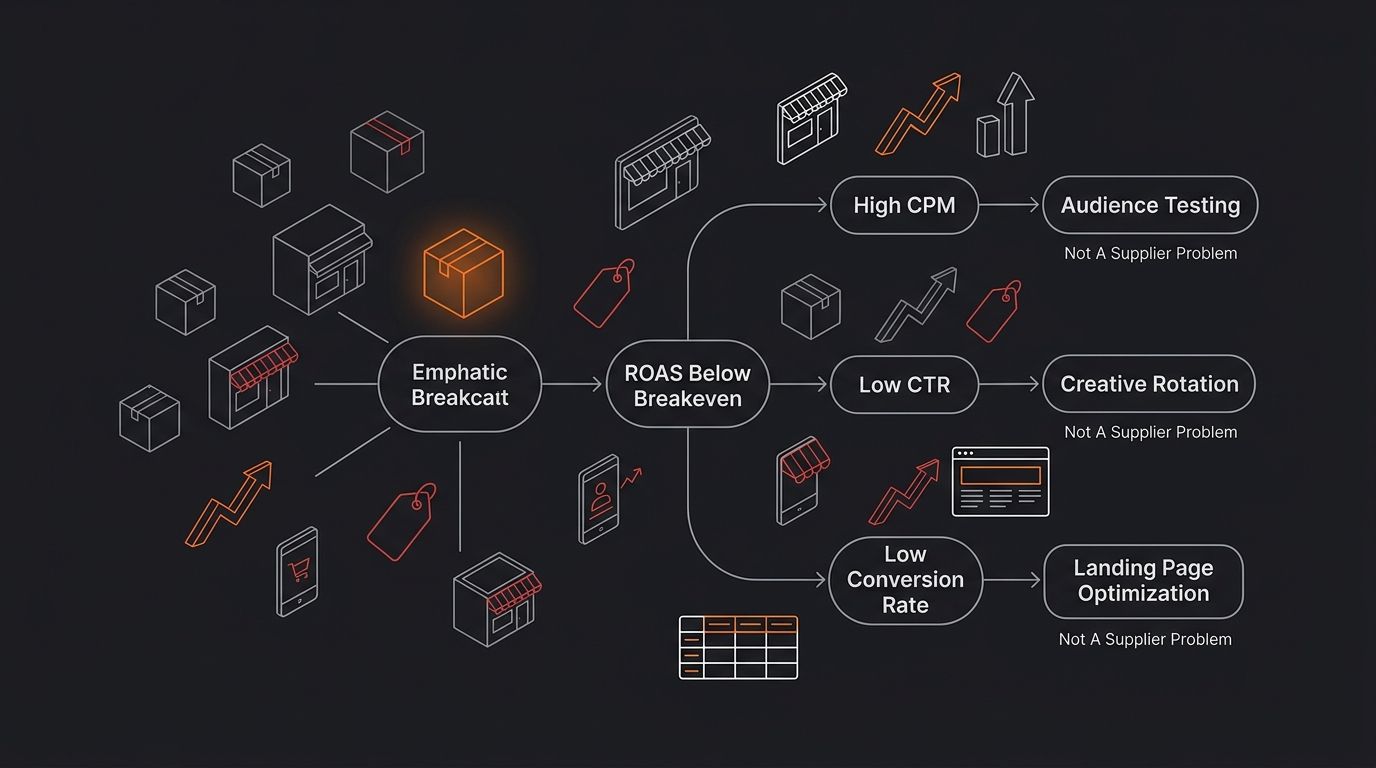
Facebook ads ROI in dropshipping hinges on three numbers that interact with each other: CPM (cost per thousand impressions), CTR (click-through rate), and on-site conversion rate. When operators complain about "low ROAS," the breakdown is almost always rooted in one of these three, and each one has a different fix.
High CPM, decent CTR, decent conversion rate: You're targeting an expensive audience. Parents of young children, for example, cost 15–25% more in CPM than general targeting segments. The fix is audience testing, not supplier changes.
Normal CPM, low CTR, decent conversion rate: Your ad creative isn't compelling enough to drive clicks. Rotate fresh creatives every one to two weeks to prevent fatigue.
Normal CPM, good CTR, low conversion rate: People are clicking but not buying. This points to your product page: pricing, trust signals, or descriptions. If you're still running generic manufacturer copy on your listings, that's where the money is leaking. This has nothing to do with your supplier's fulfillment speed.
The Facebook ads ROI dropshipping operators need depends entirely on their margin structure. A store with 60% gross margin before ads can survive at 2x ROAS. A store with 40% gross margin needs 3.3x ROAS or higher just to break even. You can calculate your own threshold using the break-even ROAS formula: 1 divided by your gross margin percentage. If that number is higher than what your campaigns are delivering, scaling up will only accelerate the losses.
Creative Fatigue Looks Exactly Like a Supplier Problem
Here's where the misdiagnosis gets sneaky. A Facebook campaign starts strong: 3.5x ROAS in week one, 2.8x in week two, then 1.6x by week three. Orders slow down. The few customers who do buy start leaving negative reviews because now you're attracting price-sensitive shoppers who expected more from a $39.99 product. Refund rate ticks up.
The operator sees declining sales and rising refunds and concludes the supplier is sending worse product or shipping slower. In reality, ad fatigue degraded the campaign to the point where you're only reaching the least-qualified segment of your audience. These buyers have lower purchase intent, higher expectations relative to price, and a greater likelihood of filing chargebacks.
The actual sequence goes: creative fatigue degrades traffic quality, which increases refund rate, which gets interpreted as a "supplier problem." But the root cause was marketing all along. If you're trying to isolate whether margins collapsed due to supplier issues or campaign decay, start by checking your frequency metric in Meta Ads Manager. A frequency above 3.0 means your audience has seen your ad multiple times, and performance decay becomes almost inevitable at that point.
The Ad Placement Tax
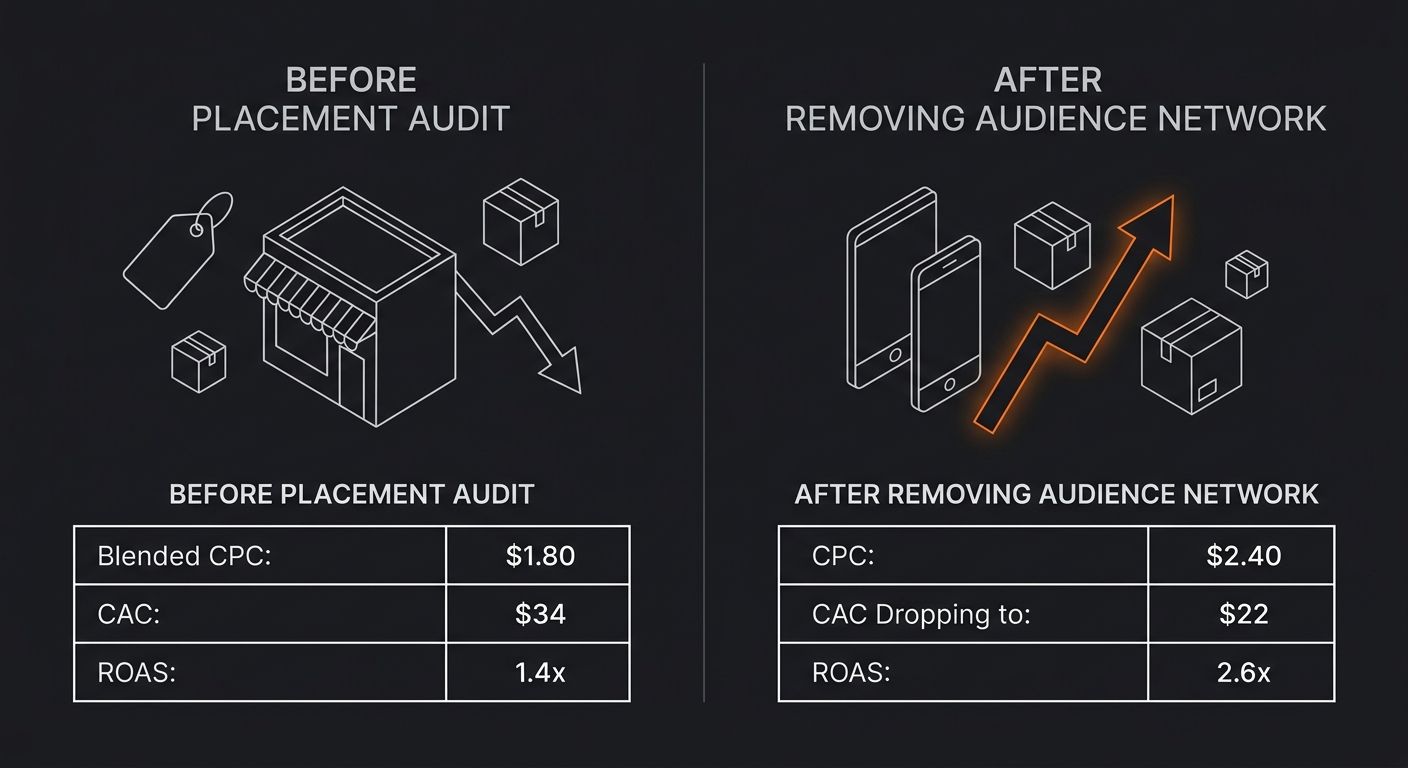
Automatic placements in Meta ads distribute your budget across Facebook feed, Instagram feed, Stories, Reels, Audience Network, and Messenger. The performance gap between placements can be enormous. Audience Network clicks, for instance, often convert at a fraction of the rate of Instagram feed clicks, but they're cheap, so Meta's algorithm spends there to hit your target cost.
This creates a scenario where your blended CPC looks acceptable, but the actual converting traffic costs significantly more than your average suggests. If you're not breaking out placement-level performance in your dropshipping ad spend analysis, you're flying blind.
Strip out underperforming placements manually. If Audience Network is eating 20% of your budget and contributing 3% of conversions, kill it. The overall CPC will rise, but cost per acquisition should drop. This one change can shift a campaign from underwater to profitable without touching a single thing about your supplier relationship.
When It Actually Is the Supplier
Not every problem is marketing. If you've confirmed your CAC is below your gross margin, your ROAS exceeds your break-even threshold, and your conversion rate is healthy, then supplier issues are genuinely worth investigating. The telltale signs are specific and measurable:
Average shipping time exceeded the promised window by more than 3 business days across 20+ orders
Product defect rate (measured by photo-verified returns) exceeds 5%
Tracking number upload delay averages more than 48 hours after order placement
Packaging consistently arrives damaged based on customer photo submissions
When you hit these thresholds, a structured post-sale audit makes sense. The key is having the ad-side data clean first so you can separate legitimate fulfillment failures from marketing-induced quality perception issues.
And if you're running the kind of contribution margin analysis that accounts for ad spend, refunds, and chargebacks per SKU, you'll see the split clearly. Products with healthy paid acquisition and high return rates have a supplier problem. Products with expensive acquisition and moderate return rates have a marketing problem dressed up in supplier clothing.
What Still Isn't Settled
The hardest diagnostic challenge remains the feedback loop between ad performance and supplier quality. When a supplier's shipping time creeps from 7 days to 14, it affects more than customer satisfaction. Negative feedback accumulates on your Facebook page, which degrades your relevance scores, which raises your CPM, which increases your CAC, which destroys your ROAS. At that point, the problem genuinely lives in both places, and no single audit resolves it cleanly.
The practical answer is to run the ad audit first because it's faster, cheaper, and within your direct control. Supplier negotiations take weeks. Campaign restructuring takes hours. If your break-even ROAS math doesn't work before factoring in shipping complaints, you have a marketing problem that would survive any supplier change. Fix the numbers in the ad account, then evaluate whether your fulfillment partner deserves the blame that's left over. Whatever you find, at least you'll know where the money actually went.
365 Dropship Editorial
Editorial team writing about E-commerce, dropshipping, and product discovery — reviews of dropshipping suppliers and platforms, trending niche guides (jewelry, beauty, pets, home, fashion), supplier due diligence, ecom operations, shipping & fulfillment strategy, product research, AOV optimization, and profitable dropshipping case studies.
Related Articles

The Supplier Audit Flowchart: Isolating Root Cause When Your Dropshipping Margins Collapse Mid-Campaign
When a Meta campaign producing $11 contribution margin per unit on day three drops to $3.40 by day fourteen, the instinct is to blame the ad creative or the audience. The ad account gets the autopsy. The supplier rarely does.
5 Supplier Communication Failures That Collapse Margins Mid-Campaign (And the SOP to Fix Each One)
Sixty percent of dropshipping stores that attempt to scale fail due to supply chain instability—inventory gaps, cost swings, quality drift—according to Spocket's analysis of DSers data.
The Post-Sale Audit Framework: How to Diagnose Which Dropshipping Mistakes Are Actually Costing You Margin
Theoretical margin on a $34.99 pet grooming kit sold through Shopify: 42%. Actual margin after pulling the last 100 fulfilled orders, tallying refund shipping labels, Facebook ad spend allocated per unit, and three chargebacks at $22 each: 19%.
Explore more topics