AI-Powered Dropshipping: Automate Your Store
Artificial intelligence dropshipping tools can save operators 8 to 20 hours per week on inventory sync, customer support, and pricing adjustments. But the operators who profit from AI follow specific rules about where automation belongs and where it destroys value.
AI-Powered Dropshipping: 6 Rules to Automate Your Store Without Killing Your Margins
Artificial intelligence dropshipping tools can save operators 8 to 20 hours per week on inventory sync, customer support, and pricing adjustments. But the operators who profit from AI follow specific rules about where automation belongs and where it destroys value.
The current artificial intelligence dropshipping toolset includes products like Tidio, Jasper, Spocket, and AI Dropship, each covering different operational layers. According to Shopify's 2026 AI dropshipping guide, AI Dropship handles automated inventory management and connects sellers with verified US and EU suppliers. Sixty-seven percent of US entrepreneurs now report that AI tools make starting a business more accessible, and 71% of AI-attributed orders on Shopify come from long-tail niche categories.
Those numbers sound exciting. They're also incomplete without guardrails. The tools work, but only if you set firm boundaries around what the algorithm controls and what you control. Here are 6 rules for using AI in your dropshipping operation without handing your margin math to a machine that doesn't understand your unit economics.
Automate inventory sync before anything else
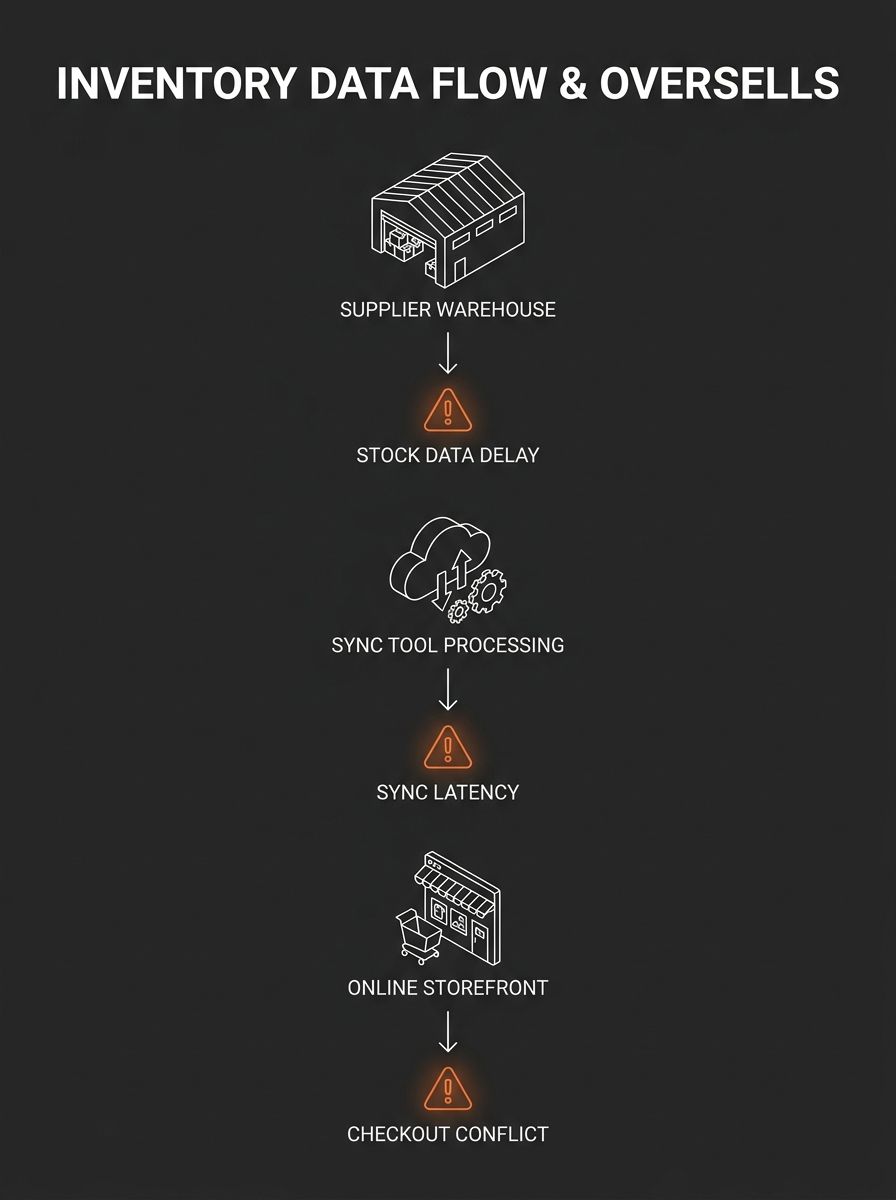
The single highest-ROI automation for any dropshipping store is real-time inventory synchronization between your supplier's warehouse and your storefront. Everything else is secondary. An IEEE study on machine learning in e-commerce inventory management confirmed that ML methods make demand forecasting and inventory optimization "more accurate and efficient" for online retail. Shopify defines dropshipping inventory management as "the process of tracking, syncing, and optimizing product availability" across supplier systems and your storefront's stock levels.
When this rule applies: every store, immediately. If you're running even 15 SKUs across two suppliers, manual stock checks will fail during a traffic spike. Oversell events tank your refund rate and your ad account trust score simultaneously. We've covered how inventory sync errors compound into conversion killers, and the math is brutal. A single oversell event costs you the refund amount, replacement shipping, the customer's lifetime value, and a negative review that suppresses future conversion rates.
When this rule breaks: if you're testing one product from one supplier and manually checking stock twice daily. At that scale, a $29/month sync tool eats margin you haven't earned yet.
Use AI for product research signals, not product decisions
Predictive product research tools use machine learning to surface trending items based on sales velocity, search trends, and social signals. Doba's 2026 analysis of AI dropshipping tools describes real AI product research as surfacing "trending products before they peak, based on sales velocity, search trends, and social signals."
That capability is useful as a signal layer, giving you directional data on what categories are heating up. It's dangerous as a decision engine. When 67% of entrepreneurs use the same AI tools, "AI-discovered" winning products get discovered by everyone simultaneously. The tool surfaces the trend. You still need to evaluate supplier reliability, landed cost, return rates, and competitive saturation before committing ad spend.
If you want to understand why product research keeps producing low-margin losers, the answer is usually this: operators trust the AI recommendation without running their own math. A product with 48% gross margin on paper drops to 19% after ad costs, returns, and chargebacks. Your specific ad efficiency and return rate aren't in the algorithm's training data, so it can't model those variables for your store.
When this rule breaks: if you're entering a completely unfamiliar niche and need directional guidance on demand patterns. AI research tools provide a starting shortlist. You still validate every item manually through supplier samples, competitor analysis, and landed cost calculations.
Let chatbots handle tier-one tickets only
Tidio, the most widely recommended AI chatbot for dropshipping, provides a pop-up chat widget with AI-powered responses. Shopify describes it as "an AI-powered customer support service" that responds to conversations through an automated chat window. Chatbot platforms in 2026 report that high automation rates reduce cart abandonment through faster response times, and stores using AI chat handle 4x more simultaneous conversations than stores relying on manual support.
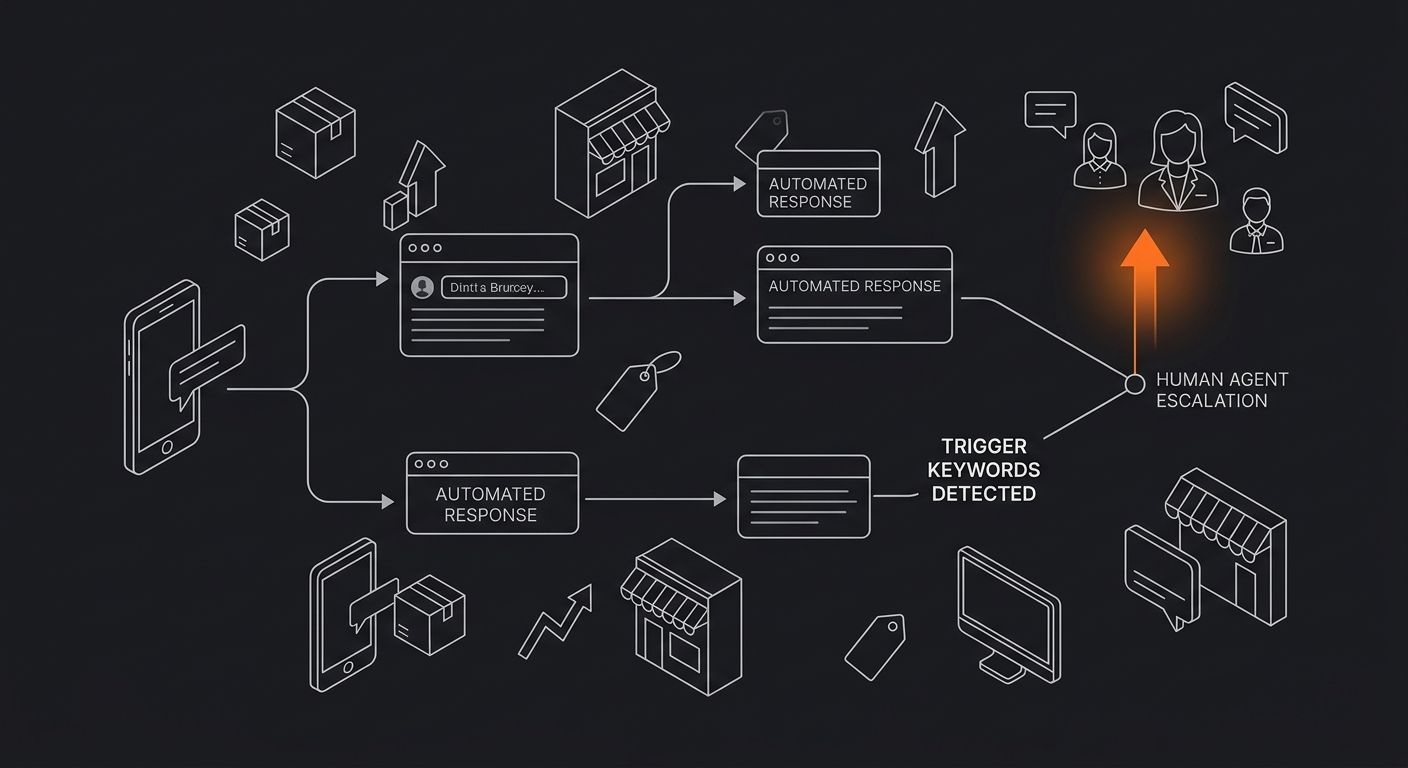
The operative word is "tier-one." Where-is-my-order queries, return policy questions, shipping time estimates: these are pattern-matching problems that AI handles well. Escalations about damaged products, billing disputes, or custom requests need a human. Stores that route everything through a bot save $400 to $800/month on labor and lose $2,000+ on retention over the same period. A customer with a $200 order problem who gets a scripted bot loop will chargeback, leave a 1-star review, and never return. That single interaction costs you $200 in revenue, roughly $15 in chargeback fees, and an unknowable amount in lost trust signals.
When this rule breaks: if you're running a sub-$3K/month store and can't afford any support staff. A chatbot covering 80% of tickets while you personally handle the rest through email is a reasonable compromise at that revenue level.
Set pricing floors before enabling dynamic pricing
Dynamic pricing automation adjusts your prices in response to competitor moves, demand shifts, and inventory levels. Doba describes this as "automatically adjusting prices in response to competitive changes." The appeal is obvious: you capture margin during high-demand windows and stay price-competitive when the market tightens.
The danger is equally obvious. Without a floor, the algorithm will chase competitor prices downward until your margin disappears. I've watched stores run dynamic pricing for 6 weeks without a floor and end up selling products at 11% gross margin, well below break-even after ad spend and transaction fees. If you haven't already mapped your real profit margin math, do that before touching any pricing automation. Your pricing floor should be your fully-loaded cost (product cost + shipping + transaction fees + estimated return rate) plus your minimum acceptable margin, typically 25% for sustainable operations.
When this rule breaks: if you're liquidating dead inventory and want to recover cash at any margin. Set a temporary floor at cost-of-goods and let the algorithm clear stock. Switch back to your standard floor immediately after.
Run demand forecasting on 90-day windows minimum
Kearney's research on predictive analytics in supply chain management establishes that AI-driven demand forecasting enhances "the efficiency, accuracy, and resilience" of supply chain operations. Predictive models process traffic patterns, historical sales data, delivery times, and supplier performance to generate inventory recommendations.
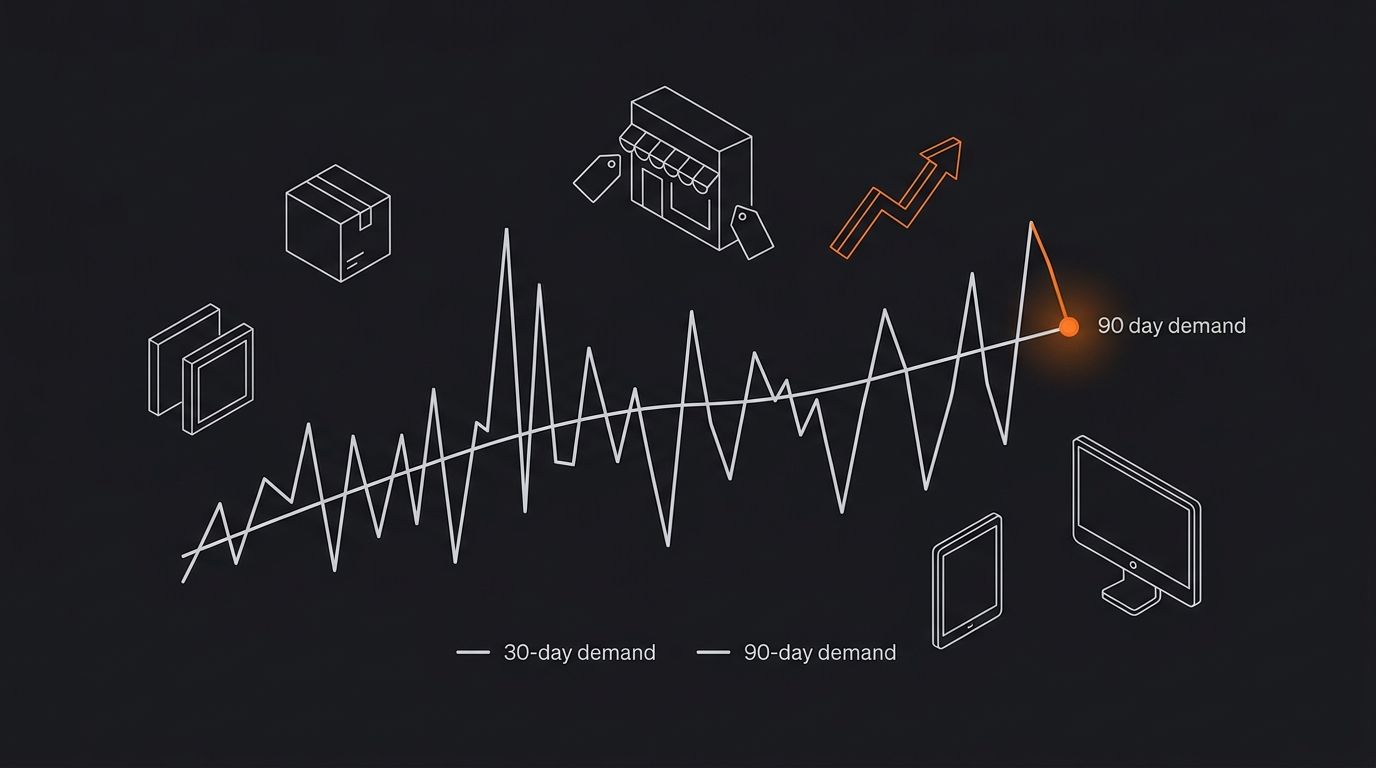
For dropshippers, the practical minimum forecasting window is 90 days. Anything shorter and the model reacts to noise: a single viral TikTok, a competitor's flash sale, a seasonal blip that reverts within two weeks. Anything longer and it misses real trend shifts in fast-moving categories. The 90-day window gives the algorithm enough data to distinguish between genuine demand increases and one-week spikes.
This matters for inventory sync across multiple channels because your forecasting model determines how much buffer stock you ask suppliers to hold. Forecast too aggressively and you're paying for inventory reserves you don't need. Forecast too conservatively and you hit stockouts during your best sales windows. A 12% stockout rate during a peak traffic period (common for stores using 30-day forecasting windows) translates to roughly 12% of potential revenue evaporating.
When this rule breaks: during product launches where you have zero historical data. For new SKUs, rely on supplier-side velocity data and comparable product benchmarks rather than your own forecasting model. Accumulate 90 days of sales data, then switch on AI forecasting.
Audit every AI tool against your actual margin math
The average Shopify dropshipping store runs 8 to 12 apps. Each one costs $15 to $79 per month. Stack them up: an AI chatbot ($39/month), a dynamic pricing tool ($49/month), an inventory sync app ($29/month), a product research tool ($59/month), and a content generation subscription ($49/month). That's $225/month in fixed overhead before you've sold a single unit.
On a store doing $8,000/month in revenue at 30% gross margin, your gross profit is $2,400. The AI tool stack just consumed 9.4% of it. And that's before ad spend, which typically runs 20 to 35% of revenue for paid-traffic-dependent stores.
The question for every AI tool: does this specific automation save enough time or prevent enough loss to justify its cost at my current revenue? A $49/month dynamic pricing tool that increases your average margin by 3 percentage points on $8,000 in revenue generates $240/month in additional gross profit. That's a 4.9x return. Worth keeping. A $59/month product research tool that surfaces the same trending items you'd find in 20 minutes browsing AliExpress trend pages? Kill it.
We've written about how the Shopify app stack becomes a margin tax, and AI tools are the newest layer of that tax. The fact that a tool uses artificial intelligence doesn't exempt it from basic ROI scrutiny. Run the math quarterly, and cut any tool that isn't returning at least 2x its monthly cost in saved time or captured margin.
When this rule breaks: during your first 30 days of testing a new tool. Give any AI tool a full month to demonstrate value before judging it. Demand forecasting tools especially need data accumulation time before they produce useful outputs.
When These Rules Collapse
Every rule above assumes a standard dropshipping model: you list products, drive traffic, fulfill through a third-party supplier, and optimize the gap between revenue and costs. Three scenarios break that assumption.
Branded private-label operations where you control the product and pricing power don't need dynamic pricing floors the same way, because you're not competing on identical SKUs with 40 other sellers. Your AI investment shifts toward content generation and customer segmentation instead of price defense.
High-volume stores above $50K/month can afford dedicated AI development. As Inventory Source reports, companies building custom solutions create "tailored algorithms for product recommendations, demand forecasting, and pricing optimization" that outperform off-the-shelf tools. At that revenue level, a $2,000/month custom integration improving margin by 2 percentage points across 10,000 orders generates $10,000+ in additional monthly profit. The ROI math completely changes at scale.
Stores with fewer than 10 SKUs and under $2K/month should ignore most AI tools entirely. Your bottleneck is traffic and product-market fit, not operational efficiency. Spending $225/month on AI automation when you're generating $600/month in gross profit means the tools are consuming 37.5% of your margin. Fix your foundational store setup first. Automate later, when the revenue math actually supports it.

Ryan Torres
Ryan Torres is a former Amazon FBA seller turned dropshipping consultant who has generated over $2.8M in ecommerce revenue across 14 product launches. He specializes in supplier vetting, margin optimization, and scaling DTC operations for sub-$1M brands. Ryan focuses on actionable frameworks that drive measurable results for independent operators.
Related Articles
AI Store Builders vs. Manual Shopify Setup: The 2026 Speed-to-Profit Tradeoff for Dropshippers
Atlas AI Store Builder generates a fully functional Shopify store in under two minutes, according to a Dropmagic comparison of seven AI tools. Manual Shopify configuration typically requires 15 to 40 hours of theme work, copywriting, image editing, and SEO.
The Automation Tool Selection Trap: Why Feature Parity Doesn't Equal Profit Growth for Your Dropshipping Store
Feature parity — when two automation platforms check the same boxes on a comparison chart — tells you almost nothing about which tool will grow your store's contribution margin.
DTC Brands Using AI Revenue Agents Report 30-50% First-Time Revenue Lift as Lean Operations Model Gains Traction
Direct-to-consumer brands using AI revenue agents to automate acquisition, conversion, and retention workflows reported 30 to 50 percent higher first-time customer revenue and two- to four-times higher repeat purchase revenue compared to baseline performance, according to Ground's September 4 analys
Explore more topics