The Multi-Supplier Concentration Risk Matrix: Why Single-Source Dropshipping Kills Your Margins When Supply Lines Break
Dropshippers who concentrate 50% or more of total spend with one supplier face margin compression, zero fallback options, and full business exposure the moment that source raises prices or goes offline.

The Multi-Supplier Concentration Risk Matrix: Why Single-Source Dropshipping Kills Your Margins When Supply Lines Break
Dropshippers who concentrate 50% or more of total spend with one supplier face margin compression, zero fallback options, and full business exposure the moment that source raises prices or goes offline. Three sourcing models—single-source, dual-backup, and full portfolio diversification—carry measurably different risk-to-margin tradeoffs worth mapping before your next supplier decision.
The Single-Source Model and Its Hidden Cost Structure
Running every order through one supplier keeps your tech stack simple, your relationship tight, and per-unit costs low through volume consolidation. The tradeoff: you're one stockout, one price hike, or one customs delay away from zero revenue. According to Mitratech's supply chain risk framework, companies with over 50% of spend concentrated in top suppliers face high risk levels that compress cash flow flexibility and eliminate negotiating power.
The margin math looks attractive on paper. Single-source lets you negotiate volume discounts, sometimes 8–15% off list price for consistent monthly order counts. You deal with one API integration, one returns process, one relationship manager. For a store doing $20,000/month in revenue with a 40% gross margin, that $8,000 spread feels comfortable.
But supplier concentration risk compounds silently. As Lasso Supply Chain's procurement analysis puts it: "Over-reliance on a single supplier can leave an organization vulnerable if that supplier faces disruptions—whether due to financial instability, production issues, or geopolitical events." When that one source raises prices by 22%, your entire catalog's margin structure breaks simultaneously. There's no partial exposure here. The damage is total.
And the vulnerability goes beyond price hikes. Single-source stores can't absorb a 48-hour supplier outage without losing every sale in that window. If your supplier ships exclusively from Guangdong province and a port backup adds 9 days to transit times, you have no alternative routing. Every customer complaint, every refund request, every negative review during that period hits your store—and your ad spend keeps running against products you can't fulfill. If you've experienced order tracking sync failures with a single supplier, imagine debugging that problem while simultaneously losing revenue from zero backup capacity.
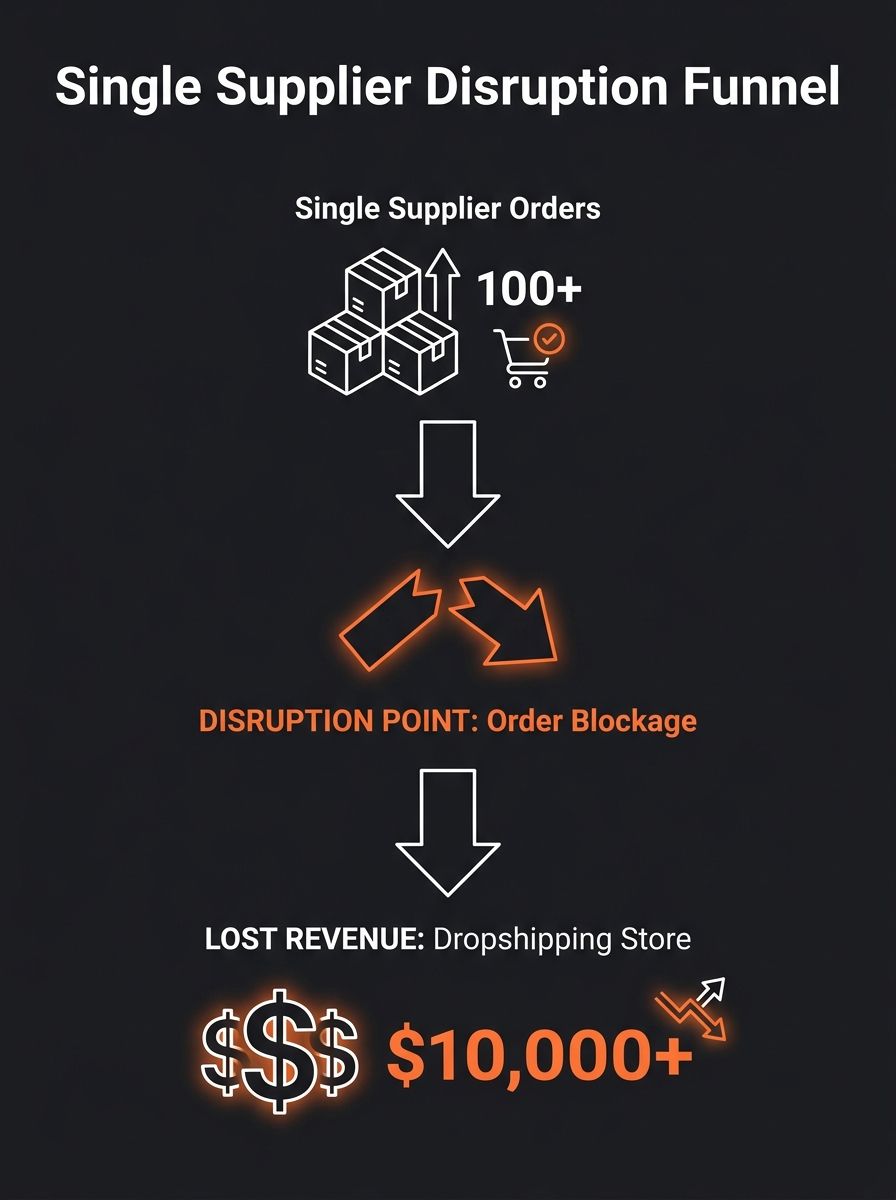
The real hidden cost of single-source isn't the disruption event itself. Value Source Global's sourcing research frames it clearly: "Relying on one source limits your flexibility to pivot, scale, or innovate quickly." You can't test new product variations, you can't A/B test shipping speeds across vendors, and you can't walk away from a bad deal because there's nowhere else to walk.
Dual-Supplier Backup: Where Partial Diversification Falls Short
Why do most dropshippers who add a second supplier still get caught flat-footed during regional disruptions? Because dual-sourcing solves the vendor-failure problem while leaving geographic, category, and lead-time concentration untouched.
The dual model typically works like this: you keep your primary supplier for 70–80% of orders and onboard a second vendor as backup for the same SKUs. If Supplier A goes down, you reroute to Supplier B. Setup cost runs $200–600 for a second API integration through platforms like Flxpoint or AutoDS, plus 3–5 hours of test-order validation. Your per-unit cost on the backup supplier runs 5–12% higher because you're not hitting volume thresholds, which means every order routed to Supplier B eats into margin.
But here's where dual-sourcing gets dangerous: it creates a false sense of security. If both suppliers ship from the same region—say, Yiwu and Shenzhen, both relying on the same port infrastructure—a regional disruption takes out both sources simultaneously. The port disruption economics we've documented show that bunker fuel shocks and congestion events don't discriminate between your primary and backup vendor when they share logistics corridors.
The numbers on dual-sourcing's limitations are striking. Only 19% of dropshippers use structured supplier relationship management programs, according to industry benchmarks. That means 81% of stores running dual-supplier setups have no formal process for testing failover, validating backup inventory levels, or confirming that Supplier B can actually absorb Supplier A's order volume on short notice. As Flxpoint's multi-supplier management guide recommends, merchants should "simulate rerouting orders to backup suppliers to confirm system readiness"—but almost nobody does this.
Dual-sourcing also fails to address category concentration. If you sell 15 SKUs and all 15 come from two suppliers, a single product category disruption (say, silicone goods facing new regulatory inspection requirements) still wipes out your catalog. The tariff and import duty analysis that catches most dropshippers off guard applies equally to Supplier A and Supplier B when they manufacture in the same jurisdiction.
The dual model works best for stores with fewer than 30 SKUs, monthly revenue under $15,000, and product lines where geographic risk is genuinely distributed—for example, one US-based supplier and one Southeast Asian supplier covering the same catalog.
Full Portfolio Diversification Across Three or More Suppliers
Dropshippers working with three or fewer suppliers face a 72% higher failure rate than those using six or more, based on 2025 industry data. That stat alone makes the case for procurement risk modeling at the portfolio level, but the execution is where most stores stumble.
A multi-supplier strategy means working with multiple suppliers across product lines, geographic regions, and service types. SuperDS's analysis identifies three core advantages: better inventory management, pricing flexibility, and risk reduction. But portfolio diversification adds real operational overhead that you need to budget for.
Here's what the cost structure actually looks like at scale. Each additional supplier adds $150–400 in monthly management time (communication, quality checks, reconciliation). API integrations multiply—six suppliers means six potential sync failure points that need monitoring. Your supplier vetting process runs 3–5 times instead of once. And you'll likely carry 2–4% higher average per-unit costs because your volume is split across more vendors, reducing individual discount tiers.
The payoff is measurable. Risk Ledger's concentration risk research confirms that supplier concentration risk "can be reduced and managed through visibility, scenario planning, and intelligent diversification". The recommended target: keep top-supplier concentration below 30% of total spend. For a $50,000/month store, that means no single supplier handles more than $15,000 in orders.
Weekly communication with each supplier reduces fulfillment issues by 42%. Stores with a dedicated supplier relationship management process—even if it's just a spreadsheet and a calendar—see 29% higher supplier satisfaction scores, which translates to priority treatment during high-demand periods.
The portfolio model also unlocks competitive pricing intelligence. When you work with six suppliers for overlapping SKUs, you generate real-time pricing data across the market. If Supplier C quotes $4.80 for a product that Supplier F offers at $4.20, you don't just save $0.60 per unit—you gain a data point for renegotiating with Supplier C. Multiply that across 50+ SKUs and the margin recovery often exceeds the additional management costs. Operators who survived the pandemic-era supply chain chaos credit this pricing visibility as a major factor in maintaining margins when costs spiked industry-wide.
How To Choose Between These Three
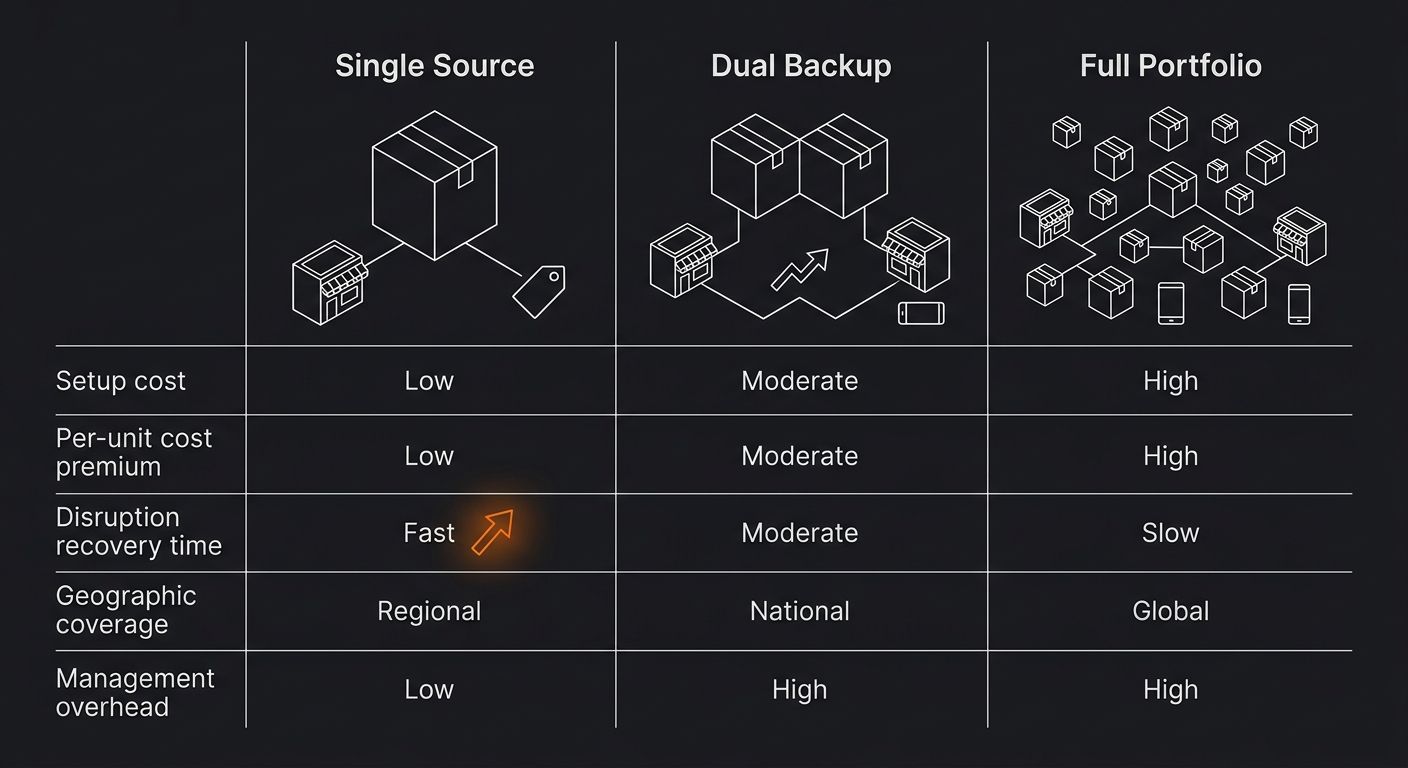
Factor | Single-Source | Dual-Supplier | Full Portfolio (3+) |
|---|---|---|---|
Monthly management overhead | 2–4 hours | 5–10 hours | 12–20+ hours |
Per-unit cost premium vs. best price | 0% (volume discount) | 5–12% on backup orders | 2–4% average across vendors |
Recovery time from supplier outage | Days to weeks | 4–24 hours if tested | Under 4 hours with automation |
Geographic risk coverage | Single region | Partial (if intentional) | Multi-region by design |
Pricing negotiation power | Low (dependent) | Moderate | High (competitive data) |
Best for monthly revenue | Under $5,000 | $5,000–$15,000 | Above $15,000 |
Minimum SKU count to justify | Any | 10+ | 25+ |
The honest answer depends on where your store sits today and where it's headed in the next 6 months.
If you're running under $5,000/month with fewer than 10 SKUs, single-source is fine as a starting position. The management simplicity matters more than theoretical disruption risk at that scale, because a supply disruption at $5K/month revenue costs you $150–250 in lost daily sales. You can absorb that while onboarding a replacement.
Between $5,000 and $15,000/month, dual-sourcing becomes essential. At this revenue level, a 48-hour outage costs $330–$1,000 in lost sales plus ongoing ad spend you can't pause fast enough. Budget $500–800 for setup and 5–10 hours monthly in supplier management. Make sure your two suppliers ship from different countries or at minimum different provinces.
Above $15,000/month, a full portfolio approach with three or more suppliers per critical product category is the only defensible strategy. At $50,000/month, a single supplier failure costs $1,600+ per day. The 12–20 hours of monthly management overhead and 2–4% cost premium across vendors looks cheap against that exposure. Use the supplier audit flowchart to evaluate each vendor on quality, lead time, and communication before adding them to the portfolio.
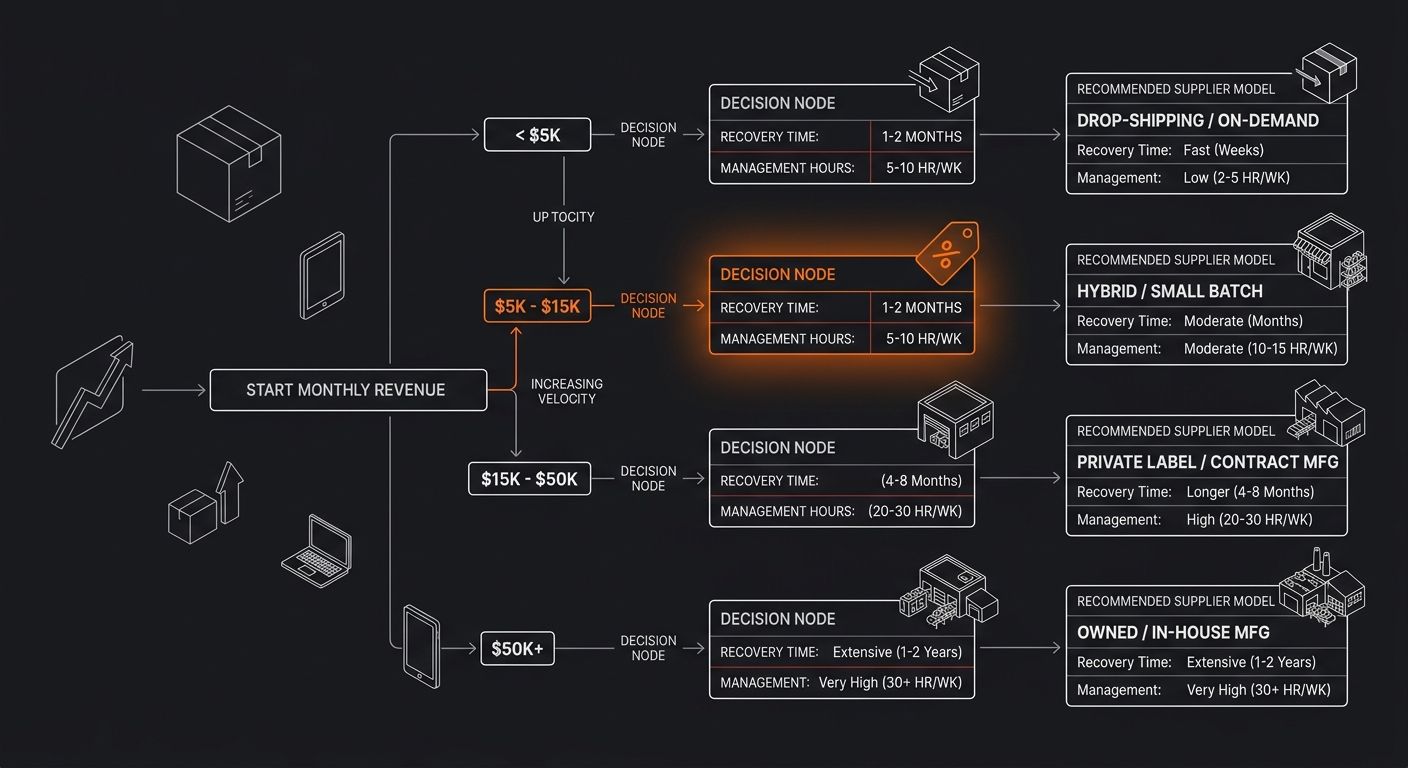
The pattern across all three models: your dropshipping portfolio diversification strategy should scale with your revenue exposure. A store doing $100,000/month that still runs single-source isn't saving money on management overhead. It's borrowing margin from the future, and the interest rate on that loan spikes to 100% the day its one supplier fails.
Proactive structural changes consistently outperform reactive scrambles. Research published in the International Journal of Production Economics shows that a dispersed supply chain combined with planned contingency measures delivers the highest improvement in both fill rate and profit—while purely reactive strategies improve profits by only 6–59% and offer zero long-term stability. The difference between stores that survive supply disruptions and stores that don't isn't luck or product selection. It's whether the supplier concentration risk was mapped before the disruption arrived.
365 Dropship Editorial
Editorial team writing about E-commerce, dropshipping, and product discovery — reviews of dropshipping suppliers and platforms, trending niche guides (jewelry, beauty, pets, home, fashion), supplier due diligence, ecom operations, shipping & fulfillment strategy, product research, AOV optimization, and profitable dropshipping case studies.
Related Articles

Building a Backup Supplier Network: The Insurance Policy Every Dropshipper Overlooks
A backup supplier you've never routed a live order through is functionally identical to having no backup at all. The spreadsheet of "alternative vendors" sitting in your Google Drive doesn't constitute a backup supplier strategy; it's a wish list.
The KPI Hierarchy: Which Metrics Actually Matter When You're Managing 5+ Suppliers
Scorecard tools from platforms like Tradogram, SourceDay, and Ramp default to equal weighting across four categories: quality, delivery, cost, and service.
Dropshipping Platform Guide Breaks Down Storefront vs. Sourcing Trade-offs Across Nine Provider Categories
Dropshipping operators choosing between marketplace listings and standalone storefronts face fundamentally different cost structures, shipping timelines, and quality control requirements, according to a platform comparison guide 4Topic published June 22. The analysis separates nine provider categori
Explore more topics