Naphtha Shortage & Packaging Costs: How Japan's Supply Shock Is Forcing US Dropshippers to Recalculate Unit Economics in 2026
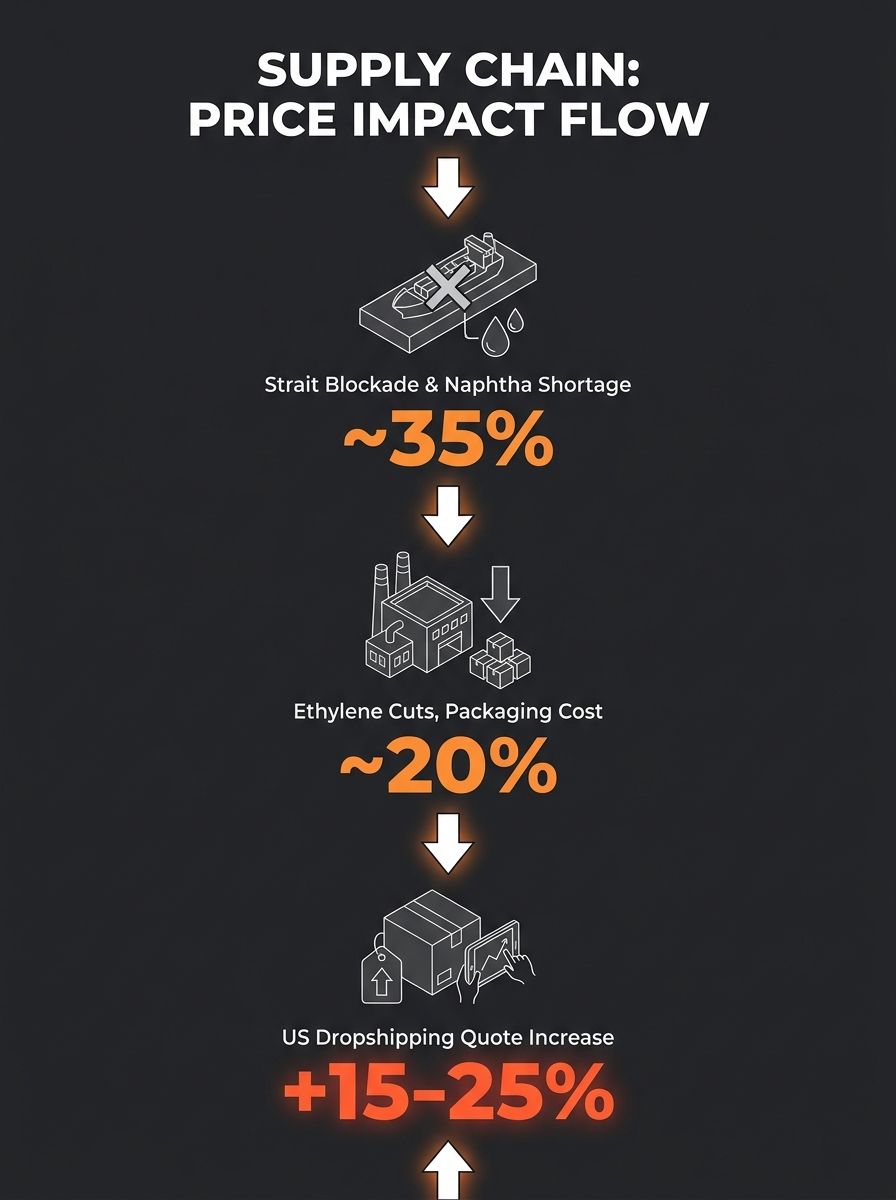
Naphtha surged past $1,000 per metric ton in March 2026 after the Strait of Hormuz blockade severed over 80% of Asia's traditional petrochemical supply lines.

Naphtha Shortage & Packaging Costs: How Japan's Supply Shock Is Forcing US Dropshippers to Recalculate Unit Economics in 2026
Naphtha surged past $1,000 per metric ton in March 2026 after the Strait of Hormuz blockade severed over 80% of Asia's traditional petrochemical supply lines. That spike is now rippling into polypropylene, PET, and plastic film costs on every supplier quote US dropshippers receive, and most profit calculators and margin-tracking apps are still running on pre-crisis inputs.
The Hormuz Blockade Severed Asia's Primary Feedstock Artery
The Strait of Hormuz closure, triggered by the ongoing Middle East conflict, cut off the corridor through which most of Asia's naphtha historically flowed. Japan, the region's largest naphtha importer, watched its ethylene production capacity get slashed by more than half. According to The Guardian's May 19 reporting, Japan's government is fighting to cushion the economic impact as inflation rises and the crisis threatens Prime Minister Sanae Takaichi's poll lead.
The Japanese government maintains that alternative supply from the US and Russia has been secured to last into 2027, with imports expected to triple in May according to The Japan Times. But a former head of a major Japanese trading house warned via Bloomberg on May 25 that Japan could face a shortage of naphtha-derived chemical products as early as late June 2026, directly contradicting the government's more optimistic timeline.
The downstream effects are already visible. Calbee, one of Japan's largest snack makers, switched to black-and-white packaging in May 2026 to halve ink usage. Lawson, the convenience store giant, replaced plastic coffee lids with paper alternatives due to solvent shortages. Mizkan and Takanofoods raised prices on natto products by 15–20% in June 2026, citing soaring costs for plastic film and packaging.
Packaging Cost Inflation Hits Your Supplier Quotes Before You See It
Why should a US-based dropshipper care about Japanese snack packaging? Because naphtha is the feedstock for polypropylene, polyethylene, and PVC — the materials that wrap, protect, and ship virtually every physical product sold online. The naphtha shortage impact started in Asia, but as Inbound Logistics reported, the effects of production cuts are rippling outward from Asia toward every market that depends on plastic packaging to move goods.
Resin costs across the plastics manufacturing sector have risen significantly, with the British Plastics Federation confirming in its March market update that oil and naphtha prices drove sharp increases in Europe. A Rabobank study cited by Assemblies.com found that high energy costs and global supply chain factors will contribute to food packaging price increases in North America during the next twelve months. Aluminum cans, PET containers, and corrugated packaging are all seeing inflated operating costs.
For dropshippers, this cost increase rarely arrives as a line-item labeled "packaging surcharge." It shows up as a 3–8% bump in your supplier's per-unit price, blended into the product cost. If you're sourcing packaging-heavy categories like beauty, supplements, food products, or home goods from Chinese or Southeast Asian suppliers, their raw material costs are climbing in tandem with Japan's crisis. And if you haven't built your true unit cost model with updated packaging assumptions, the gap between your spreadsheet margin and your real margin is widening every week.
Your Profit Calculator Is Lying to You
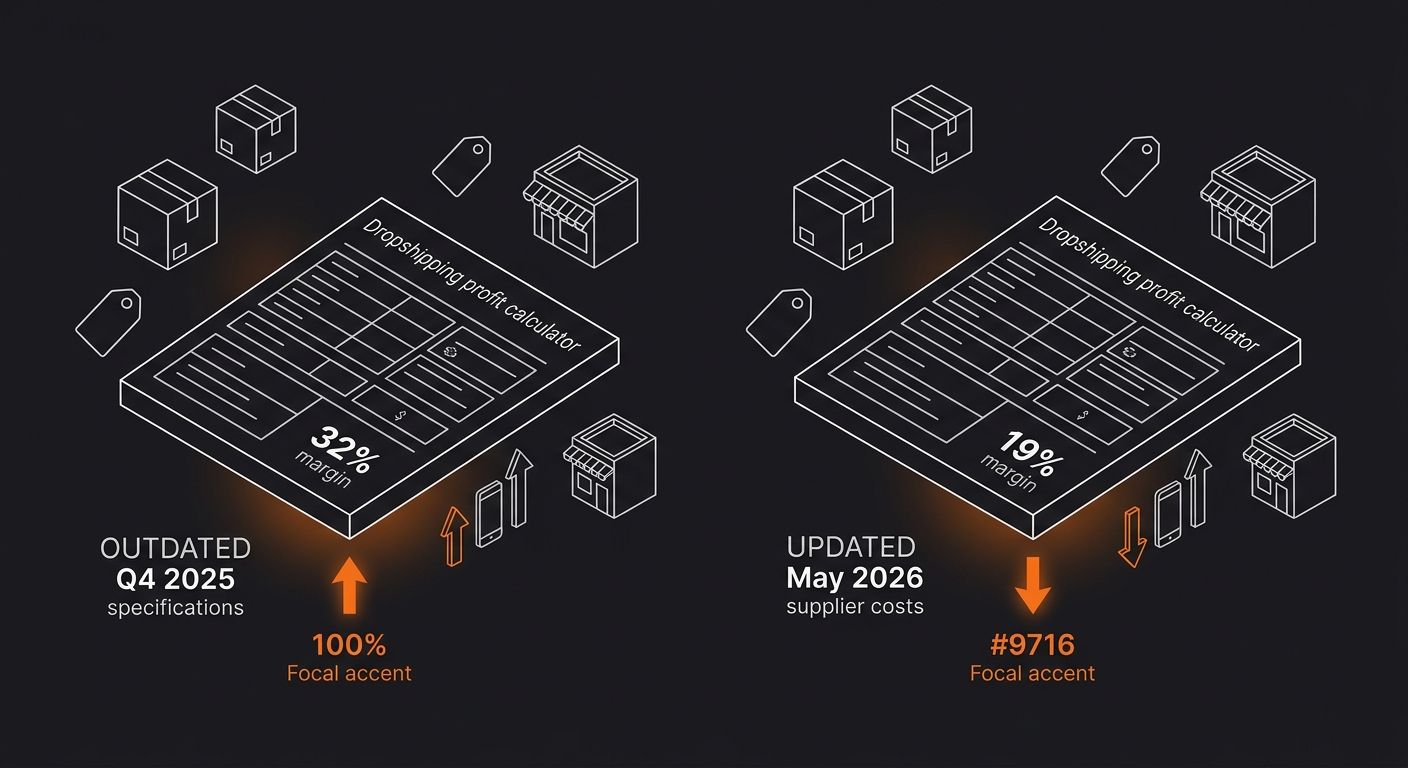
Here's the operational problem: most dropshipping profit calculators — whether standalone tools like Ecom Beacon, built-in Shopify app calculators, or custom spreadsheets — treat product cost as a static input. You enter $8.50 per unit in January, and the tool happily spits out a 32% margin through July, even though your supplier quietly bumped that cost to $9.20 in April because polypropylene film got 15% more expensive.
A 2026 analysis from Financial Models Lab found that a 190% variable cost rate means a dropshipping business loses 90% of revenue immediately on every sale before covering fixed costs. At that ratio, even a $0.70 per-unit increase in packaging-driven supplier costs can flip a product from marginally profitable to genuinely unprofitable once you layer in ad spend, platform fees, and shipping.
The tools themselves aren't broken. The inputs are stale. And this is where the supply chain disruption dropshipping operators face in 2026 differs from a simple tariff increase or freight surge: packaging cost inflation creeps in through materials science, not through a line-item duty rate you can look up in a table. Your automation tools don't flag it. Your order sync systems don't detect it. The only way to catch it is to manually re-audit supplier pricing against a fresh baseline.
Which Tools Actually Help With Unit Economics Recalculation
The meaningful difference between profit-tracking apps right now comes down to one feature: how easy they make it to update and stress-test variable costs on a rolling basis.
Tool / App | Cost Update Frequency | Scenario Modeling | Packaging Cost Isolation | Price |
|---|---|---|---|---|
Ecom Beacon Calculator | Manual per-product | No | No | Free |
BeProfit (Shopify App) | Syncs COGS per order | Basic A/B | Groups "product cost" only | $25–75/mo |
TrueProfit | Auto-syncs supplier costs | Margin alerts | No packaging breakout | $25–100/mo |
Yakkyofy Dashboard | Updates on PO changes | Limited | Shows packaging line | Platform fee |
Custom Google Sheet | Whenever you remember | Whatever you build | Whatever you track | Free |
None of these tools currently pull real-time resin or naphtha pricing feeds. The best you can do is treat your supplier's latest invoice as the source of truth and update your calculator inputs at least monthly during periods of packaging cost inflation like this one. Yakkyofy's 2026 guide emphasizes that platform fees, app subscriptions, and recurring costs must be factored into unit economics — but packaging material cost drift deserves the same scrutiny.
If you're running multiple suppliers, the recalculation burden multiplies. A backup supplier strategy gives you negotiating power and pricing visibility across sources, but each supplier's packaging cost exposure differs depending on their geography and material sourcing. Chinese suppliers with access to coal-based olefins (an alternative to naphtha-derived plastics) may hold pricing longer than suppliers dependent on imported naphtha feedstock.
The Margin Math on a Real Product
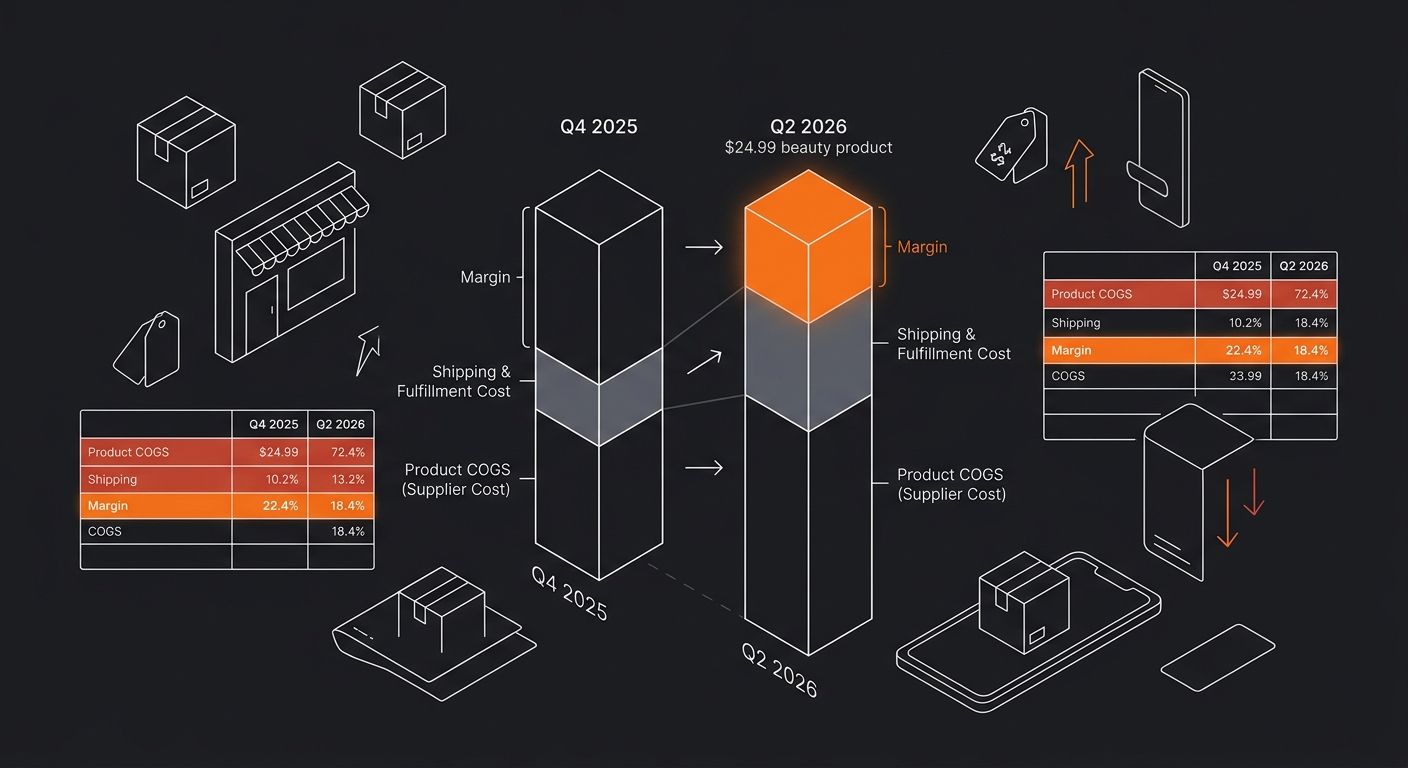
Take a typical beauty product sold via a Chinese supplier on CJ Dropshipping. Pre-crisis Q4 2025 numbers:
Supplier cost: $6.80 (including packaging)
ePacket shipping: $3.50
Shopify + apps: ~$1.10 per order (amortized)
Ad cost per acquisition: $8.00
Selling price: $24.99
Contribution margin: $5.59 (22.4%)
Now apply the 2026 packaging cost inflation. If polypropylene film and PET container costs push the supplier's price up by just $0.60 (a conservative 9% increase on the packaging-heavy portion), and port efficiency losses add another $0.40 to shipping:
Supplier cost: $7.40
Shipping: $3.90
Shopify + apps: ~$1.10
Ad cost: $8.00
Selling price: $24.99
Contribution margin: $4.59 (18.4%)
That's a 4-percentage-point margin compression from costs the seller never explicitly chose to absorb. At $8.00 CAC, the payback period stretches, and scaling into that product with paid traffic becomes a losing game faster than your dashboard shows — because your dashboard still has the old numbers plugged in.
What's Still Unresolved
The biggest open question is duration. If the Hormuz blockade lifts in Q3, naphtha prices could normalize within 60–90 days and packaging costs would follow, albeit with a lag. If the conflict persists, some countries are already considering strategic naphtha reserves modeled after strategic petroleum reserves, which would signal a structural shift rather than a temporary shock.
For dropshippers, three threads remain tangled:
Coal-based olefin substitution: Chinese producers are shifting toward coal-to-olefins (CTO) processes as a naphtha alternative. If this scales, it could decouple Chinese supplier packaging costs from Middle East oil pricing. But CTO carries higher carbon intensity, which may conflict with evolving ethical sourcing requirements your brand has committed to.
Resin contract timing: Large packaging buyers lock in quarterly or annual resin contracts. Smaller suppliers — the kind most dropshippers work with — buy spot. The gap between contracted and spot resin prices is currently 12–18%, meaning your small supplier is eating proportionally more cost increase than a large manufacturer.
Tool development: No major Shopify profit-tracking app has announced real-time materials cost integration. Until that changes, unit economics recalculation remains a manual discipline. The operators who build a monthly supplier audit habit into their workflow will catch cost drift. Everyone else will discover it in their bank account three months too late.
The naphtha shortage impact on US dropshipping is indirect but measurable. It arrives as a slow squeeze on margins rather than a dramatic event, and the tools most operators rely on aren't designed to surface it. Updating your cost inputs monthly, stress-testing your margins against a 10–15% packaging cost increase scenario, and maintaining pricing visibility across multiple suppliers are the only reliable defenses right now — none of them automated, all of them essential.
365 Dropship Editorial
Editorial team writing about E-commerce, dropshipping, and product discovery — reviews of dropshipping suppliers and platforms, trending niche guides (jewelry, beauty, pets, home, fashion), supplier due diligence, ecom operations, shipping & fulfillment strategy, product research, AOV optimization, and profitable dropshipping case studies.
Related Articles
Bunker Fuel Shocks & Last-Mile Economics: Why Global Port Disruptions Are Reshaping Dropshipping Unit Economics in 2026
On February 28, 2026, the Strait of Hormuz closed to commercial shipping traffic as the Iran conflict escalated into a direct naval blockade. Over 90% of crude and refined product exports from the Persian Gulf were cut off within 72 hours.

Container Freight Surges and Dropshipping Unit Economics: Why Port Efficiency Losses Are Reshaping Your 2026 Supplier Costs
Landed cost calculators take your product cost, layer on freight, duties, insurance, and port fees, then output the true per-unit cost of getting inventory to a customer's door.

Inside the Supplier Markup Stack: How Aggregator Platforms Layer Fees Between Factory Price and Your Cost of Goods
Three to seven distinct fee layers sit between a product's factory price and the number aggregator platforms display as your "supplier cost." Fulfillment surcharges, payment processing cuts, per-order fees, and shipping markups each compound silently.
Explore more topics