The Supplier Test Order Audit: Using Real Shipments to Spot Quality Collapse Before It Tanks Your Margins
Industry data from 2025 shows that 72% of businesses experienced at least one major supply chain disruption caused by underperforming suppliers.

The Supplier Test Order Audit: Using Real Shipments to Spot Quality Collapse Before It Tanks Your Margins
Industry data from 2025 shows that 72% of businesses experienced at least one major supply chain disruption caused by underperforming suppliers. For dropshippers, that disruption usually surfaces as a slow bleed: rising refund rates, 1-star reviews, and margin compression you don't notice until it's already cost you thousands. A structured supplier test order evaluation, run on a recurring cadence, catches the collapse before the damage compounds.
Why a Single Pre-Launch Test Order Falls Short
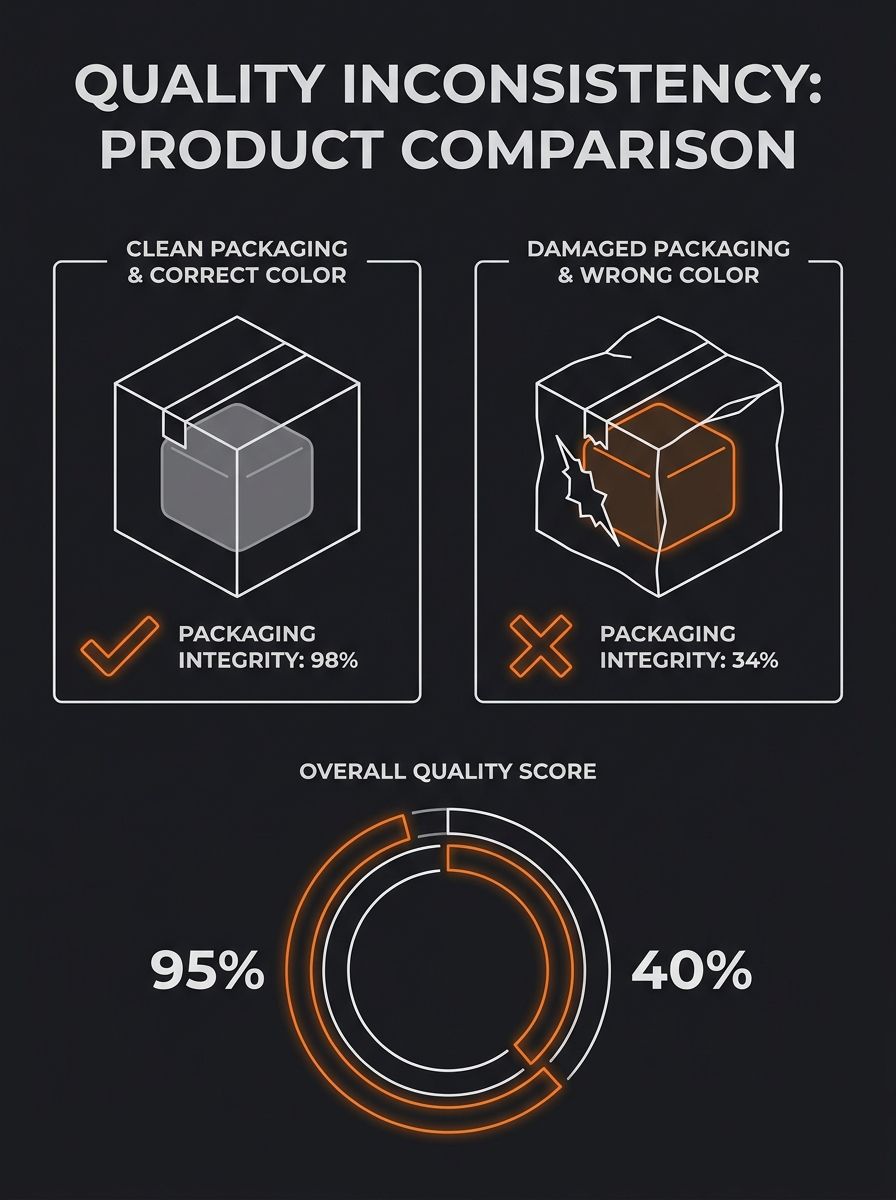
The standard advice tells you to order a sample before listing a product. That's a necessary step, and we covered what to measure beyond shipping speed in a dedicated breakdown. But a single sample reflects a snapshot. Suppliers change manufacturers, swap materials, or cut corners once order volume picks up. The product you approved in January can look unrecognizable by June.
Spocket's quality control team advises dropshippers to "order samples from multiple suppliers selling the same product to compare quality and shipping reliability," and to test multiple variants (sizes, colors, bundles) because quality often differs by variant. A supplier might nail the black version of a phone case but ship a visibly thinner material for the white one. Variant-level quality drift is one of the hardest supplier red flags to detect without physical test orders.
That comparison is valuable at launch. The missing piece is repeating it on a cadence, because the supplier you validated at month one isn't guaranteed to hold that standard at month six.
The 5-Point Shipment Quality Scorecard
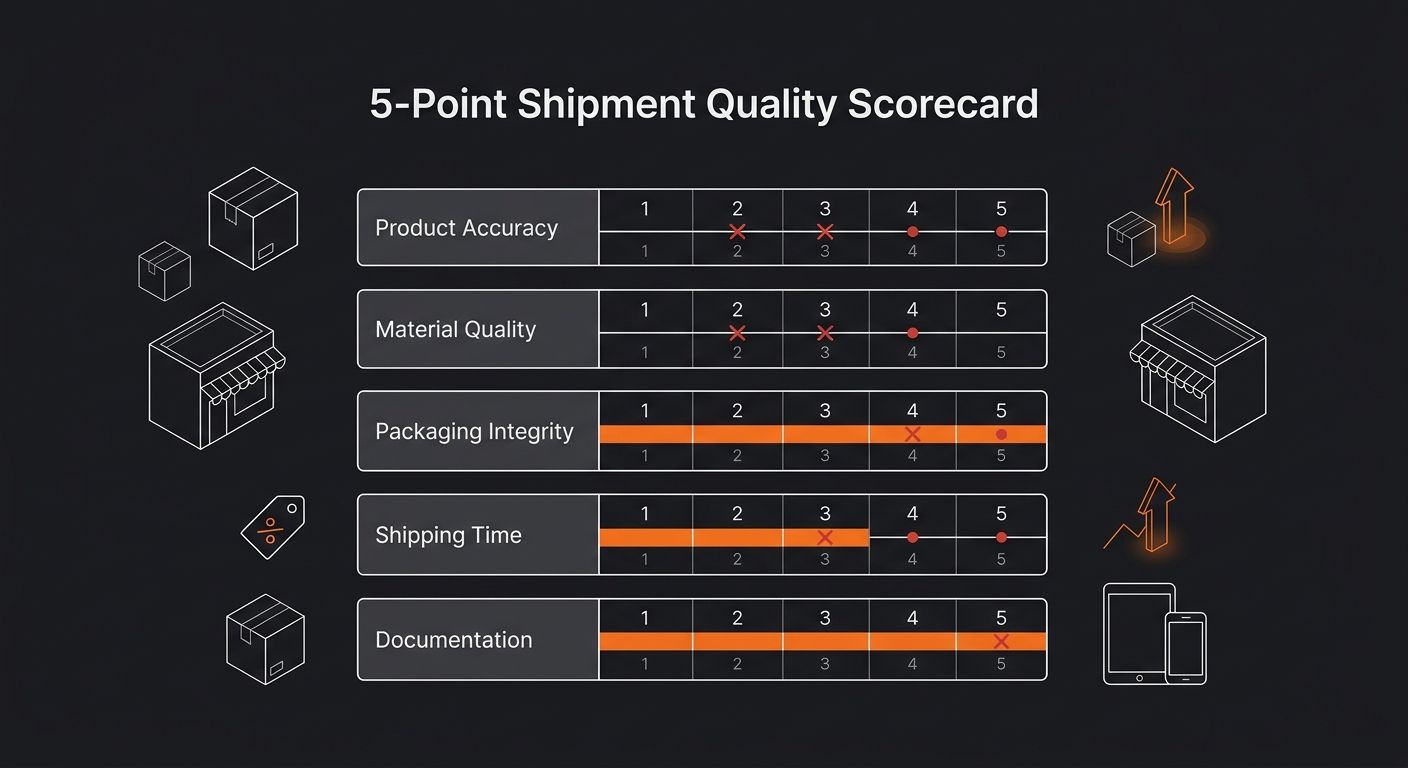
Supplier performance scorecards in traditional supply chains assess vendors on "on-time delivery, quality consistency, responsiveness, and cost efficiency," according to Saga Elastomer's supply chain research. The 5-Point Shipment Quality Scorecard adapts that industrial concept for the realities of dropshipping, where you don't visit factories but you do receive physical products at real addresses.
Five categories, each rated 1 through 5:
Category | What You're Measuring | Red Flag Threshold |
|---|---|---|
Product accuracy | Match against listing photos and specs | Score below 3 on any single order |
Material and build quality | Fabric weight, stitching, finish, durability | Decline of 1+ points between test periods |
Packaging integrity | Damage protection, branding accuracy, insert quality | Any crushed, wet, or mislabeled package |
Shipping time | Days from order to delivery at customer's zip | Exceeds posted estimate by 3+ days |
Documentation and tracking | Valid tracking number, accurate carrier info, updates | Tracking goes dark for 5+ days mid-transit |
Score each category on every test order. Track scores over time. For dropshipping quality control to work at scale, set a hard cutoff: any supplier scoring below 3.0 in aggregate for two consecutive test periods should be flagged for replacement. If you've built a backup supplier network, this is exactly the scenario where that insurance policy pays off.
Shipping Time Benchmarks That Actually Predict Margin Erosion
Delivery timing anchors the entire customer experience. SourceDay's OTD metrics breakdown defines on-time delivery (OTD) as whether shipments arrive "within the promised delivery window," noting that the metric focuses strictly on timing, not product condition or completeness.
The standard shipping time benchmarks for dropshipping vary by fulfillment origin:
Fulfillment Origin | Acceptable OTD Window | Red Flag Range |
|---|---|---|
US domestic warehouse | 3–5 business days | Over 7 business days |
China (ePacket/Yanwen) | 12–20 business days | Over 25 business days |
China express (CJ/Zendrop expedited) | 7–12 business days | Over 15 business days |
European warehouse | 5–8 business days | Over 12 business days |
Industry consensus puts the OTD target above 95% for reliable suppliers. Anything below 90% OTD across your test orders should trigger an immediate review. Track-POD's delivery KPI research confirms that "analyzing past data on supplier performance allows you to spot patterns and red flags affecting your total OTD rate," including shipment delays and communication breakdowns.
When test orders consistently land in the red flag range, you're facing a margin problem, not a logistics inconvenience. A shipping delay of 5+ days beyond your posted estimate drives refund requests, chargeback exposure, and negative reviews that suppress conversion rates for months. At a $15 CAC and $25 average refund, 10 failed deliveries in a month costs $400+ in direct losses before you even account for review damage.
Spotting Financial and Operational Red Flags Between Orders
Supplier red flags detection extends well beyond the physical product. SafeCoze's supplier red flags checklist warns specifically about "excessive advance payments, payment to third parties, or changing terms late in negotiation" as high-risk signals. You should also check for recent financial distress, bankruptcy filings, or high staff turnover.
QCAdvisor's 28-point quality risk assessment identifies three categories of non-product red flags that correlate strongly with future quality collapse: "negative industry feedback, unresolved customer complaints, and a lack of credible references." If your supplier starts appearing in negative feedback threads on AliExpress forums, Reddit sourcing communities, or dropshipping Discord servers, treat that signal with urgency, even if your own test orders haven't degraded yet.
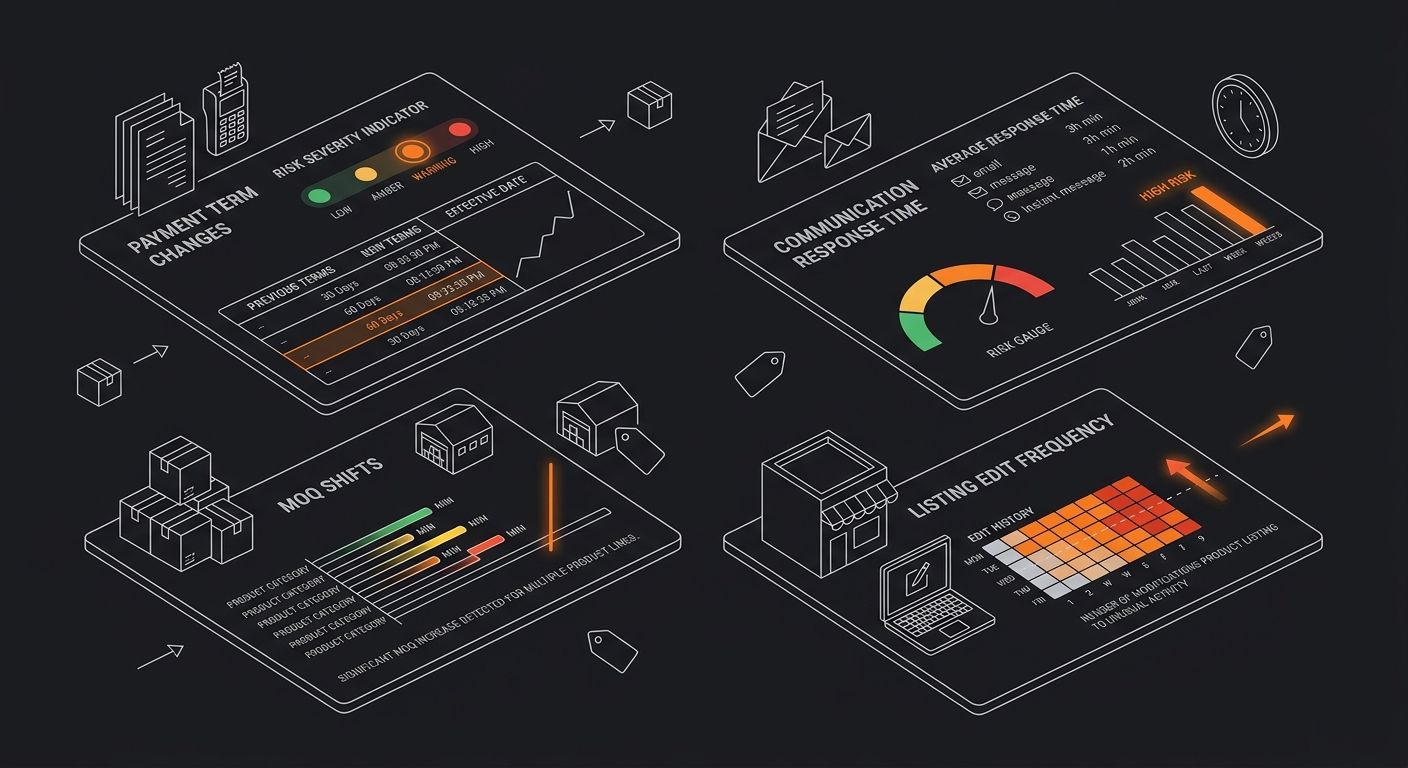
Between test order cycles, watch for four specific warning patterns:
Payment term changes: Supplier suddenly requests larger upfront payments or switches to a different receiving account. This signals cash flow stress that typically hits product quality within 30 to 60 days.
Communication slowdowns: Response times stretch from hours to days. Support contacts change without notice.
MOQ pressure: Supplier pushes minimum order quantities on products they previously fulfilled at any volume.
Listing discrepancies: Product photos on their platform listings change, or specs get quietly edited without announcement.
Payment term changes and communication slowdowns carry the highest weight because they reflect internal operational stress. MOQ pressure and listing edits are secondary signals, but two secondary signals appearing together carry the same urgency as one primary signal.
Building the Audit Into Monthly Operations
DSers' research on test orders notes that the process allows dropshippers to scrutinize "the craftsmanship and durability of the products" and evaluate "the adequacy of packaging and branding." The key insight is turning this from a one-time event into a recurring operational habit with a fixed cadence.
Here's the schedule that works for stores doing $5K to $50K per month:
Monthly: Place 1 test order per top-5 supplier (by revenue contribution). Score it using the 5-Point Shipment Quality Scorecard.
Quarterly: Order the same SKU from 2 to 3 alternative suppliers for side-by-side comparison. This refreshes your supplier concentration risk assessment.
After any communication red flag: Place an immediate test order within 48 hours. Don't wait for the monthly cycle.
The cost is small relative to the protection. Five test orders per month at $8 to $15 average product cost runs $40 to $75 monthly. Compare that to a single batch of defective products generating 10 refund requests at $25 each ($250), plus the wasted ad spend acquiring those customers at a $15 CAC ($150). One bad supplier month wipes out $400+ before review damage enters the equation. The $75 monthly test order budget pays for itself if it catches a single quality slip before it reaches real customers.
What the Hidden Data Flow Reveals
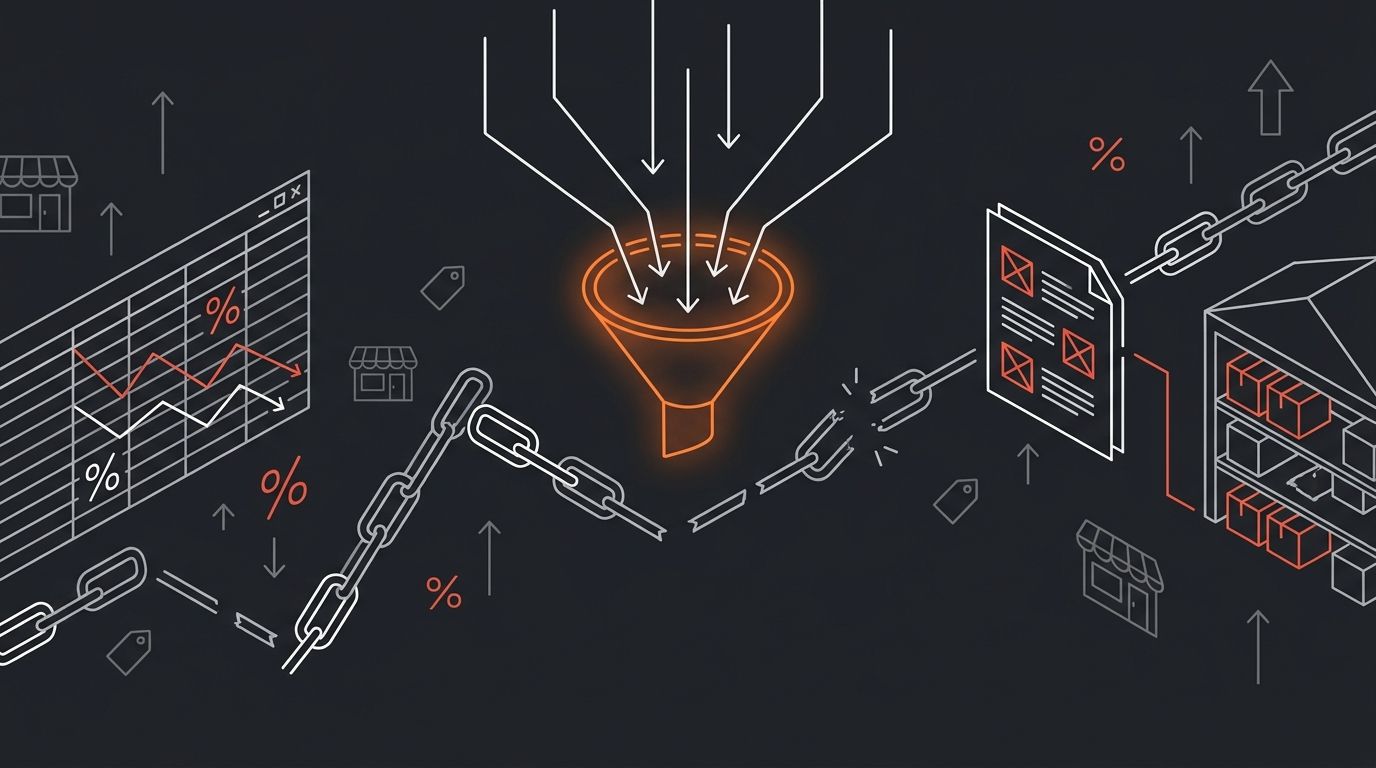
Your supplier handles more data transfers than most dropshippers realize between checkout and fulfillment. Each of those handoff points is a potential failure zone. Test orders give you ground truth to validate whether the data flow matches reality.
When a test order's tracking number shows "delivered" but the package actually arrived 2 days later, that's a data integrity problem. When the SKU on the packing slip doesn't match what you ordered, that's an accuracy failure in the supplier's order management system. These discrepancies rarely surface in a single order. They appear as patterns across 3 to 5 orders, which is why the monthly cadence matters.
Corrective action matters here too. The CPCON Group (April 2026) emphasizes that "effective root cause analysis ensures that corrective actions address the underlying problem rather than just its visible manifestation." When you surface a quality issue through test orders, push the supplier for a written corrective action plan. A supplier who can't articulate what went wrong and how they'll fix it will repeat the failure.
Questions the Numbers Still Can't Answer
The 5-Point Shipment Quality Scorecard measures what arrives at your door. It doesn't measure what your customers experience after 30, 60, or 90 days of product use. A phone case that looks perfect on arrival but cracks within two weeks won't show up in any test order audit. For durability signals, you need to cross-reference your customer review data for operational blind spots alongside test order scores.
The numbers also can't tell you why a supplier's quality dropped. Was it a raw material substitution? A factory change? Seasonal labor turnover? Test orders surface the signal. Root cause analysis demands direct communication with the supplier and, in some cases, requesting batch records and production documentation. SimplerQMS's supplier audit framework describes auditors examining "standard operating procedures, batch records, training logs, and nonconformance reports" for exactly this purpose.
And the scorecard doesn't capture concentration risk. If 70% of your revenue flows through a single supplier who scores 4.5 on every test, you're still exposed to catastrophic failure if that supplier goes offline. Shipment audits reduce quality risk. Eliminating single-point-of-failure risk requires a fundamentally different strategy built around supplier diversification, something the numbers from your test orders won't prompt you to do until it's too late.
365 Dropship Editorial
Editorial team writing about E-commerce, dropshipping, and product discovery — reviews of dropshipping suppliers and platforms, trending niche guides (jewelry, beauty, pets, home, fashion), supplier due diligence, ecom operations, shipping & fulfillment strategy, product research, AOV optimization, and profitable dropshipping case studies.
Related Articles

The Pre-Launch Supplier Test Order Audit: What to Measure Beyond Shipping Speed
A pre-launch supplier audit should measure defect rates, packaging accuracy, documentation completeness, tracking validity, and invoice consistency alongside delivery time. Amazon enforces Order Defect Rates below 1% and Valid Tracking Rates above 95% Valid Tracking.

The Supplier Scorecard Audit: Building a Quality Matrix That Catches Red Flags Before Your First 100 Orders
Procurement scoring frameworks use a 0-100 scale where any supplier below 60 earns "red" status, meaning business on hold and corrective action required.
5 Supplier Communication Failures That Collapse Margins Mid-Campaign (And the SOP to Fix Each One)
Sixty percent of dropshipping stores that attempt to scale fail due to supply chain instability—inventory gaps, cost swings, quality drift—according to Spocket's analysis of DSers data.
Explore more topics