AI Store Builders vs. Manual Shopify Setup: The 2026 Speed-to-Profit Tradeoff for Dropshippers
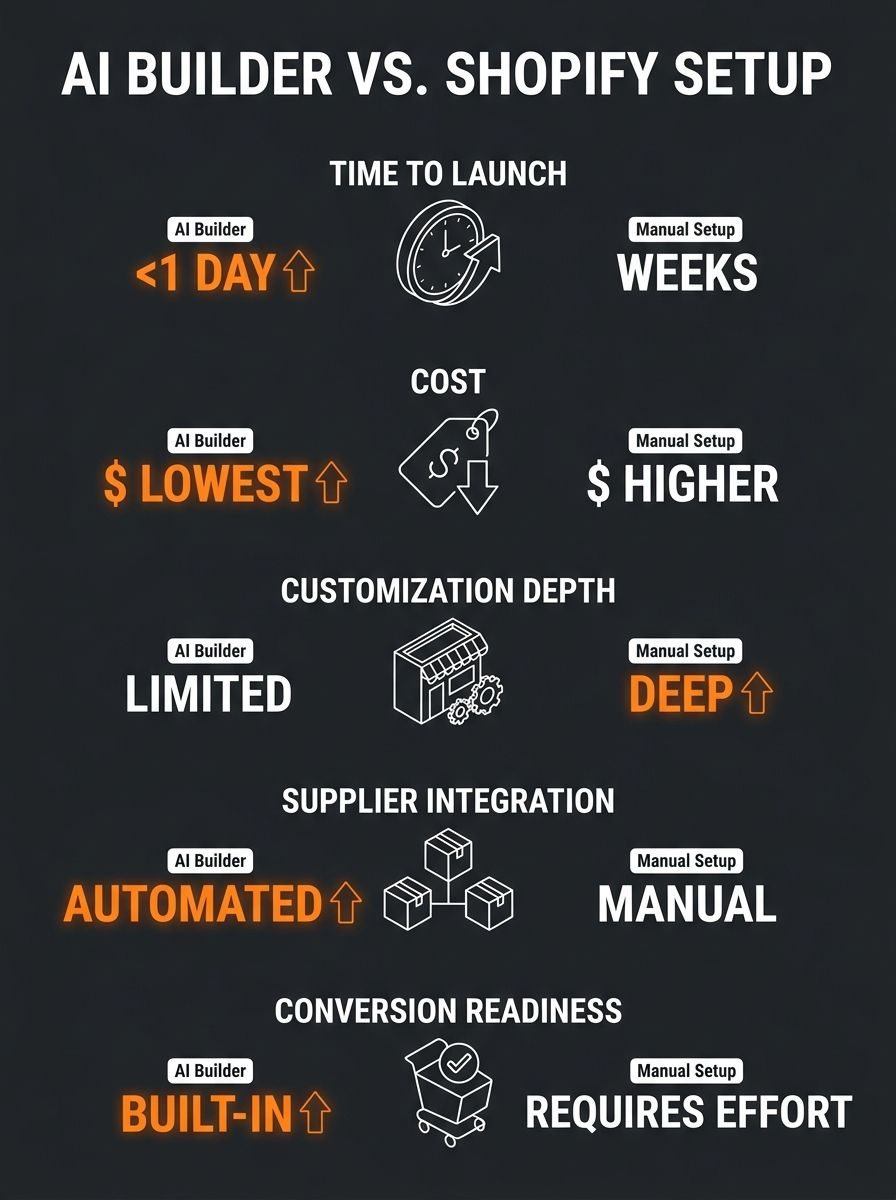
Atlas AI Store Builder generates a fully functional Shopify store in under two minutes, according to a Dropmagic comparison of seven AI tools. Manual Shopify configuration typically requires 15 to 40 hours of theme work, copywriting, image editing, and SEO.
AI Store Builders vs. Manual Shopify Setup: The 2026 Speed-to-Profit Tradeoff for Dropshippers
Atlas AI Store Builder generates a fully functional Shopify store in under two minutes, according to a Dropmagic comparison of seven AI tools. Manual Shopify configuration typically requires 15 to 40 hours of theme work, copywriting, image editing, and SEO. That gap determines when your first ad dollar starts working.
The tradeoff between AI store builders for dropshipping and manual Shopify setup maps onto six decisions. Get any one of them wrong and you'll either waste weeks building by hand or launch a store that converts at half the rate it should. These rules apply whether you're launching your first store or your fifteenth.
Know your real time-cost before picking a method
A Gartner report cited by Dropmagic found that AI-powered store creation reduces average time-to-launch by 73% compared to manual methods. Shopify's own data shows merchants using AI tools launch stores up to 10x faster. But "faster to launch" and "faster to profit" are different metrics, and confusing them is the most expensive mistake in this space.
Manual Shopify setup eats time across five phases: theme selection (2-4 hours), product page creation ($0.50-$2.00 per SKU if outsourced, or 10-15 minutes each if you write them yourself), image editing (1-3 hours for a 20-product catalog), navigation and collection structure (2-4 hours), and SEO configuration (3-6 hours). A 25-SKU store built from scratch lands somewhere around 20 to 35 hours of hands-on work.
AI builders collapse that into minutes. AI Store Builder serves over 15,000 entrepreneurs with a package that includes 20 pre-loaded winning products, free advertising credits, and $3,000 in training resources. You provide a niche description, the tool generates everything: design, product pages, copywriting, images, and layout.
The time-cost calculation you actually need to run: hours saved on setup × your hourly rate, minus the revenue you'll lose from AI-generated defaults that need fixing. For a store with 25+ SKUs, manual setup at $25/hour costs $500-$875. AI setup costs $0-$50 plus 3-5 hours of cleanup. The AI path wins on raw math for almost every operator below the $100/hour threshold.
Rewrite every AI-generated product description before going live
Why do AI-built stores underperform on conversion despite looking polished? Because the product copy reads like catalog filler. An AI builder takes a product URL or niche description and generates text that's technically accurate and completely forgettable. Generic manufacturer copy tanks conversion rates, and AI-generated descriptions share the same problem: they describe features without selling outcomes.
Shopify President Harley Finkelstein has said: "The next generation of commerce tools won't just help merchants build stores — they'll build the stores for them." That's true for structure. It's wrong for copy. The descriptions AI generates need at least one editing pass where you add specific use cases, address common objections, and write like a person who has actually handled the product.
If you've already launched a store with AI-generated descriptions and your add-to-cart rate sits below 5%, the copy is the first place to audit. We've covered why generic manufacturer copy kills your conversion rate in detail. The short version: every product page needs a reason to buy this product from this store, and AI builders don't generate that.
Budget 15-30 minutes per product page for rewrites on your top 10 sellers. That's 2.5-5 hours of work that produces measurably better results than any theme tweak.
Choose your builder by supplier integration depth, not template design
PageFly offers over 120 drag-and-drop templates with CRO-focused features. That sounds impressive until you realize the template is the part of your store that matters least for profitability. What matters is whether the builder connects to your suppliers in a way that keeps inventory synced, orders flowing, and tracking numbers updating without manual babysitting.
Branvas built its entire model around this principle. As they explain, one-click product import lets you launch new SKUs in minutes instead of hours, and their tight supplier integration eliminates the overselling risk that plagues stores relying on fragmented tool stacks. A Shopify Plus agency that automated its backorder PO resolution flow reduced manual intervention from 9 steps to 2, cutting order cycle time by 17%.
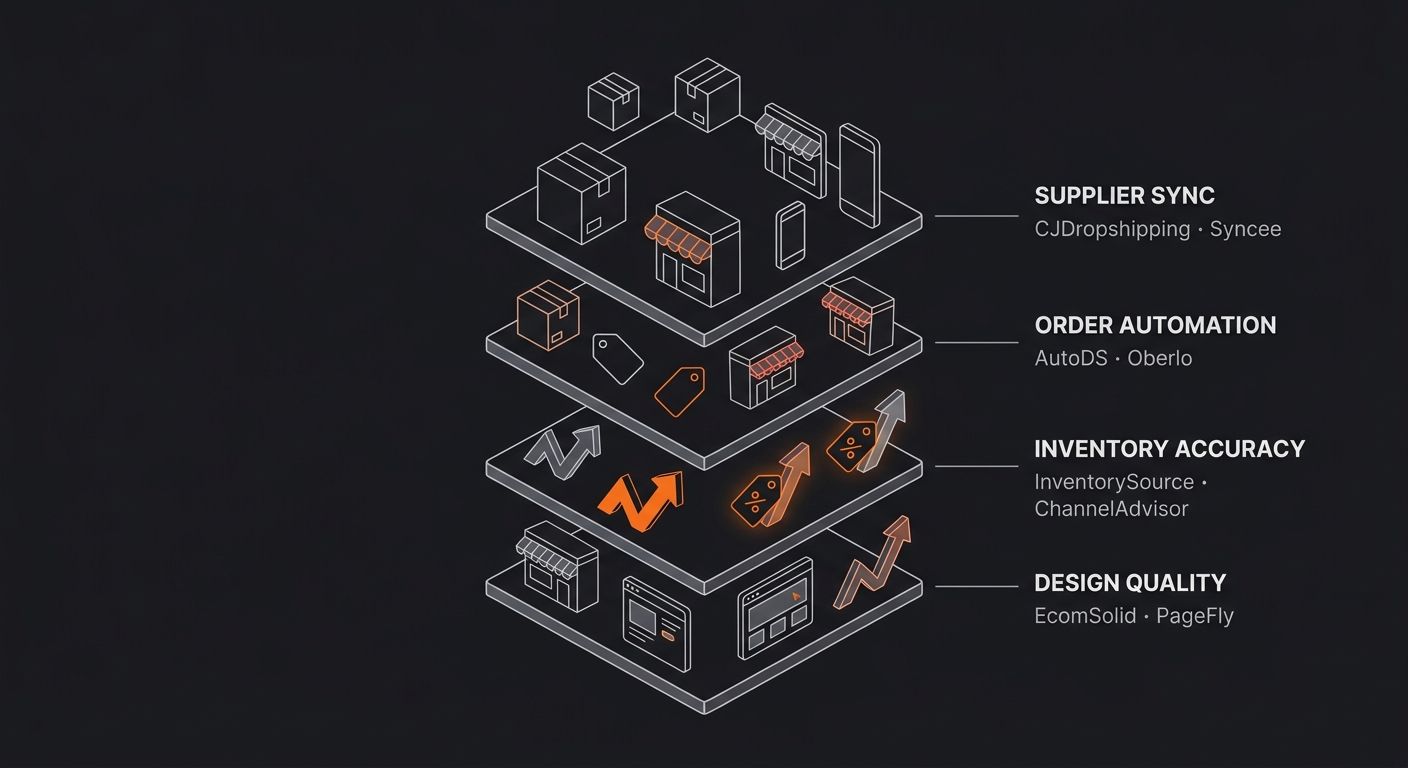
When evaluating AI store builders for dropshipping, rank your options using what I call the Integration Priority Stack: supplier sync reliability first, order automation second, inventory accuracy third, design quality fourth. A gorgeous store that drops orders between Shopify and fulfillment loses you more money than an ugly store with bulletproof automated supplier sync systems.
Budget for the app stack AI builders leave out
AI store builders generate the storefront. They don't generate the operational infrastructure that determines whether you're profitable at month three. Shopify's own guide to automated dropshipping tools identifies several operational areas where automation saves time: product discovery, listing management, order routing, inventory sync, and pricing rules. Most AI builders handle the first two. The last three require separate apps.
Here's what a typical AI-built store still needs before it's operationally complete:
Function | Example App | Monthly Cost | What Happens Without It |
|---|---|---|---|
Order routing | DSers, AutoDS | $20-$50 | Manual order placement per sale |
Inventory sync | Stock Sync, Branvas | $5-$30 | Overselling, refund costs |
Returns management | Loop Returns | $29-$155 | Customer service overload |
Review collection | Judge.me, Loox | $0-$15 | No social proof, lower CVR |
Email/SMS flows | Klaviyo, Brevo | $0-$45 | Zero retention revenue |
Hidden costs compound. Some AI builders throttle image optimization beyond 200 SKUs. Others charge $49/month for GDPR compliance features. Third-party payment gateways add 0.3%-0.8% in transaction fees on top of Shopify's standard rates. A store that looks "free to launch" with an AI builder often runs $100-$250/month in operational apps before you factor in ad spend.
When tracking where your post-sale margin actually goes, these app costs frequently account for 8-15% of gross revenue on stores doing under $5,000/month.
Test checkout on three devices before spending a cent on ads
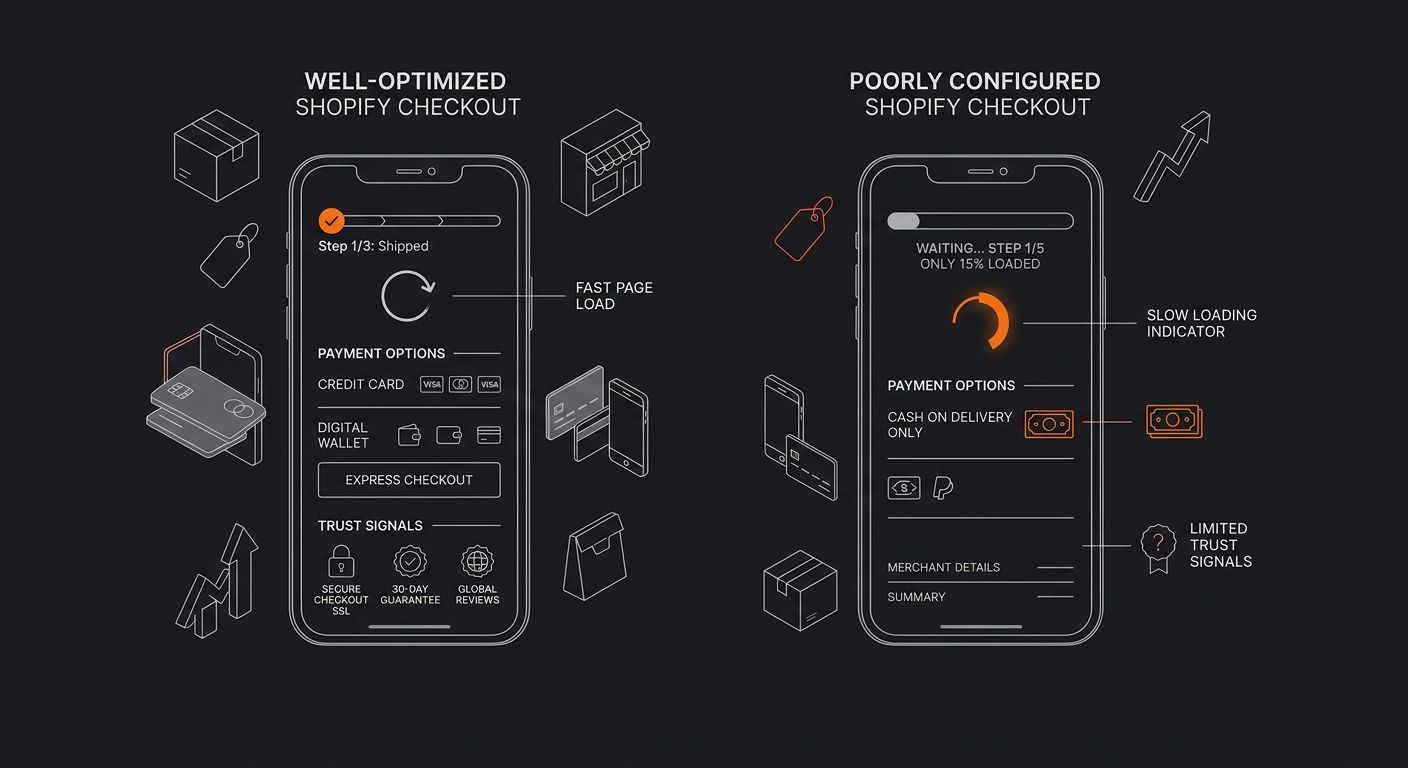
An AI builder can hit a Lighthouse performance score above 92 and still have a broken mobile checkout. The benchmark for launch readiness has three components: time-to-add-to-cart under 3 seconds on 4G, cart abandonment rate within 15% of your niche's industry average, and a complete test purchase on iPhone, Android, and desktop.
Shopify's store builder speed to launch is legitimately fast with AI tools. But speed creates a dangerous temptation to start running traffic before the checkout actually works. Run a $0 test order through every payment method you've enabled. Click every link in your order confirmation email. Verify that tracking sync fires correctly between your supplier and the customer's order status page. If you've dealt with sync failures between Shopify and fulfillment, you know that a broken tracking flow generates support tickets that eat 20-40 minutes each.
Protect your margins by auditing AI pricing defaults
AI store builders set prices using algorithmic rules that don't know your actual landed costs. If you're importing from overseas suppliers, your true unit cost includes tariffs, duties, and shipping surcharges that the builder's pricing engine ignores entirely. An AI tool that imports a product at $8 supplier cost and sets the retail price at $19.99 based on a 2.5x markup formula doesn't account for the $3.20 in shipping, $1.10 in duties, and $0.85 in transaction fees that bring your real margin down to $6.84.
The dropshipping store customization tradeoffs become sharpest here. Manual setup forces you to think about pricing because you're entering every number yourself. AI setup hides the pricing logic behind automation, and you don't discover the margin squeeze until your first month's P&L looks thin.
Build a simple spreadsheet with four columns: supplier cost, landed cost (including shipping and duties), AI-suggested retail price, and your adjusted retail price. Run every SKU through it before launch. The 30 minutes this takes will save you from discovering at scale that your top seller carries a 12% margin instead of the 40% you assumed.
When These Rules Break Down
These six rules assume you're building a store to test products, run ads, and iterate toward profitability within 30-90 days. They break down in two scenarios.
Scenario one: you're building a brand, not testing a niche. If your store IS the product (think curated lifestyle brand with custom photography, editorial content, and a specific aesthetic), manual Shopify setup gives you control that AI builders strip away. The 20-40 hours of manual work becomes an investment in differentiation that directly affects your customer lifetime value. Stores competing on community and brand identity rather than viral items need that level of control.
Scenario two: you have developer resources. Custom automation layers built with n8n, Make, or Latenode outperform both AI builders and manual setup for operators who can maintain them. The Reddit AI Agents community is right that this path demands technical comfort. But for stores processing 50+ orders daily, the operational savings compound fast enough to justify the engineering overhead.
For everyone else, the playbook is straightforward: use AI builders to generate the scaffolding in minutes, then spend 5-10 hours turning that scaffolding into a store that actually converts. The speed advantage of AI is real. The profit advantage comes from what you do with the time it saves you.
365 Dropship Editorial
Editorial team writing about E-commerce, dropshipping, and product discovery — reviews of dropshipping suppliers and platforms, trending niche guides (jewelry, beauty, pets, home, fashion), supplier due diligence, ecom operations, shipping & fulfillment strategy, product research, AOV optimization, and profitable dropshipping case studies.
Related Articles
How to Start Dropshipping: A Beginner's Guide
Starting a dropshipping store requires three connected layers: a storefront platform (Shopify leads), a supplier automation app (DSers, Spocket, or Zendrop), and a payment-plus-shipping configuration.
AI-Powered Dropshipping: Automate Your Store
Artificial intelligence dropshipping tools can save operators 8 to 20 hours per week on inventory sync, customer support, and pricing adjustments. But the operators who profit from AI follow specific rules about where automation belongs and where it destroys value.
The Automation Tool Selection Trap: Why Feature Parity Doesn't Equal Profit Growth for Your Dropshipping Store
Feature parity — when two automation platforms check the same boxes on a comparison chart — tells you almost nothing about which tool will grow your store's contribution margin.
Explore more topics