Cuba, Tariffs & Your Supply Chain: How Geopolitical Shipping Suspensions Force Dropshippers to Rethink Supplier Diversification in 2026
Executive Order 14380, signed January 29, 2026, declared a national emergency over Cuba and introduced a tariff framework targeting any country that supplies oil to the island. For dropshippers, the fallout reaches far beyond Cuba.
Cuba, Tariffs & Your Supply Chain: How Geopolitical Shipping Suspensions Force Dropshippers to Rethink Supplier Diversification in 2026
Executive Order 14380, signed January 29, 2026, declared a national emergency over Cuba and introduced a tariff framework targeting any country that supplies oil to the island. For dropshippers, the fallout reaches far beyond Cuba. Geopolitical shipping disruptions are cascading through carrier networks, port access, and landed costs in ways that punish single-source supply chains.
The Maritime Rule Quietly Constraining Your Carrier Options
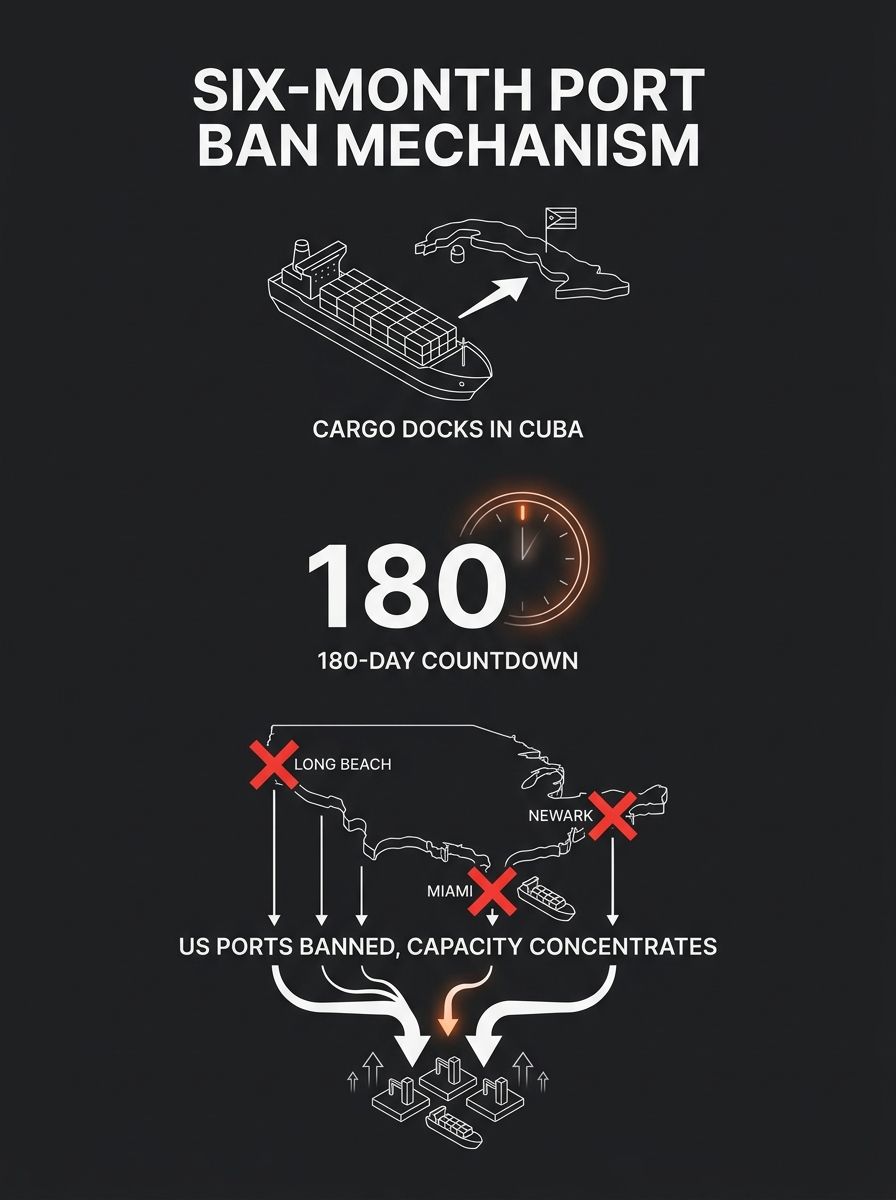
Under the U.S. embargo against Cuba, ships that dock at Cuban ports are prohibited from entering U.S. ports for six months. This rule, codified in the Cuban Liberty and Democratic Solidarity Act of 1996, sounds like a niche maritime regulation. For dropshippers routing products through carriers that serve Caribbean and Latin American trade lanes, it's a capacity constraint hiding in plain sight.
The mechanism works like this: a cargo vessel calls at Havana or Mariel, then gets locked out of every U.S. port for 180 days. Carriers that serve both Cuba and the broader Americas have to either pull vessels from Cuban routes or accept losing access to the world's largest consumer market for half a year. Most choose to avoid Cuba entirely, which concentrates available shipping capacity onto fewer vessels and fewer routes. That concentration drives up rates on the lanes dropshippers actually use.
The January 2026 emergency declaration intensified enforcement. Mexico halted oil shipments to Cuba under U.S. pressure on January 27, 2026. On March 30, a Russian tanker delivered crude to the island, and the geopolitical signal was clear: any vessel servicing Cuba-related trade risks exclusion from U.S. commerce. The State Department updated its Cuba sanctions guidance as recently as May 18, 2026, tightening the enforcement framework further. For carriers running tight margins on trans-Pacific and Caribbean routes, that risk calculus reshapes which ports they'll serve and at what price.
The practical result for your store: if your supplier ships through a carrier with any Cuba-adjacent routing, you're exposed to capacity squeezes and rate hikes that have nothing to do with your product, your niche, or your margins. This is the kind of supplier concentration risk that erodes margins when supply lines break. And Cuba's embargo enforcement is a textbook example of that dynamic in action.
Tariff Volatility Became a Permanent Operating Condition
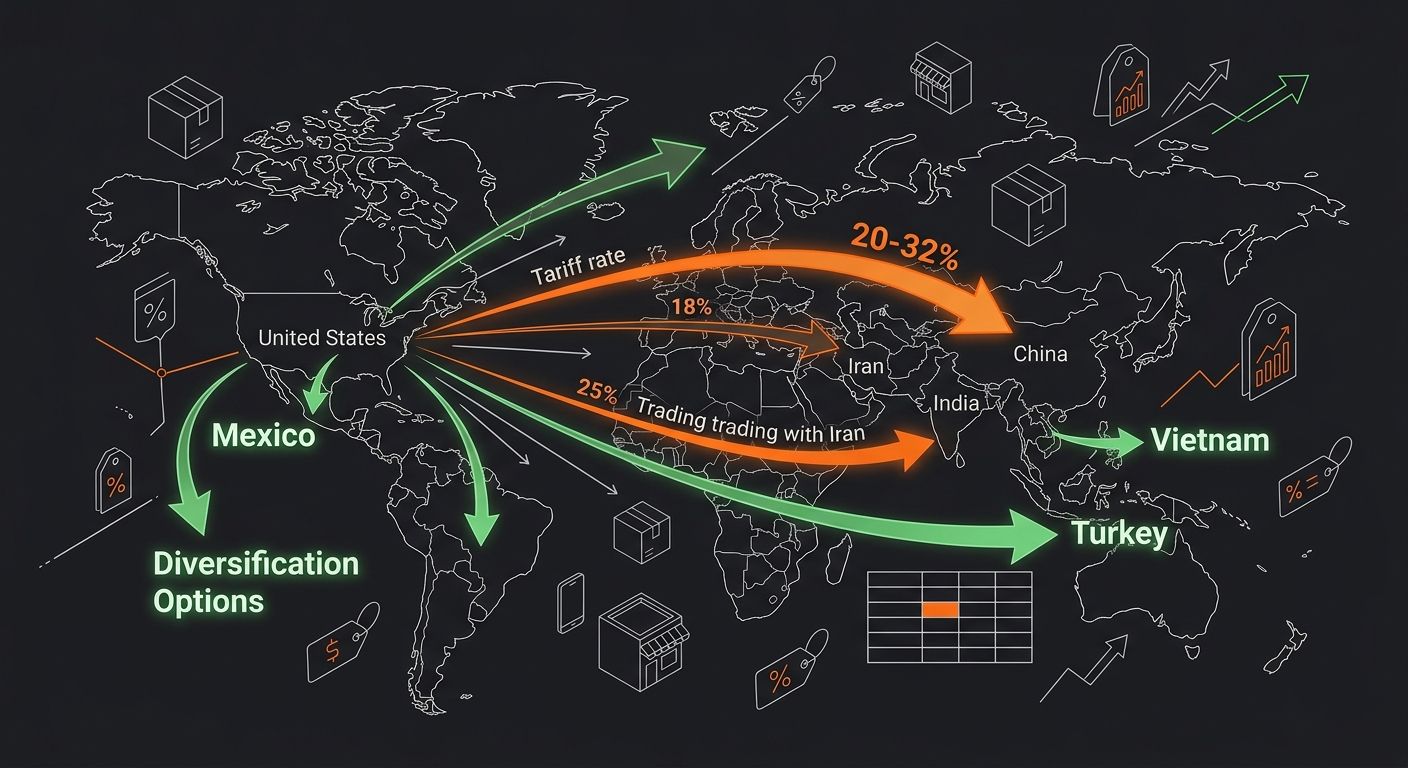
The Cuba situation doesn't exist in isolation. Current U.S. tariff rates sit at 20–32% on Chinese goods, 18% on Indian imports, and 25% on countries trading with Iran, according to the Greenberg Traurig analysis of Executive Order 14380. The U.S. Supreme Court ruled on February 20, 2026, in Learning Resources, Inc. v. Trump, that the International Emergency Economic Powers Act (IEEPA) cannot be used to impose import tariffs. That decision limits but doesn't eliminate the administration's ability to weaponize trade policy.
What this means for tariff risk management: the legal ground beneath tariff policy is shifting in real time. Even when courts strike down specific tariff authorities, new executive orders and emergency declarations create fresh uncertainty. As the Thomson Reuters Institute reported, when landed costs become unstable, companies shift toward "just-in-case strategies by holding more inventory, extending forecast horizons, or redesigning production footprints." That works for manufacturers holding warehouse space. It's a terrible fit for dropshippers who don't hold inventory at all.
Your exposure is different from a traditional retailer's. You can't pre-buy 90 days of stock at today's tariff rate and ride out a policy change. Every order your customer places triggers a new purchase from your supplier at whatever the current landed cost happens to be. If tariffs on Chinese goods jump from 20% to 32% overnight, your margin on a $45 product sourced at $12 from Shenzhen shifts by $1.44 per unit. On 500 orders a month, that's $720 in margin erosion you didn't forecast. Building a true unit cost model before selecting suppliers is the only way to see these numbers before they hit your P&L.
Research from CEPR on geopolitical risk and supply chain diversification shows that Japanese multinationals responded to rising geopolitical risk between 2009 and 2022 by diversifying production from China to ASEAN economies, rather than reshoring or fully decoupling. The same pattern applies at the micro scale for dropshippers: you don't need to abandon Chinese suppliers entirely. You need suppliers in Vietnam, Turkey, India, and Mexico so that when tariffs spike on one origin country, you can shift volume to another within days, not weeks.
What a Carrier Diversification Strategy Demands Right Now
Supply chain resilience in 2026 demands a carrier diversification strategy that goes beyond signing up for two shipping accounts. ShippyPro's 2026 analysis found that single-carrier risk is "real and measurable: rate hikes, capacity caps, and disruptions regularly hit without warning." ProShip's 2026 report argues that retailers should focus on "combining carrier diversity with reliable execution and clear performance visibility."
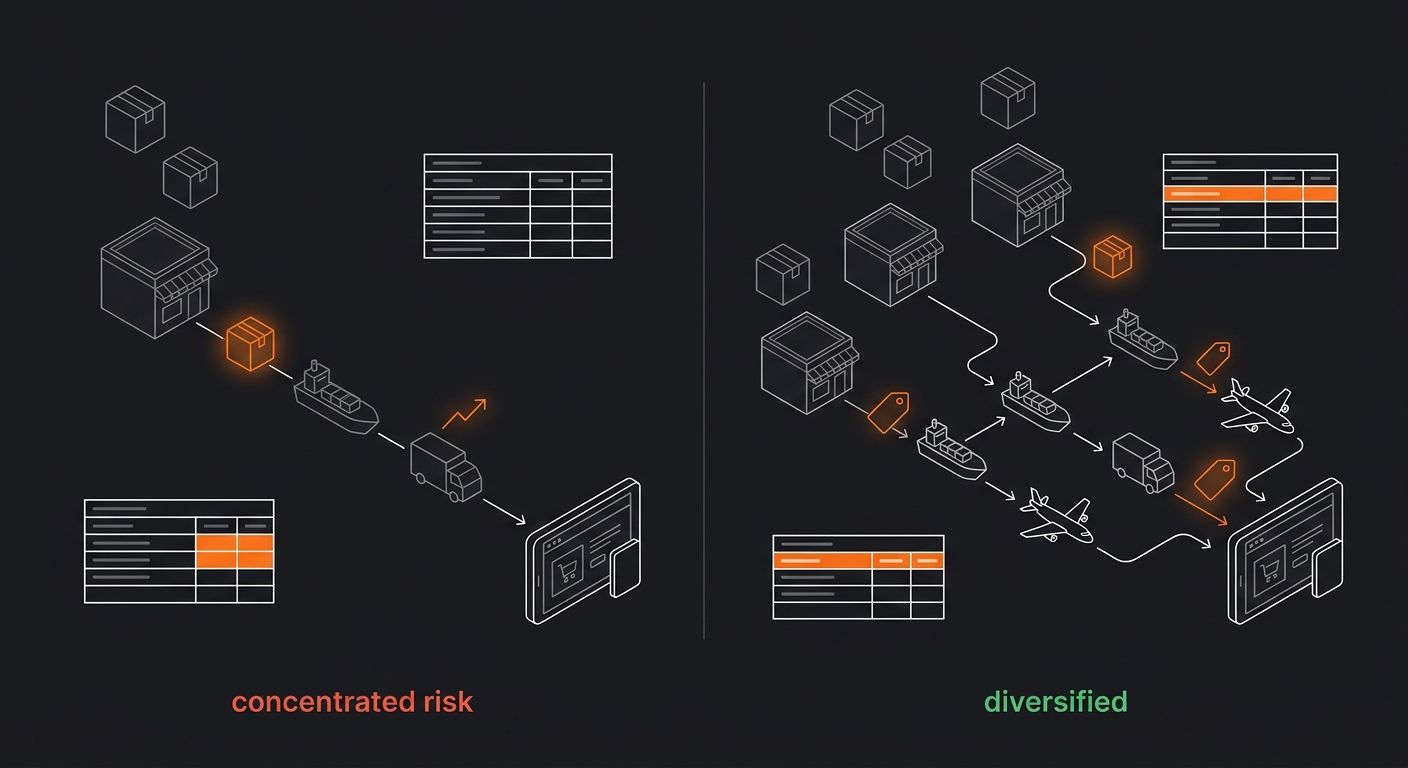
For dropshippers, this translates into concrete operational changes. Your supplier network needs genuine geographic spread. If all three of your backup suppliers ship from Guangdong Province through the same port in Shenzhen, you haven't diversified anything. You've created the illusion of diversification while maintaining identical port-level and country-level exposure. Genuine geographic spread means suppliers in at least two distinct trade-lane corridors, like China-to-U.S. Pacific and Turkey-to-U.S. Atlantic, so that a disruption in one corridor doesn't freeze your entire catalog.
Your carrier relationships also need to exist before the crisis arrives. Ivalua's 2026 procurement analysis emphasizes that "deep supplier visibility, including sub-tier mapping, is essential to understanding exposure to tariffs and anticipating upstream disruptions before they impact operations." In practice, this means running test orders through backup suppliers while your primary supplier is still performing well. You're testing packaging quality, shipping speed, tracking accuracy, and landed cost consistency before you need them, not after your primary supplier's lane gets hit with a 25% surcharge.
And your fulfillment routing needs to account for geopolitical exposure explicitly. The traditional approach of picking the cheapest supplier with the fastest shipping ignores what happens when that supplier's trade corridor gets disrupted. If you're selling pet accessories sourced from a single Chinese supplier through AliExpress standard shipping, and tariffs on Chinese goods jump to 32%, your choices are eat the margin, raise prices, or scramble for alternatives at the worst possible time. A backup supplier network built around geographic and carrier diversity gives you the third option without the scramble.
Where the Uncertainty Actually Lives
The honest problem with supply chain resilience in 2026 is that nobody knows where the next disruption will land. The Cuba situation is escalating this week. The Economist reported on May 28 that the administration faces "bad options" on the island. POLITICO noted on May 25 that economic pressure is inching closer to military action. Foreign Affairs published on May 29 that a deal with Washington may be Cuba's only remaining path. Whether this escalates into broader Caribbean shipping restrictions, additional tariff threats against oil-supplying nations, or a diplomatic resolution that eases pressure on trade lanes remains unknowable.
What is knowable: the structural conditions that make geopolitical shipping disruptions painful for dropshippers aren't going away regardless of what happens with Cuba. Tariff rates on Chinese goods have ranged from 20% to 32% within the same calendar year. The IEEPA ruling introduced legal uncertainty about presidential tariff authority without eliminating executive discretion over trade emergencies. And the 180-day port ban on Cuba-adjacent vessels continues to constrain carrier capacity on routes that serve the broader Americas trade.
The dropshippers who will navigate this period without margin collapse are the ones building geographic supplier diversity and carrier optionality into their operations now, while port efficiency losses continue reshaping supplier costs across every major trade lane. Geopolitical risk belongs in your unit economics model alongside COGS, shipping, and ad spend. Treating a 20% tariff on your sole Chinese supplier as a fixed cost rather than a variable that could jump by 60% with a single executive order is the most expensive assumption a dropshipper can make in this environment.
365 Dropship Editorial
Editorial team writing about E-commerce, dropshipping, and product discovery — reviews of dropshipping suppliers and platforms, trending niche guides (jewelry, beauty, pets, home, fashion), supplier due diligence, ecom operations, shipping & fulfillment strategy, product research, AOV optimization, and profitable dropshipping case studies.
Related Articles
Bunker Fuel Shocks & Last-Mile Economics: Why Global Port Disruptions Are Reshaping Dropshipping Unit Economics in 2026
On February 28, 2026, the Strait of Hormuz closed to commercial shipping traffic as the Iran conflict escalated into a direct naval blockade. Over 90% of crude and refined product exports from the Persian Gulf were cut off within 72 hours.

Shipping Fuel Shock & Margin Math: How Rising Port Costs Are Reshaping Dropshipping Economics in 2026
Maersk disclosed $500 million per month in additional fuel costs on May 7, 2026, driven by the closure of the Strait of Hormuz and the resulting scramble for bunker fuel outside the Persian Gulf.
Freight Rate Inflation and AI Chip Demand: How Dropshippers Should Adjust Shipping Strategy in H2 2026
Global air freight capacity sits roughly 9% below pre-conflict levels according to DSV logistics data, while AI chip shipments growing at 30% annually absorb the remaining space. Dropshippers are competing for cargo slots against hyperscaler procurement teams with functionally unlimited budgets.
Explore more topics