The Supplier Audit Trap: Why Automation Tools Hide Quality Red Flags Until Your First 100 Orders
DSers, Spocket, and Zendrop all surface supplier scores built from the same thin data: listing age, order volume, and aggregate star ratings.

The Supplier Audit Trap: Why Automation Tools Hide Quality Red Flags Until Your First 100 Orders
DSers, Spocket, and Zendrop all surface supplier scores built from the same thin data: listing age, order volume, and aggregate star ratings. None of these metrics measure what actually breaks your store — inconsistent product quality, packaging swaps, and undisclosed stockouts that trigger chargebacks after your first 50 to 100 fulfilled orders. The automation tool blind spots are structural, and they cost operators real margin before any red flag appears in a dashboard.
The Green Dashboard and Its Missing Inputs
Automation platforms grade suppliers on a narrow set of signals that look reassuring on screen but miss the variables that determine whether your fulfillment holds up under real order volume. The typical supplier scorecard inside a tool like DSers or AutoDS pulls from four data points: overall star rating, store age (months active), total transaction count, and average shipping time as reported by the platform. That's it.
What's absent from that scoring model is everything that matters for supplier quality auditing at scale: batch-to-batch consistency, defect rates per SKU, packaging accuracy, communication response time under load, and whether the supplier actually holds inventory versus dropshipping from a third party themselves. Advanced Purchasing Dynamics published an analysis of autonomous procurement agents and found that these systems assume a level of data quality that most procurement setups don't have. Variability in data formats, missing fields, and inconsistent definitions create false outputs — and autonomous agents "often rank suppliers incorrectly" as a result.
That finding applies directly to the dropshipping automation stack. When your tool shows a supplier with a 4.8-star rating and 12,000+ orders, you're looking at a composite number that blends buyers who ordered one unit of a phone case with buyers who ordered 500 units of a custom-printed product. The score tells you nothing about performance at your order profile.
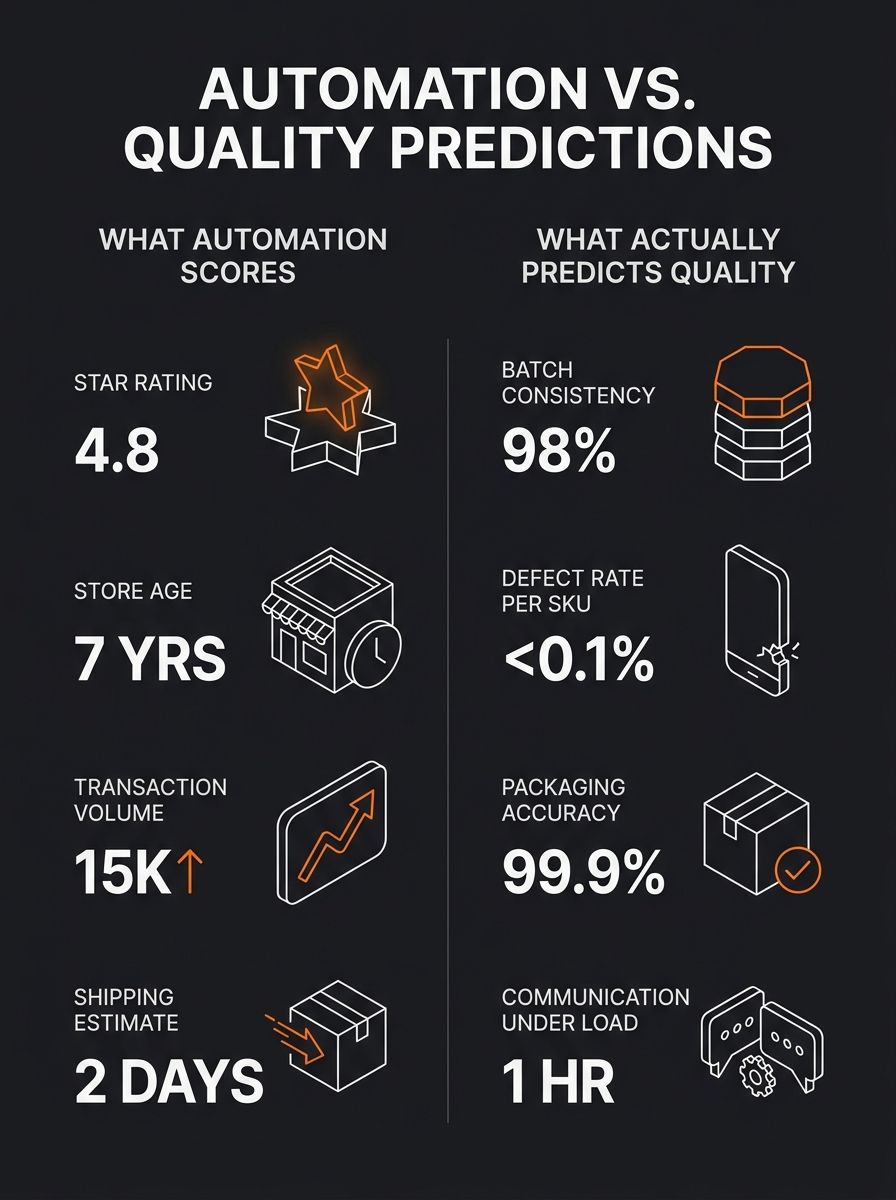
And the gap between what automation checks and what you need checked widens as your order count grows. A supplier who handles 5 orders a week flawlessly can fall apart at 25 orders a week — different production batches, different warehouse staff, different packaging materials. Your automation tool scores them identically at both volumes because it never measures the transition.
Orders 1 Through 30: The Honeymoon Window
The first 30 orders from a new supplier almost always go well, and that's precisely the problem. Suppliers on AliExpress and similar marketplaces understand that early orders from a new dropshipping buyer represent a trial period. AutoDS's own supplier guide documents that AliExpress hosts flaky suppliers with poor communication or sudden stockouts that halt business momentum — but those behaviors rarely surface in the first batch.
During orders 1 through 30, the supplier is typically pulling from current, in-stock inventory. Production batches haven't rotated. The items you receive (or your customers receive) match the listing photos. Shipping times land within the quoted window. Your automation dashboard shows green across every metric: on-time rate above 95%, no disputes, no refund requests.
This is the window where most operators lock in a supplier and move on to the next problem — ad spend, landing page optimization, email flows. The supplier question feels "solved." But the data your tool collected during this period is statistically meaningless for predicting performance at 100+ orders. A sample of 30 shipments across a 3-to-4-week window captures one production batch, one logistics corridor, and one level of supplier attention.
If you've dealt with oversell events caused by sync lag, you already know how thin the data layer is between your store and your supplier's actual inventory. The same thinness applies to quality signals. Your automation platform polls stock status, not quality status.
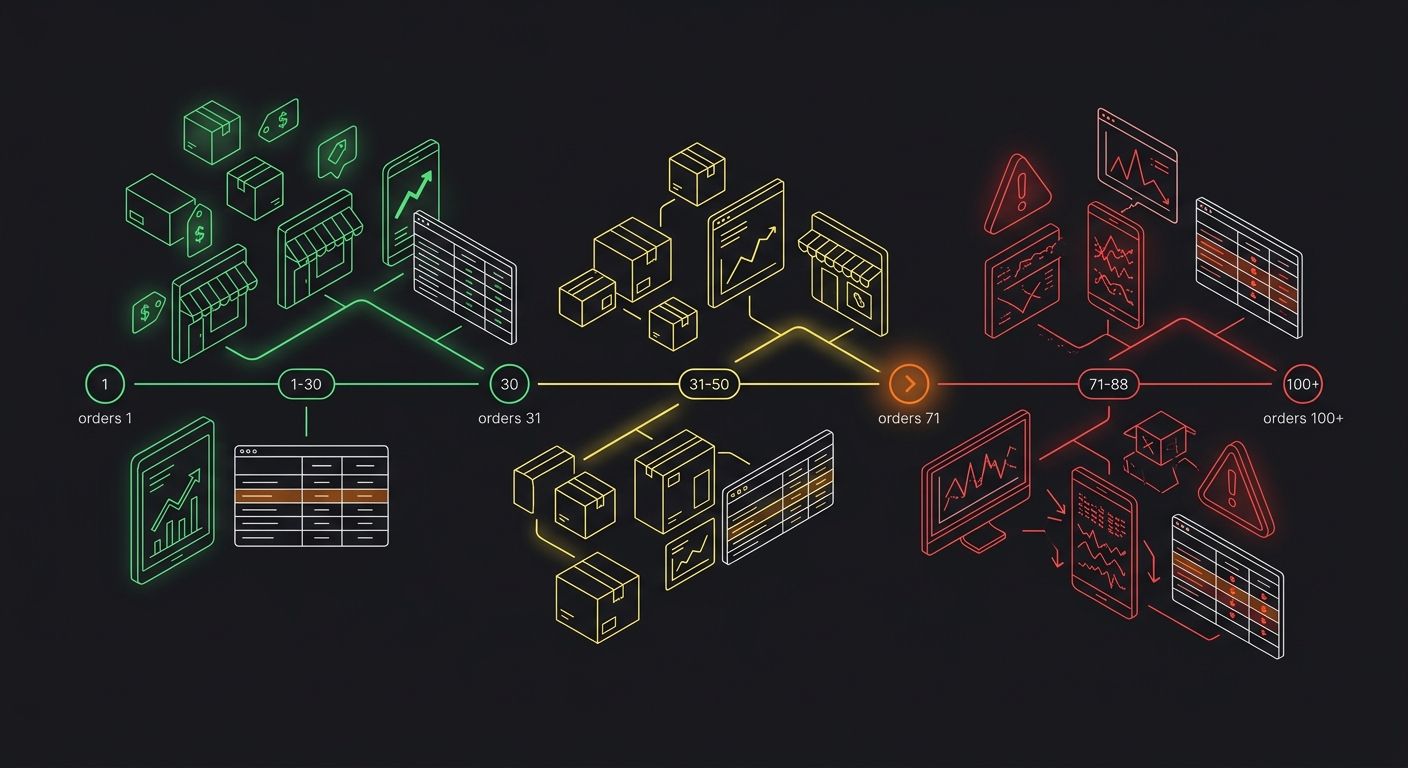
Orders 31 Through 100: Where the Scoring Model Cracks
Between order 31 and order 100, three things typically change at the supplier level, and none of them generate alerts in your automation tool.
Production batch rotation. The supplier exhausts the inventory batch that matched your initial test orders. New batches arrive from a different sub-supplier or factory run. Material weight shifts by 10-15%. Color accuracy drifts. Stitching patterns change on apparel. Your tool doesn't photograph incoming product — it tracks whether a tracking number was generated.
Attention reallocation. Your account is no longer new. The supplier now has 15 other dropshippers ordering the same SKU. Response times in chat stretch from 4 hours to 18 hours, then to 48 hours. Your tool logs shipping confirmations but doesn't measure communication latency or willingness to resolve issues pre-shipment.
Stealth stockouts. The supplier runs out of a variant (size medium in black, for example) and either ships a substitute without notification or delays fulfillment by 5-7 days while sourcing from another vendor. Your automation tool sees the delay but categorizes it as a shipping variance, not an inventory problem. The distinction matters enormously for oversell prevention — a shipping delay resolves itself, but a stealth stockout means you're selling product that doesn't exist in your supplier's warehouse.
HowToRobot's analysis of automation and quality outcomes found that too many projects fall short because quality wasn't prioritized in the early stages, "leaving manufacturers with automation that improves efficiency but doesn't tackle their quality issues." That's the exact dynamic playing out in your dropshipping tool: the automation handles order routing, tracking sync, and price monitoring efficiently. Quality assessment was never in scope.
By order 75 or 80, your refund rate has climbed from under 2% to 6-8%. Your PayPal dispute ratio is creeping toward the 1.5% threshold that triggers account review. Customer reviews on your store are trending negative. And your supplier dashboard still shows an overall 4.7-star rating because it's pulling from 12,000 historical transactions that have nothing to do with your specific order profile.
The AliExpress vs. Verified Supplier Gap in Practice
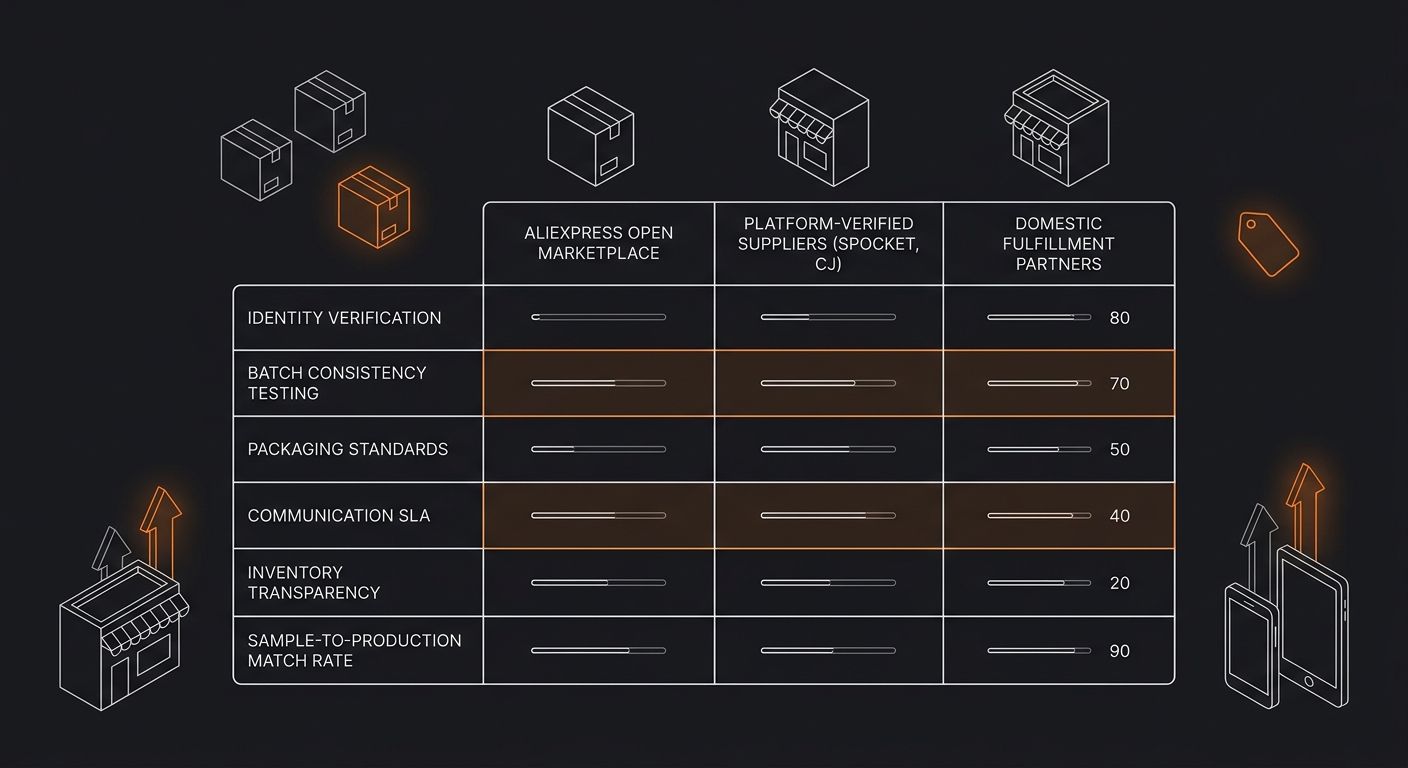
The structural difference between AliExpress and verified suppliers (Spocket's vetted catalog, CJdropshipping's warehouse-verified products, or domestic fulfillment partners) is real but frequently overstated by the platforms themselves. When operators ask about AliExpress vs verified suppliers, the honest answer involves understanding what "verified" actually means in each context.
Spocket's verification process checks that a supplier exists as a registered business, ships from the claimed location, and has sample products available for review. That's a meaningful baseline — it eliminates the ghost listings and brushing scam operators that Surfshark documented on AliExpress in 2026, where electronics from unfamiliar sellers connected to remote servers and joined click-fraud networks. But Spocket's verification doesn't test production consistency across batches or measure defect rates over time. It's an identity check, not a quality audit.
CJdropshipping warehouses product in their own facilities, which gives them a layer of inbound quality control that AliExpress doesn't provide. The trade-off is a narrower catalog and 3-7% higher unit costs on equivalent SKUs. For operators with disciplined margin targets, that cost premium often pays for itself through lower return rates and fewer customer service hours.
Domestic US-based fulfillment partners represent the strongest fulfillment risk assessment position — you can order samples from the same production runs your customers receive, visit the warehouse, and inspect packaging standards in person. The unit economics shift dramatically, as we've covered in our breakdown of how domestic suppliers reshape dropshipping margins, but the quality visibility is incomparably better.
The takeaway: every tier of supplier verification reduces one category of risk (fraud, identity, location) without addressing the category that actually generates chargebacks and refund losses (product consistency and fulfillment accuracy over time).
The Manual Audit Protocol That Catches What Dashboards Miss
The operators who avoid the 100-order trap run a parallel audit process that their automation tools don't handle. This manual layer adds about 2 hours of work per new supplier per month, and it's the difference between catching a quality degradation at order 40 versus discovering it at order 120 through a spike in PayPal disputes.
Kodiak Hub's supplier audit framework breaks the process into structured workflows connecting planning, execution, evidence collection, and corrective action. You don't need enterprise audit software to apply the same logic at a dropshipping scale. The workflow translates to four concrete checks:
Sample re-orders at defined intervals. Order your own product from the supplier at order 25, order 60, and order 100. Ship it to yourself. Compare it against the original sample you evaluated before listing. Photograph both side by side. If material weight, color, or construction has drifted, you've caught the batch rotation problem before your customers catch it for you.
Communication stress tests. Send the supplier a detailed question about a specific variant at 9 PM their local time. Measure response time. Then send a follow-up asking about a hypothetical bulk order. Suppliers who are stretched thin across too many clients will reveal it through delayed or generic responses. Operators who've dealt with supplier communication breakdowns mid-campaign know this test is cheap insurance.
Inventory verification pings. Ask the supplier to confirm exact stock counts for your top 3 SKUs, broken down by variant. Compare their answer to what your automation tool shows as available. Discrepancies here are an early warning for stealth stockouts. If the supplier can't provide variant-level counts within 24 hours, their inventory management system isn't reliable enough to support your order volume.
Dispute-to-order ratio tracking outside the platform. Your automation tool tracks overall order metrics, but you need a separate spreadsheet that logs every customer complaint, every "item not as described" message, and every refund request mapped to the specific supplier and SKU. A 3% dispute rate across all orders might look acceptable in aggregate while hiding a 12% dispute rate on one supplier's product line.
When you're setting up automation for your store, build these manual checkpoints into your operations calendar from day one. The automation handles order routing, price syncing, and tracking updates well. Supplier quality auditing requires human judgment applied at regular intervals — no current tool replaces it.
The 100-Order Threshold as a Decision Gate
The pattern described here isn't universal across every supplier or every product category. Commoditized goods with simple construction (phone cases, cable organizers, basic accessories) show less batch variance than products with textile components, mixed materials, or electronic internals. But the structural problem with automation tool blind spots applies regardless of category: the tools measure logistics performance, not product quality, and they report historical averages rather than trend-line shifts.
Treating order 100 as a formal decision gate — continue, replace, or dual-source this supplier — forces a review cadence that automation dashboards don't impose. By order 100, you have enough data from your manual audits to assess batch consistency, communication reliability, and inventory accuracy under real load. Operators who've been through rebuilding a supplier stack after a margin shock understand that the cost of switching suppliers at order 100 is a fraction of the cost at order 500, when your refund rate has already damaged your store's review profile and your payment processor's trust score.
The audit doesn't need to be elaborate. It needs to exist as a defined step in your operations, separate from whatever your automation platform reports. The tools are good at what they do. They're measuring the wrong things for quality, and they'll keep measuring the wrong things until someone builds a supplier scoring model that incorporates defect rates, batch sampling, and communication latency as first-class inputs. Until that tool exists, the gap is yours to fill manually.
365 Dropship Editorial
Editorial team writing about E-commerce, dropshipping, and product discovery — reviews of dropshipping suppliers and platforms, trending niche guides (jewelry, beauty, pets, home, fashion), supplier due diligence, ecom operations, shipping & fulfillment strategy, product research, AOV optimization, and profitable dropshipping case studies.
Related Articles

The Supplier Scorecard Audit: Building a Quality Matrix That Catches Red Flags Before Your First 100 Orders
Procurement scoring frameworks use a 0-100 scale where any supplier below 60 earns "red" status, meaning business on hold and corrective action required.

Best AliExpress Dropshipping Suppliers 2024
Three sourcing paths dominate the AliExpress dropshipping supplier landscape: manual vetting directly on the platform, automation tools like DSers and AutoDS layered on top of AliExpress, and hybrid fulfillment services such as CJDropshipping, Spocket, and Zendrop that pull from AliExpress catalogs

AliExpress and Dropshipping: Complete Guide
AliExpress dropshipping is a retail fulfillment method where your online store forwards each customer order to an AliExpress supplier who ships directly to the buyer. You hold zero inventory.
Explore more topics