From 22% to 41% Gross Margin: How One Operator Rebuilt Their Supplier Stack After a Tariff Shock Broke Their Unit Economics
A tariff shock that eliminates the de minimis exemption and adds 10% to landed costs can collapse a dropshipping store's gross margin from a workable 30-35% to the low 20s overnight.
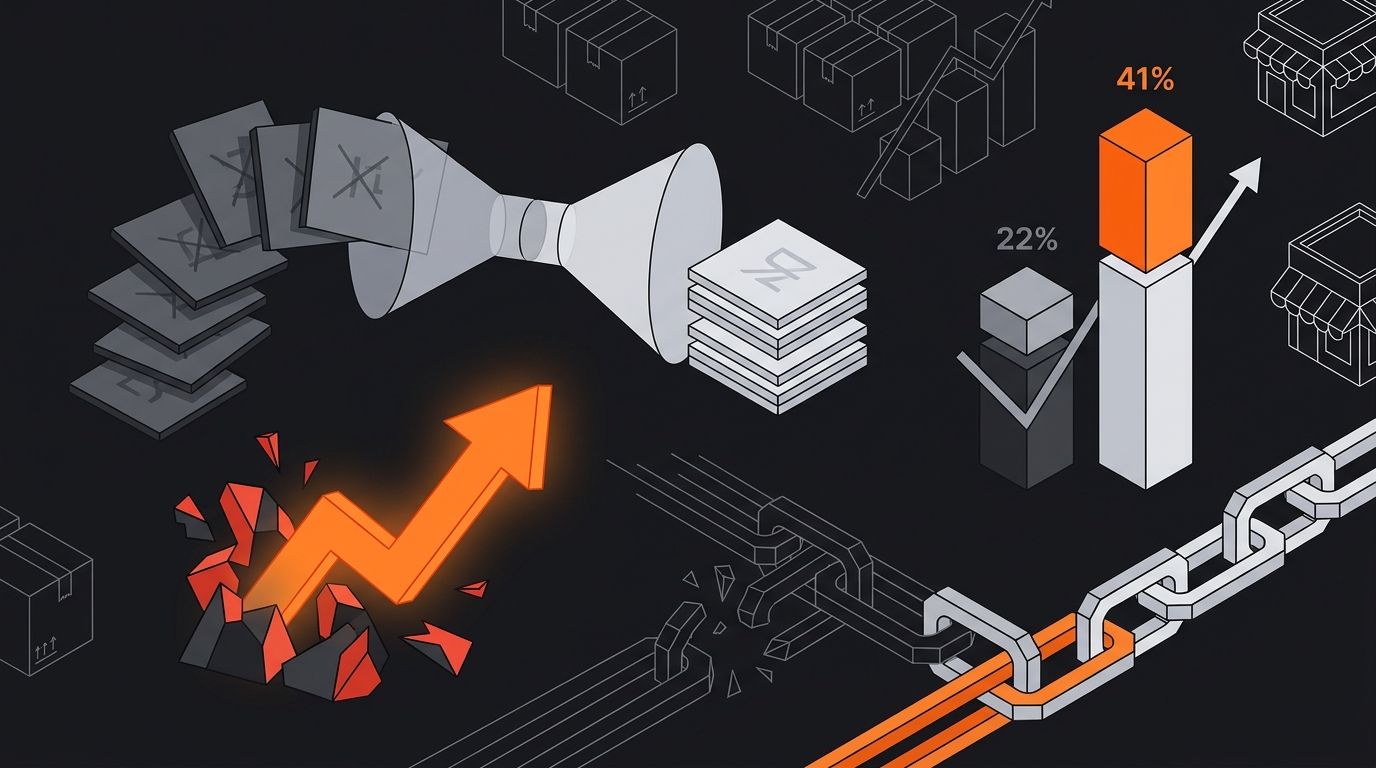
From 22% to 41% Gross Margin: How One Operator Rebuilt Their Supplier Stack After a Tariff Shock Broke Their Unit Economics
A tariff shock that eliminates the de minimis exemption and adds 10% to landed costs can collapse a dropshipping store's gross margin from a workable 30-35% to the low 20s overnight. Recovering requires supplier substitution across non-tariffed regions, SKU-level margin auditing, and ruthless catalog pruning.
What a 10% Cost Increase Actually Does to a Dropshipping P&L
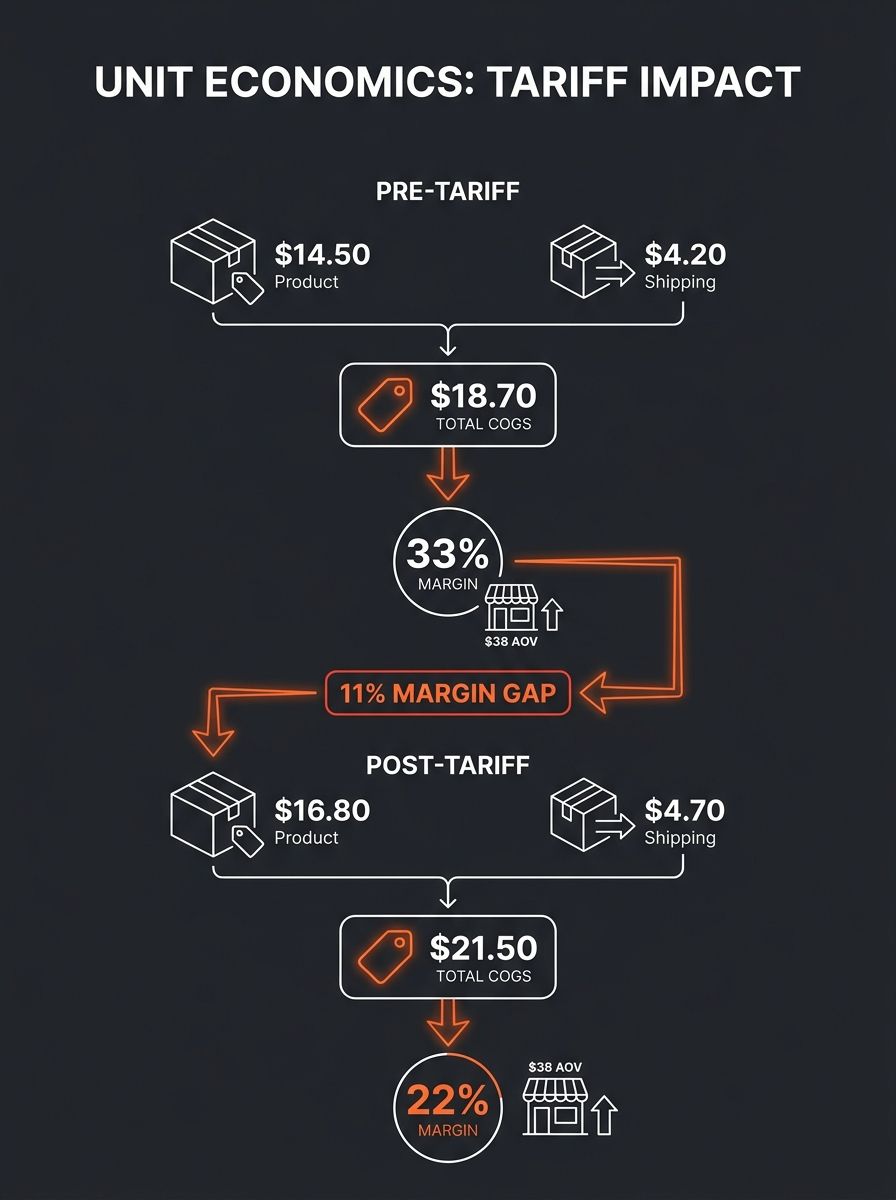
The math here is deceptively violent. Consider a store selling home décor products at a $38 average order value with a $14.50 cost of goods (COGS) and $4.20 in shipping, yielding roughly a 33% gross margin before ad spend. When all shipments entering the U.S., including those previously under the $800 de minimis threshold, became subject to tariffs, that $14.50 COGS didn't rise by 10% in isolation. Suppliers passed through tariff costs as higher wholesale prices and increased shipping rates, according to reporting from Tradelle, compounding the damage. A product that cost $14.50 to land in a customer's hands might now cost $16.80 to $17.40 when you stack the supplier's wholesale price bump, the tariff itself, and adjusted carrier surcharges.
That $2.30 to $2.90 increase per unit sounds manageable until you run it through the full P&L. On a $38 AOV, a shift from $18.70 in total COGS-plus-shipping to $21.50 drops gross margin from roughly 33% to about 22%. For a store doing $25K/month in revenue, that's approximately $2,750/month in gross profit evaporating, which is often the entire ad budget or the owner's take-home pay. The operator in this scenario didn't have a revenue problem. They had a COGS problem that made every sale worth less than the cost of acquiring the customer.
This is the core of what makes tariff shock dropshipping so destructive compared to a gradual cost increase. There's no time to test price elasticity, negotiate new terms, or find alternative suppliers before the margin damage starts compounding through every order. And you can't simply raise retail prices by 10% and expect conversion rates to hold. According to ecommerce margin analysis from Upcounting, margins in categories like beauty, supplements, and home décor vary wildly between products, which means a blanket price increase punishes your best-converting SKUs alongside your worst performers.
The Supplier Substitution Sequence That Rebuilt COGS
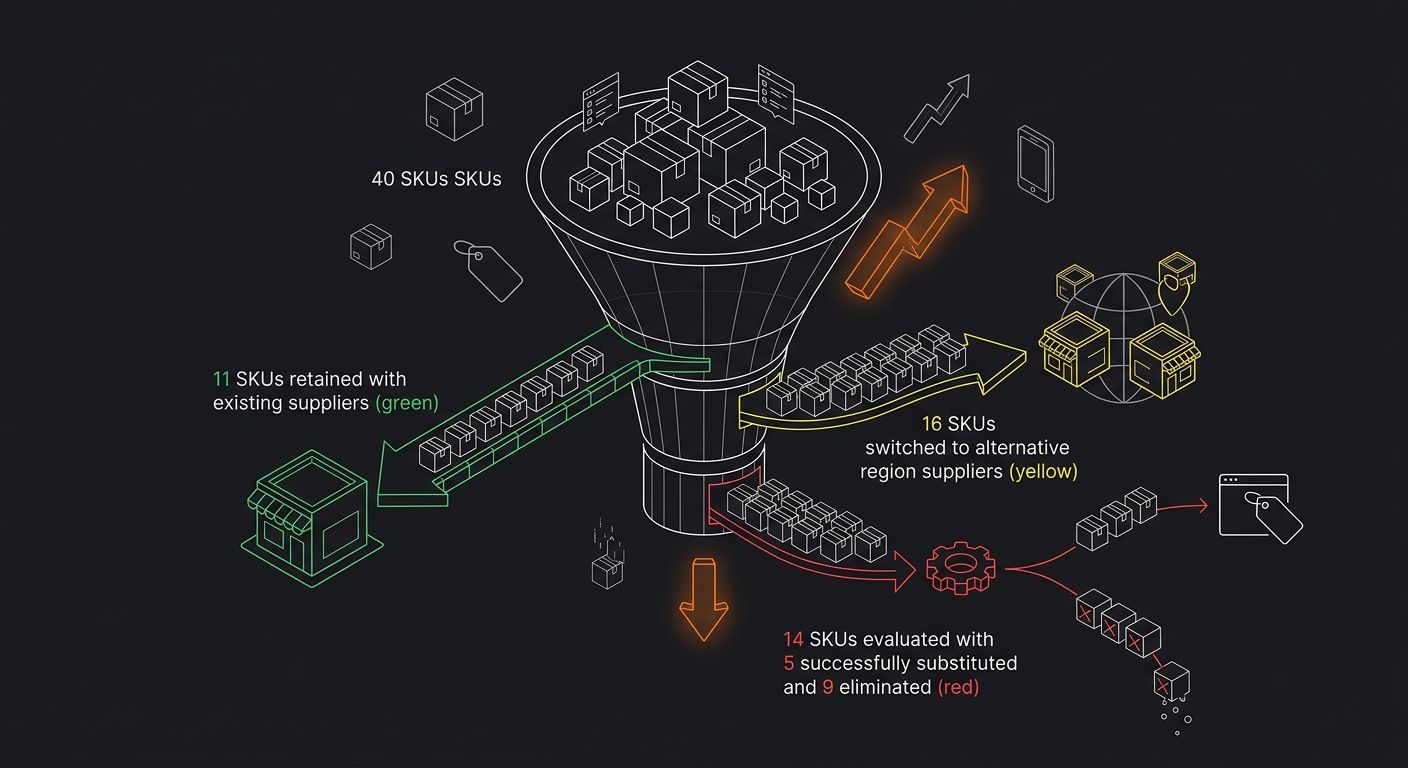
The path from 22% back to a workable gross margin didn't start with finding cheaper suppliers. It started with a SKU-level audit that most operators skip. You need to know exactly which products are still profitable at the new tariff-adjusted COGS and which ones are now underwater. In a 40-SKU catalog, the operator found that 11 products still maintained a gross margin above 28% even with the tariff increase, because those products had higher retail prices and lower weight-to-value ratios. The remaining 29 SKUs fell below 25% gross margin, and 14 of those dropped below 20%, which made them functionally unsellable once you accounted for ad spend and payment processing fees.
The supplier substitution itself followed a specific order. First, the operator sourced alternatives for the 14 worst-margin SKUs from suppliers based in countries with lower or zero tariff exposure. Industry guidance on supply chain diversification recommends building supplier bases across multiple low-risk regions, with nearshoring as a primary strategy. For U.S.-focused stores, that means Mexico, Turkey, India, and parts of Southeast Asia where tariff rates differ substantially from China. The operator tested suppliers in Turkey for textured home textiles and India for brass and ceramic décor items, landing COGS reductions of 12% to 18% compared to the tariff-adjusted Chinese supplier prices.
Second, the operator cut 9 of those 14 SKUs entirely because no alternative supplier could deliver equivalent quality at the necessary price point. This is the part that hurts. Cutting nearly a quarter of your catalog feels like shrinking the business. But as anyone who has studied the relationship between product validation and margin outcomes already knows, carrying low-margin products doesn't grow your business. It dilutes your blended margin and wastes ad spend on orders that generate almost no gross profit.
Third came renegotiation with the remaining Chinese suppliers on the 11 still-profitable SKUs. With a smaller order commitment concentrated on fewer products, the operator negotiated 4% to 7% reductions in per-unit cost by committing to consistent weekly order volumes rather than unpredictable spikes. According to the ISD's analysis of tariff mitigation timelines, supplier diversification and duty drawback programs typically take 3 to 6 months to show significant results, while inventory optimization and tariff engineering can produce benefits within 30 to 60 days. This timeline aligned almost exactly with the operator's experience: the initial COGS improvements from renegotiation and catalog pruning showed up within the first month, while the full benefit of new regional suppliers didn't materialize until month four.
How the Margin Actually Climbed to 41%
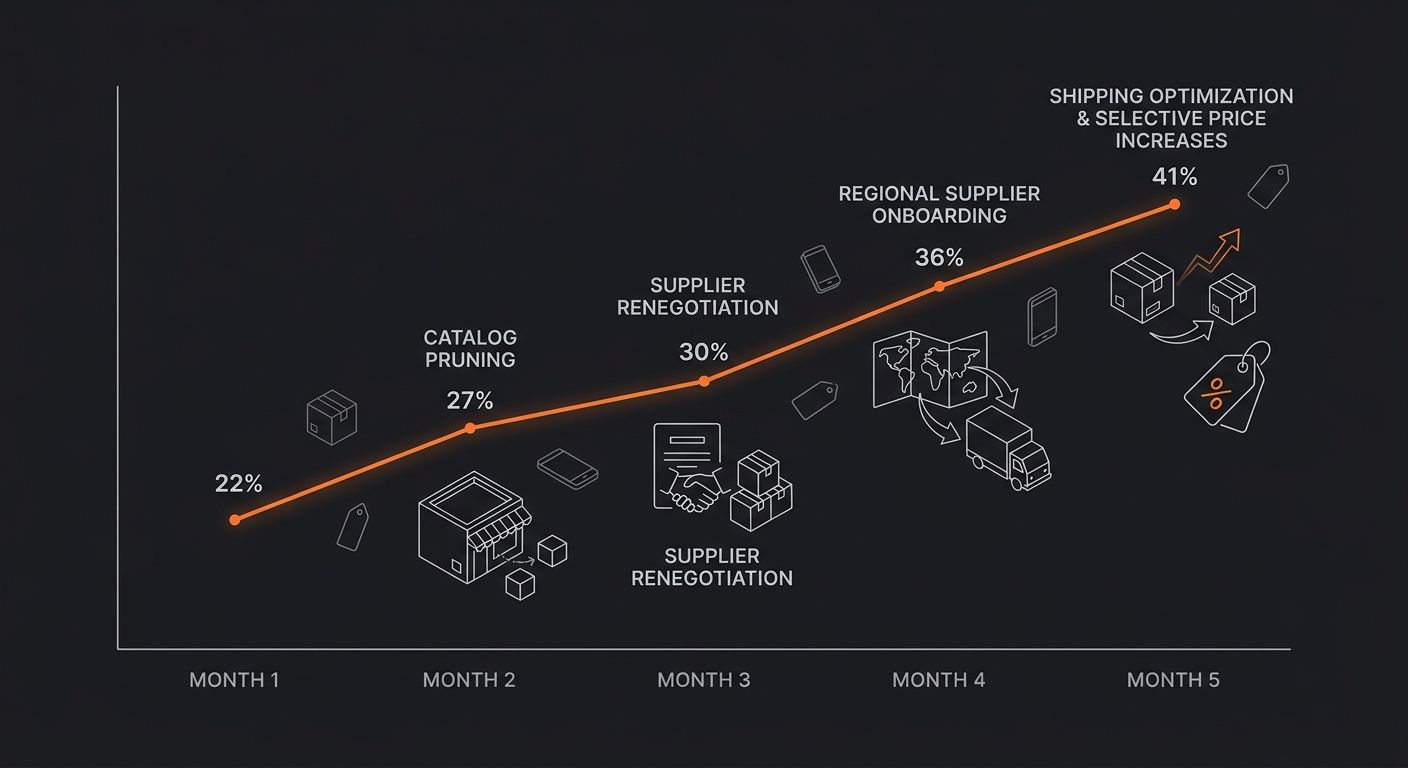
The gross margin recovery didn't come from one dramatic move. It accumulated across four distinct levers pulling in the same direction over roughly five months. The catalog pruning removed the worst-margin drag on blended COGS immediately, pushing the blended gross margin from 22% to approximately 27% within the first three weeks simply by eliminating orders that were losing money after ad spend. The renegotiated terms on the retained Chinese suppliers added another 2 to 3 percentage points by month two. And the new Turkish and Indian suppliers, once fully onboarded with reliable shipping times and quality-checked samples, brought COGS on substituted products down by an average of 15% compared to the tariff-adjusted Chinese equivalents, pushing blended margin into the 34% to 36% range by month four.
The final jump from 36% to 41% came from a move that had nothing to do with suppliers. The operator restructured their shipping cost allocation by implementing zone-based shipping strategies and consolidated fulfillment routing to reduce per-order shipping costs by $1.40 on average. They also raised prices on 6 high-demand SKUs by $3 to $5, testing the increases incrementally and finding that conversion rates dropped by less than 4% on those products. A $4 price increase on a product with $15 COGS adds more than 10 percentage points of gross margin on that SKU, and when those products represent a significant share of total orders, the blended effect is substantial.
The operator also reduced their Shopify app stack from 11 installed apps to 5, removing roughly $180/month in subscription costs that were showing up as operating expenses. That doesn't change gross margin directly, but it improves the operating margin picture that determines how much cash the business actually generates. Combined with the COGS work, the store went from a position where scaling ad spend was mathematically unprofitable to one where each incremental dollar of ad spend at a 3.2x ROAS actually contributed meaningful profit. Understanding your true CAC payback period becomes possible only when your unit economics are clean enough to support the math.
The Uncomfortable Reality About Supplier-Stack Rebuilds
This unit economics rebuild worked, but several things about it should give other operators pause before assuming they can replicate the results cleanly. The Turkey and India suppliers required 6 to 8 weeks of sample testing, quality comparison, and shipping reliability verification before the operator felt confident routing real customer orders through them. During that period, the store was running on a reduced catalog with suppressed revenue, and the owner absorbed a meaningful personal income hit. Not every operator has the runway to sustain 2 months of lower revenue while waiting for new supplier relationships to stabilize. And the due diligence process for vetting unfamiliar suppliers is genuinely time-consuming when you're evaluating factories in regions where you have no existing relationships or reference points.
The other unresolved tension is durability. Tariff policy changes again, trade agreements shift, and the suppliers you diversified into can themselves become tariff targets in a subsequent policy cycle. The operator who rebuilt from 22% to 41% gross margin did so under a specific tariff regime. If Turkey or India face new duties in 2027, the entire exercise starts over. Supplier substitution as a tariff response is real and effective, but it's a moving target rather than a permanent fix. Building genuine gross margin recovery into a dropshipping business requires treating supplier diversification as an ongoing operational discipline, not a one-time crisis response. The operators who maintain healthy margins over multi-year horizons are the ones who run SKU-level COGS audits quarterly, maintain backup supplier relationships in at least two regions, and kill underperforming products before those products kill their blended margins. The 22-to-41 story is encouraging, but the honest version includes the acknowledgment that margin defense never actually ends.
365 Dropship Editorial
Editorial team writing about E-commerce, dropshipping, and product discovery — reviews of dropshipping suppliers and platforms, trending niche guides (jewelry, beauty, pets, home, fashion), supplier due diligence, ecom operations, shipping & fulfillment strategy, product research, AOV optimization, and profitable dropshipping case studies.
Related Articles
From Pandemic Pivot to Profitable Store: The Untold Operations Lessons Behind 2020-2026 Dropshipping Success Stories
COVID-era ecommerce operators who survived past 2022 share a pattern that has nothing to do with finding the right product or running the right ad. The pattern is operational: supplier onboarding speed, cash flow reinvestment discipline, and fulfillment consolidation.
Stop Chasing 60% Margins: Why a Disciplined 30% Gross Margin Business Outperforms Most 'High-Margin' Dropshipping Stores
A 60% gross margin on a $50 dropshipped product leaves $30 before costs. After $12 in ad spend, $2 in payment processing, $1 in platform fees, and $3 in return-related losses, that $30 becomes $12 — a 24% net margin.

Cross-Border Tariffs & Import Duties: The Hidden Margin Killer Dropshippers Overlook
Every package entering the U.S. from China now triggers a full customs entry.
Explore more topics