Shopify Markets Consolidates Seven Cross-Border Configuration Layers Into Single Admin Dashboard
Seven separate market configuration layers—currency display, payment methods, domain routing, translated content, duty collection, shipping profiles, and localized pricing—can now be managed from a single Shopify admin interface, according to a June 27 beginner guide published by Racklify, a warehou

Shopify Markets Consolidates Seven Cross-Border Configuration Layers Into Single Admin Dashboard
Seven separate market configuration layers—currency display, payment methods, domain routing, translated content, duty collection, shipping profiles, and localized pricing—can now be managed from a single Shopify admin interface, according to a June 27 beginner guide published by Racklify, a warehouse comparison and logistics platform. The feature allows merchants to adapt one online store for multiple local audiences without deploying separate Shopify instances per country.
The documentation, updated by Racklify contributor Erwin Richmond Echon, positions Shopify Markets as a control center for merchants expanding beyond their domestic market. The feature addresses a common friction point: customers in international markets expect to see prices in local currency, read product descriptions in their language, and understand final costs including duties and taxes before checkout.
How Shopify Markets Handles Multi-Country Configuration
Shopify Markets bundles capabilities that merchants previously managed through separate apps or manual workflows. The feature defines markets by country or region, then applies market-specific rules across the storefront, according to Racklify's breakdown.
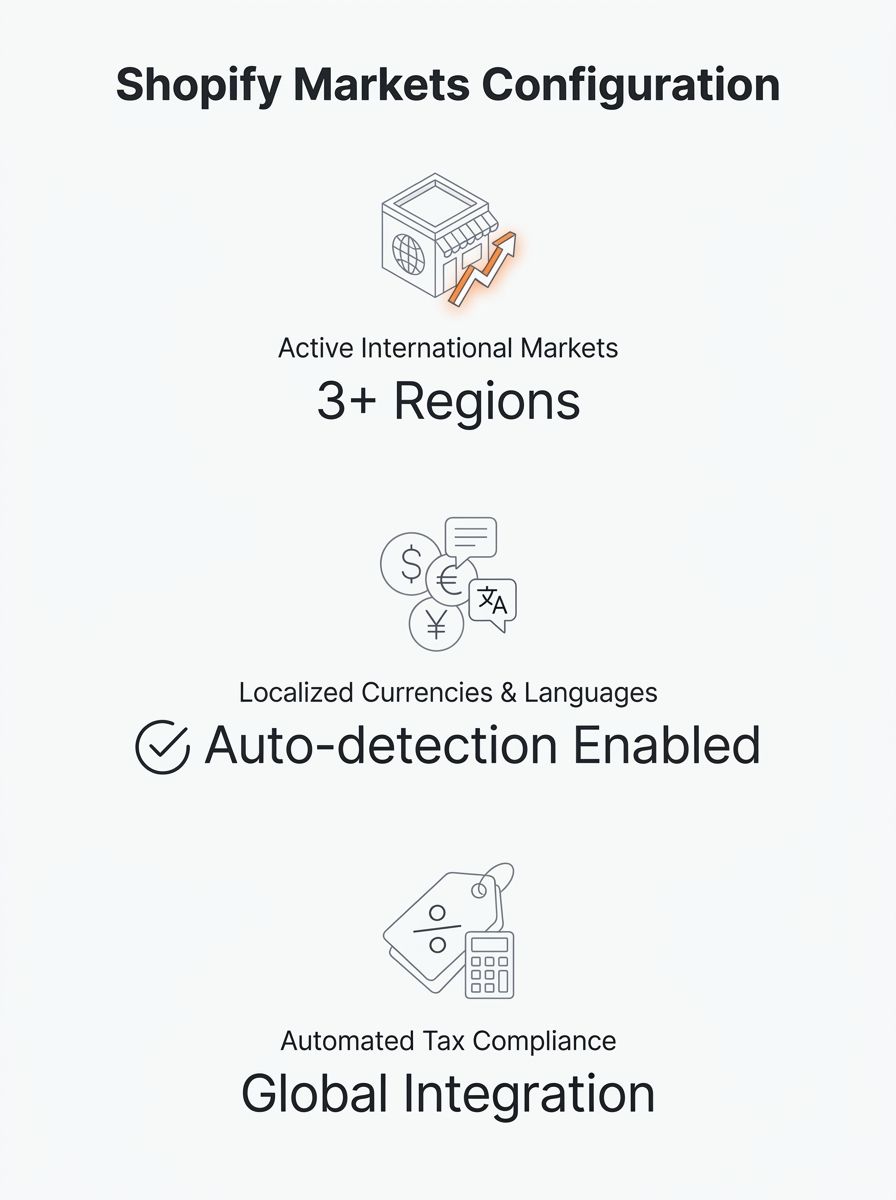
The currency and payment layer displays prices and accepts payments in local currencies while supporting region-preferred payment methods. The localization layer translates product descriptions, policy pages, and checkout flows. The compliance layer manages duties and import taxes, either displaying them at checkout or collecting them upfront so buyers see a final price with no surprises.
Domain and URL redirection automatically routes customers to the appropriate version of the store based on geolocation. Shipping and fulfillment rules apply different carriers, rates, and delivery profiles that reflect local logistics realities. The pricing strategy layer allows merchants to set custom prices per market to reflect local competition, input costs, and currency fluctuations.
Real-World Implementation Path
Racklify's guide illustrates the feature with a U.S.-based apparel brand expanding to the UK and Germany. Without Shopify Markets, the merchant would need separate Shopify stores or manual workarounds to display prices in GBP and EUR, translate content, and configure different shipping rules, the documentation states. With the feature enabled, the merchant defines the UK and Germany as distinct markets, sets currency display and payment methods for each, uploads or connects translations, and configures shipping and tax behaviors—all while analyzing sales data in one consolidated dashboard.
The platform recommends merchants start with one or two neighboring countries where demand already exists before scaling globally. The guide emphasizes testing checkout flows to verify how taxes, duties, and shipping display so customers never encounter unexpected costs at final payment. For dropshippers working with cross-border logistics partners, the feature simplifies the coordination of supplier fulfillment with customer-facing pricing and compliance layers.
Platform Limits and Margin Considerations
Racklify's documentation notes several constraints for operators evaluating the feature. Some advanced tax behaviors or checkout customizations still require third-party apps or custom code. Not every payment method is available in every market; merchants must verify supported gateways for their target regions. Export rules, privacy laws, and product restrictions vary by country, requiring consultation with local regulations and customs requirements.
International selling typically carries higher shipping costs, return logistics expenses, and compliance overhead. The guide directs merchants to track margin impact per market—a critical step for dropshippers whose domestic unit economics may not translate directly to cross-border orders. Operators who add markets without recalculating shipping costs and duty collection often discover that incremental revenue doesn't translate to incremental profit.
The feature integrates with Shopify's existing checkout and fulfillment infrastructure, allowing merchants to layer international configurations onto their current storefront without migrating platforms.
What This Means for Dropshipping Entrepreneurs
Dropshippers who have deferred international expansion due to technical complexity now have a bundled toolset within their existing Shopify subscription. The ability to serve UK, EU, Australian, or Canadian customers from one admin panel reduces the operational overhead that previously required separate storefronts or extensive app integrations.
For operators evaluating cross-border growth, Shopify Markets lowers the setup barrier but does not eliminate the margin math. Shipping cost differentials, duty and tax collection, and currency conversion friction still impact unit economics. The feature's value lies in consolidating configuration layers so merchants can test international demand without duplicating their entire tech stack.
Merchants already using Shopify for domestic sales can activate Markets incrementally—adding one or two countries, monitoring conversion rates and average order value, and expanding only when the per-market contribution margin justifies the added complexity. That stepwise approach aligns with the documented recommendation to start small and prioritize markets where demand signals already exist.

Ryan Torres
Ryan Torres is a former Amazon FBA seller turned dropshipping consultant who has generated over $2.8M in ecommerce revenue across 14 product launches. He specializes in supplier vetting, margin optimization, and scaling DTC operations for sub-$1M brands. Ryan focuses on actionable frameworks that drive measurable results for independent operators.
Related Articles
Logistics Platform Publishes Shopify Markets Setup Guide for Cross-Border Merchants
Racklify, a warehouse comparison and logistics platform, published a beginner-focused breakdown of Shopify Markets on June 26, detailing how independent merchants can configure multi-country storefronts, currency display, and duties handling from a single Shopify admin, according to the encyclopedia

Warehouse Platform Releases Shopify Markets Configuration Tutorial for Cross-Border Merchants
Independent Shopify merchants exploring international sales can now access a centralized tutorial covering Shopify Markets' seven configuration layers, following a June 29 guide release by warehouse comparison platform Racklify that breaks down multi-currency setup, domain routing, and duty collecti

Racklify Publishes Shopify Markets Setup Guide Covering Multi-Currency Configuration and Tax Display Rules for Cross-Border Sellers
Racklify published a Shopify Markets configuration guide on September 9, 2026, documenting localization features that allow merchants to manage international storefronts, multi-currency pricing, and duty display from a single Shopify admin, according to the warehouse logistics platform's encyclopedi
Explore more topics