AliExpress and Dropshipping: Complete Guide
AliExpress dropshipping is a retail fulfillment method where your online store forwards each customer order to an AliExpress supplier who ships directly to the buyer. You hold zero inventory.
AliExpress and Dropshipping: How the Fulfillment Model Actually Works
AliExpress dropshipping is a retail fulfillment method where your online store forwards each customer order to an AliExpress supplier who ships directly to the buyer. You hold zero inventory. The trade-off: shipping speed, product quality, and margin math all depend on supplier selection and the automation apps connecting the chain.
What "AliExpress Dropshipping" Actually Means
The term describes a specific fulfillment architecture. You list products sourced from AliExpress suppliers in your own store (Shopify, WooCommerce, Wix, or a marketplace like eBay). When a customer places an order, you purchase that item from the AliExpress supplier at wholesale cost, provide the customer's shipping address, and the supplier sends the product directly. Your profit is the spread between your retail price and the supplier's price plus shipping.
Shopify's own AliExpress dropshipping guide breaks the setup into four sequential steps: pick a product niche, vet suppliers using seller ratings and a test order, build a store, and connect an automation app like DSers to sync orders and inventory.
The critical distinction from wholesale: you never bulk-purchase. Each unit is bought on demand. That eliminates inventory risk but creates per-order dependencies on supplier reliability, stock accuracy, and shipping consistency.
The Order Lifecycle Under the Hood
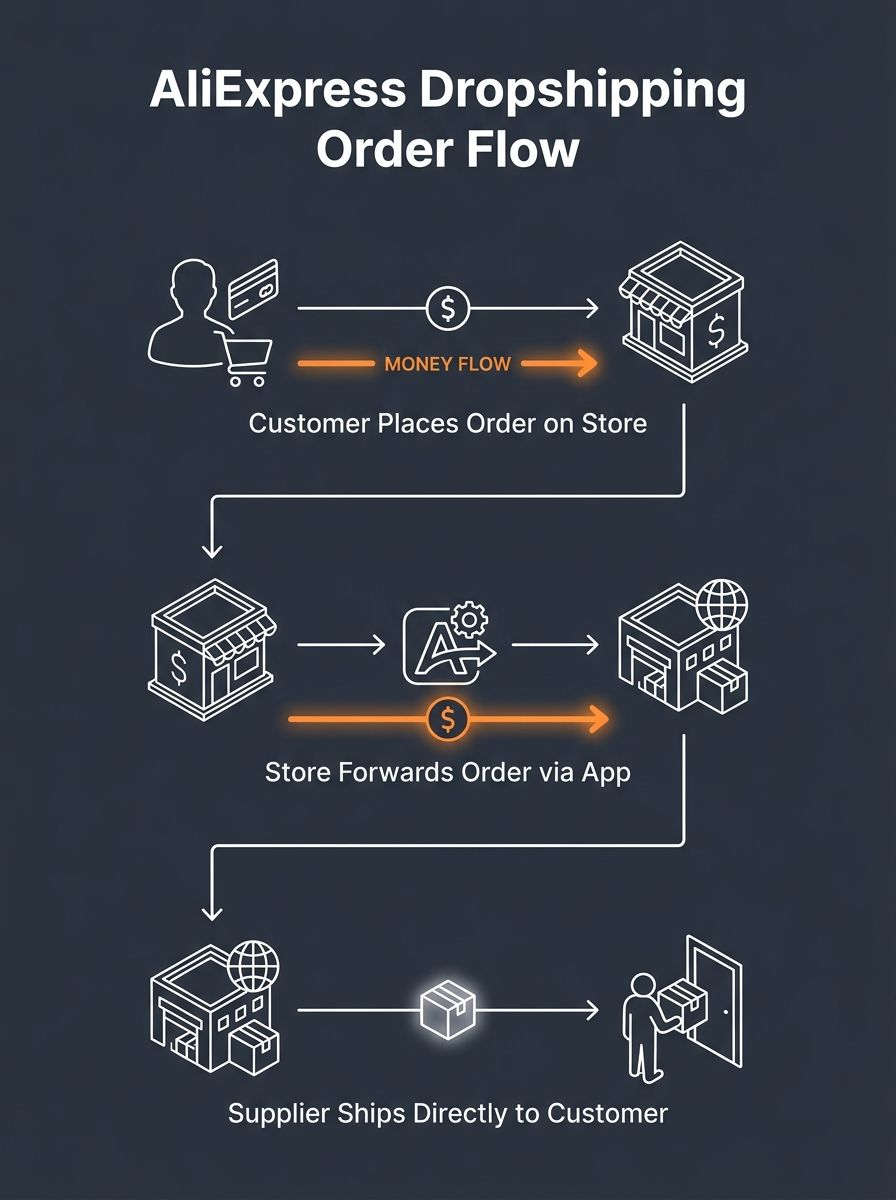
Every AliExpress and dropshipping transaction follows a five-step sequence, and understanding where each step can fail is the difference between a 30% margin and a chargeback.
Step 1: Product import. An automation app (DSers, AutoDS, Dropshipman, or AliDrop) pulls product data, images, descriptions, variants, pricing, from AliExpress into your store. The app creates a listing with your markup applied.
Step 2: Customer purchase. A buyer orders through your storefront at your retail price. Your payment processor (Stripe, PayPal, Shopify Payments) captures the funds.
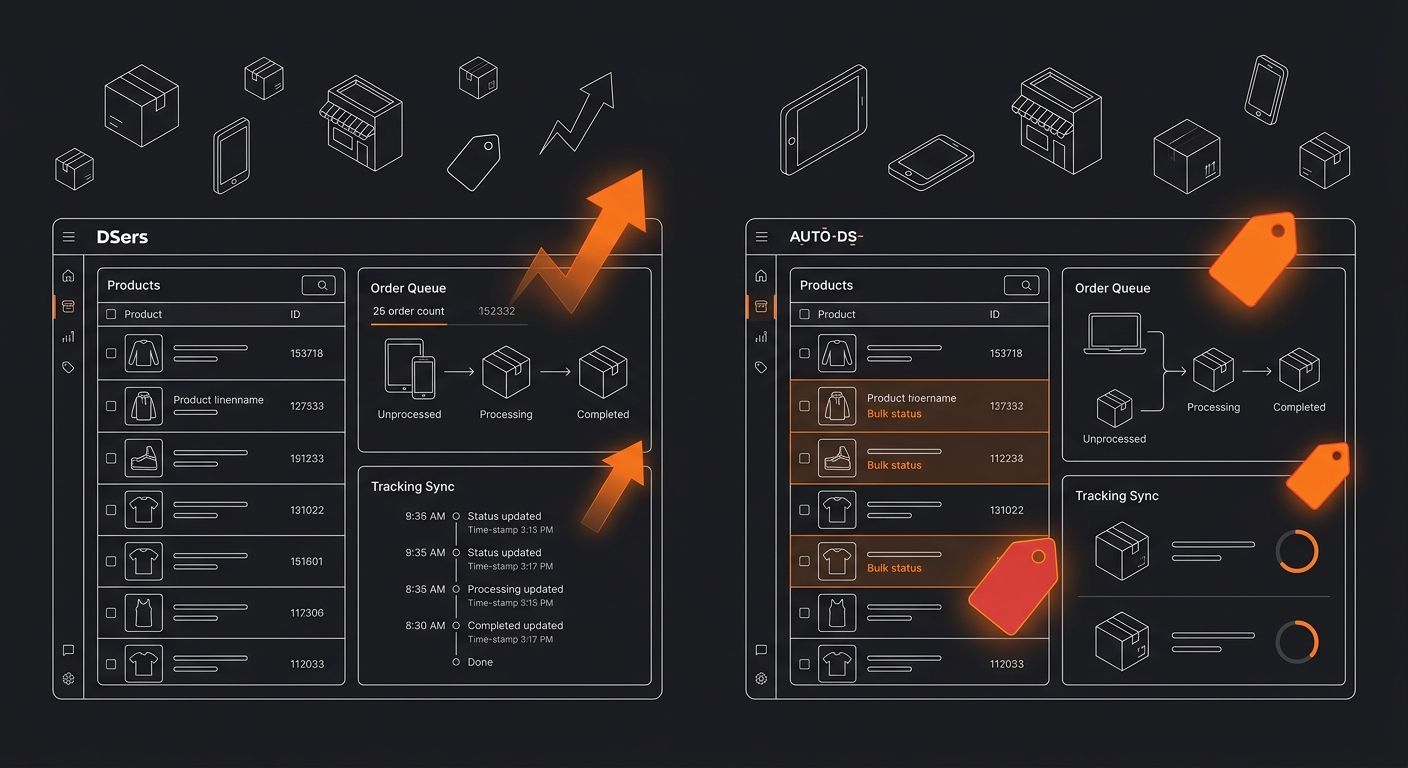
Step 3: Order forwarding. The automation app detects the new order and places a corresponding purchase on AliExpress using your payment method. DSers handles this in bulk, you can forward hundreds of orders in a single click, which is why it dominates stores processing more than 20 orders per day. The supplier receives the order with the customer's shipping address.
Step 4: Supplier fulfillment. The AliExpress seller picks, packs, and ships the product. Standard shipping averages 10-15 days. AliExpress's "Choice" program cuts that to 7-12 days, and 98% of buyers now prefer Choice-eligible orders, making non-Choice products increasingly difficult to sell.
Step 5: Tracking sync. The automation app pulls the tracking number from AliExpress and pushes it to your store, which triggers a shipping confirmation email to the customer. If the tracking number doesn't sync (common with smaller suppliers), you're manually copying and pasting, and that eats time fast.
If you're building on Shopify, we've covered the full store setup process separately.
The Automation App Layer
The apps that sit between your store and AliExpress are the actual engine of this model. Without them, you'd be copy-pasting order details into AliExpress manually, viable at 3 orders a day, impossible at 30.
App | Bulk Order Processing | US/EU Warehouse Access | Price Monitoring | Free Tier Limit |
|---|---|---|---|---|
DSers | Yes (batch) | Limited | Auto-update | 3,000 products |
AutoDS | Yes (auto) | Yes | Auto-update | None (paid only) |
AliDrop | Yes | US/EU suppliers | Manual | 25 products |
Dropshipman | Yes | Limited | Auto-update | 1,000 products |
DSers remains the default choice for most AliExpress and dropshipping stores because it's free up to 3,000 products and handles the bulk order workflow efficiently. AutoDS costs more but adds automatic order processing without manual confirmation clicks, a real time-saver past 50 daily orders. AliDrop's edge is access to US and EU-based suppliers, which solves the shipping speed problem but narrows your product catalog.
The app you choose determines your daily operational overhead. A comparison of top Shopify dropshipping apps shows the gap between free-tier limits and paid features grows meaningful above $5K monthly revenue.
Supplier Vetting Determines Everything Downstream
AliExpress hosts over 300,000 suppliers, and quality variance across them is enormous. A single defective product triggers a refund, a negative review, and potential chargeback fees of $15-25 per incident. According to AliExpress's own supplier reliability guide, product reliability depends on careful supplier selection and ongoing monitoring.
The vetting process that works uses what I'll call the Three-Gate Filter:
Gate 1, Ratings floor. Ignore any supplier below 95% positive feedback. Sort by order volume within your product niche. High volume with high ratings indicates consistent fulfillment, not a one-off viral product with inflated reviews.
Gate 2, Communication test. Message the supplier before ordering. Ask about stock levels, shipping methods, and whether they can include custom packaging inserts. Response time under 12 hours signals a supplier who's actively managing their store. More than 48 hours means they'll be unresponsive when something goes wrong.
Gate 3, Sample order. Place a real order with your own address. Measure actual shipping time (not the estimate), inspect product quality, note packaging condition. This $5-15 investment prevents you from listing a product that generates returns. AutoDS recommends building "strong, smart supplier relationships" as the foundation of any profitable store.
An important trend affecting supplier availability: 18% of active AliExpress dropshipping suppliers exited the platform in early 2026, consolidating into larger factory collectives. The suppliers still on AliExpress are generally larger and more established, but niche product availability has thinned.
Shipping Mechanics and the Margin Squeeze
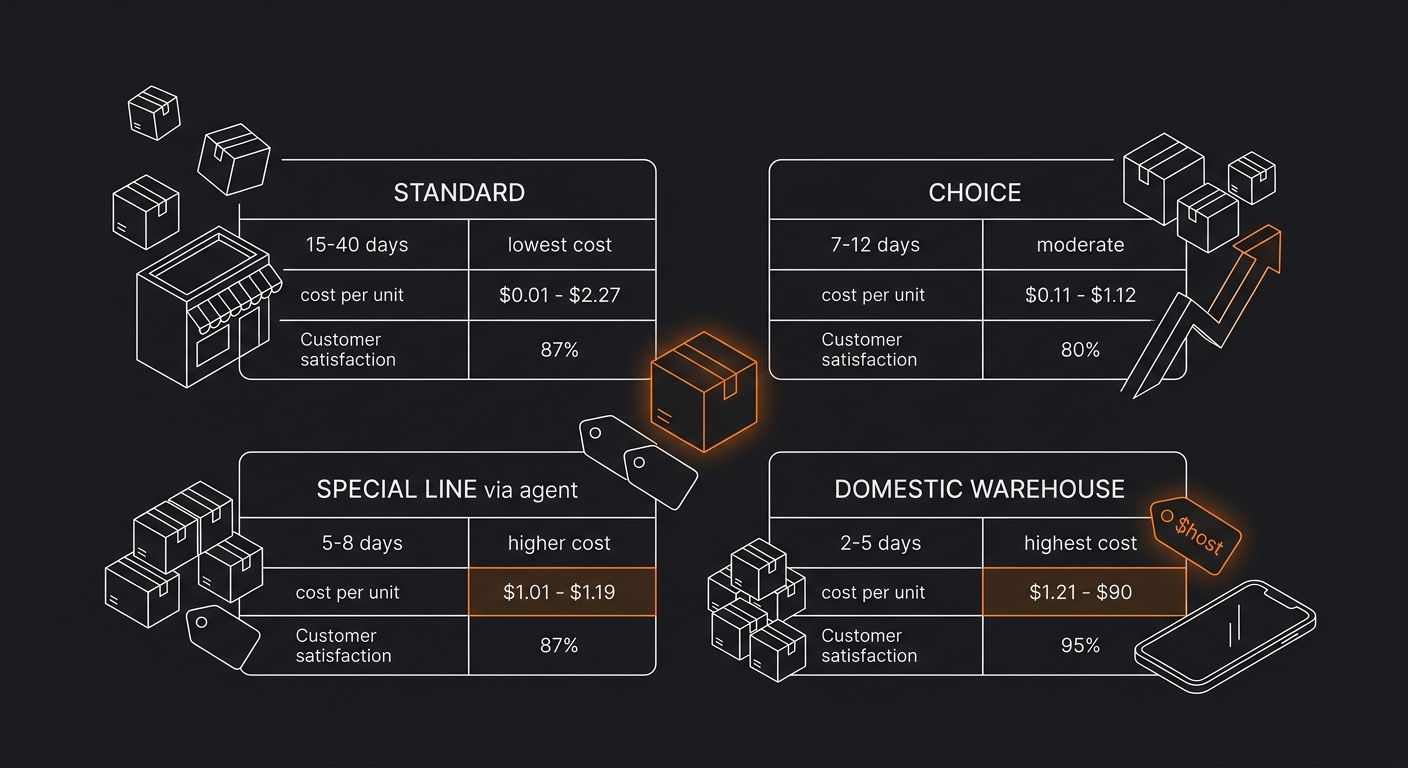
Shipping is where the AliExpress dropshipping model faces its hardest constraint. Standard AliExpress shipping runs 15-40 days depending on destination and carrier. Many dropshippers treat 20-40 day shipping as reasonable, but consumer expectations in 2026 are 3-7 days. That gap creates refund requests, chargebacks, and one-star reviews.
The workarounds, ranked by effectiveness:
AliExpress Choice shipping (7-12 days): Products enrolled in AliExpress's Choice program ship from consolidated warehouses with better carrier contracts. The downside: product selection is curated, so you can't force your suppliers' products into Choice.
ePacket/Special Line (10-20 days): Before the pandemic, ePacket was the standard for fast, cheap international shipping. It used passenger flights, which collapsed in 2020 and never fully recovered. "Special Line" services from agents like CJ and Zendrop offer 5-8 day delivery by pre-shipping inventory to US/EU warehouses, but this adds $2-5 per unit in fulfillment cost.
Domestic warehouse sourcing: AliDrop and some DSers integrations connect you to suppliers with US or EU warehouse stock. Shipping drops to 2-5 days, but product cost increases 15-30% compared to China-direct pricing.
Understanding your actual shipping cost structure is essential to pricing products correctly. Average return shipping cost runs 50-70% of the product's value according to AliExpress's margin calculation guide, which means you should build a 5-8% buffer into your cost of goods for returns and refunds.
When you're calculating whether a product is profitable after shipping, the margin formula needs to include supplier cost, shipping fee, platform transaction fees (typically 2.9% + $0.30), ad spend per unit, and that return buffer.
Where the Model Breaks
AliExpress dropshipping has structural limits that no amount of app optimization can fix.
Scaling past $10K/month revenue. Manual AliExpress purchasing, even through DSers, becomes a bottleneck. Payment processing limits, supplier stock-outs mid-campaign, and customer service volume all compound. Approximately 95% of dropshipping businesses fail within the first 30 days, and the ones that survive that window often hit a second wall at the scaling stage.
Tariff and customs exposure. The US suspended its $800 de minimis duty exemption, and the EU eliminated duty-free thresholds for parcels from non-EU sellers. Every package from China now faces potential customs fees that the customer didn't expect. This creates chargebacks you can't prevent through better supplier selection. Our coverage of the CBP's new mail entry process details the operational impact.
Brand control. You don't control packaging, insert cards, or unboxing experience. The product arrives in a generic poly mailer with Chinese shipping labels. For commodity products, this is acceptable. For anything positioned above $30 retail, it undermines the brand perception you spent ad dollars building.
Supplier disappearance. With 18% of suppliers exiting AliExpress in early 2026, stores that relied on a single supplier for their best-selling product found their listings broken overnight. The mitigation is maintaining 2-3 backup suppliers for every top product, but that multiplies your vetting workload.
The stores that outgrow these constraints typically graduate to a hybrid model: they continue dropshipping low-volume test products through AliExpress while moving proven winners to fulfillment agents (CJ Dropshipping, Zendrop, or direct factory contracts through platforms like 1688). That transition is where AliExpress stops being the fulfillment layer and becomes a product discovery engine.
Common Questions
Is AliExpress dropshipping still profitable in 2026?
Yes, but profitability depends on product selection, marketing execution, and cost control rather than the platform itself. Stores focusing on underserved niches with strong branding and efficient ad spend still generate 20-40% gross margins. The stores that struggle are those listing commodity products with no differentiation, competing purely on price against dozens of identical stores.
How long does AliExpress shipping take for dropshipping orders?
Standard AliExpress shipping runs 15-40 days. Choice-enrolled products ship in 7-12 days. Fulfillment agents offering "Special Line" services deliver in 5-8 days at an additional cost of $2-5 per unit. Domestic warehouse sourcing (US/EU stock) brings delivery down to 2-5 days but increases per-unit product cost by 15-30%.
What's the best automation app for AliExpress dropshipping?
DSers is the default for most stores, free up to 3,000 products, reliable bulk order processing, and fast API updates. AutoDS is better above 50 daily orders because it automates the purchase confirmation step. AliDrop is the pick if your priority is US/EU warehouse suppliers and faster shipping over catalog breadth.
Do I need to order samples before listing products?
Always. A sample order costs $5-15 and reveals the actual product quality, real shipping time, and packaging condition. Skipping this step means your first customer is your quality test, and if the product arrives damaged or misrepresented, you're absorbing the refund cost and the negative review.
What happens when my AliExpress supplier runs out of stock?
Your automation app should detect stock changes and pause the listing. In practice, detection isn't instant, DSers and AutoDS check inventory periodically, not in real time. If a customer orders between the stock-out and the sync, you'll need to cancel and refund manually. Maintaining backup suppliers for your top 5-10 products prevents this from becoming a recurring problem.
365 Dropship Editorial
Editorial team writing about E-commerce, dropshipping, and product discovery — reviews of dropshipping suppliers and platforms, trending niche guides (jewelry, beauty, pets, home, fashion), supplier due diligence, ecom operations, shipping & fulfillment strategy, product research, AOV optimization, and profitable dropshipping case studies.
Frequently Asked Questions
- How does AliExpress dropshipping work?
- AliExpress dropshipping is a fulfillment method where you list products from AliExpress suppliers in your online store, and when a customer purchases, you buy the item from the supplier at wholesale cost and have them ship directly to the customer. You keep the profit margin between your retail price and the supplier's price plus shipping, while holding zero inventory.
- What automation apps are best for AliExpress dropshipping?
- DSers is the default choice for most stores with free access up to 3,000 products and efficient bulk order processing. AutoDS is better for stores processing over 50 daily orders because it automates purchase confirmations. AliDrop is the best option if you prioritize US/EU warehouse suppliers for faster shipping.
- How long does AliExpress dropshipping shipping take?
- Standard AliExpress shipping takes 15-40 days, while Choice-enrolled products ship in 7-12 days. Special Line fulfillment services deliver in 5-8 days at an additional $2-5 cost per unit, and domestic US/EU warehouse sourcing brings delivery down to 2-5 days but increases product costs by 15-30%.
- How do I vet AliExpress suppliers for dropshipping?
- Use the Three-Gate Filter: first, only work with suppliers above 95% positive feedback with high order volume; second, message the supplier to test response time (should be under 12 hours); third, place a sample order ($5-15) to verify actual shipping time, product quality, and packaging condition.
- What is the profit margin in AliExpress dropshipping?
- Profitable stores typically achieve 20-40% gross margins by focusing on underserved niches with strong branding and efficient ad spend. However, you must account for supplier cost, shipping fees, platform transaction fees (2.9% + $0.30), ad spend per unit, and a 5-8% buffer for returns and refunds.
- Is AliExpress dropshipping still profitable in 2026?
- Yes, AliExpress dropshipping remains profitable for stores that focus on product selection, strong branding, and cost control, generating 20-40% gross margins. Stores that struggle are those listing commodity products with no differentiation and competing purely on price.
- What happens if my AliExpress supplier runs out of stock?
- Automation apps like DSers and AutoDS check inventory periodically but not in real time, so stock-outs aren't detected instantly. If a customer orders after a stock-out, you'll need to manually cancel and refund. Maintaining 2-3 backup suppliers for your top products prevents this recurring problem.
- What are the main limitations of AliExpress dropshipping?
- Key constraints include scaling challenges past $10K/month revenue, tariff and customs exposure (customers now face unexpected fees), limited brand control over packaging and unboxing experience, and supplier disappearance risk (18% of suppliers exited in early 2026). Successful stores typically graduate to hybrid models using fulfillment agents for proven winners.
Related Articles
Best AliExpress Dropshipping Suppliers 2024
Three sourcing paths dominate the AliExpress dropshipping supplier landscape: manual vetting directly on the platform, automation tools like DSers and AutoDS layered on top of AliExpress, and hybrid fulfillment services such as CJDropshipping, Spocket, and Zendrop that pull from AliExpress catalogs
AliExpress Dropshipping: Complete Beginner's Guide
AliExpress connects your store to over 100 million products from 300,000+ suppliers, and you never touch inventory.
Aliexpress Dropshipping Websites
Three apps dominate AliExpress dropshipping websites: DSers for bulk ordering, AliDrop for US/EU supplier access, and Dropshipman for pre-shipment quality checks. This guide walks you through selecting one, connecting it to your storefront, and placing a verified test order in about four hours.
Explore more topics