Logistics Encyclopedia Entry Details 15-25% Cost Reduction Through Strategic Shipping Zone Networks
Racklify published a logistics encyclopedia entry June 3 that quantifies how distributed fulfillment networks reduce parcel costs by 15-25% through strategic warehouse placement and carrier zone optimization, according to the guide authored by Erwin Richmond Echon. The entry details operational fram
Logistics Encyclopedia Entry Details 15-25% Cost Reduction Through Strategic Shipping Zone Networks
Racklify published a logistics encyclopedia entry June 3 that quantifies how distributed fulfillment networks reduce parcel costs by 15-25% through strategic warehouse placement and carrier zone optimization, according to the guide authored by Erwin Richmond Echon. The entry details operational frameworks for e-commerce operators shipping nationally from centralized warehouses, where most orders cross three or more carrier zones and incur escalating per-shipment fees.
The publication addresses a cost structure challenge for independent sellers and DTC operators: carrier zone-based pricing increases proportionally with distance, forcing merchants shipping from single warehouses to absorb higher rates on coastal deliveries while competing against Amazon's distributed network advantage, according to the Racklify guide.
Distributed Fulfillment Economics
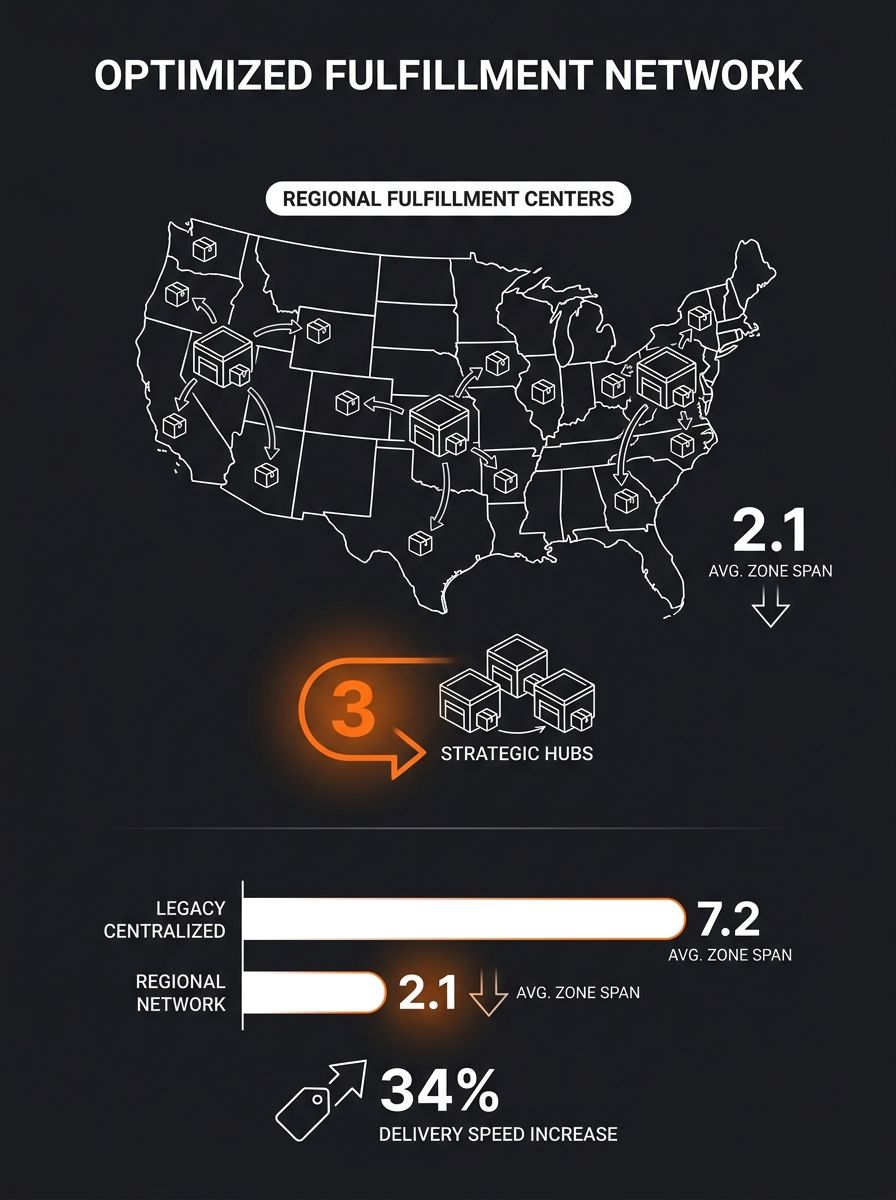
The guide models an online apparel retailer scenario where centralized fulfillment forces most orders to cross three or more zones to reach coastal customers. By adding two regional fulfillment locations—one on each coast—and routing nearby demand locally, the modeled retailer reduced average zone span by one band, cutting variable parcel costs by 15-25% while improving average delivery time by one to two days, the entry states.
Carrier zone bands approximate distance or service regions, with rates increasing as packages travel from origin zone to destination zone. A strategic approach treats zones as operational levers rather than pricing constraints, the guide argues. For dropshippers evaluating supplier locations or DTC brands planning warehouse diversification strategies, zone-aware network design directly impacts per-order shipping costs and competitive delivery promises.
The entry quantifies several zone-optimization tactics beyond simple warehouse addition. Zone skipping—consolidating parcels destined for the same distant zone and handing them to long-haul carriers at bulk rates—bypasses intermediate carrier zone charges, reducing handling costs for high-volume shippers that can aggregate weekday shipments to a hub near the target zone.
Implementation Framework and Measurement
Racklify's entry outlines five implementation steps: mapping demand to zones using historical order data, modeling network scenarios with facility-location tools that incorporate carrier zone rate tables, negotiating zone-focused carrier contracts, adopting WMS/TMS software with zone-aware routing, and piloting in targeted zones before scaling.
The guide specifies key performance indicators operators should track: average shipping cost per parcel by zone, on-time delivery percentage by zone, transit time variance by zone, inventory carrying cost versus shipping cost trade-offs, and percentage of orders shipped within the same zone. These metrics surface whether zone optimization delivers actual margin improvement or simply shifts costs from shipping to inventory holding.
Carrier segmentation by zone receives particular emphasis. Different carriers compete in different zones, the entry notes, recommending operators assign carriers based on zone-specific pricing, transit time, and reliability data. Modern Transportation Management Systems evaluate carrier rates and transit times by zone in real time, automating shipment assignment to the most cost-effective carrier-service combination for each destination zone.
The guide warns against common pitfalls: ignoring inventory carrying costs when adding warehouses, using poor data quality that produces incorrect zone mappings, over-splitting inventory into too many small locations that create operational overhead, and failing to renegotiate carrier contracts after network changes to capture zone-level discounts.
Strategic Context for Independent Operators
For solopreneurs and side-hustle sellers operating on thin margins, the zone-optimization framework presents a scaling threshold decision point. Single-warehouse operations incur predictable but higher per-shipment costs; distributed fulfillment requires minimum order volumes to justify added inventory and facility expense. The entry's 15-25% cost reduction figure applies to retailers already shipping nationally at volumes sufficient to support multiple fulfillment locations.
The publication arrives as e-commerce operators face sustained freight rate volatility and tightening parcel carrier capacity. Zone-based network design offers a structural cost advantage independent of short-term rate fluctuations, the guide argues, by reducing the baseline distance most shipments travel.
Racklify's logistics encyclopedia, which includes entries on warehouse operations and third-party logistics provider selection, targets operations managers and supply chain planners. The shipping zone strategy entry complements existing dropshipping operator frameworks around unit cost modeling by adding the post-sourcing logistics layer where zone-based carrier pricing becomes the marginal cost driver.
The Takeaway
The operational detail in Racklify's June 3 shipping zone guide reflects a broader shift in e-commerce logistics discussion—from "how to find cheap shipping" toward total-network cost modeling that balances inventory placement, carrier selection, and zone-driven pricing as interconnected variables rather than sequential decisions. For independent operators, the 15-25% cost reduction quantification provides a benchmark to evaluate whether distributed fulfillment justifies the added complexity at current order volumes. The immediate application sits less in tactical carrier switching and more in pre-scaling questions: at what monthly shipment volume does zone optimization become margin-accretive, and which regional fulfillment partner network (Shopify Fulfillment Network, ShipBob, ShipMonk) offers the best zone coverage for a store's actual customer geography rather than national averages.

Ryan Torres
Ryan Torres is a former Amazon FBA seller turned dropshipping consultant who has generated over $2.8M in ecommerce revenue across 14 product launches. He specializes in supplier vetting, margin optimization, and scaling DTC operations for sub-$1M brands. Ryan focuses on actionable frameworks that drive measurable results for independent operators.
Related Articles

SendFromChina Publishes Seven-Factor Shipping Cost Framework Targeting Dropshippers Managing Delivery Margins
Package weight, dimensions, shipping zones, carrier selection, delivery speed, product type, and insurance requirements form the seven primary cost drivers for ecommerce shipping, according to a comprehensive guide released by SendFromChina on July 20 targeting dropshippers optimizing delivery margi

SendFromChina Publishes Six-Step Fulfillment Center Workflow Guide Targeting Ecommerce Operators Evaluating Third-Party Logistics
SendFromChina released a comprehensive fulfillment center guide on July 22, 2026, breaking down warehouse operations into six sequential stages—receiving, storage, order processing, picking and packing, shipping, and returns processing—according to documentation published on the logistics provider's

Logistics Platform Publishes Quick Ship Operations Breakdown for Ecom Fulfillment
Racklify published a logistics encyclopedia entry June 17 breaking down Quick Ship fulfillment into six operational components—reserved inventory, priority order routing, pre-configured packing kits, dedicated resources, carrier coordination, and simplified quality checks—that compress order-to-deli
Explore more topics