How to Calculate Your True CAC Payback Period Before Scaling Ad Spend on a New Dropshipping Product
Your Meta Ads dashboard and Shopify analytics both report customer acquisition cost using a flawed denominator: total customers, including repeat buyers.
How to Calculate Your True CAC Payback Period Before Scaling Ad Spend on a New Dropshipping Product
Your Meta Ads dashboard and Shopify analytics both report customer acquisition cost using a flawed denominator: total customers, including repeat buyers. Strip returning customers from that number, apply fully loaded contribution margins instead of gross margin, and the real CAC payback period on a new dropshipping product typically doubles.
The Denominator That Wrecks the Math
The standard CAC formula divides total marketing spend by total customers acquired in a period. As Retainful's ecommerce CAC guide puts it, this is "the single most misread metric in ecommerce — because most merchants calculate it wrong, benchmark it wrong, and try to fix it the wrong way." The problem is structural: returning customers who buy again through a branded search ad or a retargeting campaign get counted in that denominator alongside genuinely new buyers.
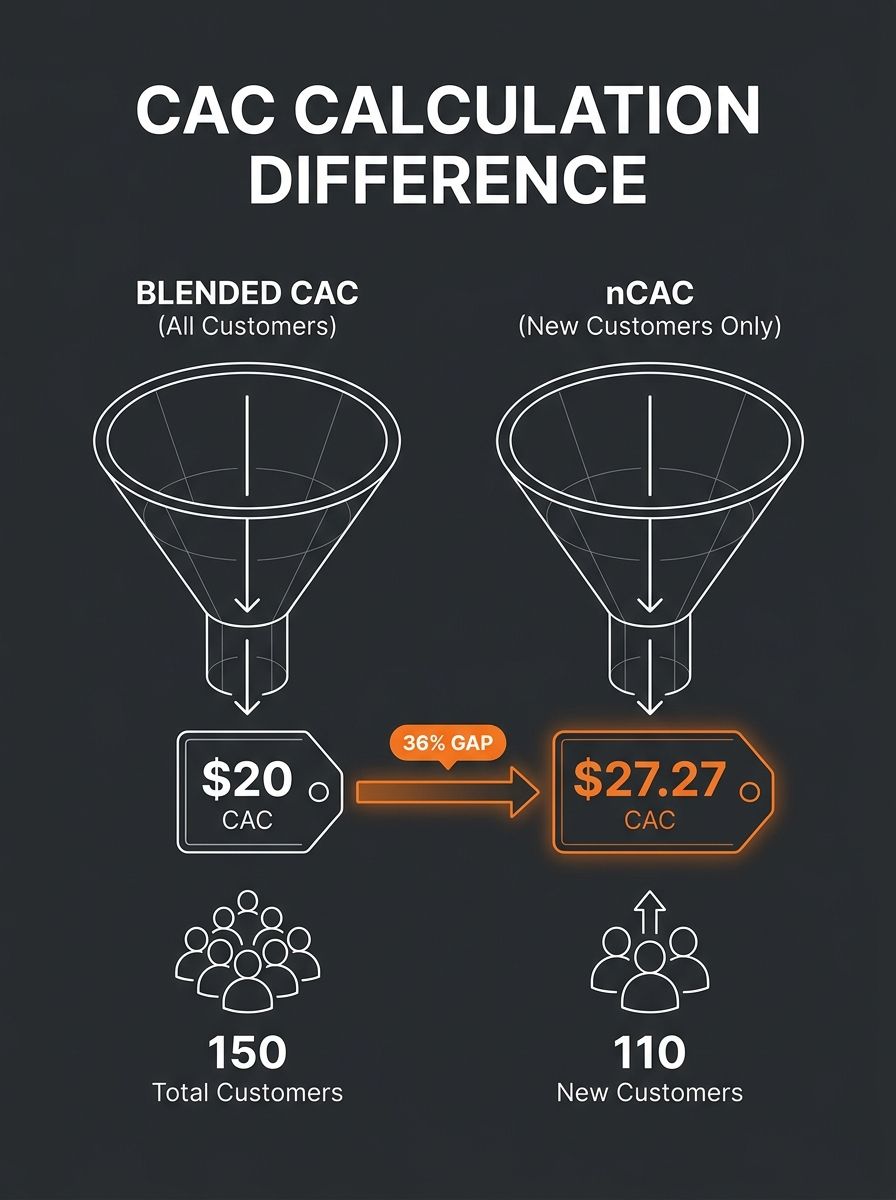
Say you spent $3,000 on Meta and Google ads this month and Shopify reports 150 orders from those channels. Your blended CAC looks like $20. But 40 of those 150 orders came from existing customers clicking a retargeting ad. Your new-customer-only CAC (nCAC) is $3,000 ÷ 110 = $27.27. That's a 36% jump from the number you were using to decide whether to scale.
This gap gets worse as your store matures and your retargeting audiences grow. A store running for six months might see 30-45% of paid-channel orders coming from repeat buyers, inflating the denominator and compressing the apparent payback period into a range that looks safe to scale against. It isn't.
The correct formula for dropshipping ad spend decisions: nCAC = Paid ad spend ÷ New customers acquired from paid channels only. According to Saras Analytics' payback analysis, a DTC payback period under 3 months signals readiness for fast growth, while anything beyond 6 months creates real cash flow pressure for bootstrapped stores.
From $38 AOV to $11.40 Contribution Margin
The second place this calculation breaks is the margin line. Plugging gross margin into the payback formula overstates how fast you recover acquisition cost because gross margin ignores the per-order costs that eat into every sale. Most dropshippers operate at 10-30% net profit margins, with anything below 10% making scaling risky. But even within that range, the gap between gross margin and contribution margin per order determines whether your payback math reflects reality.
Walk through a real product. Assume a posture corrector selling at a $38 AOV:
Line Item | Amount |
|---|---|
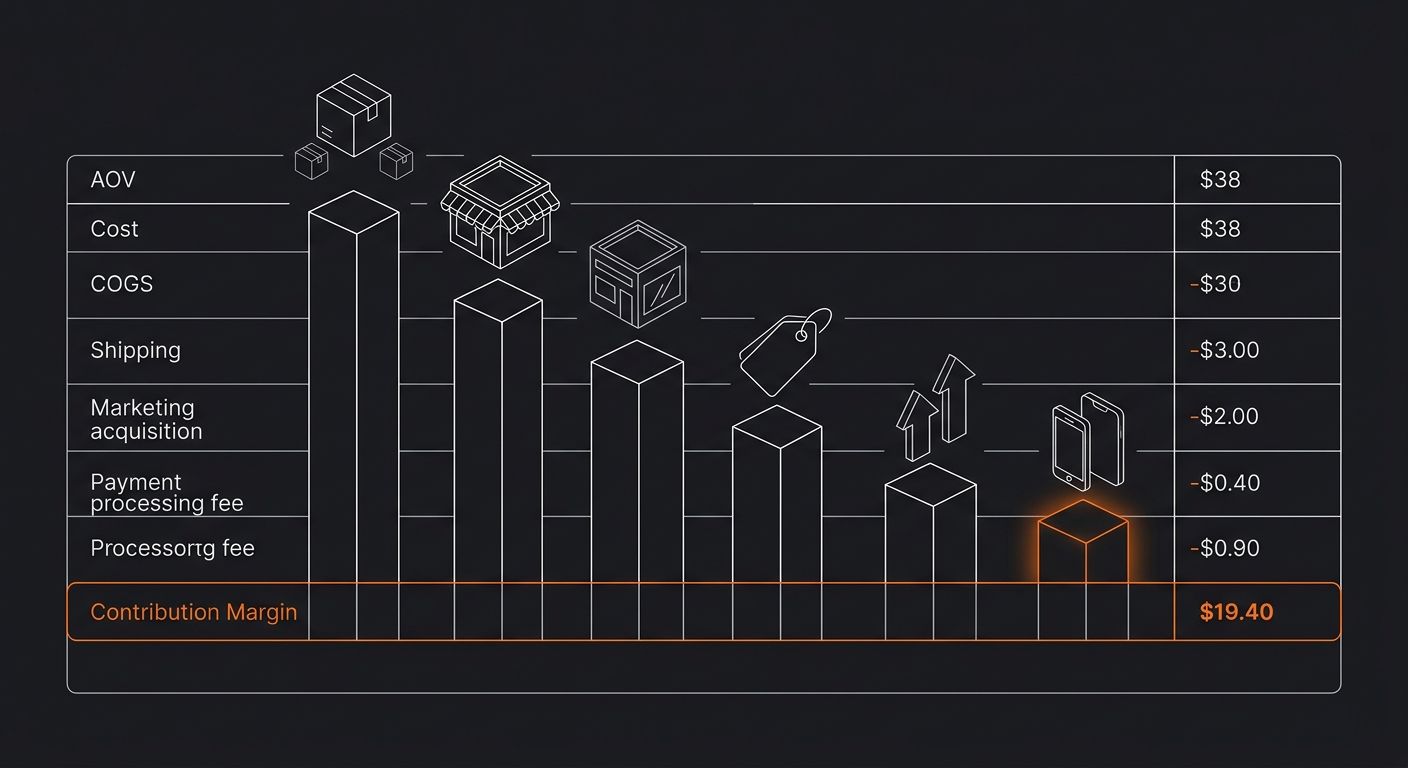
Selling price (AOV) | $38.00 |
Product cost (CJ Dropshipping) | $8.50 |
Shipping to US customer | $5.20 |
Shopify payment processing (2.9% + $0.30) | $1.40 |
Return/refund allowance (8% of AOV) | $3.04 |
Platform subscription (prorated per order at 300 orders/mo) | $0.13 |
App fees (prorated) | $0.33 |
Contribution margin per order | $19.40 |
That $19.40 is already 49% lower than the naive gross margin of $38 - $8.50 = $29.50 that many sellers use. And this example doesn't include tariffs or duties. If you're sourcing cross-border, building a tariff-aware unit cost model adds another 5-28% to your landed cost depending on product category and origin country.
With an nCAC of $27.27 and a contribution margin of $19.40, your payback on a single-purchase customer is $27.27 ÷ $19.40 = 1.41 orders. That means you need at least a second purchase to recover acquisition cost and reach profitability. For a one-time-purchase product with no repeat buy potential, you're underwater from day one at this CAC level.
Three Channels, Three Payback Clocks
Channel-level payback analysis changes the scaling decision entirely. A blended payback period across Meta, Google Shopping, and TikTok masks the fact that each channel acquires different customer profiles at different costs with different repeat purchase rates.
Here's how the same posture corrector product looks when you split the data by channel:
Metric | Meta Ads | Google Shopping | TikTok Shop |
|---|---|---|---|
Monthly ad spend | $1,200 | $1,000 | $800 |
New customers acquired | 38 | 52 | 20 |
nCAC | $31.58 | $19.23 | $40.00 |
Avg. contribution margin/order | $19.40 | $19.40 | $17.80* |
Monthly purchase frequency | 0.15 | 0.08 | 0.22 |
CAC payback period | 10.8 months | 12.5 months | 11.4 months |
*TikTok Shop's lower contribution margin reflects the platform's referral fee structure eating into per-order margin.
The formula driving that payback column: CAC Payback Period = nCAC ÷ (Contribution Margin per Order × Monthly Purchase Frequency).
Google Shopping delivers the lowest nCAC at $19.23, but its customers reorder at the slowest rate (0.08 purchases per month), stretching payback to 12.5 months. TikTok's nCAC is the highest at $40, but TikTok-acquired customers repurchase more frequently (0.22/month), which compresses payback to 11.4 months. Meta lands in the middle on both dimensions.
And notice: all three channels produce payback periods above 10 months. For a bootstrapped operation, that's a cash flow problem regardless of channel. The data from TikTok Shop's rapid growth in product discovery shows the channel captures massive top-of-funnel attention, but conversion to repeat buyers varies wildly by product category.
Before you blame your ad creative or your supplier, run this channel-level split. When the numbers come back ugly across all three channels, the problem lives in your product economics, not your marketing strategy or supplier relationship.
The Cash Runway Gate
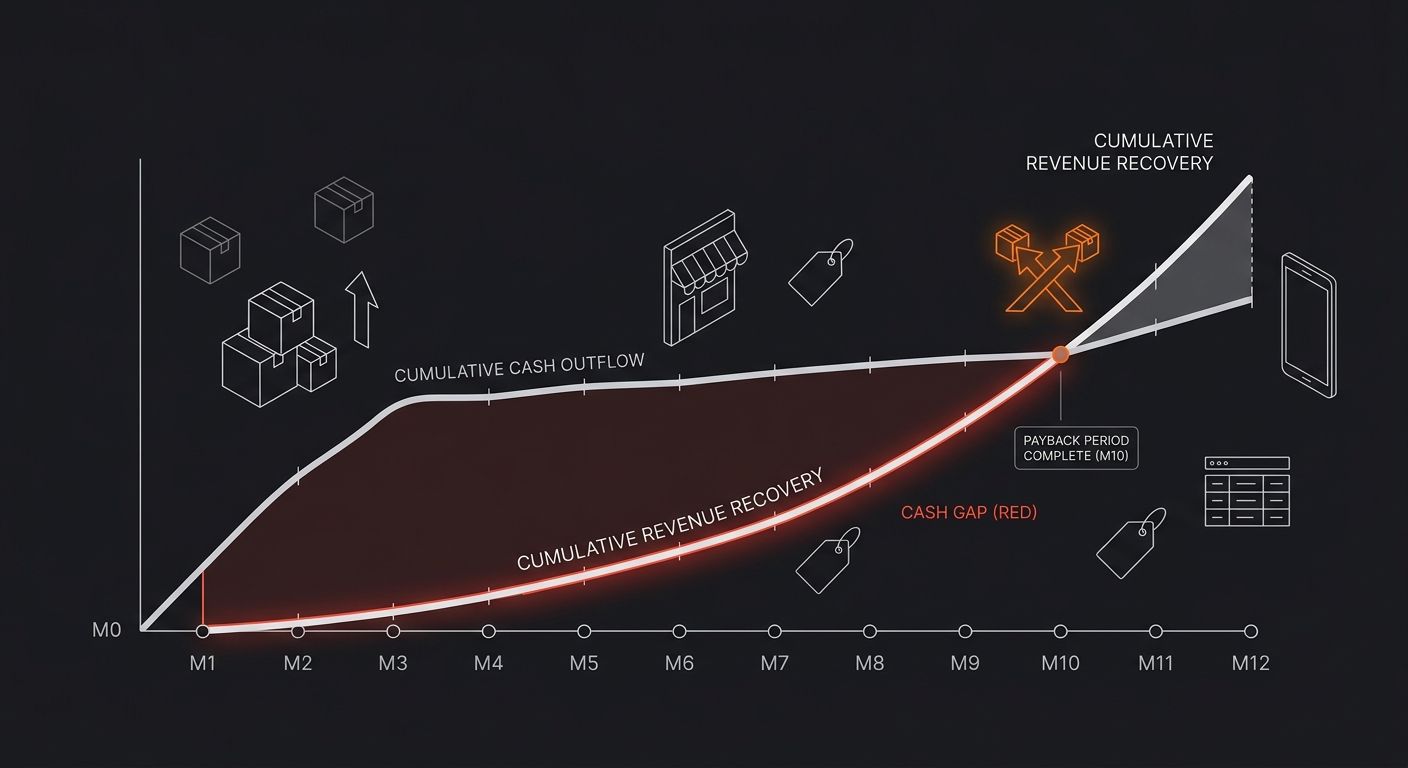
Knowing your payback period is useless without comparing it against available cash. A 6-month payback period sounds manageable until you calculate the cumulative cash outflow required to sustain 6 months of ad spend before the first cohort's revenue fully repays its acquisition cost.
The formula: Required Cash Runway = Monthly nCAC × Target New Customers × Payback Period in Months.
Using the Meta channel from the example above: $31.58 nCAC × 38 new customers/month × 10.8 months = $12,960 in cumulative ad spend before the first month's cohort has fully paid itself back. And that's just one channel. Running all three channels simultaneously requires $32,400+ in available cash earmarked purely for acquisition, with no margin for creative testing, landing page optimization, or the ad account fluctuations that hit every dropshipping campaign.
If your available cash runway is $10,000, you can't afford a 10-month payback product at this spend level. The math doesn't care how promising the product looks.
Three things shorten the payback clock before you consider increasing spend:
Raise contribution margin. Bundling accessories with the posture corrector (a resistance band, a stretching guide) can push AOV from $38 to $52-$58 while adding only $3-$5 in product cost. As SparkShipping's margin guide notes, bundling lets you "command a higher price" while consolidating marketing and fulfillment costs into a single transaction.
Increase purchase frequency. Consumable add-ons, subscription offers, or post-purchase email sequences targeting the 30-60-90 day window after first purchase can move monthly frequency from 0.15 to 0.25+, cutting payback by 40%.
Reduce nCAC. Tighter audience targeting, better creative testing loops, and organic content strategies reduce the numerator. But this lever has diminishing returns faster than the other two. When your margin math is already collapsing mid-campaign, the fix rarely lives in the ad account alone.
The Spreadsheet Before the Scale Button
The posture corrector example above delivers a verdict most dropshippers don't want to hear: a 10-12 month payback period on a $38 AOV product with moderate repeat purchase rates is not a scaling candidate at current economics. Scaling ad spend here means scaling cash burn.
That's the entire point of running this calculation before you increase budget. The CAC payback period is the bridge between "this product gets sales" and "this product builds a business." A product can convert at 3% with strong ROAS on day one and still drain your operating account over 6 months because the margin math underneath doesn't support the acquisition cost.
Run the nCAC calculation with returning buyers stripped from the denominator. Build the contribution margin from the bottom up, including every per-order cost you can document. Split the payback by channel. Compare the result against your cash runway. If the payback period exceeds your available capital buffer, optimize the margin, the frequency, or the AOV before touching the ad budget. The products worth scaling are the ones where the spreadsheet says yes before your gut does.
365 Dropship Editorial
Editorial team writing about E-commerce, dropshipping, and product discovery — reviews of dropshipping suppliers and platforms, trending niche guides (jewelry, beauty, pets, home, fashion), supplier due diligence, ecom operations, shipping & fulfillment strategy, product research, AOV optimization, and profitable dropshipping case studies.
Related Articles
Why Marketing Failures Masquerade as Supplier Problems: How to Audit Your Ad Spend Before Blaming Your Dropshipping Partner
Break-even ROAS for a typical dropshipping campaign sits around 1.95x, meaning for every dollar you spend on Facebook or TikTok ads, you need $1.95 back in revenue just to cover product cost, shipping, and platform fees.

The Seasonal Demand Blindspot: Why Calendar-Based Product Planning Beats Year-Round Niche Selection for Dropshippers
Dropshipping product research almost always starts with a category — pet supplies, home fitness, phone accessories — and then hunts for suppliers, tests ads, and builds a store around that vertical. Calendar-based niche selection flips this sequence.
Paid Traffic vs. Organic SEO for Dropshipping Stores: Where to Allocate Your First $5,000 in Marketing Spend
Stores relying primarily on organic traffic report 28% average net margins compared to 17% for paid-traffic-dependent operations.
Explore more topics