What is Dropshipping: Complete Beginner's Guide
The global dropshipping market is projected to hit $537.8 billion in 2026, expanding at a 23.6% compound annual growth rate through 2032. Dropshipping is an ecommerce fulfillment model where you sell products online without purchasing or storing inventory.
What Is Dropshipping: The Complete Beginner's Guide to the Model, the Margins, and the Math
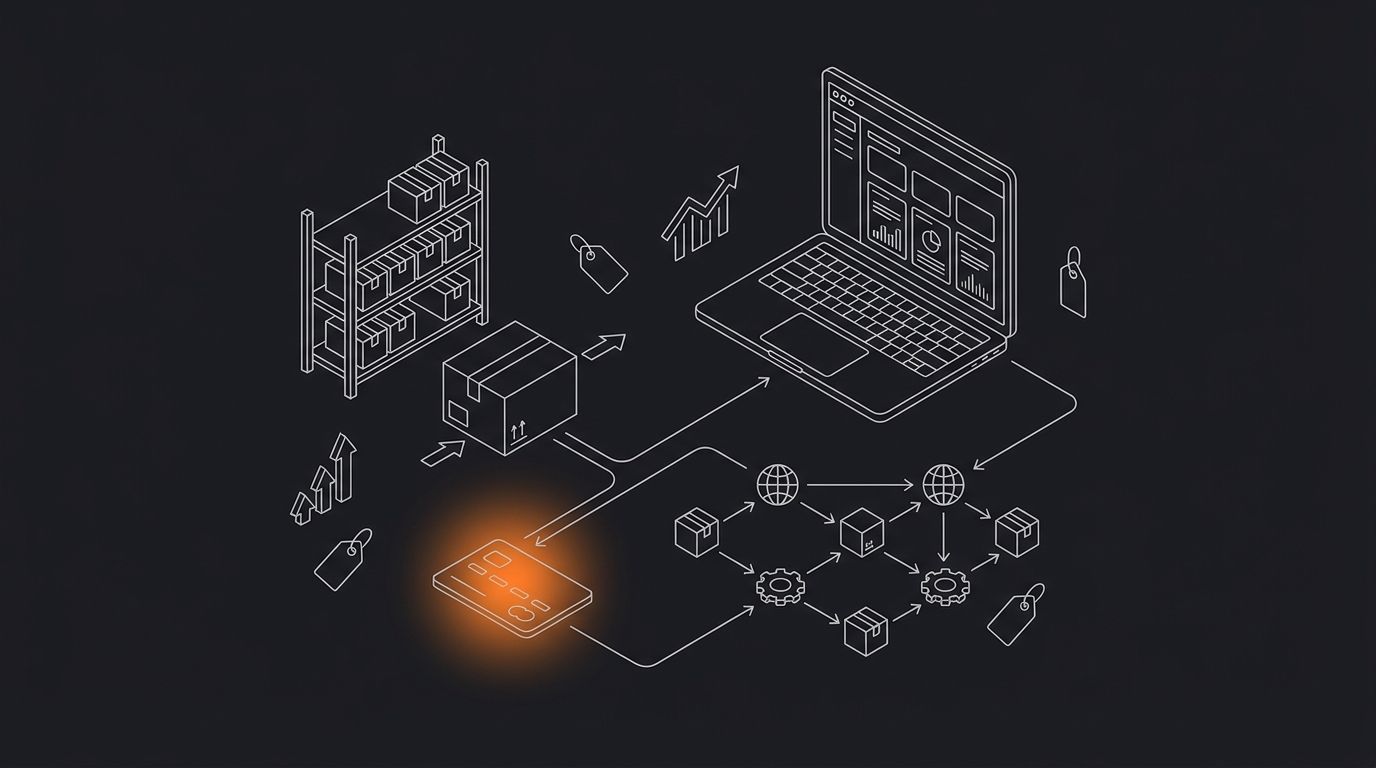
The global dropshipping market is projected to hit $537.8 billion in 2026, expanding at a 23.6% compound annual growth rate through 2032. Dropshipping is an ecommerce fulfillment model where you sell products online without purchasing or storing inventory. A supplier ships each order directly to your customer after you forward the purchase details.
How the Three-Party Transaction Actually Works
Every dropshipping transaction involves three parties: you (the retailer), your supplier, and your customer. The mechanics follow a fixed sequence. Your customer places an order on your online store at the retail price you set. You forward that order to your supplier at a lower, pre-negotiated wholesale price. The supplier packages and ships the product directly to your customer. As Shopify's merchant education team explains, "items bought from an online store are shipped directly to customers by the supplier or manufacturer." You keep the difference between your retail price and the supplier's wholesale price, minus your operating costs.
Here's the unit economics on a single order. Say you sell a posture corrector for $34.99. Your supplier charges $11.50. Shipping from a US-based warehouse runs $4.95. Your payment processor takes 2.9% + $0.30 (about $1.31). Your gross profit on that single unit: $17.23, or a 49.2% gross margin before ad spend. The moment you factor in customer acquisition cost, that margin compresses fast. At a $12 cost-per-acquisition through Meta ads, your net profit drops to $5.23 per unit, or 14.9%.

That's why I tell every operator I work with to think about what is a dropshipping business in terms of margin math, not revenue.
Dropshipping vs. Traditional Retail: Where the Numbers Diverge
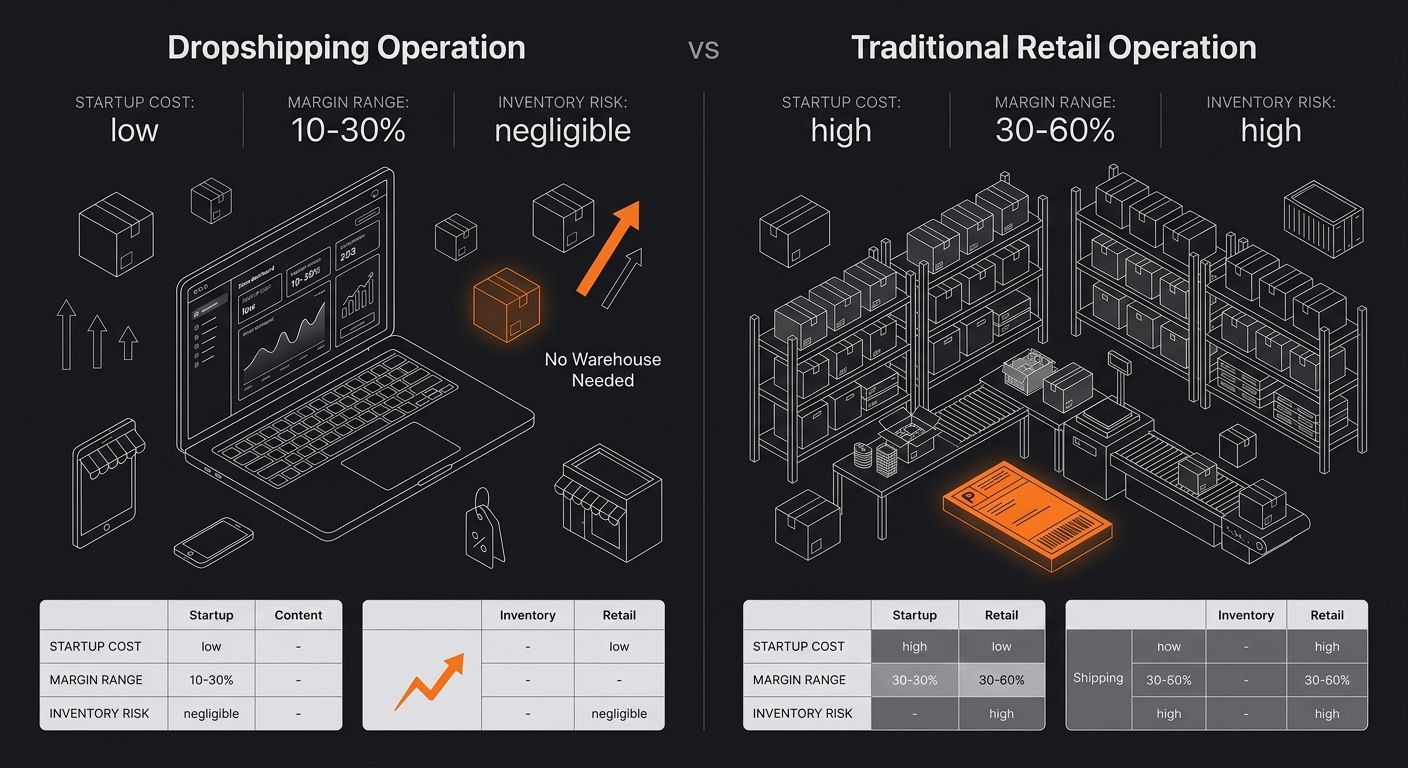
Why does this model exist when you could buy inventory in bulk and control your own fulfillment? Because the upfront capital requirements are radically different. According to Dropmagic's 2026 comparison analysis, traditional retail requires $10,000 to $100,000+ in upfront inventory investment. Dropshipping startup costs typically fall below $500, covering your store subscription, domain, and initial marketing budget.
Factor | Dropshipping | Traditional Retail |
|---|---|---|
Startup capital | $100–$500 | $10,000–$100,000+ |
Gross margins | 10–30% | 30–60%+ |
Inventory risk | None (supplier holds stock) | High (unsold stock = loss) |
Shipping control | Low (supplier manages) | High (you manage) |
Product testing speed | Days (add/remove SKUs instantly) | Weeks to months (bulk orders required) |
Brand control | Limited (supplier packaging) | Full (custom packaging, inserts) |
The tradeoff is clear. You're exchanging higher margins and brand control for dramatically lower risk and faster time-to-market. Amazon's seller data shows independent sellers accounted for over 60% of platform sales in 2025, with US-based sellers averaging more than $375,000 in annual revenue. Many of those sellers use hybrid models that blend dropshipping with small inventory holds for their best-performing SKUs.
The Real Cost Stack Most Guides Leave Out
Knowing the definition of what is a dropshipping model doesn't prepare you for the costs that eat into your margins before you sell a single unit. I've broken down why disciplined 30% margins outperform flashy high-margin claims elsewhere, but here's the baseline cost structure every beginner should internalize.
Your Shopify Basic plan runs $39/month. A domain costs $14/year. Your essential apps (product sourcing, email marketing, basic analytics) add $30–80/month depending on your stack. Forbes Advisor's startup guide recommends beginners "start with platforms like DSers, Spocket, CJDropshipping or AliExpress to locate dropshipping products." Each of those platforms carries its own fee structure. Spocket's paid plans start at $39.99/month. DSers offers a free tier for up to 3,000 products. CJDropshipping charges no monthly fee but builds margin into product pricing.
Then there's ad spend. For a new store with zero organic traffic, plan on $500–1,500 for your first month of paid acquisition testing on Meta or TikTok. Your cost-per-click on Meta for ecommerce niches runs $0.50–2.00. TikTok CPCs trend 20–40% lower, but conversion rates for cold traffic also tend to run lower. If you're evaluating where to spend those first dollars, I've written about allocating your initial marketing budget between paid and organic channels.
Choosing Suppliers: The Decision That Determines Your Business
Your supplier is your business. Everything your customer experiences after clicking "Buy Now" is controlled by someone you've never met in person. Shipping speed, packaging quality, product accuracy, return handling. All of it.
Amazon's seller education documentation states that "an ecommerce business can work with a supplier who ships products in response to orders that customers place online," but that sanitized language doesn't convey how wildly supplier quality varies. I've seen suppliers quote 3–5 day US shipping and consistently deliver in 12–18 days. I've seen product photos that bear zero resemblance to what arrives at the customer's door.
The supplier landscape breaks into three tiers:
AliExpress and similar marketplaces offer the lowest product costs ($1–15 for most consumer goods) but shipping from China runs 7–25 business days via ePacket or 15–45 days via standard. Returns are functionally impossible for low-cost items.
Aggregator platforms like Spocket and CJDropshipping sit in the middle. Spocket claims 60%+ of its catalog ships from US/EU warehouses, bringing delivery windows down to 2–7 business days. CJ operates its own warehouses in the US, Germany, Thailand, and Indonesia, with stated processing times of 1–3 days.
Direct wholesale relationships offer the best margins (often 40–60% below retail) and fastest shipping but require minimum order commitments and take months to establish. For a deeper look at how platforms layer fees between the factory price and your COGS, check out the breakdown on how aggregator platforms stack supplier markups.
The Five-Step Launch Sequence
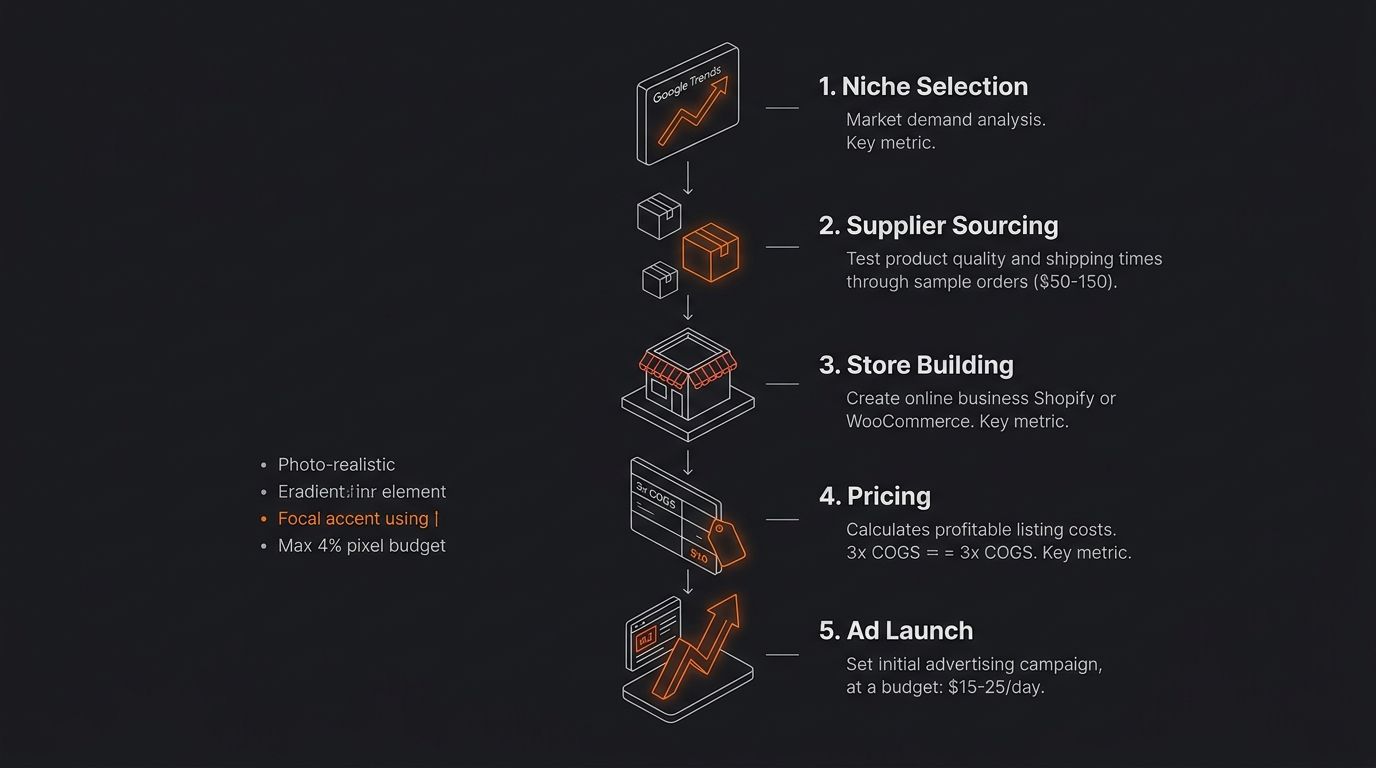
Once you understand what is a dropshipping operation at the unit-economics level, execution follows a predictable path. The market's 23.6% annual growth rate means competition intensifies every quarter, so speed matters. Here's the sequence that has worked across 14 product launches I've run:
Pick a niche with verifiable demand and manageable competition. Use Google Trends to confirm sustained search interest (not a spike-and-crash pattern). Check Amazon for category depth. If more than 3 dominant sellers own the first page, the acquisition costs will eat you alive. I've written about why saturated Amazon niches kill dropshipping margins.
Source 5–10 products from at least 2 different suppliers. Order samples from every supplier before listing a single product. Budget $50–150 for samples. This step saves you from the supplier quality problems that review aggregators hide.
Build your store on Shopify, WooCommerce, or Wix. Shopify's Basic plan ($39/month) remains the lowest-friction option for beginners. Your store needs 4 things before launch: product pages with original photos, a clear return policy, a shipping policy with honest delivery timeframes, and a functioning checkout.
Set your pricing using the 3x COGS rule as a floor. If your supplier charges $10, price at $30 minimum. This leaves room for ad spend (30–40% of revenue), platform fees (3–5%), and a 15–20% net margin.
Launch with $15–25/day in ad spend on one platform. Test 3–5 ad creatives against a single audience for 5–7 days. Kill anything below a 1.5% click-through rate after 1,000 impressions. Scale winners by 20% daily.
What The Numbers Still Can't Answer
The $537.8 billion market projection and the 23.6% growth rate tell you the model is expanding. The 10–30% margin band tells you what to expect. The $375,000 average revenue figure for US Amazon sellers tells you there's money moving through these channels.
But none of those numbers tell you the thing that actually determines whether your store survives month three. They don't tell you how your specific supplier will perform under pressure during a holiday rush. They don't tell you whether your niche's return rate will be 3% (furniture accessories) or 25% (apparel). They don't tell you whether your ad account will get restricted on day 12 because Meta's algorithm flagged your product category.
The data gives you the landscape and confirms the model works at scale. It confirms the margin band is tight but workable. What data can't replace is the $50 you spend on product samples, the 3 hours you spend reading your supplier's actual customer reviews, or the first 500 visitors you send to a landing page to find out if real people will buy what you're selling. The model is sound and the math is public. The variable that remains unmeasurable is whether you'll execute the boring operational work that separates the 14% of dropshipping stores that survive year one from the 86% that don't.
Ryan Torres
Ryan Torres is a former Amazon FBA seller turned dropshipping consultant who has generated over $2.8M in ecommerce revenue across 14 product launches. He specializes in supplier vetting, margin optimization, and scaling DTC operations for sub-$1M brands. Ryan focuses on actionable frameworks that drive measurable results for independent operators.
Related Articles
How to Do Dropshipping: Complete Beginner's Guide
This guide walks you through how to do dropshipping from zero to first sale in under a week. Seven steps cover niche selection, business registration, store setup, supplier vetting, product pricing, test orders, and ad launch, with specific costs and timelines at each stage.
Dropshipping How to: Complete Beginner's Guide
Every step of launching a dropshipping store fits into a single weekend: niche selection, LLC registration, Shopify storefront, supplier vetting, product import, and a live test order. Total startup cost sits under $150, and you'll have a functioning store accepting real orders by Sunday night.
Complete Guide to Starting a Dropshipping Business
Every dropshipping business built on Shopify, Amazon, Etsy, eBay, or Walmart faces the same registration requirement: formal business filing, a dedicated bank account, and a sales tax permit.
Explore more topics