Shopify vs. WooCommerce for Dropshipping in 2026: Total Cost of Ownership When Margins Are Already Thin
Shopify holds 27% of the ecommerce platform market while WooCommerce powers 36–38% of online stores, yet those market-share numbers reveal nothing about which platform actually costs less to operate a dropshipping business on.
Shopify vs. WooCommerce for Dropshipping in 2026: Total Cost of Ownership When Margins Are Already Thin
Shopify holds 27% of the ecommerce platform market while WooCommerce powers 36–38% of online stores, yet those market-share numbers reveal nothing about which platform actually costs less to operate a dropshipping business on. When average dropshipping margins sit between 15% and 20%, your dropshipping platform choice is a margin decision, and the monthly subscription is the smallest line item in either platform's total cost of ownership.
Add up every line item before you compare sticker prices
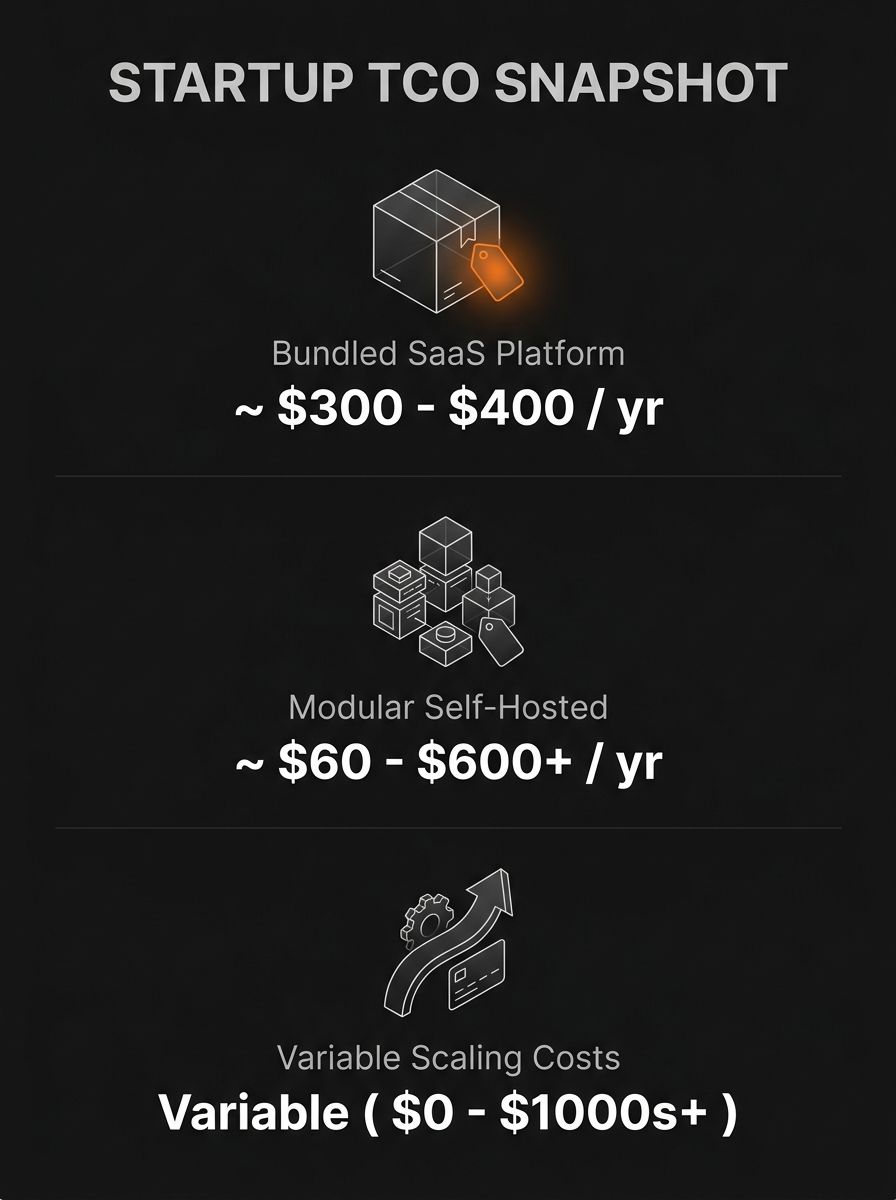
The sticker-price comparison between Shopify and WooCommerce is misleading because it compares a subscription against a plugin download. Shopify charges $39 to $105 per month with hosting, SSL, and security bundled in. WooCommerce is free to install, but you pay separately for hosting, domain registration, SSL certificates, and security plugins.
A small WooCommerce store's basic hosting runs about $100 to $200 per year according to Presta's 2025 platform comparison. That looks drastically cheaper than Shopify's $468 annual minimum on the Basic plan. But "basic hosting" means shared servers that buckle under traffic spikes, and it excludes every plugin you'll need to actually run a dropshipping operation.
Managed WooCommerce hosting through providers like Kinsta or WP Engine runs $100 to $500 per month. Add a $200–$600/month developer retainer for updates, plugin conflicts, and security patches, and your "free" platform quietly costs $3,600–$13,200 annually before you've sold a single product. The ecom platform cost gap between Shopify and WooCommerce narrows or inverts depending entirely on which hosting tier and support model you choose.
This is why Digital Hill's 2026 platform guide argues that successful sellers evaluate platforms based on total cost of ownership, not monthly pricing alone.
Cost Category | Shopify (Basic) | WooCommerce (Managed) |
|---|---|---|
Platform/Subscription | $468/year | $0 |
Hosting + SSL | Included | $1,200–$6,000/year |
Security & Updates | Included | $600–$2,400/year (dev time) |
Core Dropshipping Apps | $1,440–$3,600/year | $600–$2,400/year (plugins) |
Payment Processing | 2.9% + $0.30 | 2.9% + $0.30 (Stripe/PayPal) |
Estimated Annual Total | $1,908–$4,068 | $2,400–$10,800 |
Use Shopify Payments or budget the 2% surcharge into your COGS
Shopify fees 2026 include a detail that catches new sellers off guard: if you use a third-party payment gateway on the Basic plan instead of Shopify Payments, Shopify charges an additional 2% transaction fee on top of whatever your gateway already charges. On the $79 Shopify plan, that drops to 1%. On Advanced ($299/month), it's 0.6%.
Run the numbers on a store doing $30,000/month in revenue. That 2% surcharge on Basic equals $600/month, or $7,200/year — more than the entire annual subscription cost. For a dropshipper operating at 18% gross margins, that 2% surcharge eats 11% of your gross profit on every order processed through a non-Shopify gateway.
WooCommerce doesn't impose platform-level transaction fees. You pay your payment processor directly (Stripe at 2.9% + $0.30, PayPal at similar rates) and nothing else. This is one area where WooCommerce's ecom platform cost advantage is unambiguous regardless of revenue tier.
The compounding effect matters when you're already working to optimize checkout flows for margin leaks. A 2% transaction surcharge applied before your margin calculation makes every other optimization less effective.
Cap your app and plugin spend before launch day
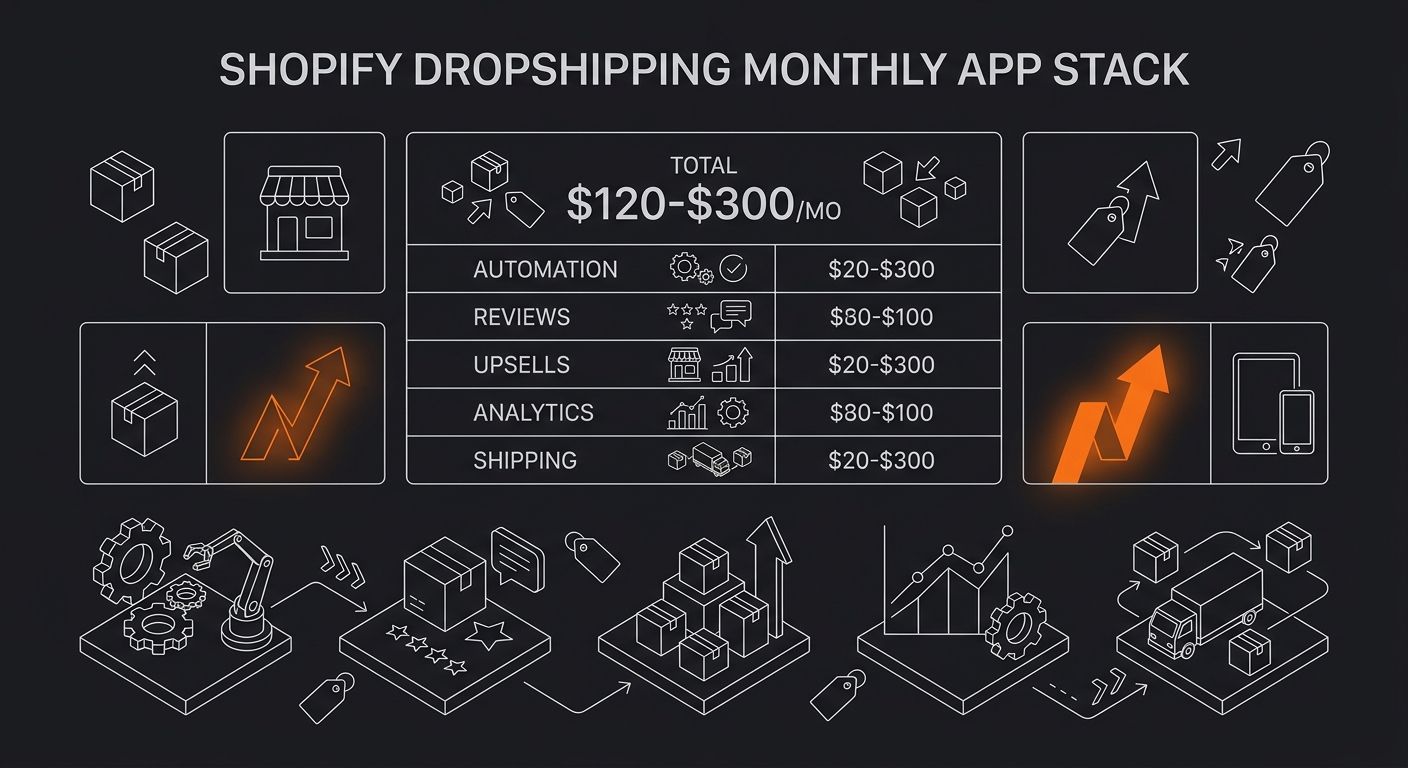
Shopify's App Store is a convenience that functions as a recurring cost center. Dropshipping automation apps (DSers, AutoDS, Spocket), review apps, upsell tools, and analytics plugins stack up to $120–$300/month for a typical store running 4–8 paid apps. That's $1,440–$3,600 annually in app fees alone, and the number tends to grow as store complexity increases.
WooCommerce plugins carry lower recurring costs on average because many are one-time purchases or freemium. But plugin conflicts, version incompatibilities after WordPress core updates, and abandoned plugins that stop receiving security patches create indirect costs that don't show up on any invoice. When you're comparing automation tools for dropshipping profit growth, the platform's plugin ecosystem stability matters as much as the sticker price of individual tools.
Set a hard monthly ceiling for apps and plugins before you launch. $150/month is a reasonable cap for a store under $20K monthly revenue. Every app you add should demonstrate measurable ROI against that budget, and you should audit quarterly to cut tools that aren't pulling their weight. The stores that bleed margin on software are the ones that never set a cap.
Be honest about your technical ceiling
WooCommerce setup takes 10–40 hours depending on your WordPress experience, according to Scandiweb's 2026 platform comparison. Shopify takes days, sometimes hours. That gap represents real money whether you value your own time or pay someone else's.
If you can't confidently handle WordPress updates, PHP version upgrades, plugin compatibility debugging, and server-side caching configuration, WooCommerce's "free" price tag comes with an implied developer dependency. Developer retainers for WooCommerce stores run $200–$600/month, and emergency fixes for broken checkout pages or hacked sites often fall outside retainer scope.
Shopify absorbs this entire maintenance layer into the subscription. You don't manage server infrastructure, handle security patches, or debug core platform conflicts. The tradeoff is control: WooCommerce gives you full code access and data sovereignty, which matters for stores building tariff-aware unit cost models or custom integrations with private suppliers. But control you can't exercise is a cost, not a feature.
Run the cost comparison at your actual revenue, not your target
The Shopify vs WooCommerce dropshipping decision flips at different revenue tiers, and projecting from where you want to be leads to overspending or underselling your infrastructure.
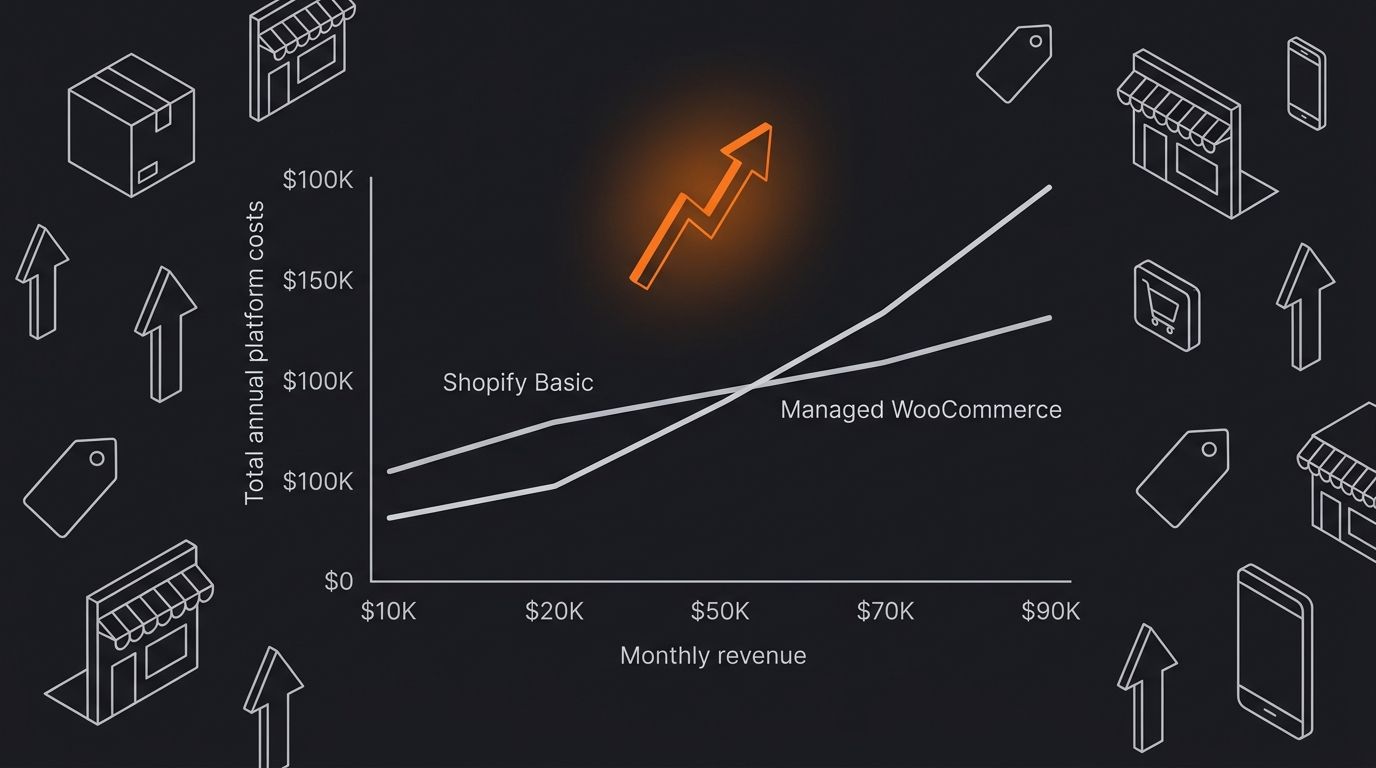
Below $50,000 in monthly revenue, WooCommerce saves $1,000–$1,800 annually for operators who can handle their own technical maintenance. The math is straightforward: cheap shared hosting plus free plugins plus your own labor keeps costs minimal. At this stage, Shopify's $468–$1,260 annual subscription feels like overhead you haven't earned yet.
Above $50,000 monthly, the equation shifts. A store generating $500,000 in annual revenue pays roughly $4,800–$9,600/year on Shopify versus $2,400–$5,400/year on WooCommerce in direct platform costs. But the WooCommerce figure excludes developer time, managed hosting upgrades to handle traffic, and the conversion cost of slower page loads. When you factor in the hidden costs that erode dropshipping margins, Shopify's predictable pricing often delivers better net margin at higher volumes.
The honest question: what is your revenue right now, this month? Use that number, not next quarter's forecast, to pick the platform that costs less today.
Treat page load time as a direct margin cost
Shopify delivers an average page load time of 1.8 seconds across its hosted infrastructure. WooCommerce load times vary wildly based on hosting quality, plugin count, theme weight, and caching configuration. Poorly optimized WooCommerce stores regularly exceed 4–5 seconds, and every additional second of load time correlates with measurable conversion rate drops.
A WooCommerce store loading in 4 seconds versus Shopify's 1.8 seconds isn't a cosmetic difference. Google's own research has consistently shown that mobile conversion rates drop roughly 12% for every additional second of load time. If your store converts at 2.5% with 1.8-second loads, the same store at 4 seconds might convert at 1.8%. On 10,000 monthly visitors with a $45 AOV, that gap equals $3,150/month in lost revenue.
Managed hosting closes this gap substantially, which is why the $100–$500/month hosting cost for WooCommerce stores handling real volume is non-optional. If you're running WooCommerce on $8/month shared hosting and wondering why your CAC payback period keeps stretching, your hosting is the margin leak.
When These Rules Contradict Each Other
Every rule above will point toward a different answer for certain stores. A technically skilled developer running a $30K/month store will find WooCommerce genuinely cheaper, faster to customize, and more capable than Shopify at the same price point. A non-technical operator at $80K/month will spend more total dollars trying to save money on WooCommerce than Shopify's subscription ever would have cost.
The dropshipping platform choice framework that actually works has three inputs: your current monthly revenue (not projected), your honest technical skill level (not aspirational), and your tolerance for unpredictable costs. If you need predictable monthly expenses because your margins are already thin (15–20% is the industry average for dropshipping), Shopify's fixed subscription eliminates variance. If you need deep customization and can maintain the infrastructure yourself, WooCommerce's lower direct costs leave more margin on the table.
The one rule that holds across every scenario: calculate total cost of ownership quarterly, not once at launch. Platforms evolve their pricing, your app stack grows, hosting needs change with traffic, and what was cheaper six months ago might be costing you more today than the alternative ever would have. Thin margins punish inattention to platform costs the same way they punish inattention to supplier costs, and the operators who run both calculations consistently are the ones who keep their businesses running.
365 Dropship Editorial
Editorial team writing about E-commerce, dropshipping, and product discovery — reviews of dropshipping suppliers and platforms, trending niche guides (jewelry, beauty, pets, home, fashion), supplier due diligence, ecom operations, shipping & fulfillment strategy, product research, AOV optimization, and profitable dropshipping case studies.
Related Articles
BuckyDrop Publishes Platform Cost Comparison Positioning Shopify Against WooCommerce and BigCommerce for 2026 Dropshipping Operations
BuckyDrop released a three-platform comparison guide on July 15 mapping Shopify, WooCommerce, and BigCommerce against dropshipping workflow requirements and total software costs, according to the company blog.
Complete Guide to Starting a Dropshipping Business
Every dropshipping business built on Shopify, Amazon, Etsy, eBay, or Walmart faces the same registration requirement: formal business filing, a dedicated bank account, and a sales tax permit.
How to Start Dropshipping: A Beginner's Guide
Starting a dropshipping store requires three connected layers: a storefront platform (Shopify leads), a supplier automation app (DSers, Spocket, or Zendrop), and a payment-plus-shipping configuration.
Explore more topics