Complete Guide to Starting a Dropshipping Business
Every dropshipping business built on Shopify, Amazon, Etsy, eBay, or Walmart faces the same registration requirement: formal business filing, a dedicated bank account, and a sales tax permit.
The App Stack Timeline: Starting a Dropshipping Business From Registration to First Sale
Every dropshipping business built on Shopify, Amazon, Etsy, eBay, or Walmart faces the same registration requirement: formal business filing, a dedicated bank account, and a sales tax permit. The sequence you follow after that filing determines whether your $200-to-$300 month-one budget produces a functioning store or a pile of unused app subscriptions.
The Registration Step Everyone Skips
Platforms can freeze your funds, restrict listings, or suspend accounts when business registration paperwork is missing. Shopify's 2026 legal guide is explicit: "Formal business registration is also required to open a business bank account, secure better payment processing rates, and obtain sales tax permits." This applies whether you sell on one platform or five.
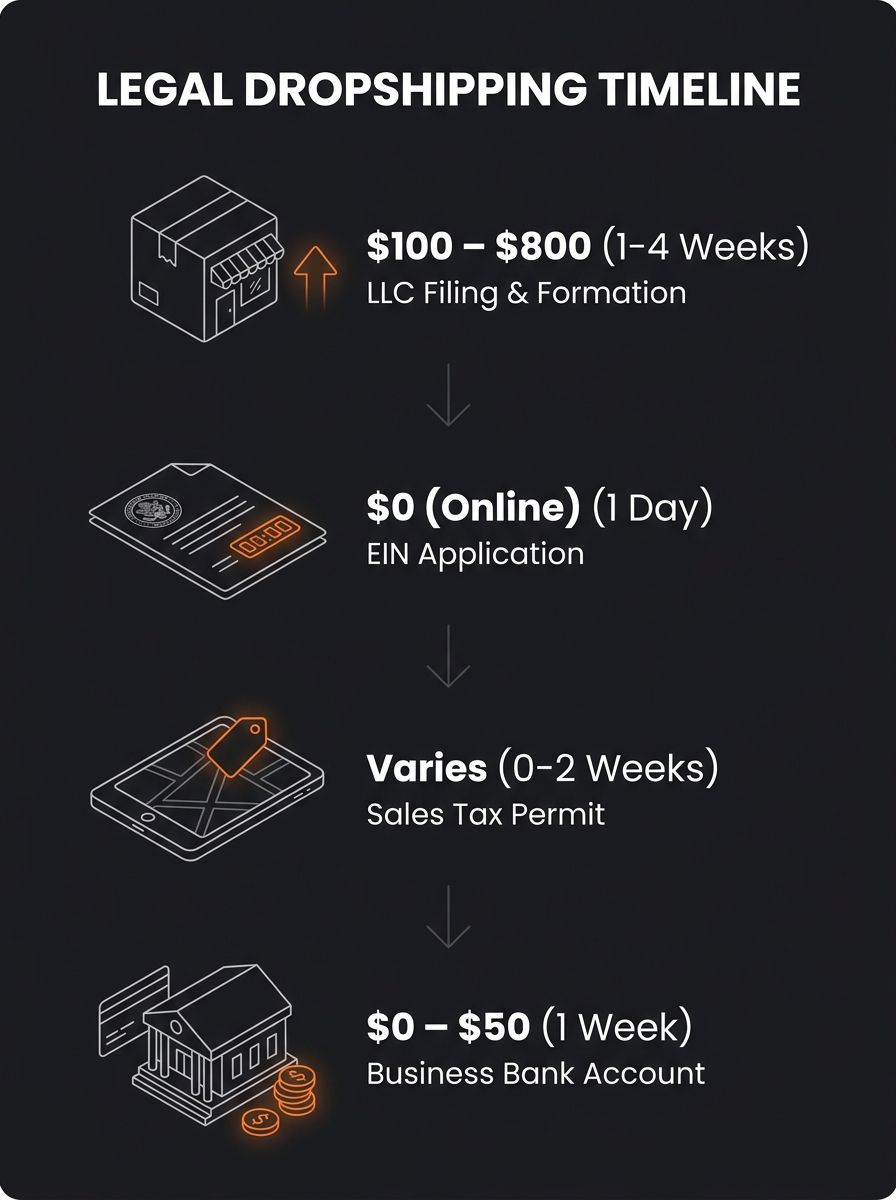
You need three things before you open any app store:
LLC or sole proprietorship filing in your state (processing takes 1-14 business days depending on the state)
EIN from the IRS (free, issued same day online)
Sales tax permit for every state where you have nexus obligations
An LLC costs between $50 (Kentucky, for example) and $500 (Massachusetts) in state filing fees. The EIN is free. Your sales tax permit varies by state but is typically free or under $25. Total legal setup: under $200 in most states, under $600 in the most expensive ones.
And here's the part that trips up new operators: you must follow consumer protection laws, collect and remit applicable taxes, accurately represent your products, protect customer data, and comply with platform policies. Get this wrong and you're exposed to lawsuits, not because dropshipping is illegal, but because you're a business and businesses get sued.
Choosing Your Store Platform
Shopify dominates the independent dropshipping business space, and for straightforward economic reasons. At $39/month for the Basic plan (which includes its AI store builder for generating custom themes from a brand description), you get checkout, hosting, and a native app ecosystem in one subscription. WooCommerce runs on WordPress and costs less upfront ($0 for the plugin itself), but hosting, security plugins, SSL certificates, and payment gateway fees push the real total-cost-of-ownership into similar territory once you factor in time spent managing the stack.
If you're weighing these two platforms, the total cost of ownership comparison between Shopify and WooCommerce breaks down every hidden line item. For operators with less than six months of operating expenses in cash reserves, NetSuite's analysis recommends dropshipping specifically because it avoids the inventory and warehousing overhead that traditional ecommerce demands.
The platform decision also constrains your supplier app options. Shopify's app store has 40+ dropshipping supplier integrations. WooCommerce has roughly half that number with reliable maintenance. Amazon's dropshipping program allows the model but prohibits purchasing from other online retailers and shipping directly to customers with another retailer's branding.
Supplier Apps That Actually Ship on Time
This is where most new dropshipping operators make their most expensive mistake. The supplier app you pick determines your shipping speed, product quality, return rate, and ultimately your profit margin. Average profit margins run 20% to 30% per sale, and a supplier with 15-day shipping will destroy your repeat purchase rate long before you hit those numbers.
Here's how the major supplier platforms compare across the metrics that actually matter:
Platform | Warehouse Locations | Avg. Shipping to US | Monthly Cost | Product Categories | Auto-Fulfill |
|---|---|---|---|---|---|
Spocket | US, EU, AU | 2-7 days (US/EU) | $39.99/mo | 20+ | Yes |
CJ Dropshipping | US, China, EU | 7-15 days (China), 3-7 days (US) | Free base | 400K+ products | Yes |
DSers (AliExpress) | Mostly China | 12-20 days | Free-$49.90/mo | Millions | Yes |
Modalyst | US, EU | 3-8 days (US/EU) | $0-$67/mo | 20+ vetted categories | Yes |
Spocket and Modalyst charge more per month but connect you to domestic and EU suppliers with 2-8 day shipping windows. CJ Dropshipping offers free base access and will source products you can't find in their catalog, with warehouses in the US, China, and Europe. DSers integrates directly with AliExpress and gives you the widest product selection, but shipping from China still averages 12-20 days without US warehousing.
The detailed comparison between Spocket and AutoDS covers automation differences at scale, but for a brand-new store, the decision comes down to this: are you selling to US customers who expect 5-day delivery, or are you willing to manage longer shipping expectations with lower COGS?

Payment Processing and Operations Setup
Once your supplier app is connected and you've imported 10-25 test products (don't launch with 200 SKUs; start narrow), you need payment processing and basic operations apps configured before you drive a single visitor.
Shopify Payments charges 2.9% + $0.30 per transaction on the Basic plan. PayPal checkout runs 3.49% + $0.49 for standard transactions. On a $40 average order value, Shopify Payments takes $1.46 per sale and PayPal takes $1.89. Over 100 orders, that $43 difference compounds.
Your operations stack at launch should include exactly three things:
Inventory sync between your supplier app and your store (built into DSers, Spocket, and CJ by default). Broken sync leads to oversell events that wreck your conversion rate. If you've already encountered that problem, the diagnosis and fix guide for inventory sync errors walks through every failure mode.
Order tracking so customers can follow shipments without emailing you (AfterShip at $0-$11/month handles this)
Email automation for order confirmations and shipping updates (Shopify's built-in email or Klaviyo's free tier for up to 250 contacts)
Skip the upsell apps, the pop-up builders, and the loyalty programs until you're doing $3K+ per month consistently. Every app subscription below that revenue level is a margin tax.
The First Marketing Dollar
With legal registration complete, platform configured, suppliers connected, and operations apps running, you're ready to spend on traffic. The global dropshipping market drives over $370 billion in annual sales with roughly 22% growth projected through 2030, and that growth is attracting more competition into every niche. Your first marketing budget has to be precise.
Allocate your initial spend across two channels:
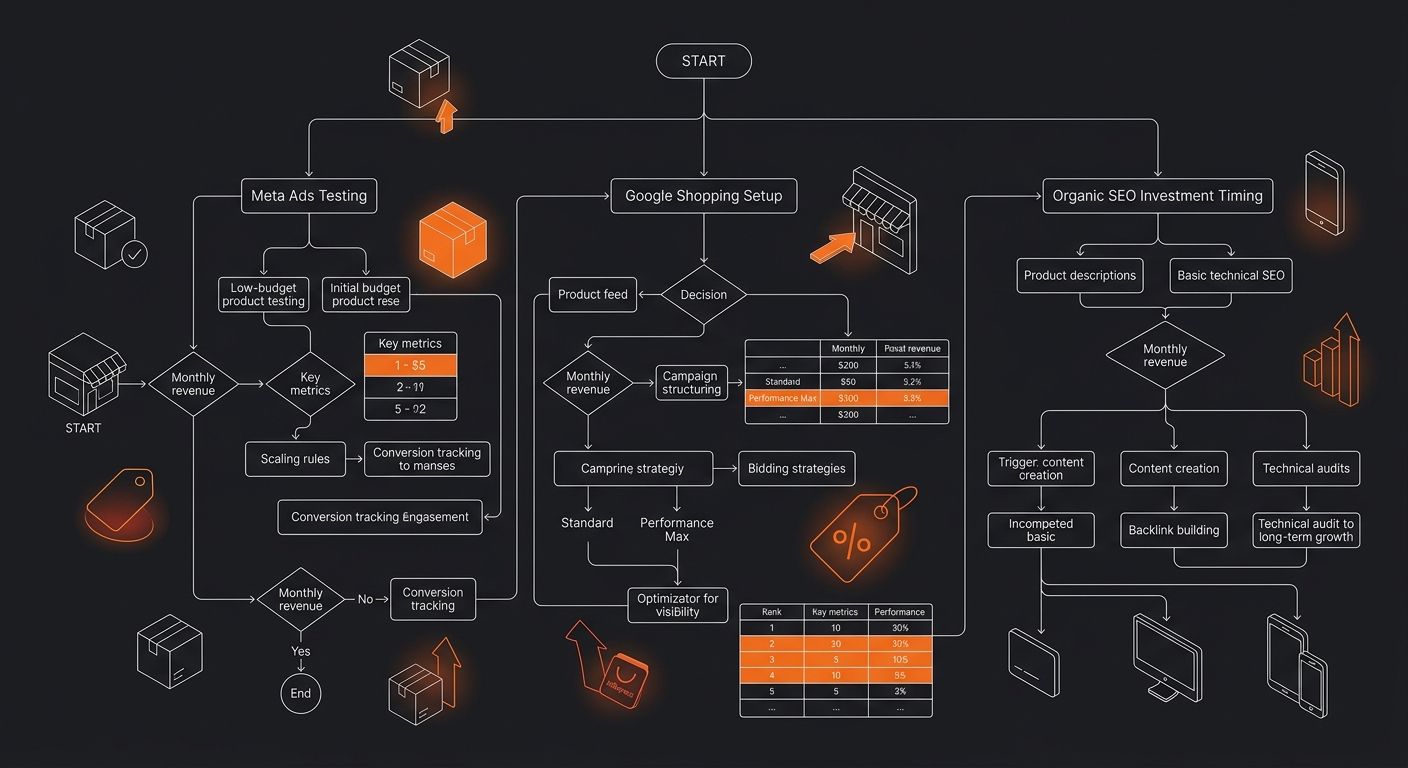
Meta Ads (Facebook/Instagram): Start with $15-$20/day testing 3-4 ad sets against your top 2-3 products. Kill any ad set with a cost-per-click above $2.50 after 48 hours and no add-to-carts. Your target cost-per-acquisition should sit below 30% of your product's selling price to preserve margin.
Google Shopping: If your products have clear search intent (people actively searching "ceramic plant pots" or "insulated water bottle"), Google Shopping can outperform Meta on ROAS from day one. Budget $10-$15/day here.
The breakdown of where to allocate your first $5,000 in marketing spend between paid traffic and organic SEO covers this split in deeper detail. But the short version: paid ads first to validate product-market fit, SEO second to build compounding traffic once you know what sells.
Where This Lands Now
The dropshipping business model in 2026 is mature. The $200-$300 month-one budget Shopify cites is real, but it assumes you sequence your spending correctly: legal registration first, platform setup second, supplier integration third, operations fourth, marketing fifth. Scramble that order and you'll install $80/month in apps before you've filed your LLC.
The operators I see hit $5K-$10K monthly revenue within 90 days share three patterns. They register their business before touching a store builder. They pick one supplier app and test 5-10 products with sample orders before listing anything. And they don't install a single marketing or upsell app until they've confirmed their unit economics work on paper: selling price minus COGS minus shipping minus payment processing minus platform fees equals a gross margin above 25%.
Annual income for dropshipping operators ranges from under $35,000 to over $100,000 depending on niche selection, supplier quality, and marketing efficiency. The app stack you build determines which end of that range you land on. Start with the five categories above, resist the urge to install everything on day one, and let your revenue justify each new subscription.

Ryan Torres
Ryan Torres is a former Amazon FBA seller turned dropshipping consultant who has generated over $2.8M in ecommerce revenue across 14 product launches. He specializes in supplier vetting, margin optimization, and scaling DTC operations for sub-$1M brands. Ryan focuses on actionable frameworks that drive measurable results for independent operators.
Related Articles
What is Dropshipping: Complete Beginner's Guide
The global dropshipping market is projected to hit $537.8 billion in 2026, expanding at a 23.6% compound annual growth rate through 2032. Dropshipping is an ecommerce fulfillment model where you sell products online without purchasing or storing inventory.
How to Do Dropshipping: Complete Beginner's Guide
This guide walks you through how to do dropshipping from zero to first sale in under a week. Seven steps cover niche selection, business registration, store setup, supplier vetting, product pricing, test orders, and ad launch, with specific costs and timelines at each stage.
Dropshipping How to: Complete Beginner's Guide
Every step of launching a dropshipping store fits into a single weekend: niche selection, LLC registration, Shopify storefront, supplier vetting, product import, and a live test order. Total startup cost sits under $150, and you'll have a functioning store accepting real orders by Sunday night.
Explore more topics