Why Review Aggregators Are Actively Misleading Dropshippers About Supplier Quality in 2026
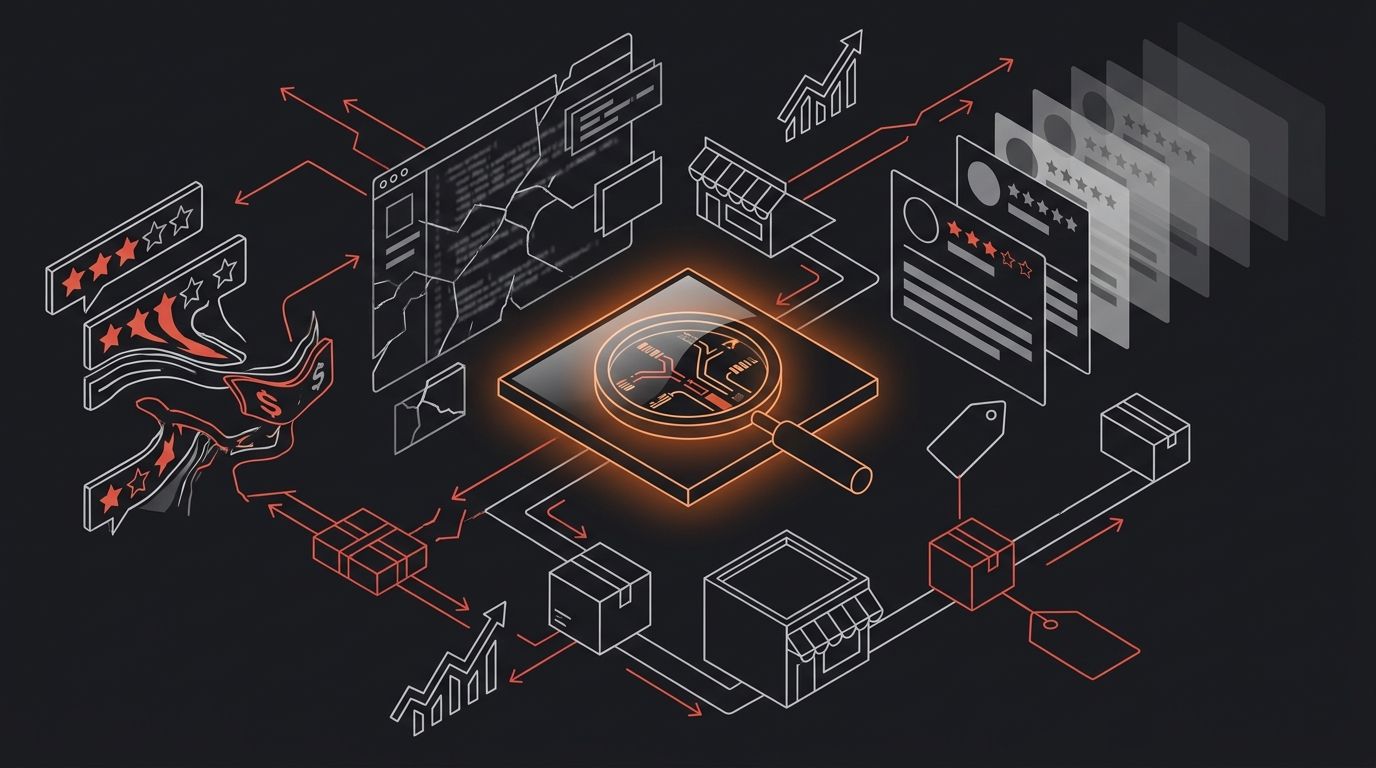
Review aggregators earn subscription and per-order fees from the supplier relationships they're supposed to objectively rate. Platforms like Spocket, Modalyst, and Doba display quality scores as neutral assessments.
Why Review Aggregators Are Actively Misleading Dropshippers About Supplier Quality in 2026
Review aggregators earn subscription and per-order fees from the supplier relationships they're supposed to objectively rate. Platforms like Spocket, Modalyst, and Doba display quality scores as neutral assessments. The economics behind those scores incentivize inflation, suppress negative feedback, and make dropshipping supplier ratings functionally unreliable for quality decisions.
How Aggregator Ratings Were Designed to Work
The original pitch was straightforward. Platforms like Spocket and Modalyst would charge dropshippers a monthly subscription ($39–$99/month depending on tier), connect them to pre-screened suppliers, and surface ratings from other operators who'd placed real orders. Doba took a similar approach, centralizing supplier catalogs and promoting supplier ratings as a decision-making tool. The promise: you pay for access, the platform vets the suppliers, and star ratings from fellow dropshippers guide you toward the good ones and away from the bad.
This model assumed two things. First, that supplier vetting would happen independently of revenue incentives. Second, that user-generated ratings would be honest, uncompensated, and based on verified orders. Both assumptions collapsed under the weight of the aggregators' own business models within the first few years of scale.
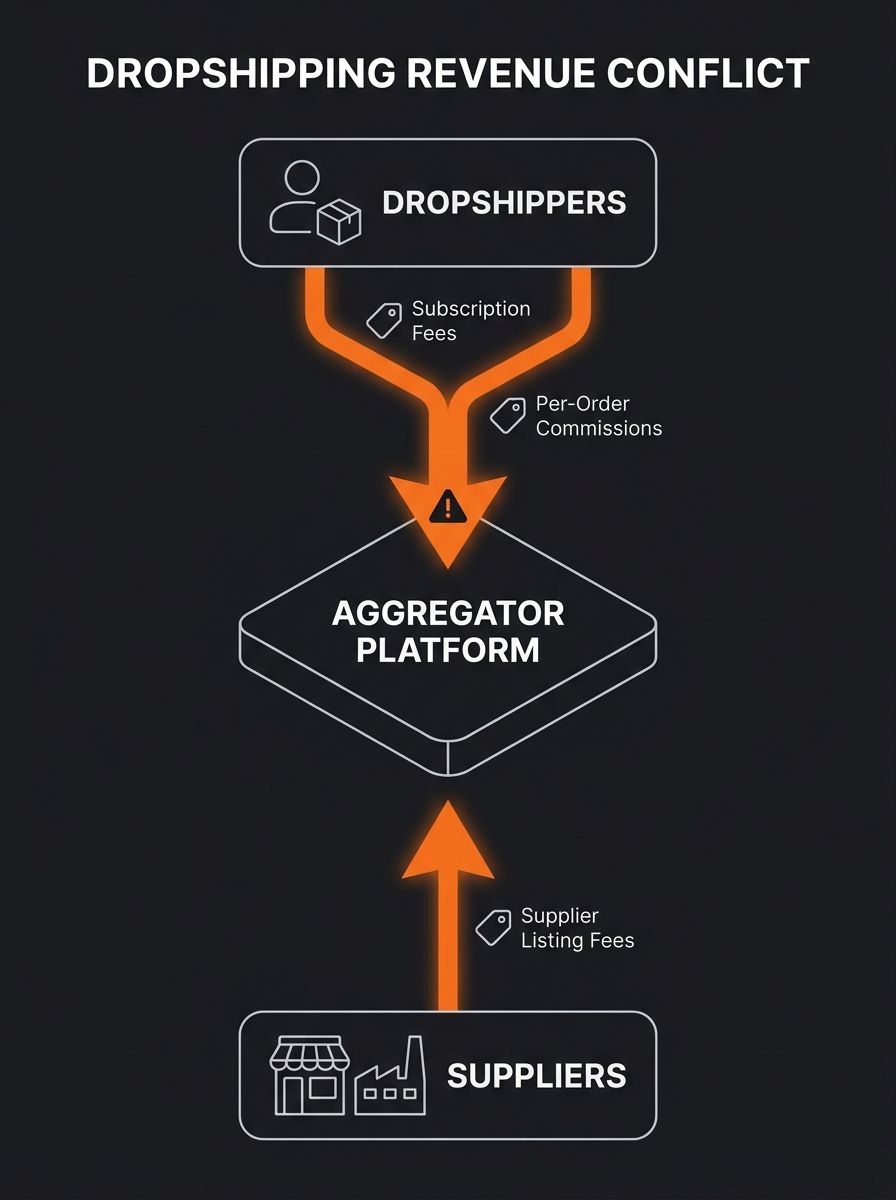
The subscription fee is the visible revenue stream. The less visible one is the per-supplier relationship: listing priority, premium placement, and featured badges that suppliers pay for or earn through volume. When a platform earns money both from the dropshipper selecting a supplier AND from the supplier being selected, the rating system sits at the center of a conflict that no amount of "vetting" language resolves. We covered how aggregator platforms layer fees between factory price and your landed cost in a separate breakdown, but the rating distortion is the upstream problem that feeds the cost distortion downstream.
The Incentive Misalignment That Broke the Model
Why would an aggregator platform surface a genuinely bad rating for a supplier that drives transaction volume? Fashion and accessories alone account for 28% of all dropshipping revenue, home and garden for 18%, and electronics for 15%. The suppliers serving these high-volume categories generate the most orders through aggregator dashboards. A negative rating that pushes a dropshipper away from a high-volume supplier costs the platform revenue on every subsequent order that operator would have placed.
The incentive math works like this: if a supplier processes 500 orders per month through a platform at a $2.50 per-order fee, that's $1,250/month in platform revenue from one supplier relationship. A 3.2-star rating that drives operators toward a competing supplier with a 4.7-star rating costs real money. Platforms don't need to manually inflate ratings to make this work. They design systems where negative reviews face friction (multi-step submission forms, minimum character counts, moderation queues) while positive ratings flow through with a single click.
Some platforms also weight ratings by recency and order volume, which sounds neutral until you realize it suppresses the single-order operator who got burned and amplifies the high-volume reseller who cares more about speed than product accuracy. The result is a ratings distribution that clusters suspiciously between 4.2 and 4.9 stars across entire supplier catalogs, with almost no suppliers falling below 3.5. If you've spent time looking at the trust gap between star ratings and actual purchase outcomes, you'll recognize this pattern.
Fake Review Networks Entered the Supply Chain
The aggregator incentive problem created an opening for something worse. CloudSEK's research on fake review networks documented agencies using WhatsApp and Telegram groups to flood product listings with fabricated positive reviews. These networks weren't limited to Amazon and consumer-facing marketplaces. Supplier-side review manipulation followed the same playbook: third-party agencies offered to generate positive ratings on aggregator platforms for $3–$8 per review, paid through cryptocurrency or informal payment channels to avoid paper trails.
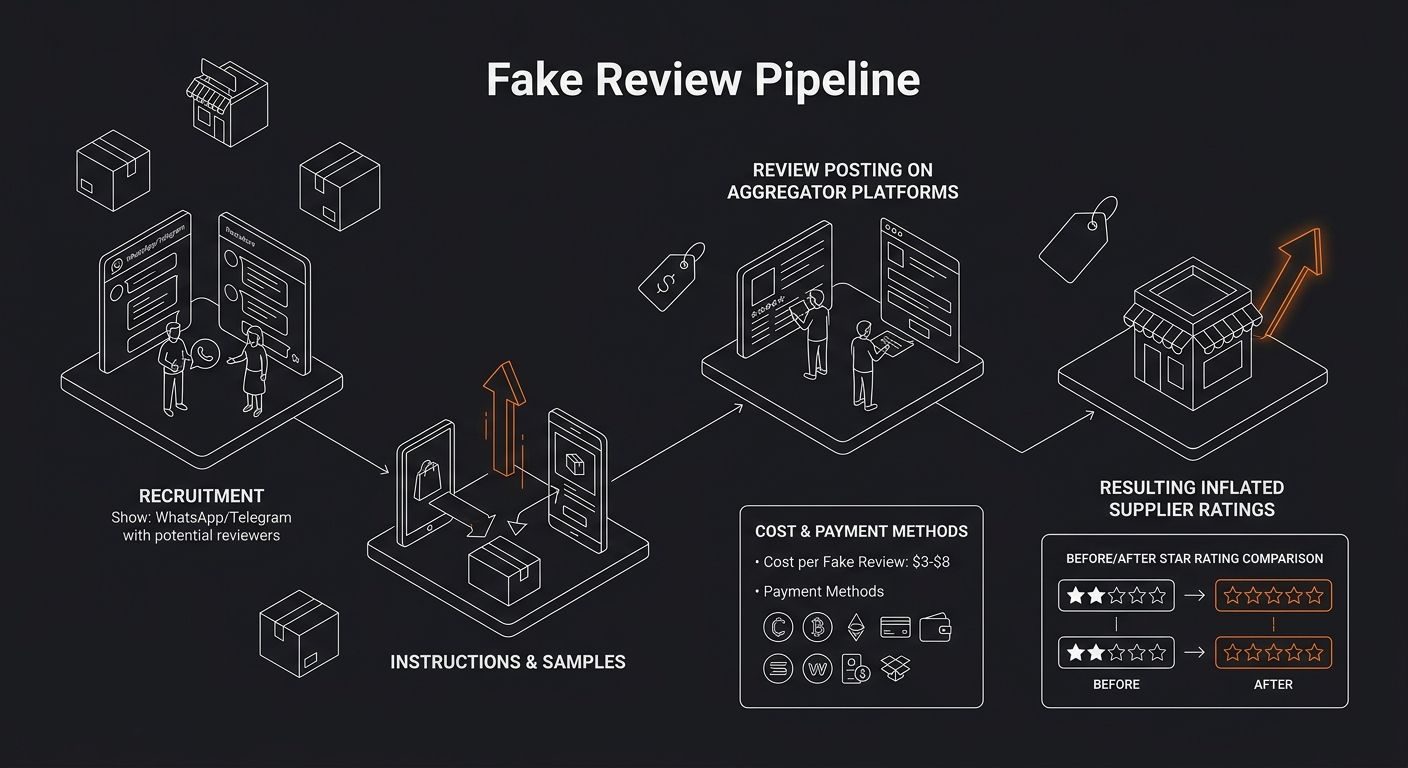
A PMC-published study on fake reviews across online platforms defined the scope: fraudulent reviews include both positive reviews favoring the sellers' own goods and negative reviews targeting competitors' goods. For dropshipping aggregators, the positive-inflation side dominates. A supplier paying $400 for 50 fake five-star reviews recovers that cost if the inflated rating drives even 15–20 additional orders at typical margins. The ROI on review fraud is extremely favorable for the supplier and invisible to the dropshipper relying on those biased supplier reviews to make sourcing decisions.
The problem compounds when aggregators display cumulative ratings without distinguishing between verified-purchase reviews and reviews from accounts with no order history. Some platforms technically require a purchase to leave a rating, but enforcement is inconsistent. A ScienceDirect analysis found that fraudulent reviews are crafted by competitors, sellers, and hired third-party agencies to manipulate consumer perceptions and distort market trends. The same dynamic plays out at the B2B supplier level, where the consumer is the dropshipper and the "market trend" is the supplier's apparent reliability score.
The FTC Drew a Line
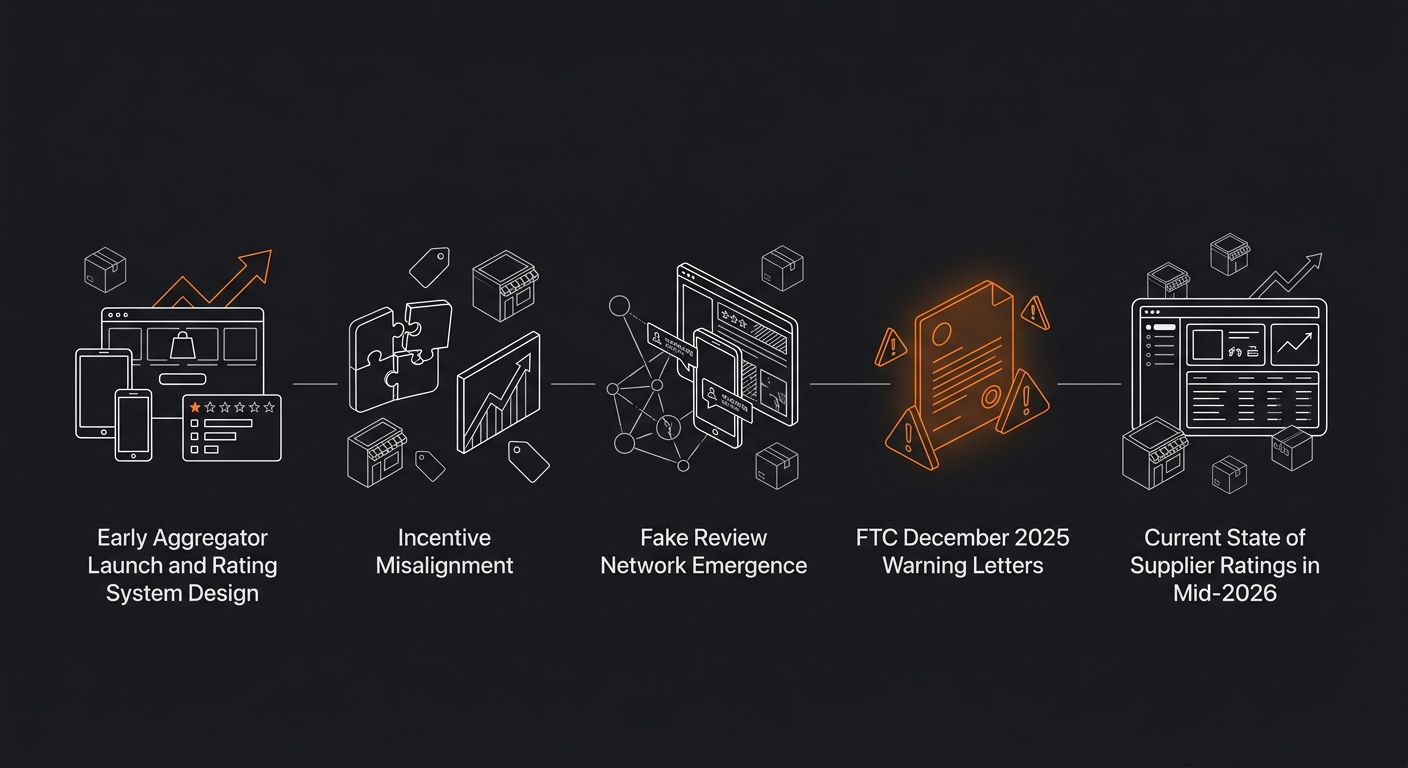
The FTC's December 2025 warning letters to businesses explicitly flagged that posting fake reviews or giving incentives for only positive reviews "may trigger enforcement actions and fines." This was a direct shot at the practices driving aggregator rating inflation. The FTC considers it illegal to incentivize reviews even when there's no explicit requirement that the review be positive, according to ReviewTrackers' analysis of the enforcement landscape.
Review aggregators like Yelp already stopped entertaining incentivized reviews entirely. But dropshipping aggregators haven't followed suit. The distinction matters: Yelp serves consumers who can verify their own experience at a restaurant. Dropshipping aggregators serve operators whose verification happens weeks or months later, after customer complaints, returns, and chargebacks reveal the actual quality of the supplier. By then, the rating that influenced the sourcing decision is buried under newer reviews.
The FTC action created a regulatory framework, but enforcement remains complaint-driven. Dropshippers who get burned by a misleadingly rated supplier would need to file formal complaints, and the FTC's bandwidth for individual supplier-level enforcement across dozens of aggregator platforms is limited. The practical effect so far has been that aggregators updated their terms of service to prohibit incentivized reviews while doing very little to detect or remove the ones already in their systems.
Where the Data Looks Today
Supplier vetting in 2026 requires treating aggregator ratings as marketing collateral, because that's what they are. The platform displaying the rating has a financial interest in you choosing a supplier through its dashboard. The supplier whose rating you're reading may have paid for some percentage of those stars. And the regulatory pressure that would force transparency exists on paper but lacks teeth in practice.
What works instead is direct verification. Building a supplier scorecard in Shopify metafields gives you a tracking system based on your own order data: defect rates, shipping time accuracy, response speed, and return frequency. These metrics accumulate from your actual transactions, and they can't be gamed by a third-party review agency.
The 2026 sourcing guidance from Accio's dropshipping trends analysis puts it bluntly: "Rigorous supplier vetting is critical to ensure product integrity and avoid reputational damage." That vetting has to happen upstream of aggregator ratings. Order samples. Run reverse-image searches on product photos. Check whether the supplier's listed address resolves to a real facility. Contact them directly and measure response time before you commit a dollar of ad spend. If you've dealt with supplier communication failures that collapse margins mid-campaign, you know that responsiveness during the sales pitch tells you almost nothing about responsiveness during a fulfillment crisis.
Vetting Method | Data Source | Manipulable? | Cost to Implement |
|---|---|---|---|
Aggregator star ratings | Platform-displayed reviews | High (fake reviews, incentive bias) | $0 (included in subscription) |
Sample orders (3–5 units) | Your own inspection | Low | $50–$200 per supplier |
Reverse image search | Google Lens / TinEye | None | $0 |
Supplier response time test | Direct communication | Low | $0 (time cost only) |
30-day defect rate tracking | Your order data via metafields | None | 2–3 hours setup |
Third-party factory audit | Independent inspection service | Low | $200–$500 per audit |
The gap between aggregator incentives and operator outcomes won't close on its own, because the business model that creates it is the same business model that funds the platform. Treat aggregator ratings as a starting point for discovery, never as evidence of quality. The suppliers worth building a business around reveal themselves through your own order history, your own defect tracking, and your own communication logs. Every other signal is someone else's revenue strategy dressed up as your due diligence.
365 Dropship Editorial
Editorial team writing about E-commerce, dropshipping, and product discovery — reviews of dropshipping suppliers and platforms, trending niche guides (jewelry, beauty, pets, home, fashion), supplier due diligence, ecom operations, shipping & fulfillment strategy, product research, AOV optimization, and profitable dropshipping case studies.
Related Articles
The Review Generation Trap: Why Fake Social Proof Is Tanking Your Conversion Rate (And How Successful Dropshippers Build Authentic Feedback Loops)
Northwestern University's Spiegel Research Center produced a finding that should have killed the fake-review industry on the spot: products rated between 4.2 and 4.5 stars convert at higher rates than products sitting at a perfect 5.0. The implication was plain. Shoppers don't trust perfection.
The Customer Experience Audit: Mining Your Reviews for Operational Blind Spots Before They Tank Margins
Systematic customer feedback analysis converts raw review text into supplier performance metrics that expose margin erosion weeks before your P&L registers the damage.

The Supplier Audit Trap: Why Automation Tools Hide Quality Red Flags Until Your First 100 Orders
DSers, Spocket, and Zendrop all surface supplier scores built from the same thin data: listing age, order volume, and aggregate star ratings.
Explore more topics