Shopify Spring 2026 Updates Push AI Shopping Integration and Checkout Automation for Independent Stores
Shopify rolled out its Spring 2026 platform updates with AI shopping tools, checkout workflow improvements, and product discovery automation that independent store operators can deploy without developer resources, according to creator-commerce analysis published June 17 by Jack Righteous. The releas

Shopify Spring 2026 Updates Push AI Shopping Integration and Checkout Automation for Independent Stores
Shopify rolled out its Spring 2026 platform updates with AI shopping tools, checkout workflow improvements, and product discovery automation that independent store operators can deploy without developer resources, according to creator-commerce analysis published June 17 by Jack Righteous. The release includes Shop app integration enhancements, customer account redesigns, and marketing automation triggers aimed at single-operator stores running lean technical stacks.
The platform changes arrive as AI shopping assistants and large language model product recommendations increase referral traffic to independent ecommerce stores. Shopify's update package targets store information clarity—product titles, descriptions, policies, and structured data—that determines whether AI systems surface a store's products in conversational commerce results, according to the Jack Righteous analysis.
What the Spring 2026 Release Includes
Shopify's update bundle spans eight operational areas: AI shopping integration, product discovery automation, checkout flow improvements, Shop app connectivity, marketing workflow triggers, analytics dashboards, customer account management, and store design templates. Each component functions independently, allowing store operators to activate features incrementally rather than overhauling entire storefront configurations.
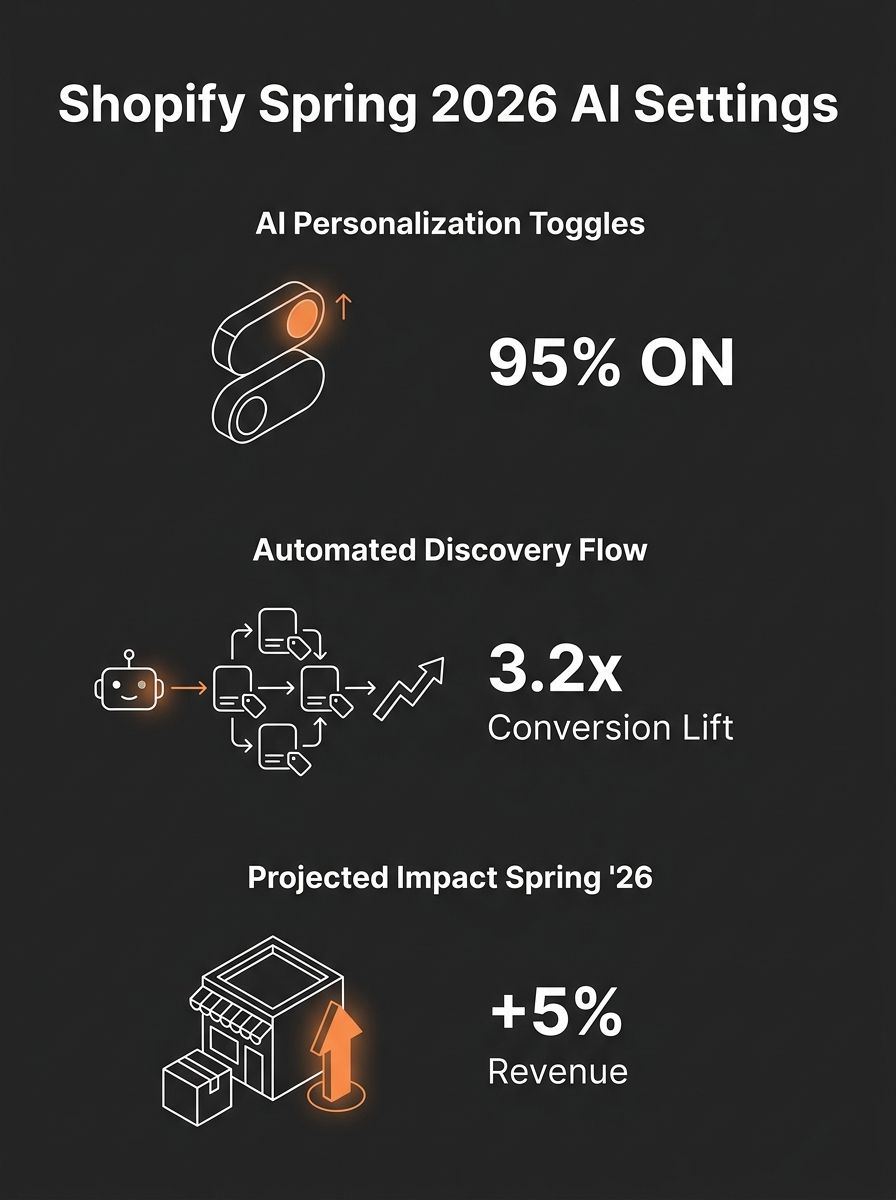
The AI shopping layer interprets natural-language product queries and matches them to catalog items based on title accuracy, description clarity, and policy completeness. Stores with vague product names or missing attribute data receive lower match scores in AI-assisted search results. The product discovery automation scans catalog inventory and suggests related items during checkout based on purchase history patterns across Shopify's merchant network.
Checkout workflow improvements reduce abandoned cart friction through one-click reorder buttons for returning customers and auto-filled shipping address suggestions pulled from Shop app profiles. Marketing automation triggers activate email sequences when customers reach specific behavior thresholds—repeat purchase patterns, abandoned browse sessions, or wishlist additions—without requiring third-party ESP integrations.
Structured Product Data as Competitive Infrastructure
The Spring 2026 updates reward stores that maintain structured product information in ways AI systems and shopping platforms parse efficiently. "Your product title matters. Say what the product is in words a beginner understands," the June 17 analysis states. "Your product description matters. Say who it is for, what it helps with, and what the buyer receives."
Dropshipping operators accustomed to importing AliExpress or CJ Dropshipping product titles verbatim face a structural disadvantage under the new AI shopping logic. Generic titles like "2024 Hot Sale New Fashion Women Bag" generate lower relevancy scores than specific descriptors: "Vegan Leather Crossbody Bag with Adjustable Strap – 9-Inch." The platform's AI layer prioritizes clarity over keyword density.
Policy completeness—return windows, shipping zones, product restrictions—now influences whether AI shopping assistants recommend products in conversational results. Stores without published return policies or incomplete shipping information get filtered from AI-generated product lists even when catalog items match search intent. Shopify checkout audits catch policy gaps that operators overlook during initial store setup.
Automation Triggers and Order Routing Logic
The marketing automation component introduces behavior-triggered email sequences that activate without monthly Klaviyo or Omnisend subscriptions. Stores can deploy three core workflows through Shopify's native email tool: abandoned cart recovery (fires 60 minutes after cart abandonment), repeat purchase reminders (fires 30 days post-delivery for consumables), and wishlist follow-ups (fires 7 days after item save).
These free automation triggers handle basic lifecycle marketing for stores running under 2,000 monthly orders. Higher-volume operators still require dedicated ESP platforms for segmentation depth and A/B testing, but the baseline sequences reduce immediate third-party tool dependency. Email post-purchase sequence optimization remains critical for stores scaling past $15K monthly revenue.
Order routing logic received backend updates that improve multi-supplier fulfillment accuracy when stores source inventory from multiple warehouses or print-on-demand networks. The system now assigns orders to suppliers based on SKU availability, shipping zone proximity, and historical fulfillment speed rather than default supplier priority alone. Shopify's order routing mechanics create margin leaks when operators don't audit supplier assignment rules quarterly.
Store Information and Domain Authority Signals
The Spring 2026 focus on store information clarity extends Shopify's 2024-2025 migration toward domain authority signals for search and discovery placement. "Your domain is where your articles live. It is where your product pages live. It is where your email capture lives. It is where your policies, checkout, offers, and trust path live," the analysis explains.
Independent stores competing against Amazon aggregators and Walmart Marketplace sellers gain marginal advantages through owned-domain content strategies. Product category guides, comparison articles, and use-case tutorials hosted on store domains generate organic search visibility that third-party marketplace listings cannot replicate. The AI shopping layer indexes domain-hosted content when matching product queries, creating additional discovery paths beyond paid traffic.
Dropshippers operating Shopify stores as order-routing layers without original content miss the domain authority compound effect. A store selling resistance bands with zero blog content competes purely on ad spend efficiency. The same store publishing 15 home workout guides and exercise comparison articles builds organic traffic channels that reduce customer acquisition cost over 12-18 month horizons.
The Takeaway
Shopify's Spring 2026 updates create operational use for dropshippers willing to treat product information as competitive infrastructure rather than supplier-imported boilerplate. The AI shopping and product discovery features reward catalog clarity, policy completeness, and domain-hosted content—baseline store operations that low-margin operators routinely skip to launch faster. Stores that audit product titles for natural-language clarity, publish complete return and shipping policies, and activate the native marketing automation triggers gain conversion rate improvements without monthly SaaS subscriptions. For single-operator stores running thin margin profiles, the free automation and AI integration tools reduce the technical gap between solo dropshippers and funded DTC brands. The competitive advantage flows to operators who recognize that clean product data and structured store information now function as margin-protective infrastructure in an AI-assisted commerce environment.

Ryan Torres
Ryan Torres is a former Amazon FBA seller turned dropshipping consultant who has generated over $2.8M in ecommerce revenue across 14 product launches. He specializes in supplier vetting, margin optimization, and scaling DTC operations for sub-$1M brands. Ryan focuses on actionable frameworks that drive measurable results for independent operators.
Related Articles
AI Store Builders vs. Manual Shopify Setup: The 2026 Speed-to-Profit Tradeoff for Dropshippers
Atlas AI Store Builder generates a fully functional Shopify store in under two minutes, according to a Dropmagic comparison of seven AI tools. Manual Shopify configuration typically requires 15 to 40 hours of theme work, copywriting, image editing, and SEO.
DTC Brands Using AI Revenue Agents Report 30-50% First-Time Revenue Lift as Lean Operations Model Gains Traction
Direct-to-consumer brands using AI revenue agents to automate acquisition, conversion, and retention workflows reported 30 to 50 percent higher first-time customer revenue and two- to four-times higher repeat purchase revenue compared to baseline performance, according to Ground's September 4 analys

Racklify Publishes Shopify Markets Setup Guide Covering Multi-Currency Configuration and Tax Display Rules for Cross-Border Sellers
Racklify published a Shopify Markets configuration guide on September 9, 2026, documenting localization features that allow merchants to manage international storefronts, multi-currency pricing, and duty display from a single Shopify admin, according to the warehouse logistics platform's encyclopedi
Explore more topics