How to Calculate Profit Margin: Step-by-Step
Profit margin measures how many cents of every revenue dollar you actually keep after costs. This guide walks you through calculating gross, operating, and net margin in under 15 minutes using real product numbers and formulas you can drop straight into a spreadsheet.

How to Calculate Profit Margin: Step-by-Step for Ecommerce Sellers
Profit margin measures how many cents of every revenue dollar you actually keep after costs. This guide walks you through calculating gross, operating, and net margin in under 15 minutes using real product numbers and formulas you can drop straight into a spreadsheet.
Before You Start
You need three things before running any margin formula:
Revenue figures for the period you're measuring (a single product, a weekly batch, or a full month). Use net revenue. Subtract refunds, chargebacks, and discounts from your gross billing first. Using gross revenue inflates the denominator and makes your margins look better than reality.
Cost of goods sold (COGS) for that same period. For dropshippers, COGS includes the supplier's product price, inbound shipping to the customer, and per-unit transaction fees (payment processor cuts, platform commissions). If you're using a print-on-demand provider like the ones covered in our Printful feature breakdown, your COGS is the base product cost plus shipping from the fulfillment center.
A spreadsheet or calculator. Google Sheets works. The Omnicalculator margin tool is useful for spot-checking individual SKUs.
Time required: 10–15 minutes for a single-product calculation, about 30 minutes if you're building a full SKU-level margin table for the first time.
Gross Profit and Gross Margin Percentage
Gross margin is the foundation of every margin analysis. Sage's business advisory team defines margin as the formula that "shows how much of each sale remains as profit after direct costs are deducted." Two calculations happen here, back-to-back.
First, calculate gross profit in dollars:
Gross Profit = Revenue − COGS
Say you sell a wireless phone mount for $29.99. Your supplier charges $7.50 per unit. Shipping to the customer via CJ Dropshipping runs $3.80. Payment processing (Shopify Payments at 2.9% + $0.30) takes $1.17.
Your COGS per unit: $7.50 + $3.80 + $1.17 = $12.47
Gross profit per unit: $29.99 − $12.47 = $17.52
Second, convert that dollar figure into a percentage:
Gross Margin % = (Gross Profit ÷ Revenue) × 100
Phone mount: ($17.52 ÷ $29.99) × 100 = 58.4%
That's a strong gross margin for a dropshipped product. Most dropshipping operations land between 15% and 40% gross margin depending on the category and supplier. Consumer electronics accessories tend to sit in the 30–60% range because perceived value outweighs commodity cost.
You'll know this step worked when you have both a dollar figure and a percentage. If gross profit is negative, you're losing money on every sale before you've paid for a single ad.
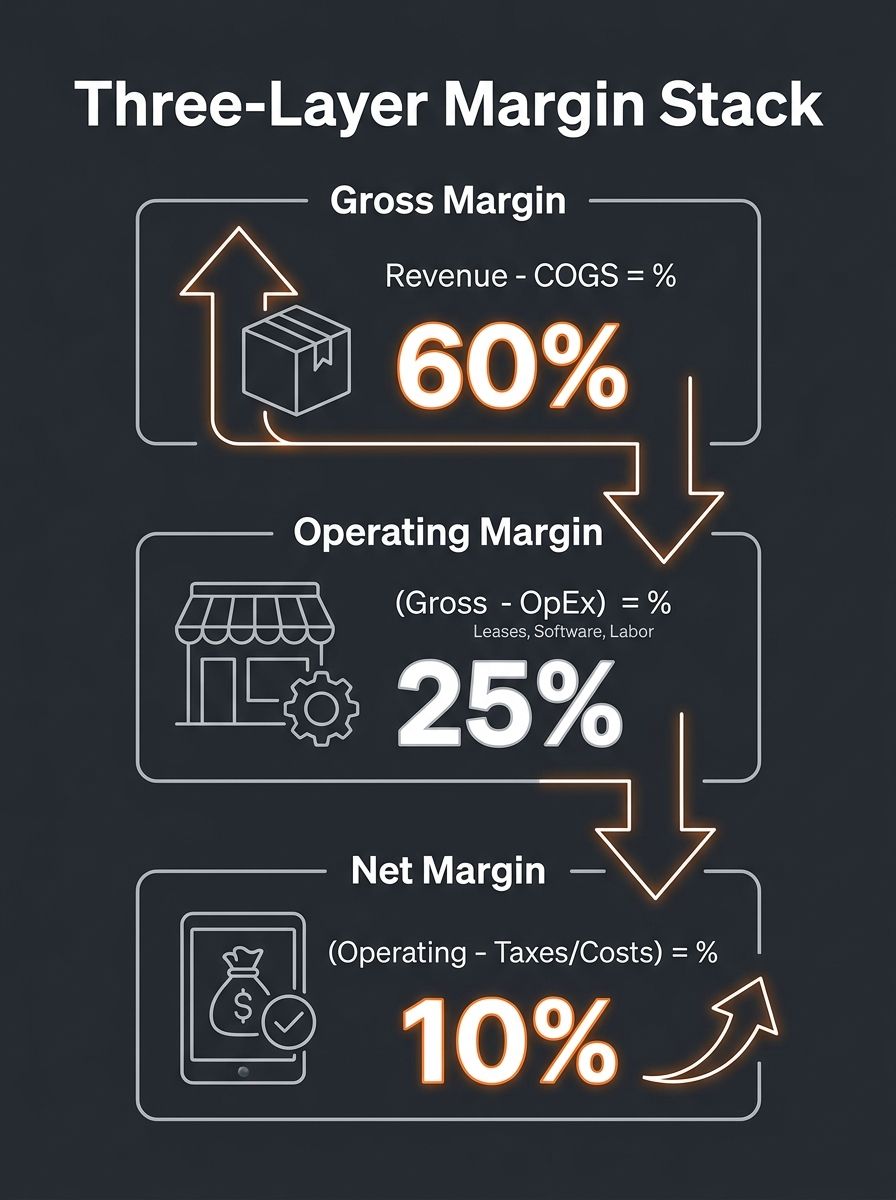
Operating Margin Strips Away the Overhead
Gross margin ignores what it costs to run your business. Operating margin adds those expenses back in: ad spend, software subscriptions, VA salaries, returns processing. Viking Mergers' profitability analysis emphasizes that "gross margin focuses on production and manufacturing efficiency" while operating and net margins reveal whether overhead is eating your profit.
Operating Profit = Gross Profit − Operating Expenses Operating Margin % = (Operating Profit ÷ Revenue) × 100
For the phone mount, assume you sell 500 units in a month:
Monthly revenue: 500 × $29.99 = $14,995
Monthly COGS: 500 × $12.47 = $6,235
Gross profit: $8,760
Now subtract monthly operating costs:
Expense | Monthly Cost |
|---|---|
Facebook/Meta ads | $3,200 |
Shopify plan + apps | $180 |
Virtual assistant | $600 |
Returns/refunds (~4% of revenue) | $600 |
Total operating expenses | $4,580 |
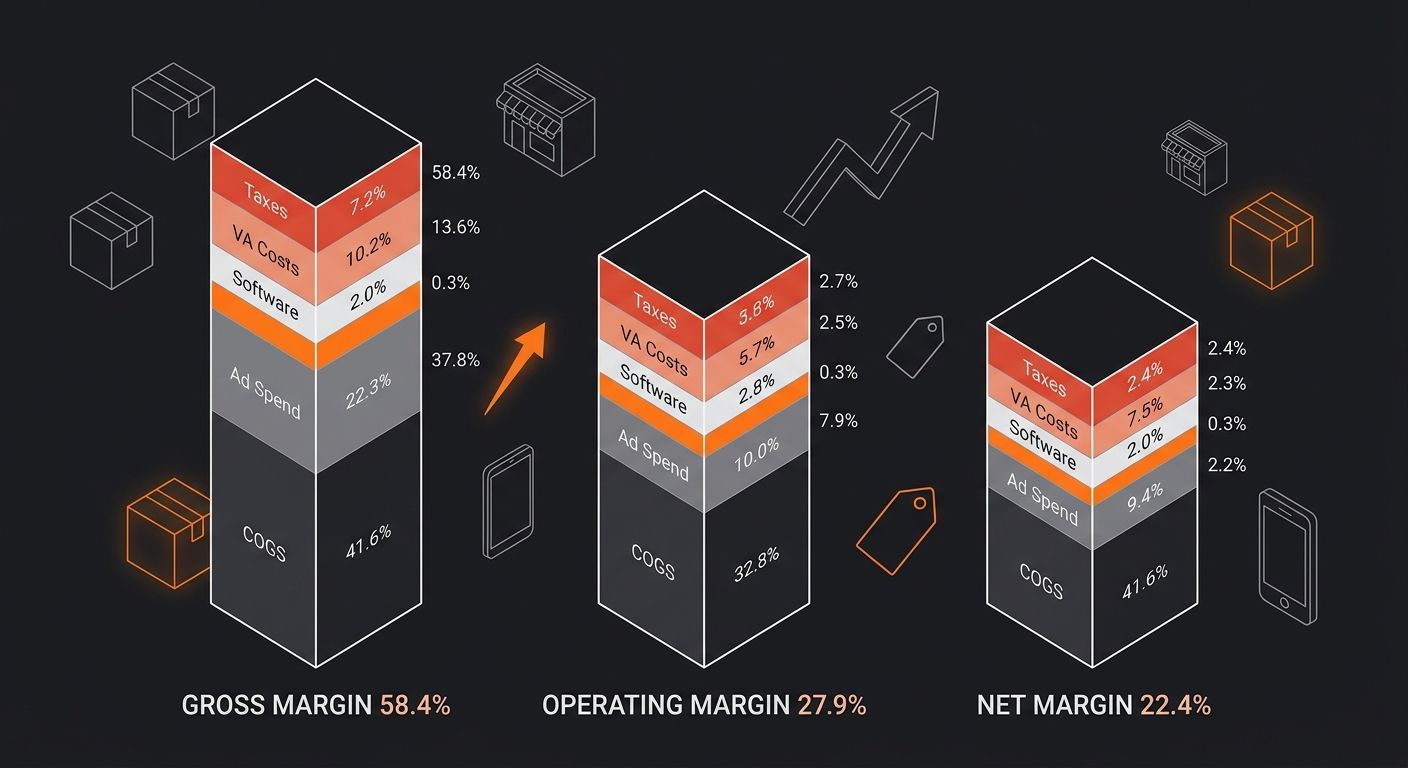
Operating profit: $8,760 − $4,580 = $4,180 Operating margin: ($4,180 ÷ $14,995) × 100 = 27.9%
You dropped from a 58.4% gross margin to a 27.9% operating margin. That 30-point gap is where most dropshipping stores bleed out. If you've been tracking which KPIs matter across multiple suppliers, operating margin is the metric that predicts whether you can sustain operations month over month.
Net Margin Tells the Whole Story
Net margin is the bottom line. It includes every cost: COGS, operating expenses, taxes, interest on loans, one-time costs like product photography.
Net Profit = Revenue − All Expenses Net Margin % = (Net Profit ÷ Revenue) × 100
Continuing the phone mount example, add:
Estimated income tax provision (federal + state, ~15% effective rate on profit): $627
One-time product photography: $200 (amortized across this month)
Total additional costs: $827
Net profit: $4,180 − $827 = $3,353 Net margin: ($3,353 ÷ $14,995) × 100 = 22.4%
A 22.4% net margin on a dropshipped product is solid. Investopedia notes that "a profit margin of 20% may indicate a company is profitable, while a margin of 10% might be average" and 5% or under "may indicate a problem." These benchmarks shift by industry, but for ecommerce DTC operations, clearing 15% net gives you room to reinvest in new SKUs and test new traffic channels.
And if you're wondering how net margin affects what your store is actually worth to a buyer, the math behind ecommerce exit multiples relies heavily on trailing net margin consistency over 6–12 months.
Drop It All into a Spreadsheet
Don't recalculate by hand every month. Set up this column structure in Google Sheets once, then fill it in on the 1st of each month:
Column | Label | Formula |
|---|---|---|
A | Revenue per Unit | (manual entry) |
B | COGS per Unit | (manual entry) |
C | Gross Profit |
|
D | Gross Margin % |
|
E | Monthly Units Sold | (manual entry) |
F | Monthly Revenue |
|
G | Monthly COGS |
|
H | Operating Expenses | (manual entry) |
I | Operating Profit |
|
J | Operating Margin % |
|
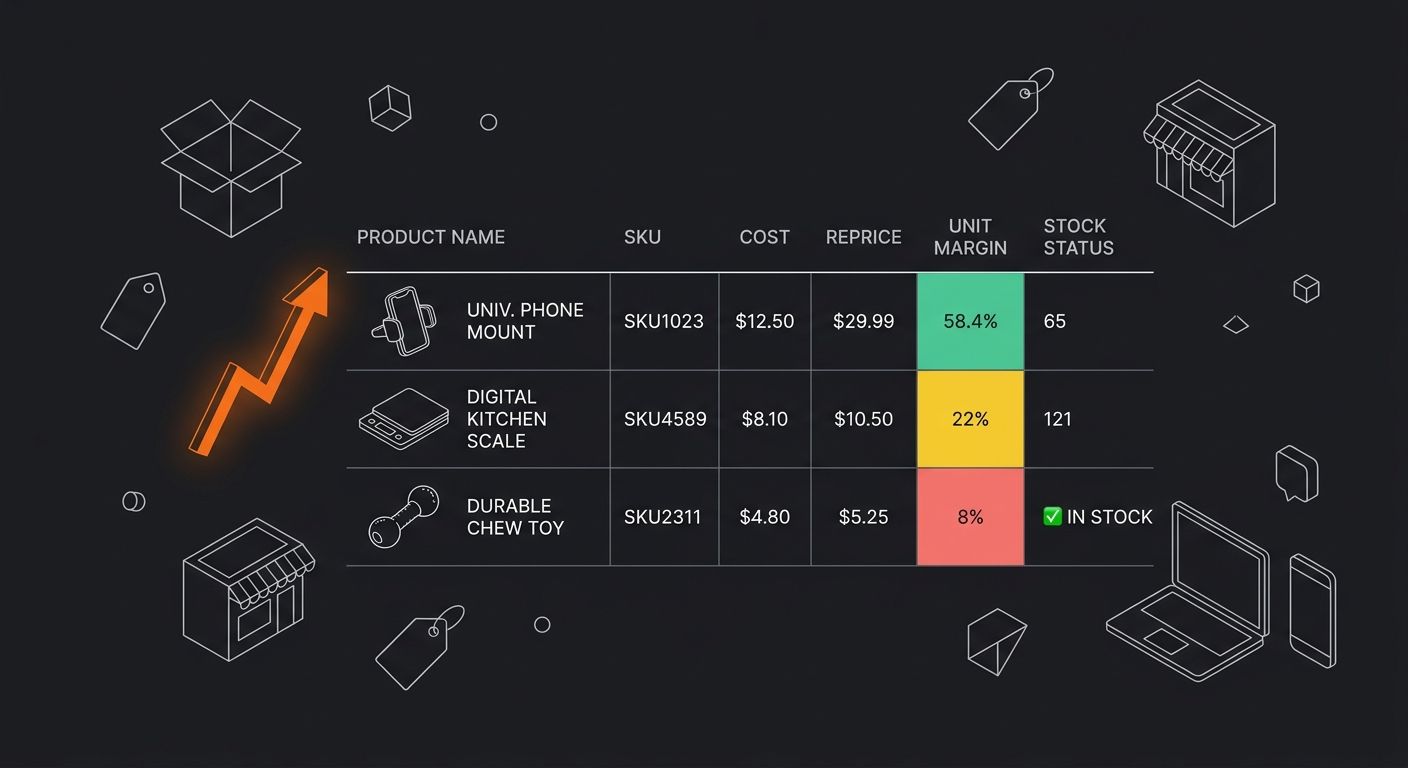
Add one row per SKU. Sort by column D descending to identify which products carry their weight and which ones drag your blended margin down. If you're running your store on Shopify, the complete setup walkthrough covers how to structure product data so pulling these numbers each month takes minutes instead of hours.
Verification: gross margin percentage in column D can never exceed 100%. If it does, you've swapped the formula inputs. Gross margin can go negative (you're selling below cost), but anything above 100% means the spreadsheet is wrong.
When the Numbers Don't Add Up
Three errors show up consistently when sellers first learn how to calculate profit margin:
Margin and markup are swapped. You set a "30% margin" but actually applied a 30% markup to your cost. A $10 product marked up 30% sells for $13, giving you a 23.1% margin. To hit a true 30% margin, divide cost by 0.70: $10 ÷ 0.70 = $14.29 sell price. This single mistake erodes profitability faster than any supplier issue.
Shipping costs are missing from COGS. If you're absorbing shipping through free shipping offers, that cost belongs in your COGS column. Understanding how DDP shipping affects your cost structure can shift gross margin by 5–12 percentage points depending on destination country and package weight. With the EU's new €3 per-item duty fee that took effect July 1, 2026, sellers shipping into Europe need to recalculate landed costs immediately.
Returns aren't factored in. Ecommerce return rates average 20–30% for apparel and 5–10% for electronics accessories. If you calculate margin on gross revenue without subtracting returns, your margin is artificially inflated. Always use net revenue as your denominator.
Where the Math Leads
The formulas here are straightforward arithmetic. The hard part is running them consistently, per SKU, every month. Most sellers I've worked with know their revenue number cold but couldn't tell you their operating margin within 10 percentage points. That gap between knowing your top line and knowing your actual profit is where stores slowly go under without realizing it until the bank account tells them.
Build the spreadsheet. Fill it in on the first of every month. When a product's operating margin dips below 15%, you have a decision: raise the price, find a cheaper supplier, or cut the SKU. The margin number makes that decision clear, you just have to look at it.

Ryan Torres
Ryan Torres is a former Amazon FBA seller turned dropshipping consultant who has generated over $2.8M in ecommerce revenue across 14 product launches. He specializes in supplier vetting, margin optimization, and scaling DTC operations for sub-$1M brands. Ryan focuses on actionable frameworks that drive measurable results for independent operators.
Frequently Asked Questions
- What is the formula for calculating profit margin?
- The basic profit margin formula is (Revenue − Cost) ÷ Revenue × 100. This formula is applied at three levels—gross, operating, and net—to show what percentage of each revenue dollar you keep after costs.
- What should be included in cost of goods sold (COGS) for dropshipping?
- For dropshippers, COGS includes the supplier's product price, inbound shipping to the customer, and per-unit transaction fees such as payment processor cuts and platform commissions. For print-on-demand, COGS is the base product cost plus shipping from the fulfillment center.
- What is the difference between markup and margin?
- Markup is calculated against cost while margin is calculated against revenue, which causes them to diverge significantly. For example, a 140% markup on a $12.47 product only translates to a 58.3% margin, not 140%.
- What is a good net profit margin for an ecommerce store?
- For ecommerce DTC operations, a net margin of 15% or higher gives you room to reinvest in new products and test new traffic channels. Investopedia notes that 20% may indicate a company is profitable, while 10% is average and 5% or under may indicate a problem.
- How often should I recalculate profit margins?
- You should run margin calculations monthly because supplier prices shift, ad costs fluctuate with seasonal demand, and shipping rate changes happen without warning. A healthy margin in January can erode by March if not rechecked regularly.
- What revenue figure should I use when calculating margins?
- Use net revenue, which means subtracting refunds, chargebacks, and discounts from your gross billing first. Using gross revenue inflates the denominator and makes your margins look better than reality.
- What is the typical gross margin range for dropshipping businesses?
- Most dropshipping operations land between 15% and 40% gross margin depending on category and supplier. Consumer electronics accessories tend to sit in the 30–60% range because perceived value outweighs commodity cost.
Related Articles

How to Calculate Profit Percentage
Markup and margin produce different percentages from the same dollar amounts: a $15 cost and $20 sale price gives you 33% markup but 25% profit margin. This tutorial shows you how to calculate profit percentage at both the gross and net level, then verify your math with four free online calculators.

Profit Margin Calculator Guide
Multiplying your product cost by 1.30 does not give you a 30% profit margin. It gives you a 23% margin, and that seven-point gap is where thousands of ecommerce operators silently lose money every month.

Profit Margin Formula: Calculate & Improve
The profit margin formula divides profit by revenue and multiplies by 100. Gross margin uses (Revenue − COGS) / Revenue. Net margin uses Net Income / Revenue. This guide walks you through calculating both in under 15 minutes using free online calculators and a basic spreadsheet.
Explore more topics