Printful print-on-demand App Review: Features & Costs
Printful's base product costs run 15–35% higher than Printify's on comparable items, while Gelato undercuts both on international fulfillment speed through local production routing. The right print-on-demand platform depends on whether you're optimizing for quality, margin, or geographic reach.
Printful Print-on-Demand App Review: Features, Costs, and How It Compares to Printify and Gelato
Printful's base product costs run 15–35% higher than Printify's on comparable items, while Gelato undercuts both on international fulfillment speed through local production routing. The right print-on-demand platform depends on whether you're optimizing for quality, margin, or geographic reach.
I'm comparing these three across four criteria: base product cost (what you pay per unit before shipping), print quality consistency, fulfillment speed to US and international addresses, and integration depth with major ecommerce platforms. I'm excluding marketplace-only options like Redbubble and Amazon Merch on Demand because they don't let you own the customer relationship or connect to your own storefront.
Printful's Quality-First Model
Printful is the right choice when brand presentation drives your repeat purchase rate and you can price products at 2.5x+ markup to absorb higher base costs. The platform operates 12 fulfillment centers globally with a 0.19% reshipment rate, meaning fewer than 2 in 1,000 orders get reprinted due to defects.
The print quality numbers back this up. DTG prints hit color accuracy within 2 Delta-E, which is close to imperceptible to the human eye. Benchmark reviewers rate Printful 9/10 for print quality and 10/10 for branding and white-label options. You get inside labels, custom packing slips, and pack-in inserts. That's the unboxing experience that makes customers forget they're buying from a printful print-on-demand provider rather than a vertically-integrated brand.
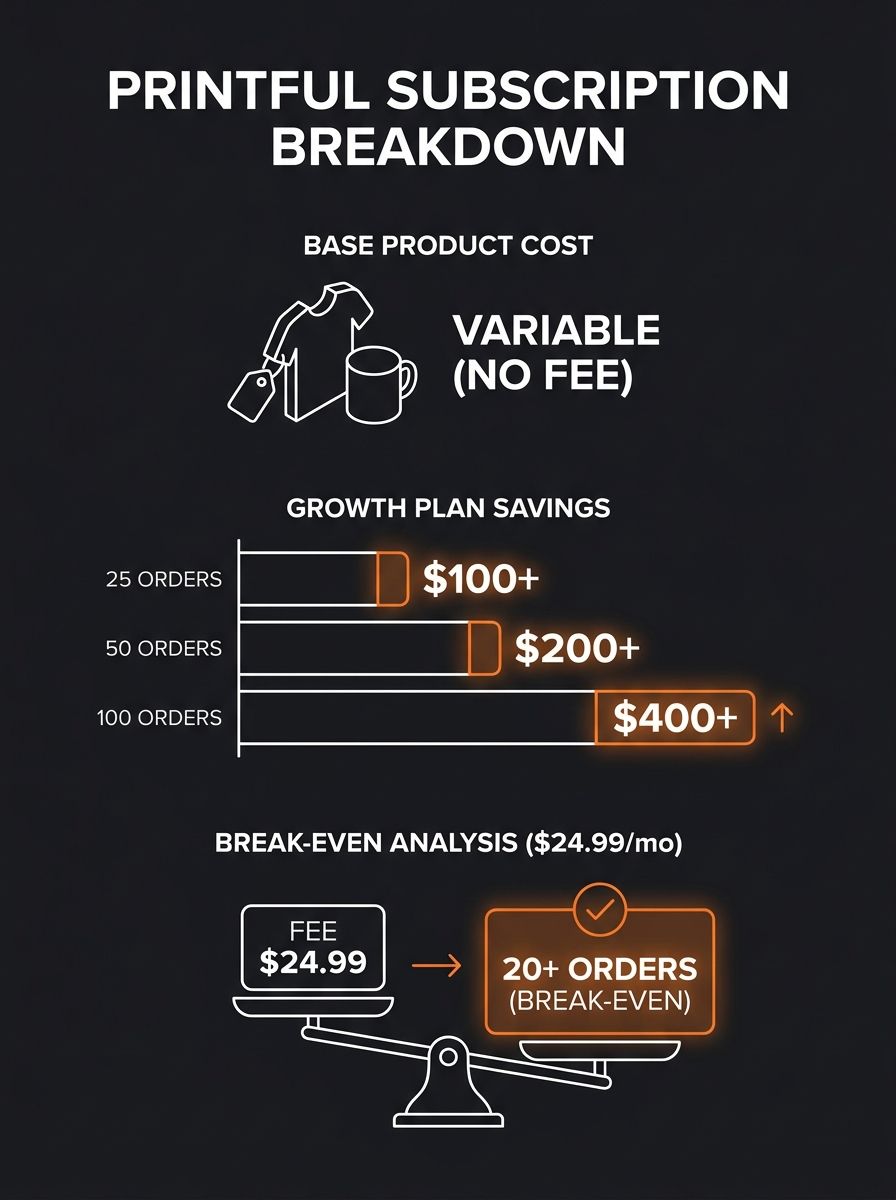
The cost structure is where sellers hesitate. Printful's monthly costs equal the products you purchase plus any additional paid features. Shipping is not included in plan pricing or product prices. The Growth plan at $24.99/month (waived when annual sales hit $12,000) unlocks up to 33% off product pricing, 9% off branding, and 25% off sample orders.
But here's the margin math that matters: if you're doing fewer than 50 orders per month, that Growth plan discount rarely offsets the subscription cost for most product types. You need volume to make the premium pricing work. User reviews on GetApp consistently flag that pricing is higher than competitors, directly affecting profit margins, and international shipping costs compound the gap.
Integration-wise, Printful connects natively with Shopify, Etsy, WooCommerce, Amazon, TikTok Shop, Walmart, eBay, Squarespace, and Wix. The Shopify integration is free and requires no minimum orders. If you're building on Shopify and want a complete store setup for dropshipping, Printful's order routing from storefront to production is well-documented and reliable.
Support is the weak point. Expert ratings drop to 6/10 for customer support, with response times that have degraded over the past two years. When a print defect does happen on a $35 hoodie, slow support means slow resolution, and your customer doesn't care whose fault it is.
Printify and the Race to Lowest Unit Cost
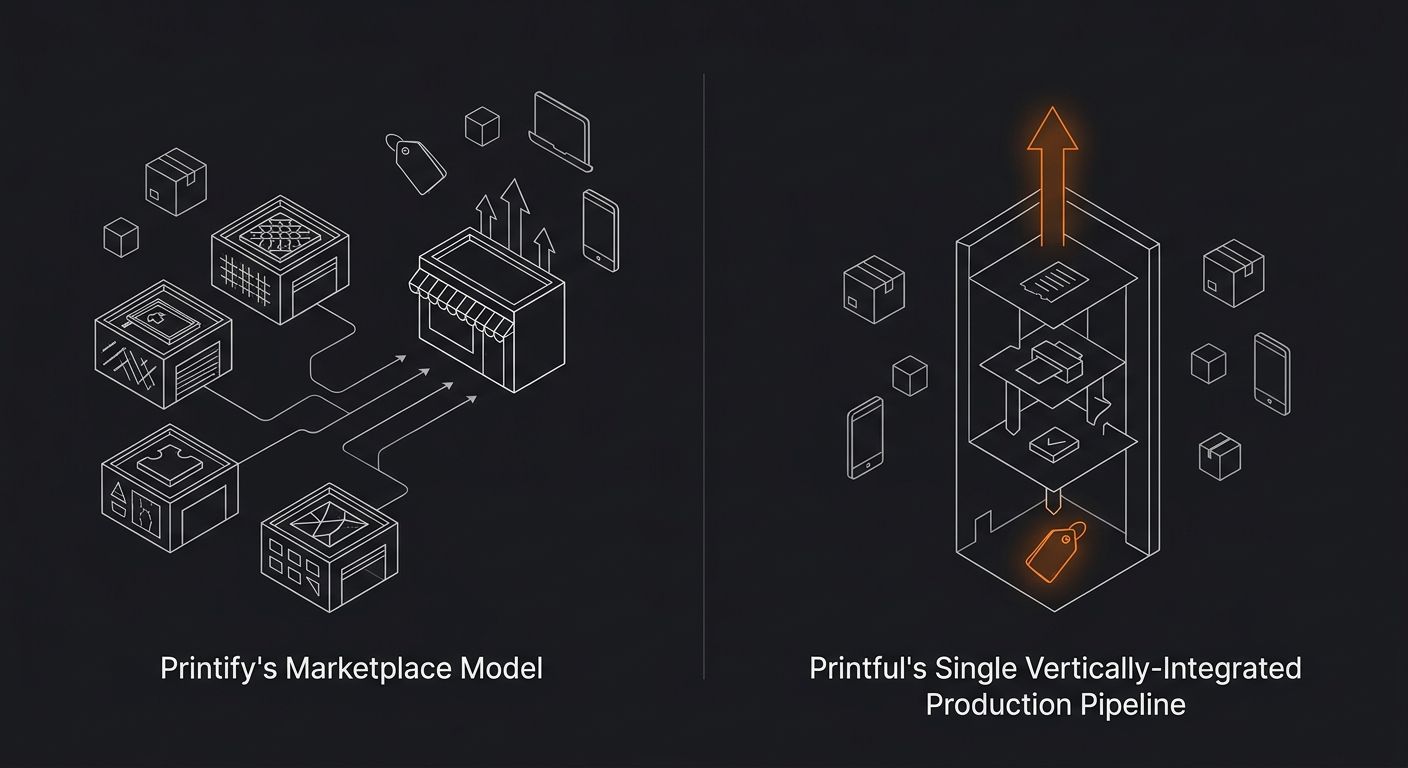
Printify wins when your strategy is margin-first and you're comfortable managing quality across multiple print providers. The platform operates as a marketplace connecting you to a network of third-party facilities, each with different prices, quality levels, and fulfillment speeds.
This marketplace model is Printify's core advantage and its core risk. You'll find the same Bella+Canvas 3001 tee available from five different providers at five different price points. The cheapest option saves you 15–35% versus Printful's equivalent. But quality varies between providers. One might produce crisp, saturated prints while another delivers washed-out colors on the same design file.
We covered Printify's full feature set in our dedicated Printify review, but the pricing comparison is what matters here. Printify Premium costs $29.99/month and unlocks discounted pricing across its provider network, plus a product personalization tool. The per-unit savings on Premium can be substantial if you're running 100+ orders monthly through a single provider you've vetted.
Catalog size is another Printify advantage. The platform offers access to over 900 products through its provider network, compared to Printful's roughly 479 in-house products. If you're selling niche items like all-over-print leggings, canvas prints, or phone cases in dozens of models, Printify's catalog breadth gives you more SKU options.
The tradeoff: you're managing quality control across providers instead of relying on one operation. Sample ordering becomes mandatory per provider, not per platform. And when something goes wrong, you're navigating between Printify's support team and the print provider's support team. Two layers of communication that slow resolution to a crawl.
US fulfillment for Printify's faster providers runs 3–5 days for production plus shipping, comparable to Printful. But the variance between providers is wider. Your cheapest option might take 7–12 business days total, according to Zendrop's 2026 POD platform comparison.
Gelato's Distributed Production Network
Why does Gelato keep showing up in POD platform rankings despite a smaller catalog? Because its production model solves a problem the other two don't: international shipping speed.
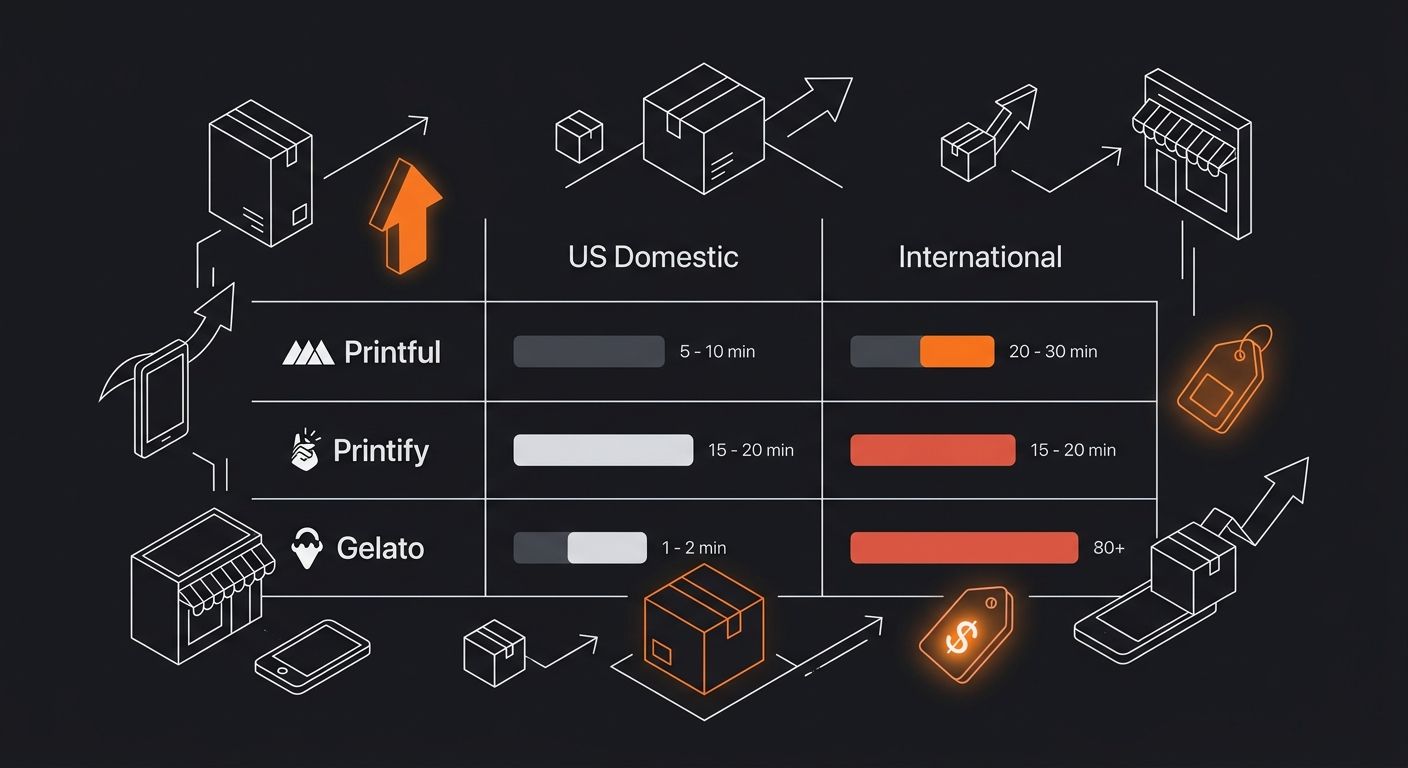
Gelato routes orders to the production facility closest to your customer's delivery address. If someone in Germany orders a t-shirt, it prints in Germany. Printful and Printify produce most orders in a handful of US facilities, then ship cross-border. That's 7–20 business days for international delivery versus Gelato's 5–12 business days through local production. For sellers watching how shipping speed affects their margins, that gap translates directly into fewer refund requests and chargebacks.
Gelato is the only platform providing fully automated local production routing, according to a BusinessWire comparison of top POD platforms. For sellers with 30%+ of revenue coming from outside the US, this changes the unit economics entirely. International shipping costs and delivery times are the top two complaints in POD customer reviews across every platform, and Gelato's model attacks both simultaneously.
The cost structure sits between Printful and Printify. Base prices are lower than Printful's but higher than Printify's cheapest providers. You're paying for the convenience of distributed production without having to manage multiple providers yourself. Gelato+ subscription runs approximately $24/month and unlocks up to 30% off products, similar to Printful's Growth plan discount range.
The catalog is more limited than either competitor, primarily focused on apparel, wall art, mugs, phone cases, and stationery. If your product line relies on embroidery, all-over prints, or specialty items like pet accessories, Gelato's selection will feel restrictive. Understanding how POD integration models handle catalog data flow becomes important when you're comparing setup complexity across these three.
How the Three Stack Up
Attribute | Printful | Printify | Gelato |
|---|---|---|---|
Monthly Plan Cost | Free tier; Growth $24.99/mo (waived at $12K/yr) | Free tier; Premium $29.99/mo | Free tier; Gelato+ ~$24/mo |
Base Product Cost | Highest (15–35% above Printify) | Lowest (varies by provider) | Mid-range |
Print Quality Rating | 9/10 (in-house, consistent) | 6–9/10 (varies by provider) | 7–8/10 (distributed partners) |
Branding Options | 10/10 (inside labels, pack-ins, custom slips) | Limited on free tier | Basic (custom labels on select items) |
US Production + Shipping | 2–5 days + 3–8 days | 2–7 days + 3–8 days | 2–5 days + 3–7 days |
International Delivery | 7–20 business days | 7–20 business days | 5–12 business days |
Product Catalog | ~479 products | 900+ products | Smaller, curated |
Reshipment/Defect Rate | 0.19% | Varies by provider | Not publicly reported |
Support Rating | 6/10 | 7/10 | 7/10 |
Key Integrations | Shopify, Etsy, WooCommerce, Amazon, TikTok Shop, Walmart, eBay | Shopify, Etsy, WooCommerce, Amazon | Shopify, Etsy, WooCommerce |
The differences show up in ongoing operations: branding depth, order resolution speed, and how much per-unit margin you're keeping after shipping. Amazon Merch beats all three on delivery speed (2–3 days with Prime for US customers) per Merch Titans' 2026 comparison, but you can't connect it to your own store or build a customer list, so it's a different game entirely.
Who Should Pick Which
Pick Printful if you're building a brand where unboxing experience and print consistency drive repeat purchases, you can sustain 2.5x+ markups, and your primary customer base is in the US. The Growth plan makes financial sense once you clear roughly 50 orders per month. Below that threshold, the free tier works, but your per-unit costs will eat margins on anything priced under $30 retail. Printful is the right platform for the seller who'd rather pay more per unit than deal with a single customer complaint about print quality.
Pick Printify if you're margin-first, comfortable managing quality across multiple print providers, and willing to invest time in sample ordering to find providers that meet your standards. The 900+ product catalog opens up niches that Printful and Gelato can't serve. But budget time and money for provider vetting. Ordering 3–5 samples per provider before committing is the minimum. Our supplier scorecard framework applies here, even though you're evaluating POD providers rather than traditional wholesalers.
Pick Gelato if 30% or more of your orders ship internationally and delivery speed is a competitive differentiator for your store. The local production model eliminates the cross-border shipping penalty that makes Printful and Printify frustrating for European, Australian, and Asian customers. The catalog limitations mean Gelato works best for sellers focused on core categories (tees, hoodies, wall art, mugs) rather than operators trying to list 200+ SKUs across specialty product types.
For most sellers starting out, begin with Printful's free tier for quality validation and brand testing, then evaluate whether Printify's lower base costs or Gelato's international speed better match where your revenue actually comes from after 90 days of order data. The platform that fits your business at 20 orders per month may be the wrong one at 200.

Ryan Torres
Ryan Torres is a former Amazon FBA seller turned dropshipping consultant who has generated over $2.8M in ecommerce revenue across 14 product launches. He specializes in supplier vetting, margin optimization, and scaling DTC operations for sub-$1M brands. Ryan focuses on actionable frameworks that drive measurable results for independent operators.
Frequently Asked Questions
- How much more expensive is Printful compared to Printify?
- Printful's base product costs run 15–35% higher than Printify's on comparable items. However, Printful offers higher print quality consistency and better branding options, which may justify the premium pricing for sellers prioritizing brand presentation.
- What is Printful's reshipment rate for defective orders?
- Printful has a 0.19% reshipment rate, meaning fewer than 2 in 1,000 orders get reprinted due to defects. This is backed by DTG prints that hit color accuracy within 2 Delta-E, which is nearly imperceptible to the human eye.
- Which print-on-demand platform is best for international customers?
- Gelato is best for international customers because it routes orders to the production facility closest to the customer's delivery address, delivering in 5–12 business days versus 7–20 business days for Printful and Printify. This makes Gelato ideal for sellers with 30%+ of revenue coming from outside the US.
- How many products does each print-on-demand platform offer?
- Printful offers roughly 479 in-house products, Printify offers over 900 products through its provider network, and Gelato offers a smaller, curated catalog focused on apparel, wall art, mugs, phone cases, and stationery.
- At what order volume does Printful's Growth plan become worth the subscription cost?
- Printful's Growth plan ($24.99/month) makes financial sense once you're doing roughly 50 or more orders per month. Below that threshold, the free tier works better, as the subscription cost rarely offsets the discounts on product pricing for most product types.
- What are the main differences between Printful and Printify's quality models?
- Printful operates as a vertically-integrated operation with consistent 9/10 print quality across all orders, while Printify functions as a marketplace connecting you to multiple third-party providers with quality ratings ranging from 6–9/10. Printify's lower costs come with the tradeoff of managing quality control across different providers.
- Which print-on-demand platform has the best customer support?
- Printify and Gelato both have 7/10 support ratings, while Printful's support is rated 6/10 with response times that have degraded over the past two years. Printful's support weakness is particularly problematic when print defects occur on higher-priced items.
- What ecommerce platforms does Printful integrate with?
- Printful integrates natively with Shopify, Etsy, WooCommerce, Amazon, TikTok Shop, Walmart, eBay, Squarespace, and Wix. The Shopify integration is free and requires no minimum orders.
Related Articles

Gelato Print on Demand: Full App Review
Gelato is a print-on-demand platform that routes each customer order to the nearest production facility in a network spanning 140+ hubs across 32 countries, producing goods locally instead of shipping from a central warehouse.

Printful vs Printify: Which Platform Wins
Printful and Printify completed a corporate merger but still operate as separate platforms with independent pricing, fulfillment networks, and dashboards. POD sellers face three real paths: Printful for brand control, Printify for margin, or a hybrid splitting the catalog across both.

Printify: Complete App Review & Guide
Printify is a print-on-demand marketplace that routes your orders to a network of over 100 independent print providers who manufacture and ship products under your brand.
Explore more topics