SendFromChina Publishes Category-Based AliExpress Alternative Guide Segmenting Suppliers by Product Type and Minimum Order Quantities
SendFromChina released a supplier sourcing guide on July 18 breaking down AliExpress alternatives across six product categories—clothing, electronics, home textiles, and smallware—with platform-specific data on minimum order quantities, shipping speeds, and pricing tiers, according to the company's

SendFromChina Publishes Category-Based AliExpress Alternative Guide Segmenting Suppliers by Product Type and Minimum Order Quantities
SendFromChina released a supplier sourcing guide on July 18 breaking down AliExpress alternatives across six product categories—clothing, electronics, home textiles, and smallware—with platform-specific data on minimum order quantities, shipping speeds, and pricing tiers, according to the company's logistics blog. The guide positions 1688, DHgate, Shein, Temu, and Spocket as category leaders addressing dropshipper complaints about AliExpress's 15–30 day standard shipping windows and inconsistent quality control.
The publication follows growing pressure on AliExpress from new US and EU tariff policies closing "de minimis" exemptions and raising duties on direct-to-consumer imports from China. SendFromChina, a Shenzhen-based fulfillment platform operating cross-border warehousing for ecommerce sellers, framed the guide as a response to merchant demand for faster delivery and verified quality outside the AliExpress ecosystem.
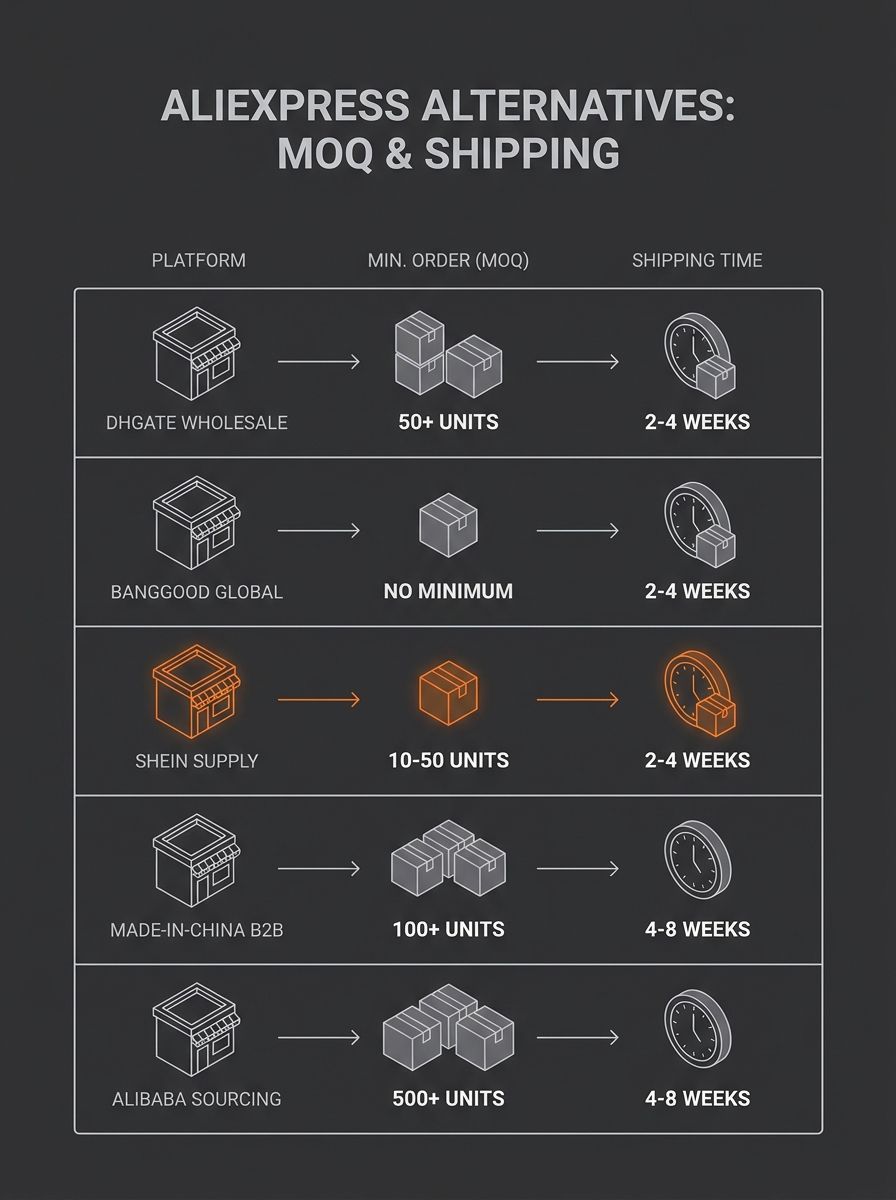
Wholesale Platform 1688 Requires Chinese Navigation but Offers Factory-Direct Pricing
The guide identifies 1688—Alibaba Group's China-domestic B2B marketplace launched in 1999—as the lowest-cost alternative for bulk sourcing, with per-unit pricing "significantly lower than even Alibaba or AliExpress" on comparable items, the report states. The platform hosts millions of manufacturers and wholesalers but enforces larger minimum order quantities than retail-focused competitors.
SendFromChina noted that 1688's primary challenge remains language barriers. "Most content and seller support is in Chinese, so a translator or sourcing agent is usually required," the guide explains. Operators using the platform typically combine 1688 sourcing with third-party consolidation services in China to handle international logistics, since the marketplace defaults to domestic Chinese shipping.
The platform gained traction among dropshippers seeking custom packaging and product development access through direct factory relationships. "Deep product catalog—often listing parts not available elsewhere," the guide states, positioning 1688 for volume buyers willing to navigate Chinese-language interfaces and multi-step fulfillment workflows.
DHgate Bridges B2B and Single-Unit Orders With Escrow Payment Protection
DHgate, a Beijing-based marketplace founded in 2004, allows both bulk and single-item purchases across 30 million products, the guide documents. The platform's flexible minimum order policies—"even single-unit purchases"—differentiate it from wholesale-only competitors, while volume discounts remain available for larger quantities.
SendFromChina highlighted DHgate's U.S. market penetration, noting the platform ranks among top free downloads in the App Store in 2025 and benefits from TikTok-driven product discovery. The guide credits escrow-based payment systems covering transactions until delivery confirmation as a risk-management advantage over peer platforms.
"Product prices can be slightly higher than AliExpress for single units—but often come with more transparent quality details," the report states, documenting a tradeoff between unit cost and seller communication quality. The guide flagged customs duties and uneven quality control among millions of suppliers as persistent challenges for DHgate users.
Clothing-Focused Platforms Shein and Temu Compete on Local Warehouse Speed
SendFromChina's clothing-category analysis positioned Shein and Temu as speed leaders using local warehouse networks in Western and European markets. The guide did not publish specific shipping timeframes for either platform but characterized both as "aggressively entering" markets with faster delivery and competitive pricing against AliExpress's standard 15–30 day windows.
The report contrasted these consumer-facing platforms with Spocket, which the guide categorized as a dropshipping-specific supplier network. SendFromChina did not provide pricing comparisons or product-count data for the clothing segment in the published excerpts.
Dropshippers evaluating supplier diversification strategies can cross-reference the SendFromChina guide against recent AliExpress shipping timeframe documentation showing variability across six service tiers ranging from 7 days to 50 days depending on route and carrier selection.
What Happens Next
SendFromChina's category-by-category breakdown gives dropshippers a framework for matching product types to platform strengths—1688 for high-volume factory-direct sourcing, DHgate for flexible minimums, and local-warehouse platforms like Temu for speed-sensitive categories. The guide's emphasis on minimum order quantities and language requirements clarifies the operational tradeoffs behind unit-cost savings.
Operators testing AliExpress alternatives should benchmark each platform's pricing against landed costs including customs duties, consolidation fees for platforms like 1688, and payment processing spreads. The supplier scorecard audit framework published earlier on this site provides a checklist for evaluating quality control and communication standards before committing to multi-platform inventory splits.
The guide did not publish product-specific cost breakdowns or supplier URLs, positioning it as a directional overview rather than a transactional sourcing tool. Merchants running margin math on alternative platforms will need to request quotes directly and factor platform fees, payment terms, and refund policies into total landed cost per SKU.

Ryan Torres
Ryan Torres is a former Amazon FBA seller turned dropshipping consultant who has generated over $2.8M in ecommerce revenue across 14 product launches. He specializes in supplier vetting, margin optimization, and scaling DTC operations for sub-$1M brands. Ryan focuses on actionable frameworks that drive measurable results for independent operators.
Related Articles
SendFromChina Documents Six AliExpress Shipping Methods With Delivery Windows Spanning 7 to 50 Days in New Logistics Guide
AliExpress shipping timeframes range from 7 days via premium express carriers to 50 days through Cainiao's economy service, according to a logistics guide published July 31, 2026, by SendFromChina that segments six shipping methods by speed, tracking capability, and cost structure for dropshipping o

AliExpress Shipping Timeframes Range From 7 Days to 50 Days Across Six Service Tiers, New Logistics Guide Documents
Delivery windows for AliExpress orders span 7 to 50 days depending on service tier selection, according to a logistics breakdown published July 10 by SendFromChina, a fulfillment platform that manages cross-border ecommerce shipments.

Eighteen Percent of AliExpress Dropshipping Suppliers Exited Platform in First Five Months of 2026 as China's Factory Base Consolidates
An estimated 18% of active AliExpress dropshipping suppliers exited the platform between January and May 2026, folding into larger factory collectives in Guangdong, Foshan, and Yiwu, according to sourcing intelligence firm Syncee's internal supplier index cited in a LooperBuy guide published August
Explore more topics