The Exit Math: Why Your $60K/Month Store Might Only Sell for $130K (And How to Fix It Before Buyers Walk)
Dropshipping business valuation multiples cluster between 2.0x and 3.0x monthly seller's discretionary earnings (SDE), and two stores in the same niche can trade 1.0x+ apart based on risk profile and operational quality alone.
The Exit Math: Why Your $60K/Month Store Might Only Sell for $130K (And How to Fix It Before Buyers Walk)
Dropshipping business valuation multiples cluster between 2.0x and 3.0x monthly seller's discretionary earnings (SDE), and two stores in the same niche can trade 1.0x+ apart based on risk profile and operational quality alone. For a $60K/month revenue store netting $5,000/month SDE after ad spend, COGS, and SaaS costs, the exit number lands between $100K and $150K on every major broker platform.
The SDE Compression Behind $60K/Month
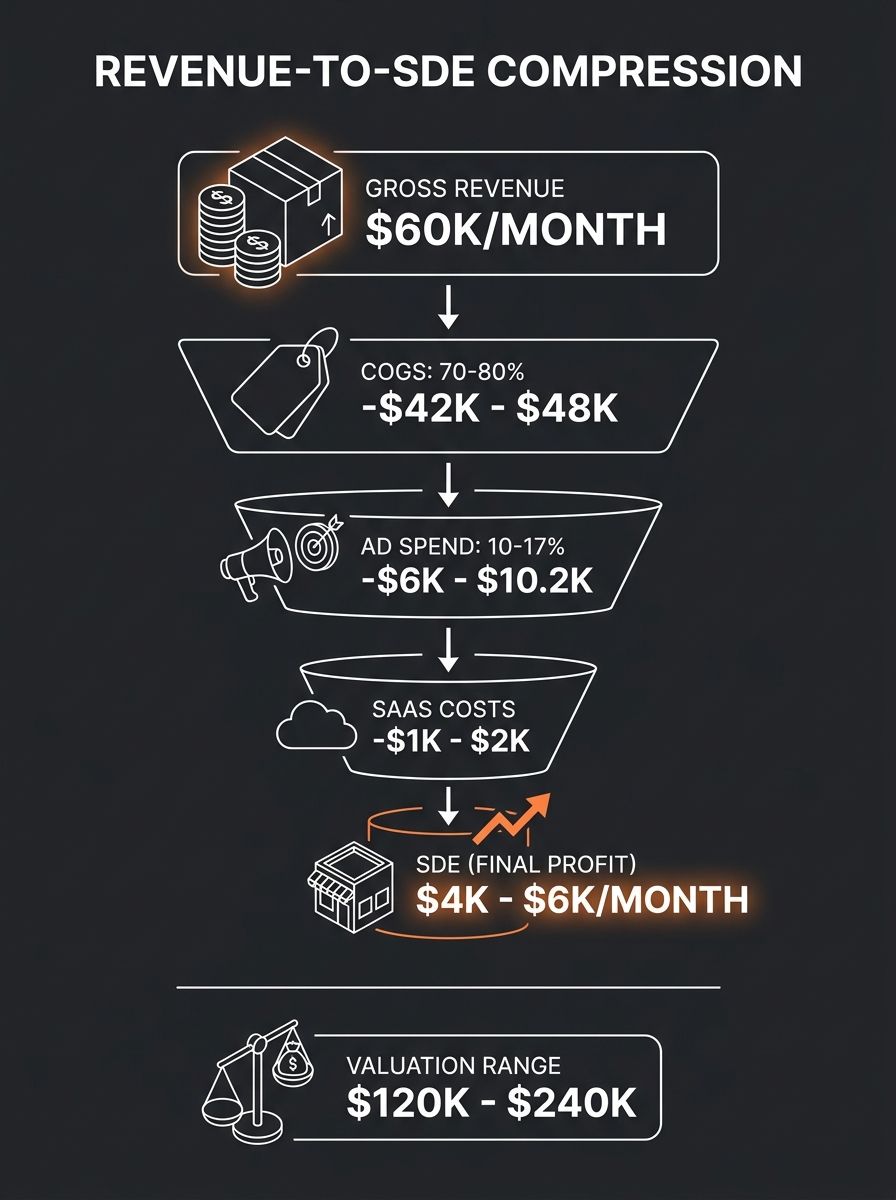
The gap between gross revenue and SDE is where most dropshipping operators get their first ugly surprise during buyer due diligence. A store doing $60K/month in top-line revenue is often clearing $42K–$48K in COGS (70–80% for typical AliExpress/CJ Dropshipping-sourced goods), spending $6K–$10K/month on Facebook and Google ads, and paying $300–$800/month in Shopify apps and subscriptions. After owner salary addbacks and one-time expenses get normalized, the real SDE might sit at $4,000–$6,000/month.
That $5,000/month SDE figure, multiplied by a 26x trailing average (roughly 2.17x annual), produces a listing price of $130,000. Operators who assumed they'd sell based on revenue multiples expected $360K–$720K. The disconnect kills deals before the first call with a buyer.
According to Trend Hijacking's analysis of ecommerce valuation multiples, proprietary products, exclusive supplier agreements, and strong brand differentiation translate to higher multiples, while stores running commodity products from shared supplier catalogs get compressed toward the floor. High customer lifetime value (CLV) and strong repeat purchase rates push multiples up; one-and-done purchase patterns push them down.
If you've been tracking your margins loosely, running the numbers through a profit margin calculator before listing saves you from learning SDE math for the first time on a broker call.
Three Broker Platforms, Three Risk Assessments
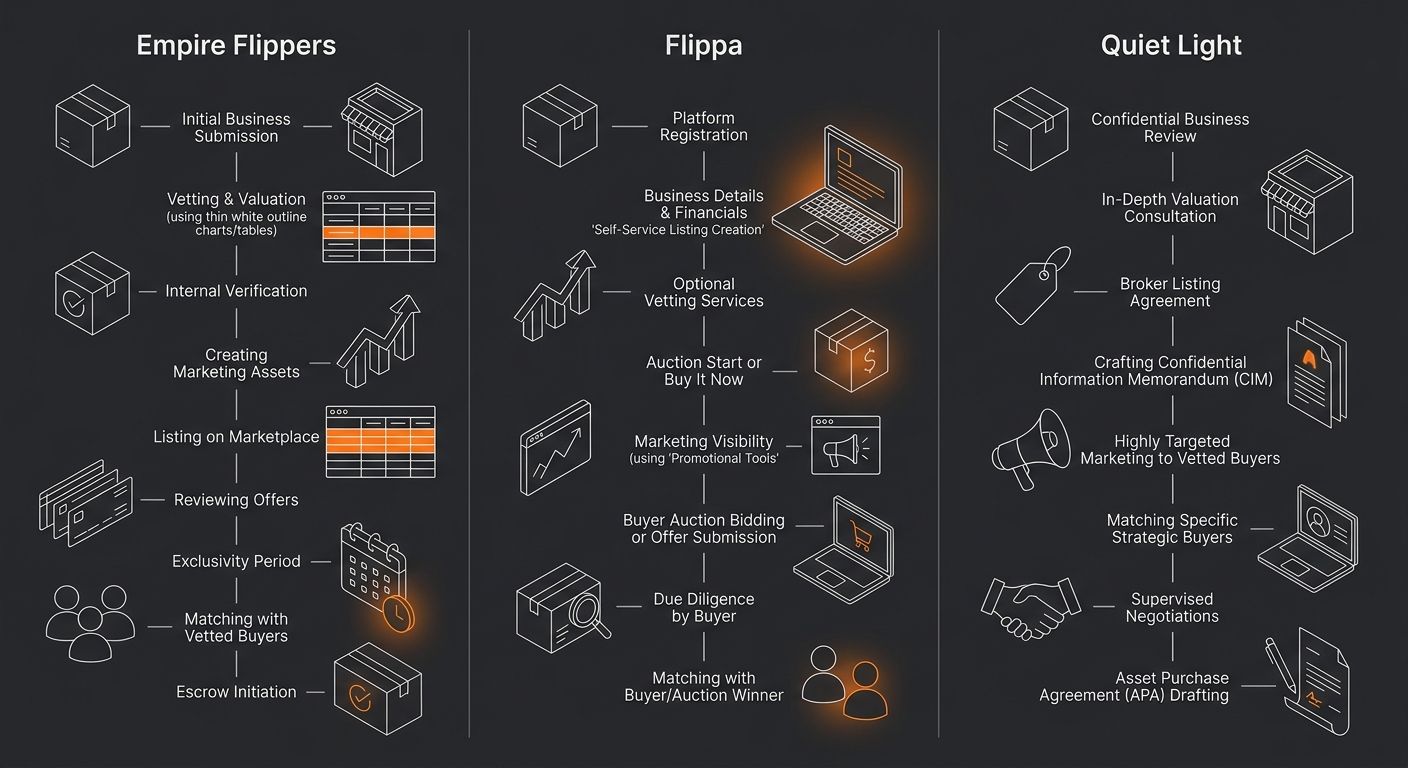
Empire Flippers, Flippa, and Quiet Light each filter dropshipping listings through different risk models, and the platform you choose shapes your valuation before a single buyer sees your P&L. As Hypersku's exit strategy breakdown notes, some brokers operate on a case-by-case basis with customized fees, while marketplace-style platforms apply standardized scoring algorithms.
Here's how the three platforms compare on factors that matter most to dropshipping exits:
Factor | Empire Flippers | Flippa | Quiet Light |
|---|---|---|---|
Minimum listing threshold | ~$1K/month net profit (12-month avg) | No minimum | ~$200K+ annual SDE preferred |
Vetting depth | 70+ point checklist, traffic and revenue verification | Seller self-reported, buyer verifies | Full financial audit by analysts |
Typical dropshipping multiple | 2.0x–3.5x monthly SDE | 1.5x–2.5x (auction dynamics) | 3.0x–4.5x (curated deal flow) |
Buyer pool size | 250K+ registered buyers | Largest marketplace by volume | Smaller, higher-intent buyer pool |
Commission | 15% (tiered down at higher prices) | 10% success fee | 15% typical |
Supplier verification | Yes, checks transferability | Minimal | Deep supplier relationship review |
Empire Flippers' 70+ point vetting process catches the same supplier red flags that trip up operators during their first 100 orders. Flippa's open marketplace means your listing competes against hundreds of others with minimal curation. Quiet Light's higher entry bar and analyst-led process targets stores with $200K+ annual SDE, which excludes most sub-$10K/month SDE dropshipping operations entirely.
For the $60K/month revenue store netting $5K SDE, Empire Flippers is the most realistic listing venue. Flippa would expose the listing to lower-multiple auction pressure. Quiet Light wouldn't take the listing.
How Concentration Risk Turns a Strength Into a Discount
BMI Mergers & Acquisitions documented a pattern across lower middle market businesses that applies directly to dropshipping: concentration in either the selling channel or the supply channel that owners viewed as a competitive strength gets treated as a valuation risk by every serious buyer. A deep, 8-year relationship with one AliExpress supplier feels like a moat to the operator. To the buyer, it's a single point of failure.
The supplier concentration risk penalty in ecommerce exit strategy shows up in three places during buyer due diligence. First, buyers ask what happens if the supplier raises prices 15%. Second, they ask whether the supplier relationship is transferable (informal WeChat agreements often aren't). Third, lenders flag vendor concentration directly, as documented by M&A advisor Sam Ballard: "If your key supplier delays production or ships faulty goods, your end customers will notice — and your brand takes the hit, not the vendor."
Stores sourcing 80%+ of SKUs from a single supplier typically see a 0.3x–0.5x multiple discount compared to stores with 3–5 verified suppliers. If you built a supplier scorecard before scaling, you already have the documentation buyers want. If you didn't, building one 12 months before listing is the single highest-ROI activity for your exit price.
Channel concentration works the same way. A store generating 90% of traffic from Facebook ads carries platform risk that buyers discount aggressively. Diversifying across 2–3 paid channels (Google Shopping, TikTok, Pinterest) plus organic SEO shifts the risk profile. One operator who rebuilt their supplier stack after a tariff shock raised gross margins from 22% to 41%, which would have added $114K+ to a 2.0x annual SDE valuation on the improved monthly profit.
The 2x MRR Premium That Reshapes the Multiple
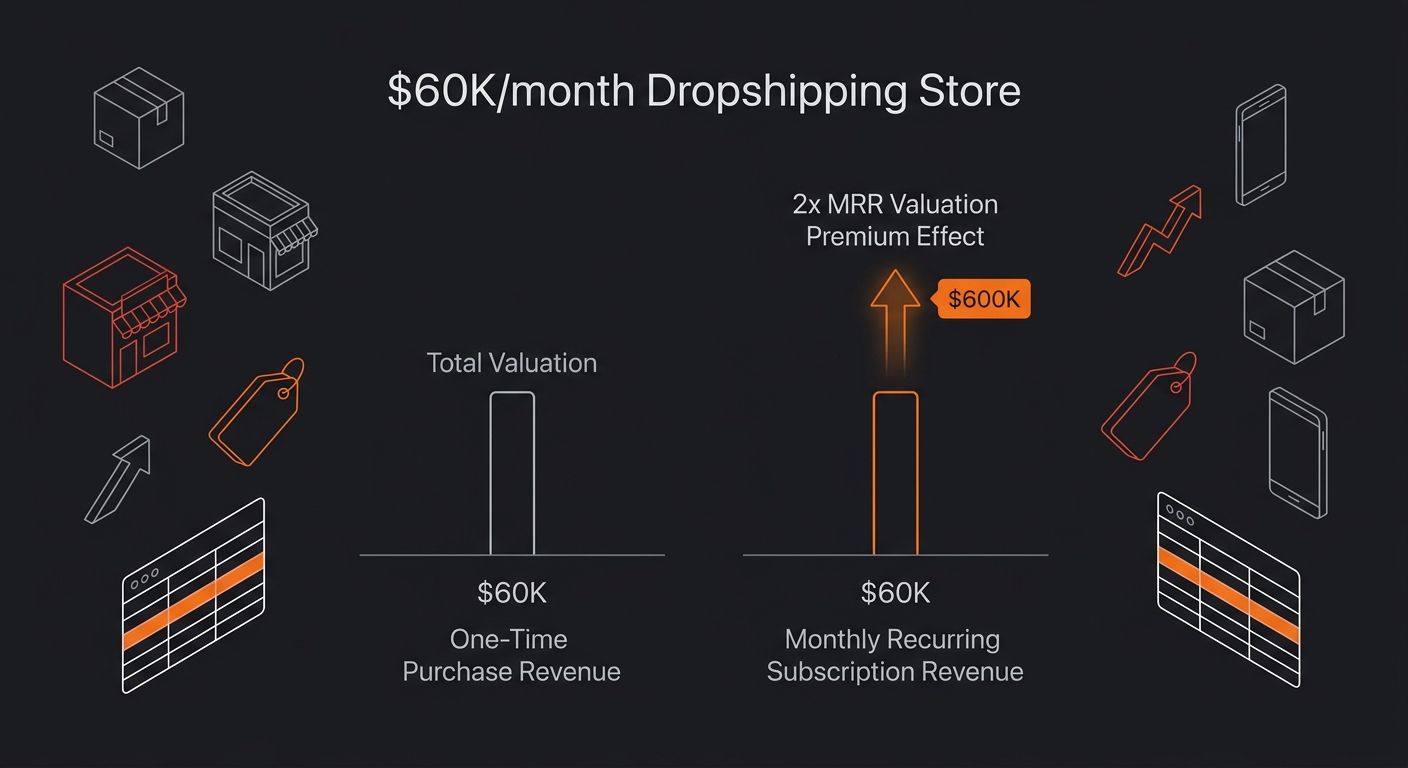
Recurring revenue metrics change the entire math. Data from deals completed by FE International shows that monthly recurring revenue (MRR) is valued at approximately 2x higher than equivalent revenue from lifetime or one-time purchases. This finding comes from SaaS transactions, but ecommerce brokers apply the same logic: predictable revenue compresses risk, and lower risk means higher multiples.
For dropshipping stores, "recurring revenue" means subscription boxes, auto-replenishment programs, or membership tiers. A pet accessories store doing $60K/month with $8K coming from a monthly treat subscription box effectively has that $8K valued at twice the multiple of the remaining $52K. If the subscription revenue carries 40% margins (common for curated boxes with negotiated supplier pricing), the SDE contribution from $8K MRR might equal or exceed the SDE from the other $52K.
High retention rates coupled with low churn rates indicate strong product-market fit, which leads to consistent recurring revenue and directly enhances valuation, according to HulkApps' analysis of recurring revenue in valuation models. Conversely, high churn diminishes recurring income and drags the multiple down. A subscription program with 15% monthly churn gets valued very differently than one with 5% churn.
Operators running general merchandise stores can explore how supplier-led catalog expansion creates subscription-friendly product lines. A 7-SKU pet accessories store that scaled to $18K/month did it partly by building repeatable purchase cycles through bundled consumables.
Fifteen Months of Pre-Listing Cleanup on a $60K Store
Broker platforms weight trailing 12-month averages when calculating SDE, which means any margin improvement, supplier diversification, or subscription revenue addition needs 12 full months of documented performance to influence the listing multiple. Add 2–3 months for broker onboarding, vetting, and listing preparation, and you're looking at a 15-month runway from "I want to sell" to "the listing reflects my improvements."
Here's what that 15-month window looks like for a $60K/month store currently netting $5K SDE with a single primary supplier and zero recurring revenue:
Months 1–3: Add 2–3 alternative suppliers for your top 10 SKUs. Negotiate written agreements (not informal chat threads) that transfer to a new owner. Run parallel test orders to verify quality and shipping times, ideally keeping fulfillment benchmarks consistent with what your current logistics setup delivers.
Months 2–5: Launch a subscription or auto-replenishment program. Even a small one generating $2K–$4K/month in MRR shifts the buyer conversation. Track churn monthly and aim below 8%.
Months 3–8: Diversify ad spend across at least 2 paid channels. Document CAC by channel with 90-day LTV calculations. Buyers want to see that removing one channel doesn't collapse revenue by 50%+.
Months 6–12: Clean your books. Separate personal expenses. Categorize every line item in your accounting software. Brokers like Empire Flippers run their own verification, and inconsistencies in your reported SDE versus bank statements kill deals at the LOI stage.
Months 12–15: List with the broker that matches your SDE range and risk profile. For a store that's moved from $5K to $7K+ monthly SDE through margin improvements, the valuation shift is significant: $130K at 2.0x becomes $182K, and a cleaner risk profile might push the multiple toward 2.5x–3.0x, producing $210K–$252K.
The difference between $130K and $250K on the same $60K/month revenue store comes down to SDE documentation, supplier diversification, and even a small subscription revenue stream. Broker platforms are evaluating operational reliability and scalability alongside profit, and the 15-month cleanup window is the minimum runway to make those improvements show up in the trailing data that determines your multiple. Operators who start preparing before they're emotionally ready to sell consistently close at higher multiples than those who list the week they decide they're done.
365 Dropship Editorial
Editorial team writing about E-commerce, dropshipping, and product discovery — reviews of dropshipping suppliers and platforms, trending niche guides (jewelry, beauty, pets, home, fashion), supplier due diligence, ecom operations, shipping & fulfillment strategy, product research, AOV optimization, and profitable dropshipping case studies.
Related Articles
The Supplier Exit Interview: Why Successful Dropshippers Document Their Handoff Process Before Selling
The typical dropshipping acquisition falls apart at supplier verification. Buyers audit ad accounts, Shopify analytics, and bank statements within days.
Stop Chasing 60% Margins: Why a Disciplined 30% Gross Margin Business Outperforms Most 'High-Margin' Dropshipping Stores
A 60% gross margin on a $50 dropshipped product leaves $30 before costs. After $12 in ad spend, $2 in payment processing, $1 in platform fees, and $3 in return-related losses, that $30 becomes $12 — a 24% net margin.
From Pandemic Pivot to Profitable Store: The Untold Operations Lessons Behind 2020-2026 Dropshipping Success Stories
COVID-era ecommerce operators who survived past 2022 share a pattern that has nothing to do with finding the right product or running the right ad. The pattern is operational: supplier onboarding speed, cash flow reinvestment discipline, and fulfillment consolidation.
Explore more topics