Printful vs Printify: Which Platform Wins
Printful and Printify completed a corporate merger but still operate as separate platforms with independent pricing, fulfillment networks, and dashboards. POD sellers face three real paths: Printful for brand control, Printify for margin, or a hybrid splitting the catalog across both.
Printful vs Printify: Which Platform Actually Wins for Your Store
Printful and Printify completed a corporate merger but still operate as separate platforms with independent pricing, fulfillment networks, and dashboards. POD sellers face three real paths: Printful for brand control, Printify for margin, or a hybrid splitting the catalog across both.
How I'm comparing these two
I'm evaluating Printful vs Printify across five criteria that actually move your P&L: base product cost, catalog breadth, fulfillment speed and consistency, branding options, and integration friction. I'm excluding design tools and mockup generators because both platforms are adequate there and neither will make or break your margins. All pricing references reflect mid-2026 rates pulled from live dashboards and third-party product testing.
Why Printful Costs More (And When That's Worth It)
Printful is the right pick when perceived quality and branded unboxing drive your repeat purchase rate. Think DTC apparel brands selling $35+ tees or $65+ hoodies where a custom neck label and branded packing slip justify the higher COGS.
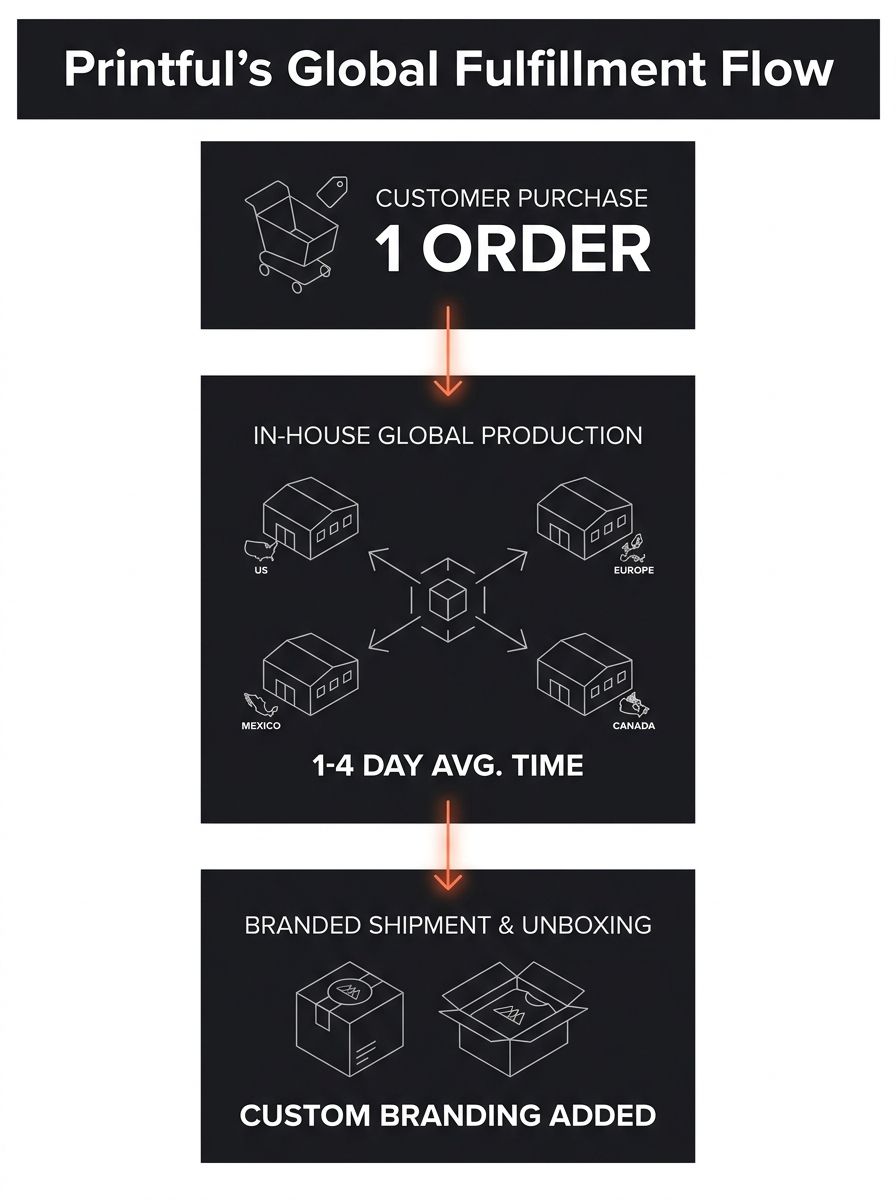
Printful operates its own fulfillment centers in the US, Europe, Canada, and Mexico. That in-house model means every order hitting a given facility goes through the same printers, the same quality checks, and the same packing workflow. Production time averages 2–5 business days across all product categories, with apparel items specifically averaging about 3 business days according to Merch Titans' 2026 testing. You don't pick a printer. Printful routes the order to whichever facility is closest to your customer, automatically.
The branding suite is where Printful separates from every other POD platform. Custom inside neck labels, branded packing slips, custom pack-ins, and branded tracking pages all ship from a single dashboard. If you're running a store where the unboxing experience matters for Instagram reels or TikTok content, this is a real competitive edge. Printify offers branding options only through select providers, and even then you won't get universal neck labels or custom mailers.
The tradeoff? Cost. Printful's base prices on a standard unisex t-shirt run $12–$14 depending on the model, compared to $7–$10 on Printify for a comparable blank. On a $25 retail tee, that's the difference between a 44% gross margin and a 60% gross margin. Printful's Growth Membership offers up to 33% off base prices, but it's built for high-volume sellers already clearing significant monthly order counts. For someone doing 10 orders a month, the math doesn't close.
The catalog is tighter too. Printful lists roughly 340–400 curated products versus Printify's 1,300+. But every item in Printful's catalog meets the same quality floor because it's all printed in-house. I've done full breakdowns of Printful's feature set and cost structure if you want the granular numbers.
Printify's Margin Advantage Comes with a Catch
A 2026 Merch Titans head-to-head test confirmed what the pricing pages suggest: Printify is generally better for beginners because it has a free plan with no monthly fees. You pay only when a sale comes through. The platform lists over 1,300 products through a network of 90+ third-party print providers, and base prices run 20–30% below Printful on comparable items.
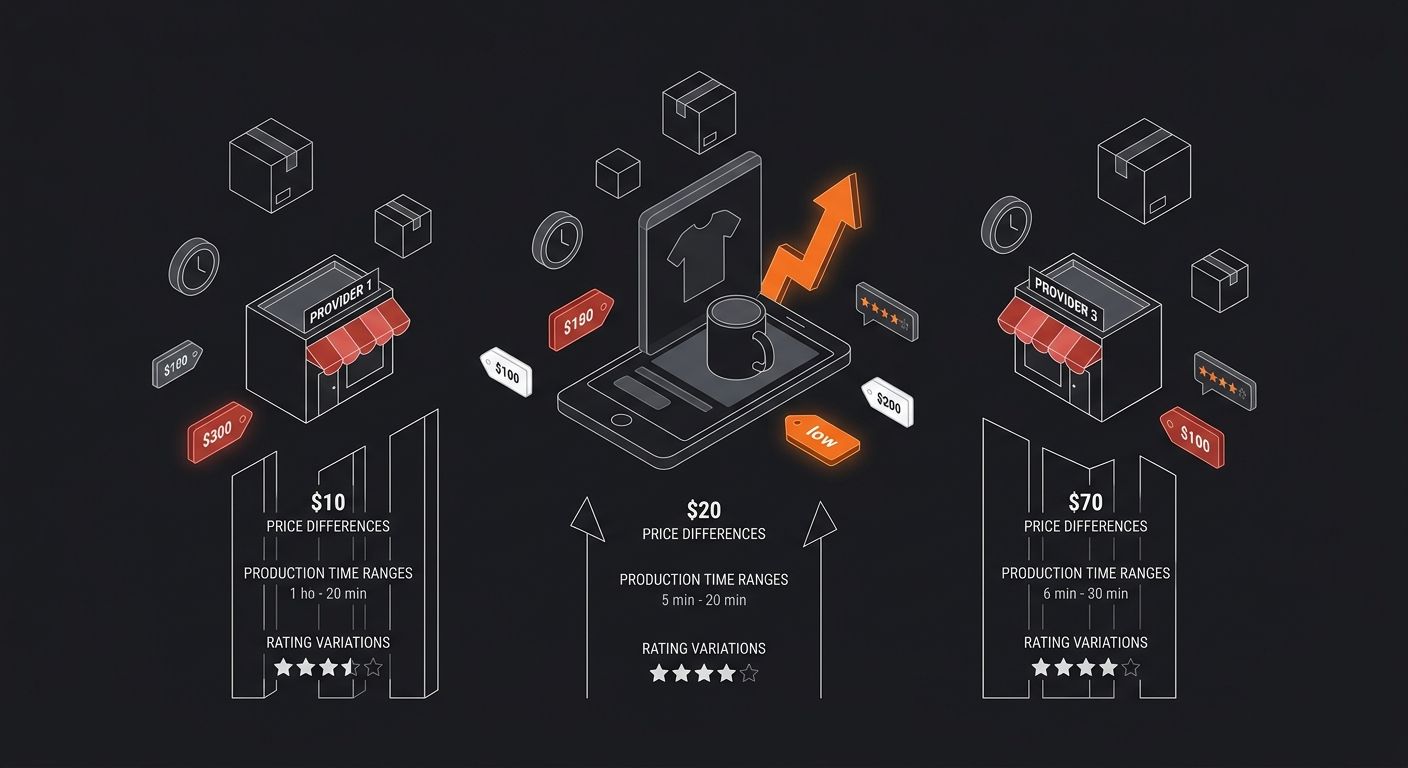
The marketplace model is Printify's defining feature and its biggest variable. For any given product, you choose which print provider fulfills it. Provider A might print a Bella+Canvas 3001 for $7.12 with 3-day production. Provider B might print the same shirt for $8.40 with 2-day production and better color accuracy. You're making supplier-level decisions that Printful abstracts away entirely. That flexibility is powerful if you're willing to do the testing. It's a headache if you aren't.
Printify's Premium plan at $29/month applies a flat 20% discount across all providers, and it pays for itself at roughly 15–20 monthly orders depending on your product mix. That's a low bar for anyone past the hobby stage.
Integration quality is strong. Printify's Shopify app holds a 4.7 out of 5 rating in the app store, with the Wix integration pulling a 4.9. The WooCommerce connection gets consistently praised for speed. One reviewer at WP Loft reported having a live product on WooCommerce minutes after uploading a design with zero lag or glitches. If you're building on Shopify specifically, our Shopify dropshipping setup guide covers the full technical wiring.
And the catch? Consistency. Because different providers use different equipment, ink formulations, and blank sources, the same design can look noticeably different depending on which provider prints it. Fulfillment speed varies too, with some providers averaging 2 days and others pushing past 5. Sample ordering is essential here, and unlike Printful (which offers sample discounts at certain sales milestones), Printify charges standard prices for samples with no discounts. Budget for $150–$300 in sample costs before you lock in providers. I've covered the full Printify platform walkthrough separately if you want deeper operational detail.
Running Both Platforms on One Store
The third path is running Printful and Printify simultaneously on the same storefront. Route your premium, brand-forward products through Printful and your margin-sensitive commodity items through Printify. For sellers doing 50+ orders per month with a mixed catalog, this approach delivers the best blended unit economics.
It works because Shopify, Etsy, and WooCommerce all support multiple POD app connections. A custom embroidered hoodie with a branded neck label ships through Printful at a $22 base cost. A novelty coffee mug ships through Printify at a $5.80 base cost. Same store, same customer, two different fulfillment backends. The customer never sees the difference.
The practical benefit is margin segmentation. Your hero products get Printful's quality floor and branding. Your impulse-buy add-ons, seasonal designs, and lower-priced accessories get Printify's cost advantage. When you calculate profit margins across your full catalog, blended COGS drops without sacrificing perceived quality on the items that define your brand.
The tradeoff is operational complexity. You're managing two dashboards, two sets of shipping profiles, and two different return workflows. If a customer orders a Printful hoodie and a Printify mug in the same cart, they'll receive two separate packages with different tracking timelines. That creates support tickets. Forbes Advisor's Printful vs Printify comparison confirmed that Printful delivers more reliable shipping and branded packaging, so the hybrid approach means accepting that some orders arrive in plain poly mailers while others arrive in branded boxes.
For stores doing under 30 orders a month, the hybrid overhead probably isn't worth it. Pick one platform, optimize your margins on that single provider, and revisit the split model when volume justifies the added complexity.
Side-by-Side Comparison
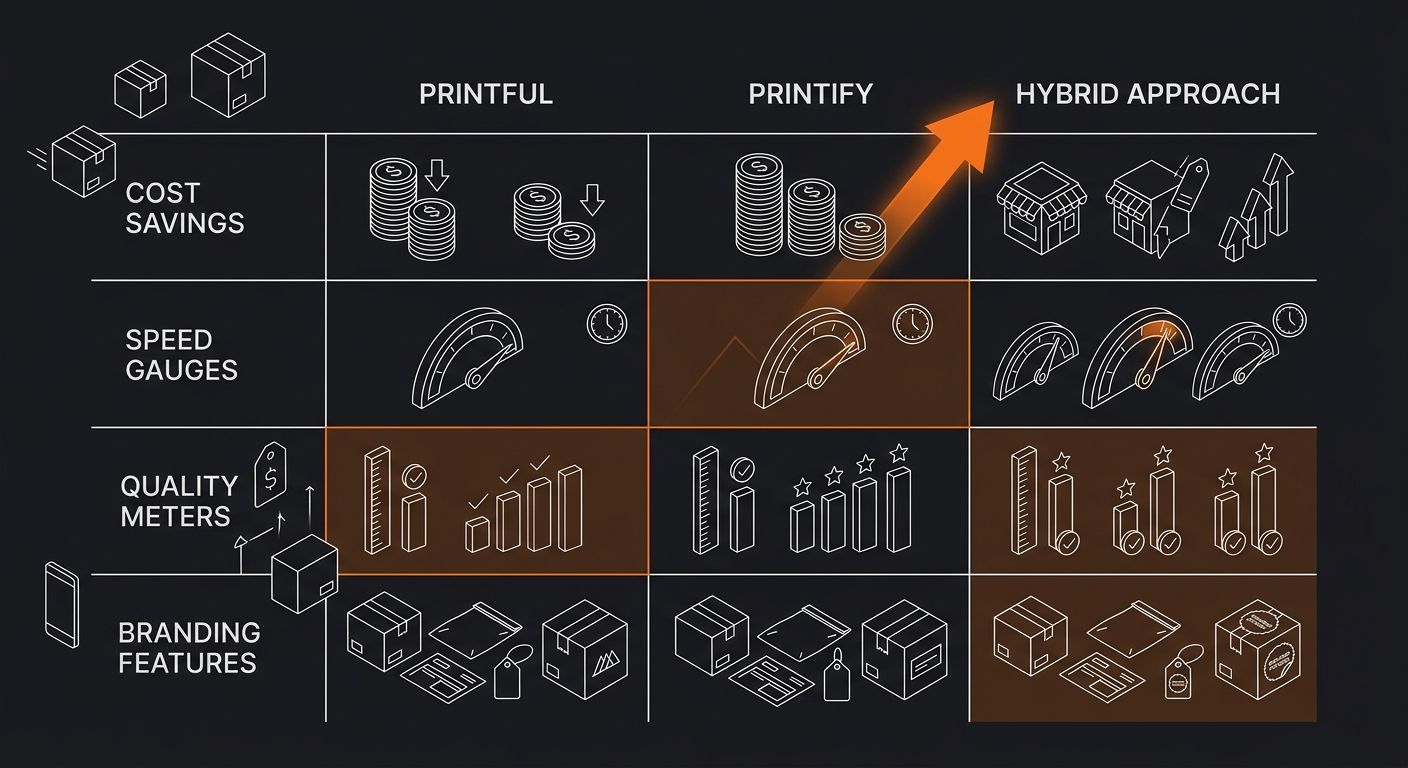
Attribute | Printful | Printify | Hybrid (Both) |
|---|---|---|---|
Base Cost (Standard Tee) | $12–$14 | $7–$10 | $7–$14 (varies by SKU routing) |
Product Catalog | ~340–400 items | 1,300+ items | Full combined catalog |
Monthly Fee | Free tier; Growth plan for volume | Free tier; Premium $29/mo (20% off) | Two subscriptions if using paid tiers |
Fulfillment Speed | 2–5 business days (avg 3 for apparel) | 2–7 days (provider-dependent) | Varies by product routing |
Quality Consistency | High (in-house printing) | Variable (provider-dependent) | High on Printful SKUs, variable on Printify |
Branding | Neck labels, packing slips, inserts, tracking pages | Limited; provider-dependent | Full branding on Printful items only |
Global Routing | Automatic to nearest facility | Manual provider selection required | Mixed |
Sample Discounts | Yes, at sales milestones | No | Printful samples discounted only |
Best For | Brand-focused DTC, $30+ items | Budget sellers, wide catalogs, beginners | 50+ orders/mo, mixed catalogs |
Who Should Pick Which
The Printful vs Printify decision comes down to two variables: your average retail price and your monthly order volume.
Pick Printful if your average product retails above $30, your brand story depends on a polished unboxing experience, and you'll accept gross margins in the 20–40% range for the sake of consistency. You're selling a brand, and the packaging is part of the product. Printful's automatic global routing also makes it the stronger play for international sellers who don't want to manually vet providers in every region.
Pick Printify if you're launching with zero budget, testing designs before committing to a niche, or selling products where the customer cares about the print quality and the price rather than the box it arrived in. Target 40%+ gross margins, invest in sample orders to lock in 2–3 reliable providers, and activate the Premium plan once you're clearing 20 orders a month. Just be aware that speed-focused provider selection can erode those margins if you're not tracking landed cost per SKU.
Pick the hybrid if you're past the testing phase, doing 50+ orders monthly, and your catalog spans both premium hero items and lower-cost accessories. The operational overhead is real but manageable with basic SKU mapping and product tagging. Blended margins will beat either platform alone across a diversified catalog.
Both companies share corporate ownership now, but their fulfillment models remain fundamentally different. Printful sells consistency and brand infrastructure at a premium. Printify sells flexibility and cost efficiency with variance baked in. The sellers who do best in POD figure out which problem they're actually solving for their specific customer, then choose the platform that matches.

Ryan Torres
Ryan Torres is a former Amazon FBA seller turned dropshipping consultant who has generated over $2.8M in ecommerce revenue across 14 product launches. He specializes in supplier vetting, margin optimization, and scaling DTC operations for sub-$1M brands. Ryan focuses on actionable frameworks that drive measurable results for independent operators.
Frequently Asked Questions
- What is the difference between Printful and Printify pricing?
- Printful charges $12–$14 per standard unisex t-shirt while Printify offers comparable blanks for $7–$10, making Printify 20–30% cheaper per unit. On a $25 retail tee, this translates to a 44% gross margin with Printful versus 60% with Printify.
- How many products does Printify offer compared to Printful?
- Printify offers 1,300+ products through 90+ third-party print providers, while Printful maintains a curated catalog of roughly 340–400 products printed in-house.
- What are Printful's branding options?
- Printful offers custom inside neck labels, branded packing slips, custom pack-ins, and branded tracking pages all managed from a single dashboard. Printify only offers limited branding options through select providers.
- How fast is fulfillment with Printful vs Printify?
- Printful averages 2–5 business days with apparel items at about 3 days, while Printify's fulfillment speed varies by provider from 2–7 days depending on which third-party printer you select.
- Should I use both Printful and Printify on the same store?
- Running both platforms simultaneously works best for sellers doing 50+ orders monthly with mixed catalogs—route premium products through Printful for quality and branding, and lower-priced items through Printify for margin advantage. For stores under 30 orders per month, the operational complexity likely isn't worth it.
- Does Printify offer a free plan?
- Yes, Printify has a free plan with no monthly fees where you pay only when a sale completes. The Premium plan costs $29/month and applies a 20% discount across all providers.
- What is the main drawback of using Printify?
- Because Printify works with 90+ different third-party providers, the same design can look noticeably different depending on which provider prints it, and fulfillment speed varies by provider. Sample ordering is essential to lock in consistent providers, and Printify charges standard prices for samples with no discounts.
- When is Printful the better choice over Printify?
- Printful is better for brands selling products over $30 where unboxing experience drives repeat purchases, for sellers prioritizing quality consistency, and for international sellers who want automatic global order routing without manually vetting providers in each region.
Related Articles
Printful print-on-demand App Review: Features & Costs
Printful's base product costs run 15–35% higher than Printify's on comparable items, while Gelato undercuts both on international fulfillment speed through local production routing. The right print-on-demand platform depends on whether you're optimizing for quality, margin, or geographic reach.

Printful's 479-Product Catalog Outweighs Tapstitch's Apparel Quality Edge in New POD Platform Comparison
Printful's 479-product catalog spanning apparel, home decor, and accessories gives it a decisive edge over Tapstitch's 400-blank apparel-only range despite Tapstitch's vertically integrated quality advantage in streetwear fulfillment, according to a platform comparison published July 8 by Ecommerce-
Printify: Complete App Review & Guide
Printify is a print-on-demand marketplace that routes your orders to a network of over 100 independent print providers who manufacture and ship products under your brand.
Explore more topics