Freight Rate Inflation and AI Chip Demand: How Dropshippers Should Adjust Shipping Strategy in H2 2026
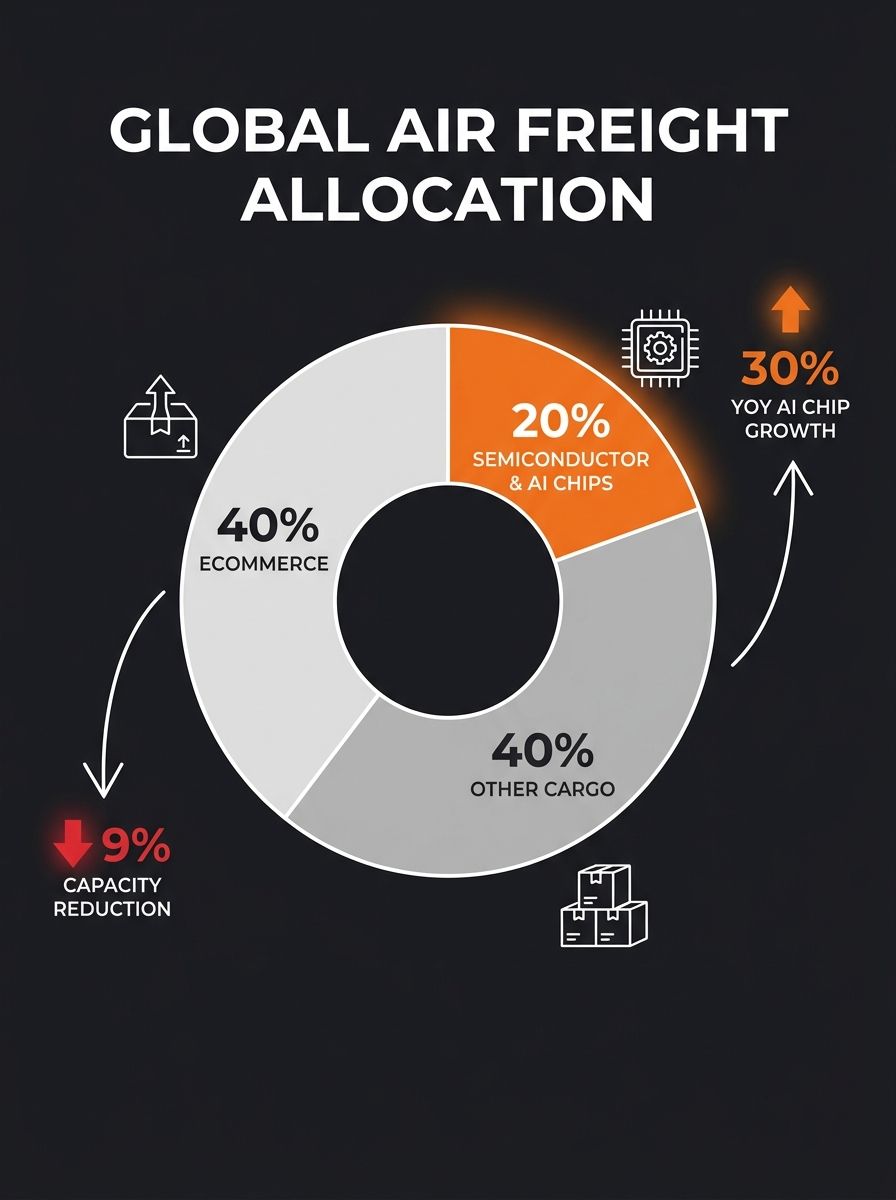
Global air freight capacity sits roughly 9% below pre-conflict levels according to DSV logistics data, while AI chip shipments growing at 30% annually absorb the remaining space. Dropshippers are competing for cargo slots against hyperscaler procurement teams with functionally unlimited budgets.
Freight Rate Inflation Meets AI Chip Demand: The Logistics Apps Helping Dropshippers Protect Margins in H2 2026
Global air freight capacity sits roughly 9% below pre-conflict levels according to DSV logistics data, while AI chip shipments growing at 30% annually absorb the remaining space. Dropshippers are competing for cargo slots against hyperscaler procurement teams with functionally unlimited budgets.
Air Cargo Is a Semiconductor Highway Now
Why does this matter for someone shipping phone cases or pet accessories? Because air freight pricing operates on allocation. When AI-driven chip demand tightens air and sea freight capacity, every shipper on those routes pays more regardless of what's in the box.
The mechanism is straightforward. TSMC's sub-3nm wafer prices are climbing 3-10% in 2026, with a single 2nm wafer now costing approximately $30,000, up from $17,000-$22,000 at 3nm. That price increase incentivizes chip manufacturers to move product faster to recoup costs, which means booking more air cargo space at premium rates. Direct China-US air services returning post-pandemic are being absorbed by massive e-commerce volumes out of South China, leaving almost no incremental capacity for other shippers. Taiwan and South Korea routes face separate tightness driven by semiconductor manufacturing clusters.
The downstream effect for dropshippers: freight rate increases in 2026 are structural, driven by chip-industry demand that won't slow down. Planning around temporary surcharges doesn't work when the capacity constraint is persistent.
The Real Cost Inflation Beyond Base Rates
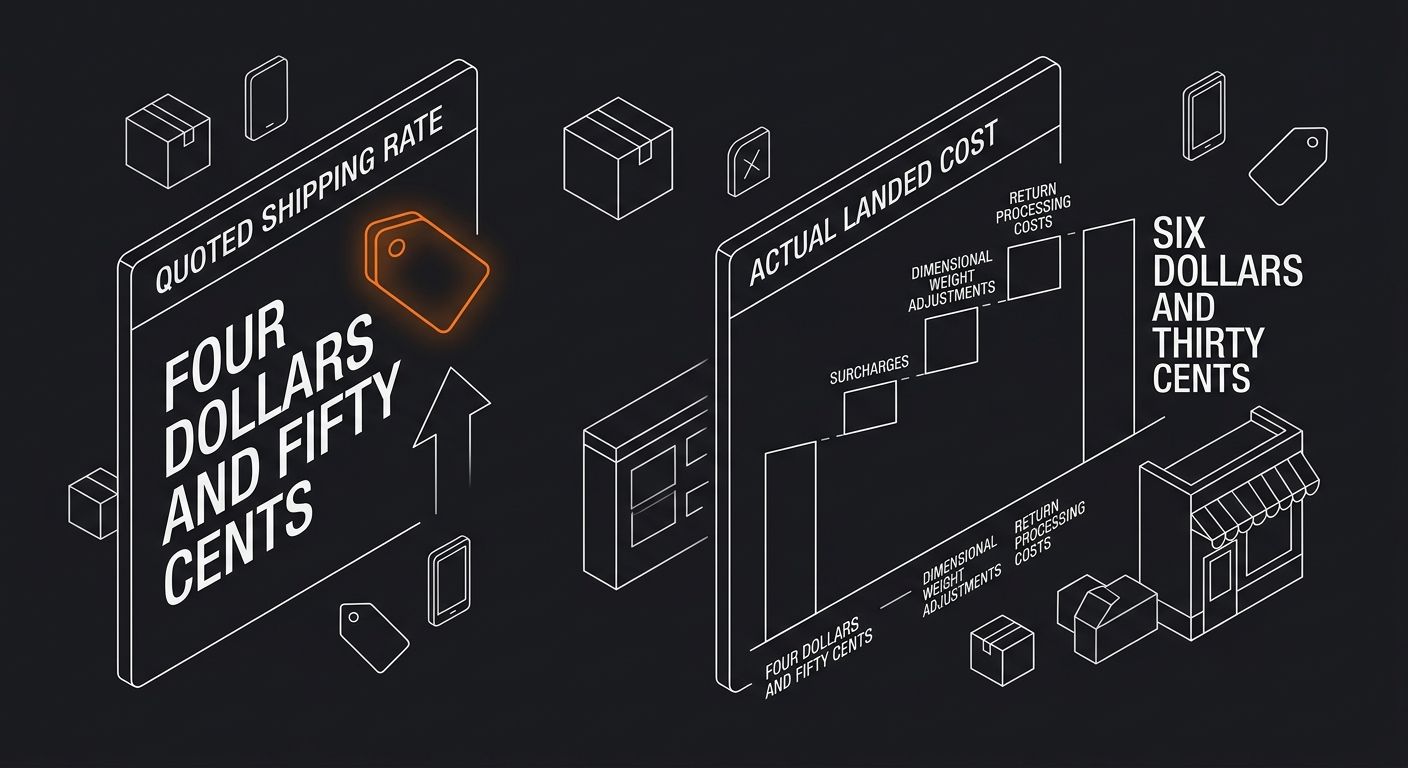
Quoted freight rates tell about 60-75% of the actual story. According to GoBolt's 2026 ecommerce shipping cost analysis, residential delivery fees, fuel surcharges, dimensional weight pricing, and peak season premiums inflate actual shipping spend by 25-40% beyond quoted rates. For a dropshipper working on 30-35% gross margins, a 25% shipping cost overshoot can erase profitability on an entire product line.
USPS adds to the pressure with pricing and dimensional measurement changes taking effect July 12, affecting sub-pound rate tiers and parcel dimension reporting. Shippers who haven't reviewed USPS's updated measurement rules risk being reclassified into higher rate brackets without realizing it.
And returns compound everything. Silicon Valley Direct's 2026 ecommerce guide flags that implementing efficient returns management logistics is essential to prevent rate hikes from multiplying the cost of processing returns. Over half of brands already cite returns as a margin drag, per GoBolt. When inbound freight costs 25-40% more than expected and returns run at 15-20% of orders, the math breaks fast.
If you're still calculating margins without accounting for these surcharges, your P&L is fiction.
Logistics Apps That Address Rate Volatility
The air cargo capacity shortage makes real-time rate visibility more valuable than annual carrier contracts. Three categories of shipping apps matter right now for dropshippers dealing with rising dropshipping logistics costs:
Multi-carrier rate comparison tools. Apps like Shippo, EasyShip, and ShipStation pull rates from USPS, UPS, FedEx, DHL, and regional carriers in real time. The value here is automatic carrier switching. When FedEx's fuel surcharge spikes 8% on a Tuesday, these platforms route your next batch to USPS or a regional carrier without manual intervention. EasyShip specifically shows estimated duties and taxes at checkout, which matters if you're shipping into the EU's new per-item fee structure.
Landed cost calculators. FreightAmigo's platform, which publishes extensive semiconductor supply chain data, also offers AI-powered rate matching that accounts for customs duties, taxes, and insurance. For dropshippers sourcing from China or Southeast Asia, the difference between a $3.20 quoted rate and a $4.85 landed cost decides whether an order is profitable.
Inventory-aware fulfillment routers. Tools like ShipBob's dashboard or Flexport's portal let you split inventory across domestic and international warehouses, routing orders to whichever fulfillment node minimizes shipping cost. Given that US-based fulfillment is reshaping unit economics for operators doing 4,000+ orders monthly, the ability to shift fulfillment geography dynamically is a concrete margin lever.
App / Platform | Real-Time Multi-Carrier Rates | Landed Cost Calculation | Auto Carrier Switching | Estimated Monthly Cost (mid-tier) |
|---|---|---|---|---|
Shippo | Yes (40+ carriers) | Limited | Yes | $19-$49 |
EasyShip | Yes (250+ services) | Yes (duties + taxes) | Yes | $29-$69 |
ShipStation | Yes (major carriers) | No | Yes | $59.99 |
FreightAmigo | Yes (AI-matched) | Yes (full landed cost) | Partial | Custom quote |
ShipBob | Yes (own network) | Yes | Yes (warehouse routing) | Per-order pricing |
Supplier Negotiation Tactics in a Capacity-Constrained Market
When freight capacity is tight, supplier negotiation tactics need to shift from price-per-unit haggling toward logistics terms. Total cost of ownership analysis, as outlined in Kodiak Hub's supplier negotiation framework, shows that the cheapest supplier quote often costs more once you factor in slower delivery, higher damage rates, and worse packaging that triggers dimensional weight penalties.
Three specific negotiation angles work when dropshipping logistics costs are climbing:
Shipping method flexibility in supplier agreements. Ask your supplier to quote both air and sea for the same SKU, with trigger points for switching. If air cargo from Shenzhen to LAX climbs above a specific $/kg threshold, the supplier ships sea freight with a 14-day buffer you've built into your listed delivery window.
Consolidation commitments for rate locks. Proposing increased order volumes or consistent weekly purchase commitments gives suppliers enough predictability to negotiate their own bulk freight rates. A 15-20% volume commitment over 90 days often unlocks 5-8% freight savings that get passed through.
Packaging spec requirements. Dimensional weight pricing means the box matters as much as the product. Negotiating maximum carton dimensions with your supplier can shift a 2-lb product from a $7.40 to a $5.10 shipping bracket. If you haven't audited your supplier's actual packaging practices, you're probably overpaying on DIM weight every single order.
FedEx's Pivot Tells You Where Carrier Priorities Are Heading
FedEx Freight announced this week that it's refocusing on high-margin shipments in healthcare, grocery, and technology sectors. For dropshippers, this signals a clear priority hierarchy: carriers will allocate capacity to shippers paying premium rates on high-value goods. General merchandise and consumer products sit lower in that queue.
The practical response is domestic fulfillment diversification. Operators who've already moved to US-based 3PL arrangements sidestep the worst of the air cargo capacity shortage because their products are already stateside. The per-unit cost is higher, but the shipping margin protection comes from predictability: domestic USPS and UPS ground rates are volatile, but they're not competing with $30,000-per-wafer chip shipments for plane space.
What Still Isn't Settled
Several factors could shift the freight picture in either direction through the rest of the year. Lower fuel surcharges have provided modest relief, but strong tech supply chain export demand is keeping shipping prices firm through peak season. If AI infrastructure spending accelerates further — and Micron's 16% stock surge on AI demand signals suggest it will — air cargo pricing for non-tech shippers gets worse, not better.
The EU's €3 per-item duty fee, effective July 1, adds another variable for anyone shipping cross-border into Europe. Combined with freight inflation, the landed cost of a $15 product shipped from China to Germany has increased meaningfully in six months. Dropshippers without real-time landed cost visibility, the kind EasyShip and FreightAmigo provide, are running blind on their most important metric: whether each order actually makes money.
TSMC has announced four consecutive years of wafer price increases through 2029, meaning the AI chip demand squeezing freight capacity has a long runway. Shipping strategy adjustments made now need to account for a multi-year capacity constraint, not a temporary disruption. The operators who treat this as a one-quarter problem will keep getting surprised by their shipping line items every 90 days, while those who lock in rate comparison tooling and renegotiate supplier logistics terms now will have a structural cost advantage through 2027 and beyond.
365 Dropship Editorial
Editorial team writing about E-commerce, dropshipping, and product discovery — reviews of dropshipping suppliers and platforms, trending niche guides (jewelry, beauty, pets, home, fashion), supplier due diligence, ecom operations, shipping & fulfillment strategy, product research, AOV optimization, and profitable dropshipping case studies.
Related Articles
Bunker Fuel Shocks & Last-Mile Economics: Why Global Port Disruptions Are Reshaping Dropshipping Unit Economics in 2026
On February 28, 2026, the Strait of Hormuz closed to commercial shipping traffic as the Iran conflict escalated into a direct naval blockade. Over 90% of crude and refined product exports from the Persian Gulf were cut off within 72 hours.
Shipping Fuel Shock & Margin Math: How Rising Port Costs Are Reshaping Dropshipping Economics in 2026
Maersk disclosed $500 million per month in additional fuel costs on May 7, 2026, driven by the closure of the Strait of Hormuz and the resulting scramble for bunker fuel outside the Persian Gulf.
The Domestic Supplier Advantage: Why US-Based Fulfillment Is Reshaping 2026 Dropshipping Unit Economics
Domesticated fulfillment with bulk DDP imports cuts per-parcel costs by 8–15% for brands shipping 4,000+ US orders monthly, according to Evolution Fulfillment's cost model.
Explore more topics