Synchronization Lag Identified as Primary Inventory Failure Point for Multichannel Ecommerce Operators
Inventory synchronization—the delay between a sale occurring on one platform and stock counts updating across all connected channels—determines whether multichannel ecommerce businesses can scale past 500 SKUs across three channels without overselling or suppressing available inventory, according to

Synchronization Lag Identified as Primary Inventory Failure Point for Multichannel Ecommerce Operators
Inventory synchronization—the delay between a sale occurring on one platform and stock counts updating across all connected channels—determines whether multichannel ecommerce businesses can scale past 500 SKUs across three channels without overselling or suppressing available inventory, according to an analysis published June 19 by TechBullion. The article frames synchronization as the critical operational bottleneck that separates businesses capable of multichannel growth from those trapped by manual reconciliation processes.
Root Cause of Overselling and False Stockouts
Two distinct inventory failures stem from synchronization delays, the TechBullion report states. Overselling occurs when a product displays as available after selling out elsewhere, triggering cancellations, refunds, and Amazon account-level penalties tied to order defect rate. False stockouts suppress sales by showing zero availability for inventory that remains in stock but hasn't synchronized across channels.
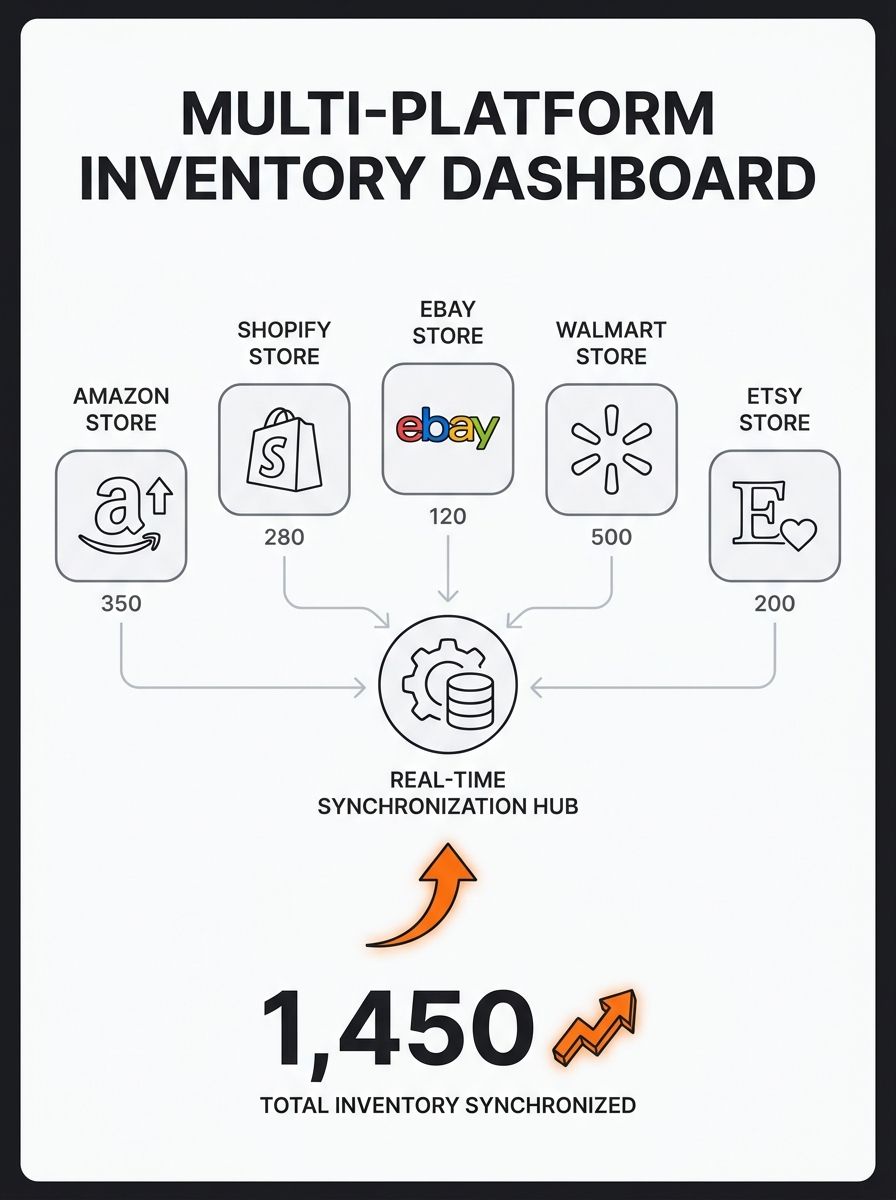
For a single SKU listed across five marketplaces—Amazon Seller Central, Shopify, eBay, Walmart Marketplace, and Etsy, as the article enumerates—five separate update points create simultaneous opportunities for stock counts to drift. Centralized real-time synchronization consolidates those points into a single source of truth, the analysis notes.
Platforms like StockKonnect have emerged to solve multichannel synchronization specifically, the report states, by automating the inventory-tracking and channel-update processes that manual spreadsheets cannot sustain at scale.
Manual Processes Break at 500 SKUs Across Three Channels
Spreadsheet-based inventory tracking functions adequately for businesses managing a few dozen SKUs on a single channel, according to the TechBullion piece. Past approximately 500 SKUs across three or more channels, the volume of hourly updates required exceeds what teams can execute reliably by hand, the report states. That threshold typically drives adoption of dedicated multichannel inventory management software to automate synchronization, reorder triggers, and reporting.
The article outlines seven interdependent inventory functions: receiving stock from suppliers, organizing storage by SKU and bin location, real-time inventory tracking, channel synchronization, order fulfillment, replenishment scheduling, and demand forecasting. Each function depends on the others; a perfectly organized warehouse still generates overselling if synchronization lags, the analysis states.
Operators already managing inventory sync errors encounter the same lag-driven failures when scaling from one platform to multiple channels.
Five KPIs Signal Inventory System Health
The TechBullion report identifies five metrics that reveal whether inventory operations function effectively:
Inventory turnover ratio (cost of goods sold divided by average inventory) measures how often stock sells and replenishes
Sell-through rate (units sold divided by units received) shows conversion efficiency from received stock to completed sales
Stockout rate tracks frequency of unavailable products when demand exists
Inventory accuracy rate compares recorded counts to physical reality
GMROI (Gross Margin Return on Investment) calculates profit generated per dollar invested in inventory
Tracking three or four of these metrics consistently catches operational problems before they compound into lost revenue, the article states.
ABC Analysis and EOQ Combine in Mature Operations
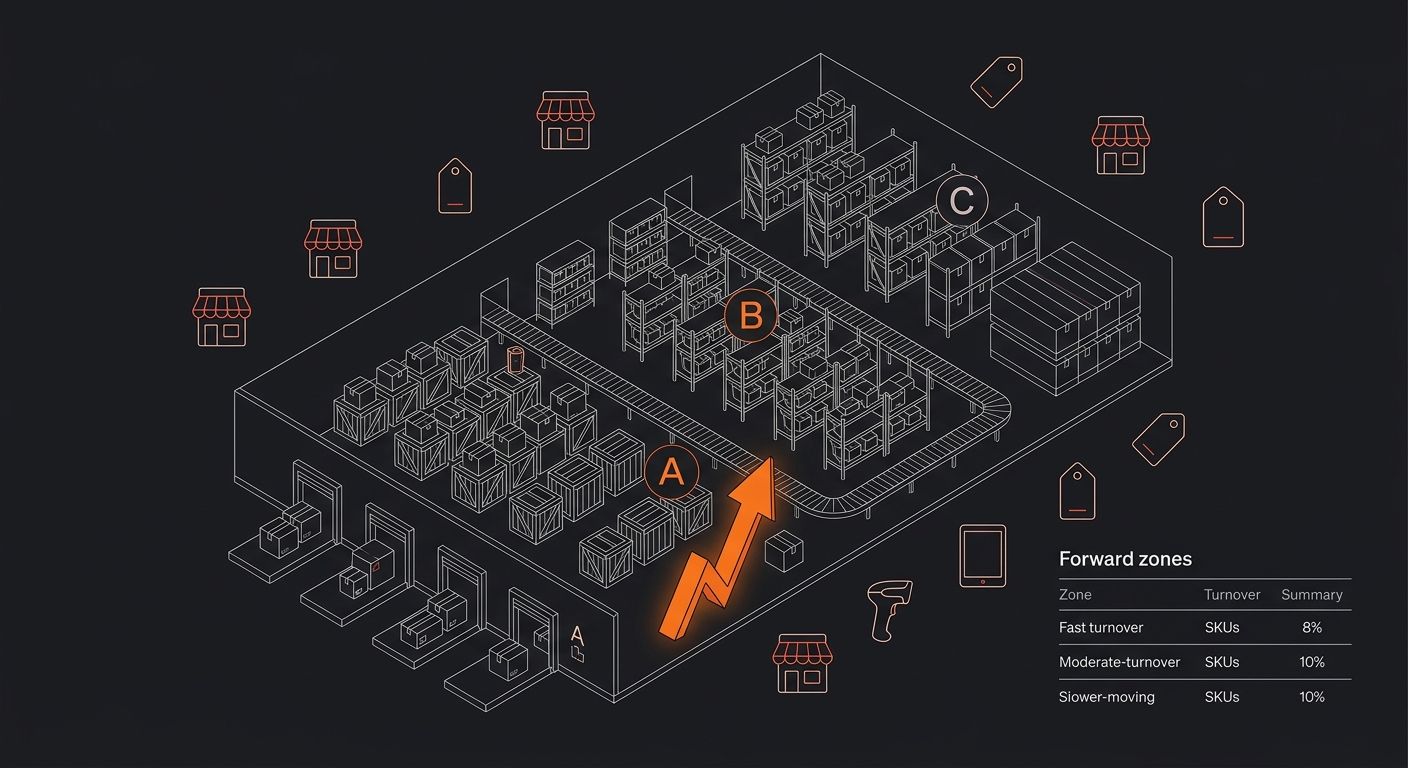
Established inventory techniques underpin most ecommerce strategies, according to the report. FIFO (First In, First Out) sells oldest stock first, standard for perishables and items with shelf lives. ABC Analysis segments SKUs by revenue contribution, concentrating forecasting effort on the highest-impact 20 percent of products. Economic Order Quantity uses formula-based methods to minimize combined ordering and holding costs. Just-In-Time ordering reduces carrying costs at the expense of supplier-delay risk. Cycle counting audits rotating inventory subsets rather than conducting single disruptive annual counts.
Most mature operations combine several techniques simultaneously, applying tighter controls—frequent counts and precise reorder points—to high-revenue SKUs and lighter management to lower-impact inventory, the TechBullion analysis states. Businesses running Shopify's order routing logic across multiple suppliers layer these methods over platform-level automation.
AI-Driven Forecasting Replaces Reactive Stock Counting
Ecommerce inventory management is shifting from reactive stock counting toward predictive systems, the article states. AI-driven demand forecasting, RFID and IoT-based tracking, and warehouse automation are converging inventory, order, and customer data into unified platforms, reducing the manual reconciliation that has historically been the discipline's biggest failure point.
The report frames the discipline's success or failure on one question: how quickly does the system close the gap between "a sale happened" and "every channel knows it happened?" Businesses that solve for synchronization, apply proven techniques like FIFO and ABC analysis, and track the right KPIs build inventory into a forecasting asset, the TechBullion piece concludes. Businesses that don't discover the cost only after an oversold bestseller, a marketplace penalty, or a warehouse full of dead stock makes the operational failure impossible to ignore.
Reading Between the Lines
The 500-SKU, three-channel threshold matters because it marks the point where hourly synchronization volume exceeds what non-automated processes can execute without error accumulation. Operators below that threshold who rely on spreadsheets aren't making a strategic mistake—they're appropriately matching tooling to transaction volume. Operators above it who haven't automated synchronization are bleeding margin to cancellations, marketplace penalties, and suppressed sales from false stockouts.
The article's framing of synchronization as the "critical failure point" rather than warehouse organization or demand forecasting reflects the operational reality that most inventory problems trace to stale data, not insufficient stock or poor purchasing decisions. A business can forecast perfectly and still oversell if five channels aren't updating from a single inventory source within seconds of each sale.
The shift toward AI-driven forecasting mentioned at the end is directionally accurate but operationally premature for most dropshippers and independent merchants. Real-time synchronization solves the immediate revenue leak; predictive modeling delivers value only after sync lag no longer creates phantom availability or hides sellable stock across disconnected platforms.

Ryan Torres
Ryan Torres is a former Amazon FBA seller turned dropshipping consultant who has generated over $2.8M in ecommerce revenue across 14 product launches. He specializes in supplier vetting, margin optimization, and scaling DTC operations for sub-$1M brands. Ryan focuses on actionable frameworks that drive measurable results for independent operators.
Related Articles
Inventory Sync Errors Are Killing Your Conversion Rate: How to Diagnose and Fix Oversell Events Before They Compound
Shopify's Admin API version 2026-04 now requires idempotency keys for every inventory mutation call.

Why Your Supplier Is Handling More Than You Think: The Hidden Data Flow Between Order and Fulfillment
Between your customer's checkout click and the tracking email that arrives hours later, six to twelve discrete data transfers fire across your store, middleware, supplier systems, and shipping carriers.
The Supplier Tracking Sync Failure Matrix: Debugging When Orders Disappear Between Shopify and Fulfillment
Shopify-supplier integration failures fall into three distinct zones: API callback misconfigurations, middleware polling gaps, and fulfillment-side acknowledgment drops.
Explore more topics