Why I'd Never Launch a Dropshipping Store in a Niche With More Than 3 Dominant Amazon Sellers
Three Amazon sellers with 1,000-plus reviews each, all ranking on page one for the same product keyword at comparable prices, create a pricing floor that no independent dropshipper's margin can survive.
Why I'd Never Launch a Dropshipping Store in a Niche With More Than 3 Dominant Amazon Sellers
Three Amazon sellers with 1,000-plus reviews each, all ranking on page one for the same product keyword at comparable prices, create a pricing floor that no independent dropshipper's margin can survive. That niche concentration risk means your customer acquisition cost will exceed gross profit on every single order before you've shipped a thing.
The reason is structural, not motivational. Amazon's fulfillment network delivers in 1 to 2 days. Your dropshipping supplier ships in 7 to 14. Amazon's review moats run into the thousands. Your fresh listing has zero. Amazon's referral fee sits at roughly 15%, and FBA fees push total platform costs to 30 to 40% of the sale price. Those sellers have already absorbed those costs and built pricing around them. You, launching a standalone Shopify store, are competing against their retail price as if it's wholesale. And each platform carries a completely different profit profile once you break down fees, traffic costs, and fulfillment overheads.
What "3 Dominant Sellers" Actually Means in Practice
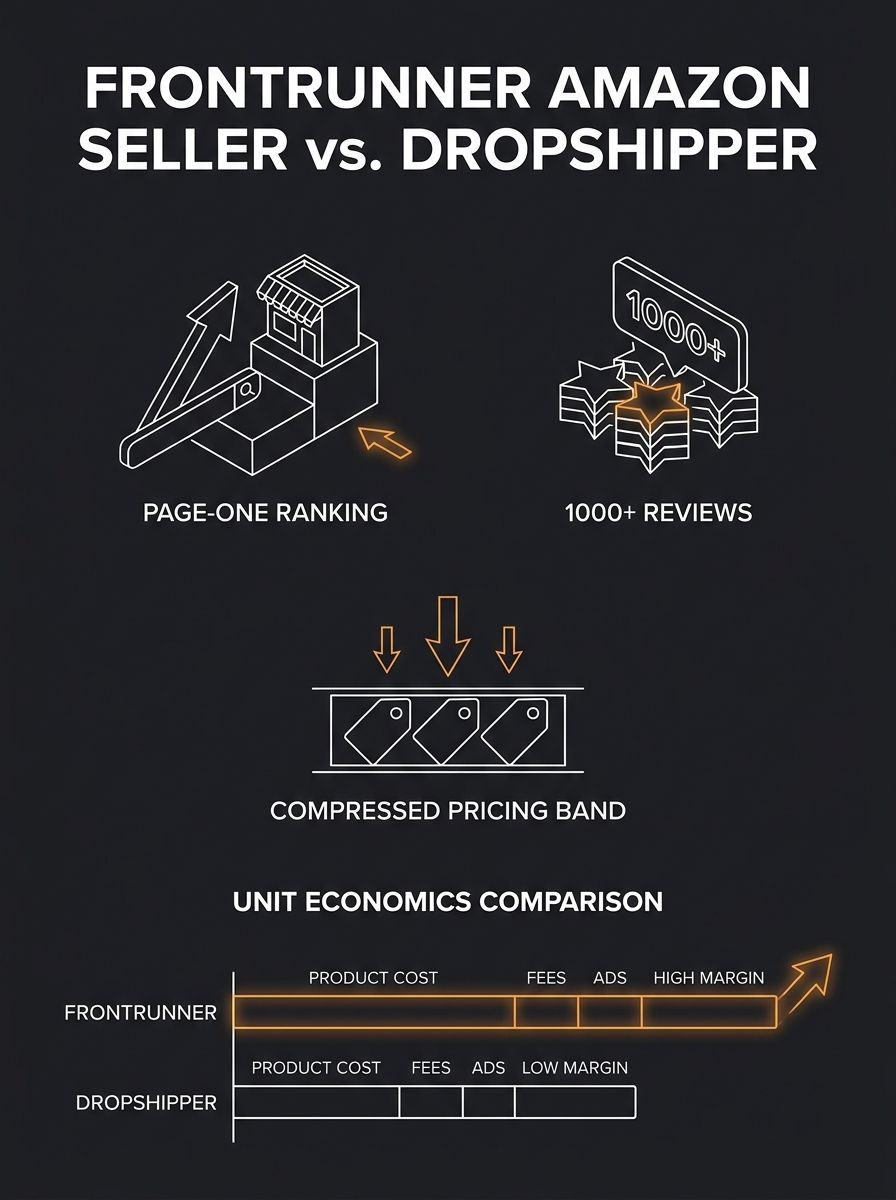
A dominant Amazon seller in a product niche holds three things simultaneously: page-one organic ranking for the category's primary keyword, a review count above 1,000 (often above 5,000), and pricing within a 15% band of the other top sellers. When three or more sellers occupy that position, they've collectively discovered the price floor for that product. They've tested it over months or years of sales velocity data. That floor reflects their landed cost plus Amazon's fee stack plus their target margin.
Your dropshipping margin, typically between 15% and 30% on most products, gets eaten alive when those three sellers have already priced the product at or near your cost of goods. According to AMZPrep's merchant comparison guide, "Amazon FBA carries more risk. You must invest in inventory upfront. If products don't sell, substantial losses can occur." Those FBA sellers accepted that risk, bought in bulk at 40 to 60% below retail, and now own the pricing conversation. You can't undercut them with a per-unit dropship cost from Spocket or CJ that's already 2x to 3x their wholesale buy.
The Concentration Ceiling Test: A Framework for Dropshipping Niche Selection
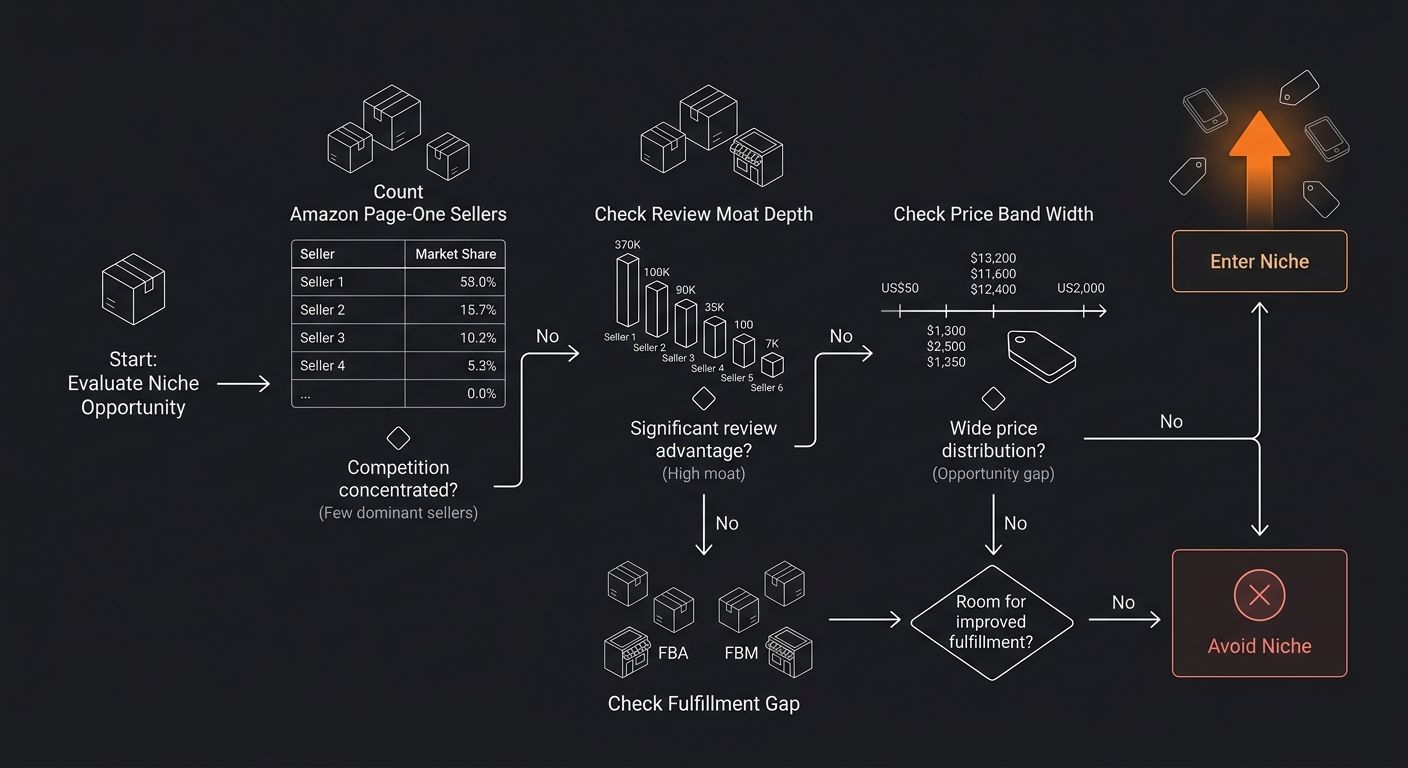
Every market saturation analysis before committing ad budget should run through what I call the Concentration Ceiling Test, evaluated on three axes.
Axis | What to Measure | Red Flag Threshold |
|---|---|---|
Review Moat Depth | Average review count of top 3 Amazon sellers for your primary keyword | 1,000+ reviews each |
Price Band Width | Percentage spread between the cheapest and most expensive of the top 3 | Less than 15% spread at sub-$30 price points |
Fulfillment Gap | Difference between their shipping speed and yours | Prime (1-2 days) vs. your supplier's 7-14 days |
If all three axes hit their red-flag threshold, you're looking at a niche with a concentration ceiling. The ceiling means there's a hard cap on how much margin you can extract, because the dominant sellers have already compressed pricing to a point where customer expectations are locked. A shopper who sees a silicone kitchen utensil set at $18.99 with 4,200 reviews and next-day delivery will not pay you $24.99 with 12-day shipping and no reviews. The math doesn't work regardless of how good your product photos are.
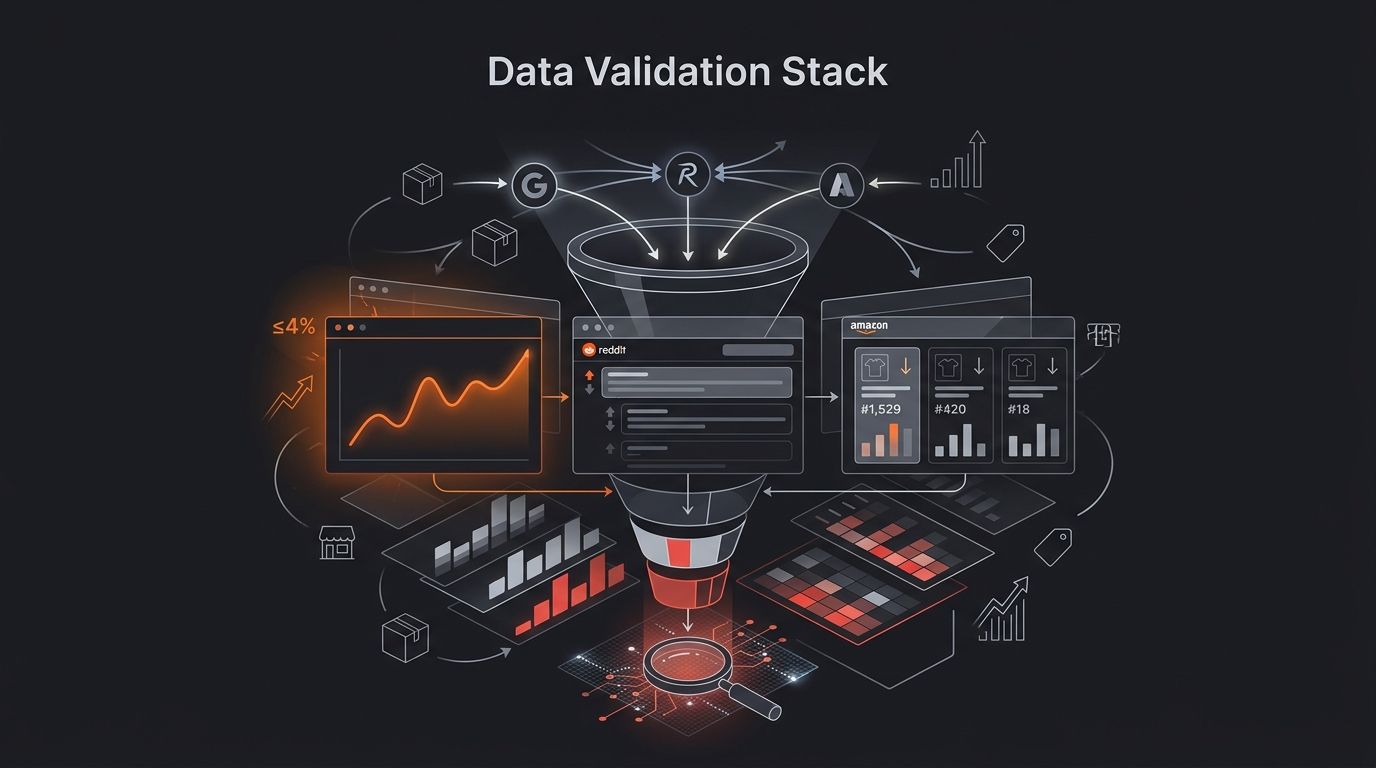
You can validate niche demand using Google Trends, Reddit, and Amazon BSR data, but validation needs to go beyond confirming that people want the product. It needs to confirm that the existing supply structure leaves room for you to sell profitably.
Where This Shows Up: The Saturated Mega-Niches
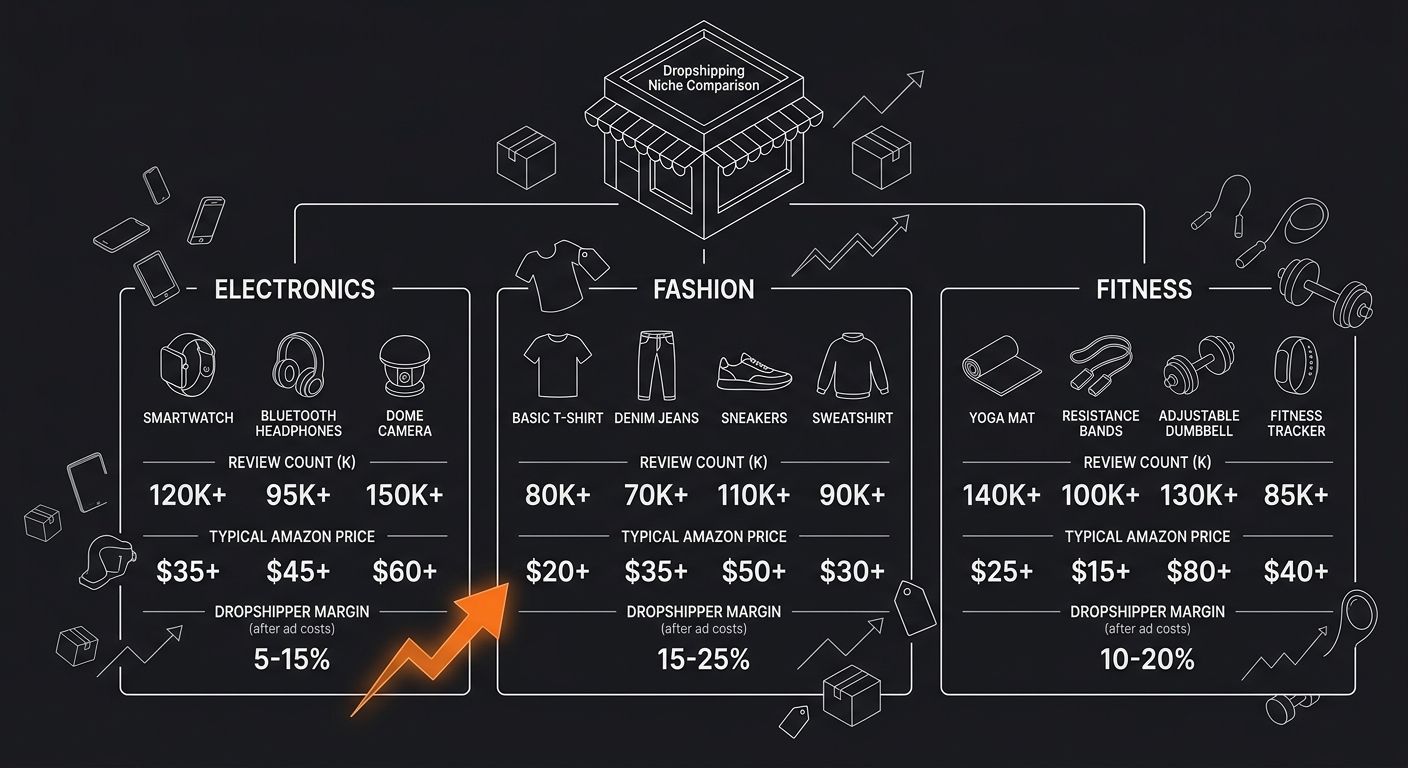
Dropshipping is heavily saturated in common niches like electronics, fashion, and fitness, according to Koala Apps' saturation analysis, making it harder for new sellers to compete. Those three categories share a pattern: each has well-funded Amazon sellers (often the brand manufacturers themselves) who dominate page one with massive review counts, aggressive pricing, and Prime fulfillment.
Take fitness resistance bands as a concrete example. The top 5 Amazon listings each carry between 15,000 and 85,000 reviews. Pricing clusters between $9.99 and $12.99 for a complete set. Your dropship cost from AliExpress or CJ for a comparable set runs $3 to $5, plus $3 to $6 shipping. That puts your landed cost at $6 to $11 before you've spent a cent on advertising. Selling at $14.99 on your own store (already more expensive than Amazon's options with zero trust signals) gives you $4 to $9 gross margin per unit. After a $6 to $12 CAC on paid social, you're losing money on every order.
USAdrop's competitive analysis puts it plainly: "For most new e-commerce sellers in 2026, dropshipping wins the first test because it lets you validate products without buying inventory; Amazon FBA wins once you already know a product can sell at volume." That volume advantage is exactly what creates the concentration ceiling. Sellers who've already validated at scale have unit economics you can't replicate with per-piece fulfillment.
How to Find Niches Where the Ceiling Doesn't Exist
The goal isn't avoiding Amazon entirely. The goal is finding categories where Amazon's top sellers haven't locked down all three axes of the Concentration Ceiling Test. Hertwill's niche selection guide recommends using Google Trends to compare sub-niche popularity, testing terms like "design swimwear" versus "sustainable swimwear" versus "functional swimwear" to find demand pockets that the dominant players haven't consolidated.
Here's what a viable niche looks like in practice:
Review Moat Depth under 500 per top seller. The top 3 Amazon listings for your keyword have fewer than 500 reviews each. That's recent enough or niche enough that trust hasn't been monopolized.
Price Band Width above 25%. When the top sellers are priced at $22, $29, and $38 for similar products, there's pricing ambiguity. Customers haven't anchored on a single expected price. Your $32 listing with better branding and a product bundle engineered for higher AOV has room.
Fulfillment Gap under 5 days. If you're working with a US-based supplier shipping in 3 to 5 business days, the speed gap against Prime shrinks enough that it's no longer the deciding factor. Comparing US suppliers against overseas fulfillment centers on landed cost shows this tradeoff clearly.
More than 27% of online stores now use the dropshipping model, which means the easy niches filled up years ago. The opportunity isn't in the broad categories. It's in the sub-niches within those categories where Amazon competition in dropshipping terms hasn't consolidated yet. Think "ergonomic left-handed scissors" instead of "scissors," or "postpartum compression wraps" instead of "shapewear."
Why CAC Compounds the Problem in Concentrated Niches
Amazon competition in dropshipping doesn't only squeeze your product margin. It inflates your advertising costs simultaneously. When 3+ Amazon dominant sellers occupy a niche, they're also running Sponsored Product ads on Amazon itself, which drives up keyword CPCs across Google Shopping and Meta as well. Branded search queries get intercepted. Review-rich Amazon listings appear in Google's organic results, stealing clicks you would otherwise capture with your Shopify store.
The result: your CAC payback period stretches far beyond what's viable for a single-purchase business model. If your gross margin per order is $8 and your blended CAC is $14, you need 1.75 purchases per customer just to break even. For a dropshipping store without a post-purchase email sequence driving repeat revenue, that repeat purchase rate stays close to zero. Amazon Sellers Lawyer warns that "if Amazon believes your FBM operation is creating a poor customer experience, Amazon may suspend listings or deactivate the entire seller account." Even sellers operating inside Amazon's ecosystem face existential risk. Operating outside it, in a concentrated niche, against those same sellers, means absorbing all of their competitive pressure with none of their platform advantages.
What Remains Unsettled
The 3-seller threshold is an operational heuristic, not a law of physics. Some niches with 4 or 5 strong Amazon sellers still have room for a differentiated DTC brand, particularly in categories where personalization, subscription mechanics, or content-driven discovery (TikTok, YouTube reviews) create demand that Amazon's search-driven model doesn't capture well. The open question is whether the fulfillment gap continues to narrow as more aggregator platforms offer 2 to 4 day US shipping, and whether that narrowing reopens niches that are currently locked behind concentration ceilings. For now, counting dominant Amazon sellers before you spend your first dollar on product sourcing remains the cheapest form of product research validation available. It takes 10 minutes, costs nothing, and saves you from entering a fight where the outcome was decided before you showed up.
365 Dropship Editorial
Editorial team writing about E-commerce, dropshipping, and product discovery — reviews of dropshipping suppliers and platforms, trending niche guides (jewelry, beauty, pets, home, fashion), supplier due diligence, ecom operations, shipping & fulfillment strategy, product research, AOV optimization, and profitable dropshipping case studies.
Related Articles
When Spy Tools Become a Liability: How Competitive Intelligence Blinds You to Sustainable Niche Selection
Spy tools trained you to pick niches your competitors already validated, which means every product you launch enters a market where margins are compressing in real time.

Niche-First Dropshipping vs. Product-First: Why 2026's Winners Are Building Around Community, Not Viral Items
Three stores selling the same viral silicone ice tray, sourced from CJ Dropshipping at $4.20 per unit, can run identical Meta ads to the same broad audience and all three will lose money.
How to Build a Niche Demand Validation Stack Using Google Trends, Reddit, and Amazon BSR Before You Source a Single Product
Novadata's 2026 Amazon BSR guide identifies subcategory rank, not main-category rank, as the actionable metric for niche competitive analysis.
Explore more topics