Your Email Post-Purchase Sequence Is Leaking Repeat Revenue: The 4 Fixes That Recover LTV for Dropshipping Stores
Post-purchase email sequences average a 59.77% open rate, the highest of any automated flow, yet most dropshipping stores treat them as order confirmations and never trigger a second purchase.
Your Email Post-Purchase Sequence Is Leaking Repeat Revenue: The 4 Fixes That Recover LTV for Dropshipping Stores
Post-purchase email sequences average a 59.77% open rate, the highest of any automated flow, yet most dropshipping stores treat them as order confirmations and never trigger a second purchase. Four structural fixes to timing, segmentation, cross-sell logic, and audience suppression recover the customer lifetime value bleeding between first and second orders.
Transactional Confirmations Are Not a Post-Purchase Sequence
The confusion starts with terminology. An order confirmation and a shipping update are transactional emails, triggered by a system event and expected by the buyer. A post-purchase email sequence is a separate, strategically timed flow designed to move a one-time buyer toward a second purchase. Hustler Marketing's retention guide states it plainly: post-purchase email "drives repeat revenue, not just confirmations." Conflating the two is where dropshipping LTV starts bleeding.
Most Shopify and WooCommerce stores have transactional emails enabled by default through the platform. This creates a false sense of coverage. Store owners see order confirmation open rates at 60%+ and assume their email marketing dropshipping setup handles retention. It doesn't. Those transactional opens carry zero cross-sell content, zero brand education, and zero review solicitation. The customer gets a tracking number and hears nothing until you retarget them with paid ads 45 days later, paying to re-acquire someone who already bought from you. When you consider that the real cost comparison between platforms already compresses margins, spending ad dollars on existing customers makes the math worse.
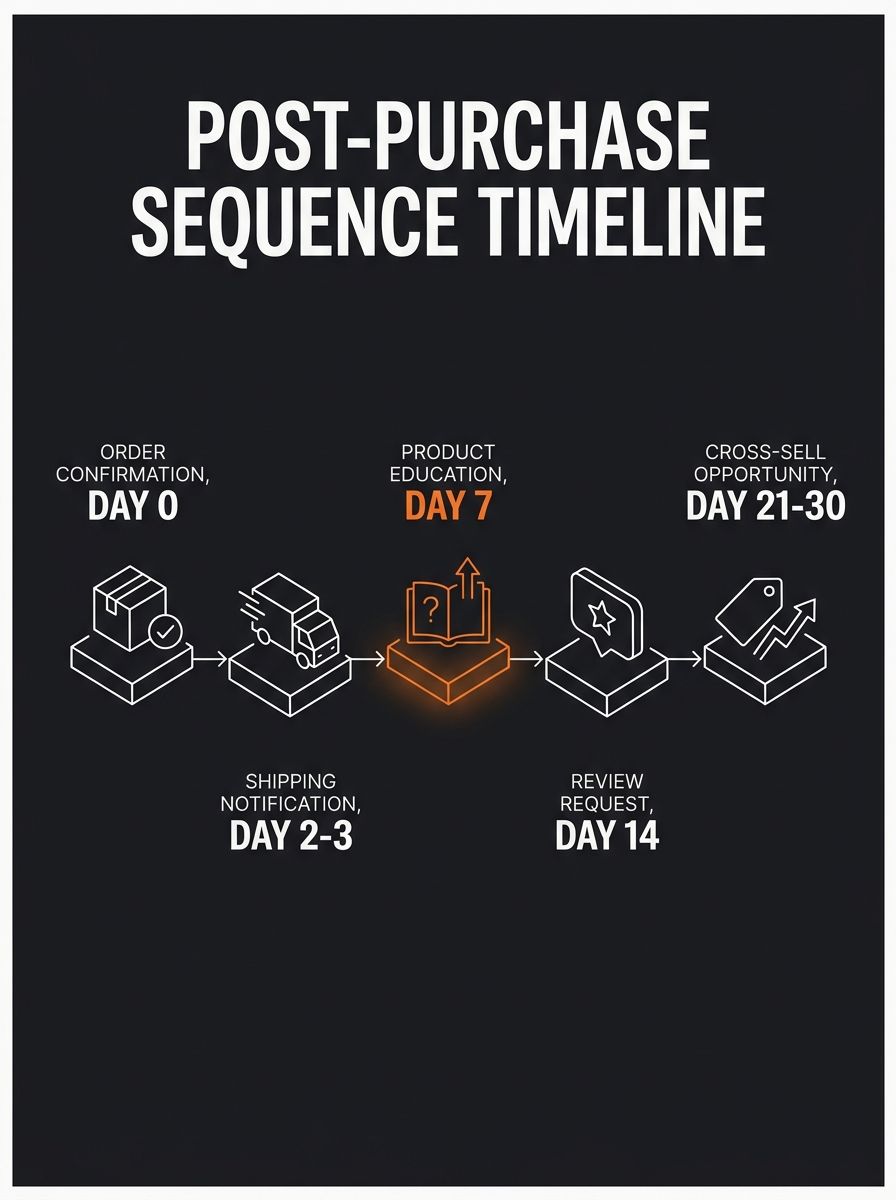
The fix is architectural. Build a dedicated post-purchase flow in Klaviyo, Omnisend, or whatever ESP you're running, triggered by the "placed order" event but separate from your platform's default transactional messages. This flow should contain five emails spread across 30 days. Email one fires immediately with order confirmation in your brand voice plus a clear return policy. Email two lands at day two or three with a shipping update that deepens brand connection. Email three arrives around day seven with product usage guidance, which reduces support tickets and returns. Email four at day 14 requests a review, timed to peak satisfaction. Email five at day 21 to 30 introduces a cross-sell framed around the outcome the buyer achieved with their first purchase.
Timing and Segmentation Failures That Destroy Repeat Purchase Rate
Why does the same five-email arc perform differently across stores? Because most implementations ignore two variables: the product's usage cycle and whether the buyer is new or returning. A skincare refill has a 45 to 60 day replenishment window. A phone case has no natural repurchase trigger at all. FluentCRM's post-purchase research explains that "the best sequence follows customer behavior, usage cycle, and buying intent." Sending a cross-sell email on day 21 for a product the customer won't finish using until day 50 wastes send volume and trains the buyer to ignore you.
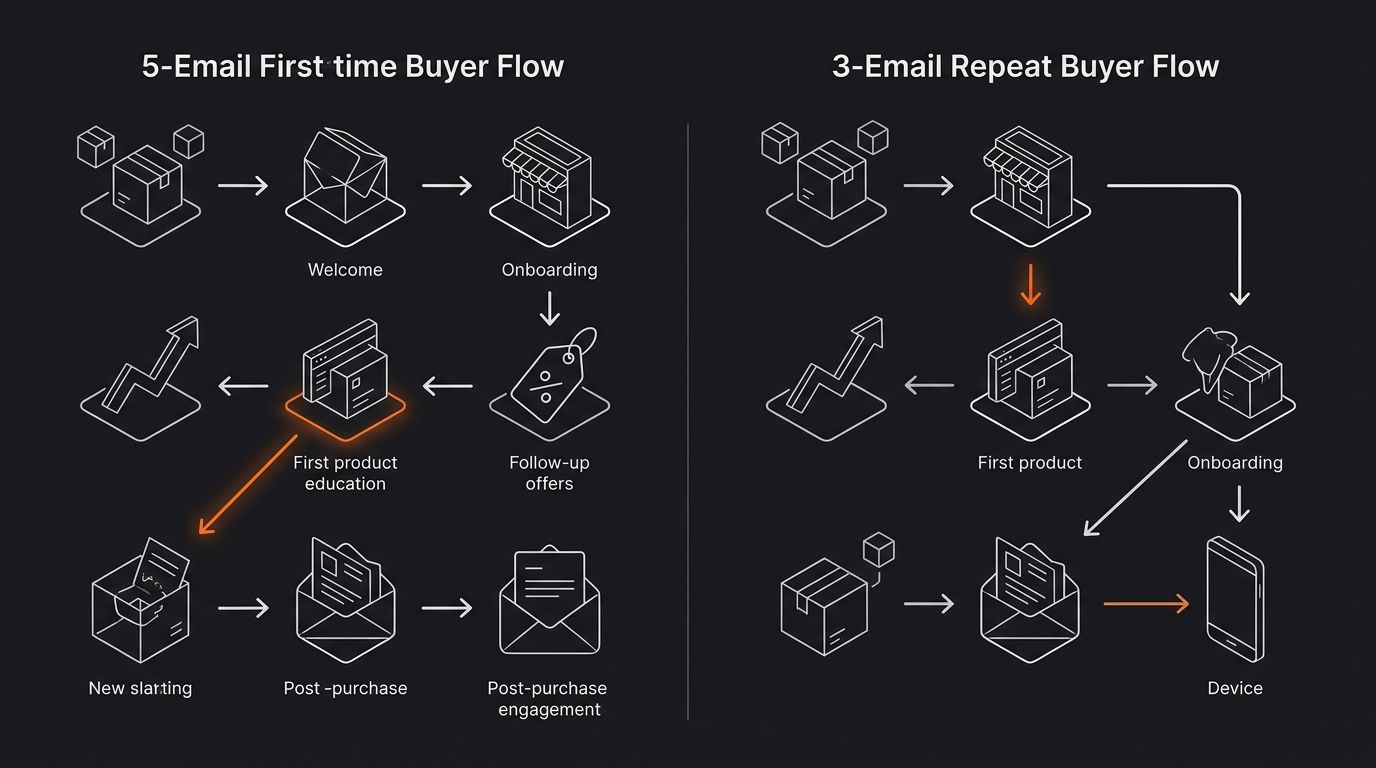
The segmentation gap compounds this. Sequenzy's retention data recommends a clear split: for repeat purchasers, "skip the brand story elements, send the review request sooner (they already trust you), and focus the cross-sell on products related to their broader purchase history." A first-time buyer needs all five emails. A returning customer should get a compressed two-to-three email path covering confirmation, shipping, and a loyalty offer. The common ecommerce retention benchmark sits around 31%, meaning roughly 69% of buyers never come back. Improving that number by even 5 percentage points with proper segmentation shifts your repeat purchase rate enough to change unit economics meaningfully.
If you're running a multi-supplier store where order routing already creates cost complexity, poor email timing on top means you're losing margin on the operational side and failing to recover it through retention. The conditional split at flow entry (first-time vs. repeat) takes about 10 minutes to configure in Klaviyo. The usage-cycle delay adjustment requires knowing your product category, but you can estimate it from return window data and customer support ticket timing. Products generating support tickets before day 7 probably need usage guidance at day 3, not day 7.
Cross-Sell Logic That Actually Moves Customer Lifetime Value
The third leak happens inside the cross-sell email itself. Most dropshipping stores pick cross-sell products manually based on what they want to move, not what the buyer's history suggests. Omnisend's research on customer lifetime value strategies found that product recommenders selecting items based on order history dramatically outperform manual selections. Amundsen Sports, a brand using order-history-based recommendations, found that nearly 1 in 3 customers who clicked their cross-sell emails converted. That's a 33% click-to-conversion rate, extraordinary compared to the 2-4% typical for broadcast promotional emails.
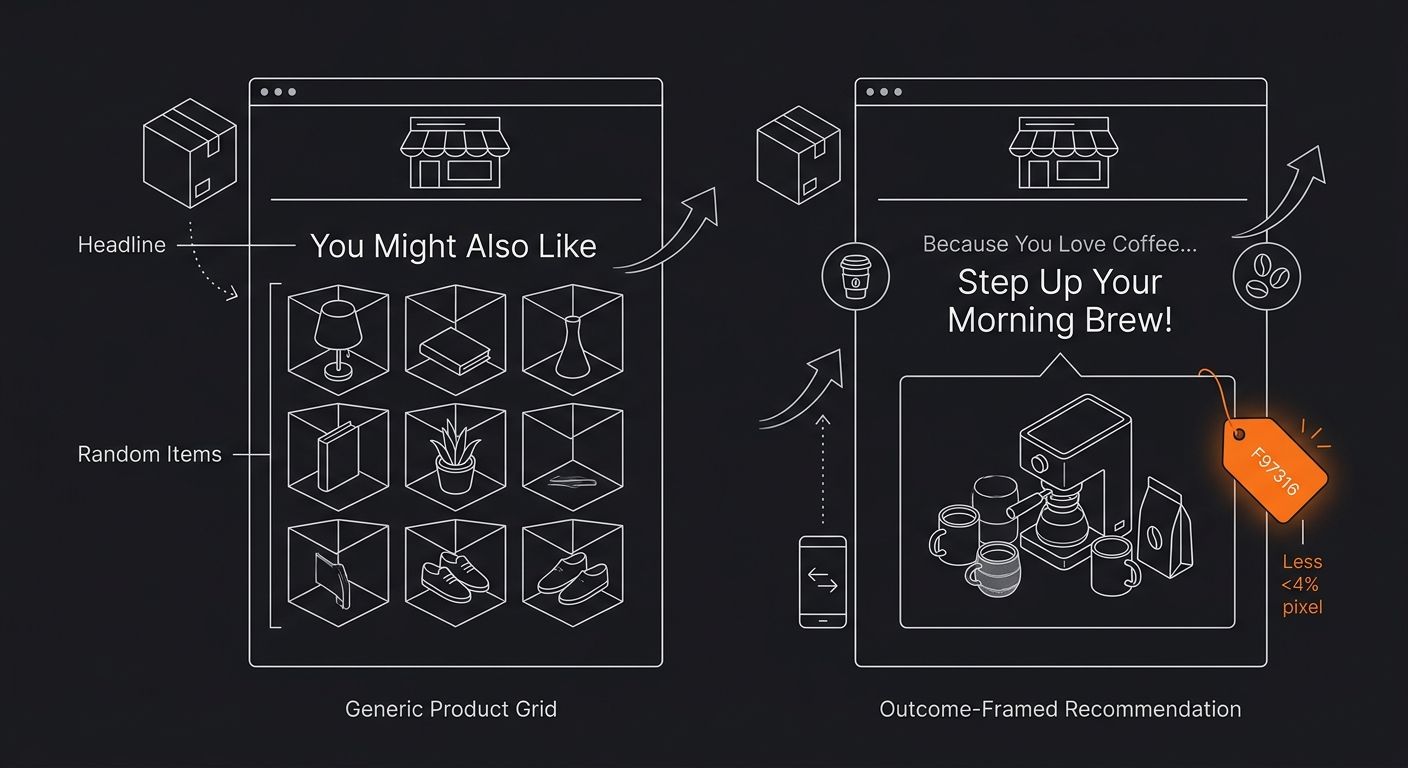
The mistake dropshippers make is thinking cross-sell means "show them another product from my catalog." Effective cross-sell in email means framing the recommendation around the outcome the buyer wanted. Someone who bought a posture corrector doesn't want "more health products." They want a desk ergonomics accessory or a foam roller, framed as the next step for the back pain relief they're already working on. Supliful's retention research captures this distinction: "Personalization makes customers feel recognized and valued, substantially increasing the likelihood of repeat purchases." The word "recognized" matters. Generic category-based recommendations feel algorithmic. Outcome-based recommendations feel like someone paid attention.
If you've already invested in building high-AOV product bundles, your cross-sell emails should reference those bundles by name. A customer who bought item A from a three-item bundle should see an email offering items B and C at a bundle discount, positioned as completing a set they already started. Brands with strong retention systems report 15-30% revenue lifts from integrated email and SMS within 90 days, and that revenue compounds without incremental acquisition costs. Your CAC payback period shrinks as repeat purchase rate climbs, because the denominator in the equation (revenue per customer) keeps growing while acquisition cost stays fixed.
The Part Nobody Wants to Hear
The product itself determines the ceiling on everything above. You can build a perfect five-email arc with proper segmentation, outcome-based cross-sells, and usage-cycle timing. But if you're selling impulse-buy gadgets with no natural repurchase trigger and no complementary product catalog, your repeat purchase rate will stay low regardless. The 31% ecommerce retention benchmark assumes a catalog deep enough to support second and third orders. Many dropshipping stores operate with 10 to 30 SKUs in a single trending niche, which means the cross-sell pool is shallow and the replenishment window may not exist.
HiFlyer Digital's analysis of LTV-driving emails captures this tension. They argue that "most emails do not increase LTV" because "they create reactions, not behavior." A well-timed, well-segmented, personalized email can create a reaction: an open, a click, maybe a conversion. But sustained behavior change, where a customer defaults to buying from you whenever they need something in your category, requires catalog depth, consistent product quality, and fulfillment reliability that many dropshipping operations struggle to maintain. If your supplier communication breaks down mid-campaign and a repeat buyer receives a worse product on their second order, no email sequence recovers that trust.
This doesn't make the four fixes worthless. A cart abandonment recovery sequence alone recovers 5-15% of abandoned carts when run as a three-email series at 1, 24, and 72 hours. Suppressing active email-flow customers from paid acquisition campaigns prevents you from paying $8-15 per click to re-acquire someone who would have converted for free from a $0.003 email send. Proactive shipping notifications and self-service return portals reduce customer service costs by 40-60%, reclaiming margin on every repeat order. These are real recoveries. But the stores that see the full 15-30% revenue lift from retention email are stores with product catalogs, brand identity, and supplier relationships built for repeat buying. For everyone else, the email sequence recovers some of what's leaking. Whether the bucket itself holds water depends on everything upstream of the inbox.
365 Dropship Editorial
Editorial team writing about E-commerce, dropshipping, and product discovery — reviews of dropshipping suppliers and platforms, trending niche guides (jewelry, beauty, pets, home, fashion), supplier due diligence, ecom operations, shipping & fulfillment strategy, product research, AOV optimization, and profitable dropshipping case studies.
Related Articles
The Niche Community Flywheel Is Overrated: Why Most Dropshippers Can't Execute the Brand-Building Playbook They Keep Reading About
Solo Brands filed its S-1 with four outdoor DTC brands and margins that, per Drivepoint's financial analysis, "blow away all other DTC brands." Content marketers cite Solo's trajectory as proof that the niche community flywheel works.
From Pandemic Pivot to Profitable Store: The Untold Operations Lessons Behind 2020-2026 Dropshipping Success Stories
COVID-era ecommerce operators who survived past 2022 share a pattern that has nothing to do with finding the right product or running the right ad. The pattern is operational: supplier onboarding speed, cash flow reinvestment discipline, and fulfillment consolidation.
Product Description Red Flags: Why Generic Manufacturer Copy Tanked Your Conversion Rate
"Premium quality material, comfortable to wear, suitable for all occasions, perfect gift for friends and family." That exact sentence, with minor word-order variations, appears across thousands of AliExpress product listings in jewelry, apparel, and home décor.
Explore more topics