Niche-First Dropshipping vs. Product-First: Why 2026's Winners Are Building Around Community, Not Viral Items
Three stores selling the same viral silicone ice tray, sourced from CJ Dropshipping at $4.20 per unit, can run identical Meta ads to the same broad audience and all three will lose money.

Niche-First Dropshipping vs. Product-First: Why 2026's Winners Are Building Around Community, Not Viral Items
Three stores selling the same viral silicone ice tray, sourced from CJ Dropshipping at $4.20 per unit, can run identical Meta ads to the same broad audience and all three will lose money. The mechanism behind that outcome is the single most important thing to understand about niche-focused dropshipping strategy right now: when you build around a product instead of a community, you're buying attention on a per-transaction basis with no compounding advantage. Niche-first operators do the opposite. They build an audience with shared interests, then select products that audience already wants. The math works differently at every stage.
How Viral Product Economics Break Down
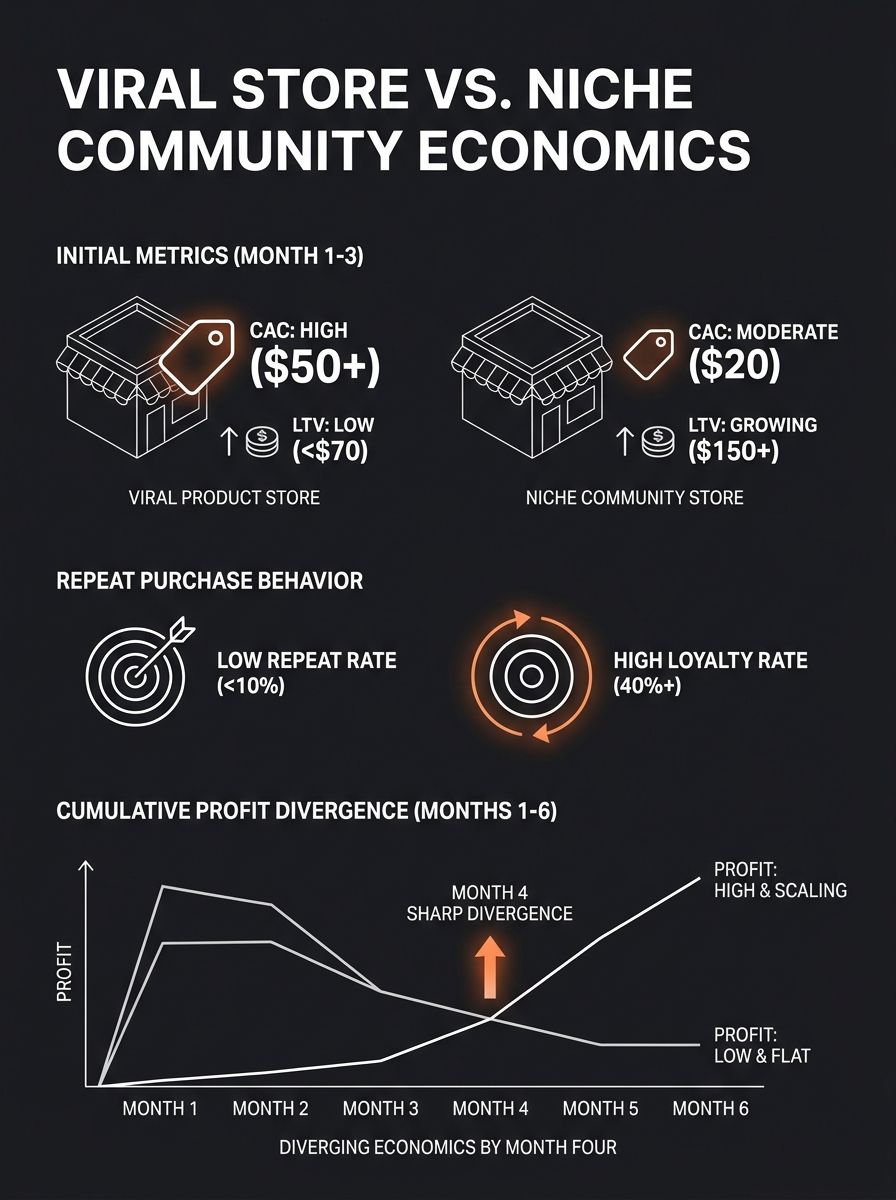
The viral product model follows a predictable cycle. A product surfaces on TikTok or Instagram Reels. Early movers see strong ROAS for 2-4 weeks. Then dozens of competitors copy the same listing, bid on the same audiences, and drive CPMs up until margins collapse.
Facebook CPM now averages $8.77. TikTok CPM ranges from $5 to $12 depending on category. If you're selling a $19.99 product with a $4.50 landed cost and spending $9-12 to acquire each customer, your contribution margin sits around $3-5 per order. That's before returns, chargebacks, and the customer support load that comes with selling to people who have no loyalty to your store.
The real killer: when the trend dies (and they all die), you start over. New product, new creatives, new ad testing budget. You're resetting your CAC learning every 30-60 days. There's no equity building between cycles.
Compare that to a store focused on, say, senior dog wellness products. The audience doesn't evaporate when one product trends down. You already know who they are, what they care about, and how to reach them.
The Acquisition Cost Flywheel
A niche-focused store reduces customer acquisition cost over time. A product-focused store does not. That distinction is the core mechanism worth understanding.
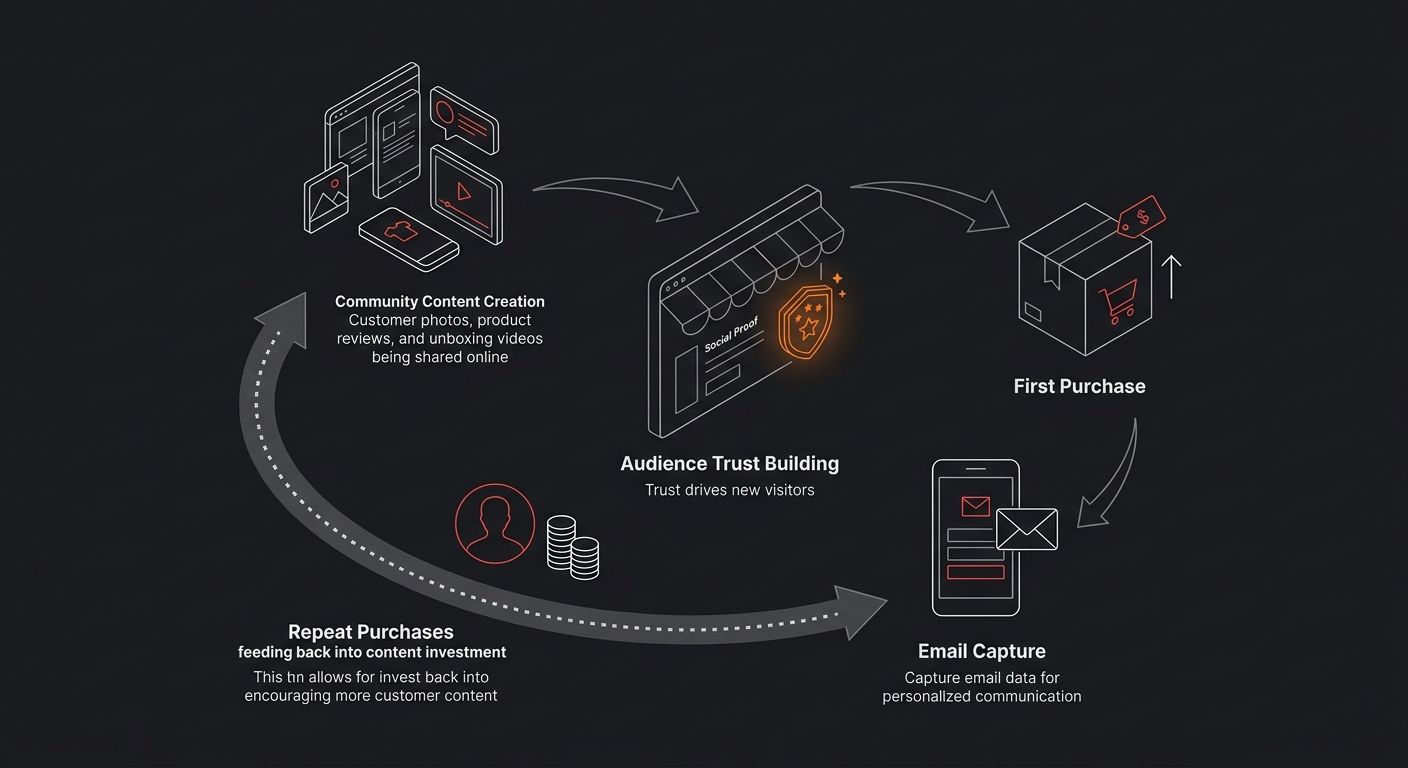
Here's how it works. When you sell to a defined community — EV owners, apartment gardeners, parents of kids with sensory needs — every piece of content you create, every email you send, every review you collect compounds. Your SEO improves because search engines reward topical depth. Your ad targeting improves because your pixel data reflects a coherent audience profile instead of random buyers of random products.
According to Zendrop's analysis of top-performing niches, categories with consistent demand, strong branding potential, and repeat purchase behavior like beauty, wellness, and pet care outperform trend-chasing stores when sellers focus on differentiation rather than price competition.
This flywheel effect means your CAC drops as your store ages. A six-month-old niche store with 200 product reviews, 15 blog posts about senior dog nutrition, and a 4,000-person email list will acquire customers at 40-60% less than a brand-new store targeting the same audience. The trust signals embedded in authentic product reviews do real conversion work that paid ads alone cannot replicate.
And here's what most operators miss about community-driven product selection: your community tells you what to sell next. Reddit threads, Facebook group discussions, TikTok comments are free product research. You don't need to guess which product to test. Your audience is already describing the problems they want solved.
Repeat Purchases as Margin Insurance
The AOV conversation in dropshipping usually focuses on upsells and bundles. Those matter. But the more important number for niche-first stores is purchase frequency.
A customer who buys a trendy LED lamp for $24.99 has maybe a 3-5% chance of buying from you again. There's no reason for them to come back. They don't remember your store name.
A customer who buys grain-free senior dog treats from a store called something like "GoldenYears Pet Co" — a store with educational content about aging dogs, a loyalty program, and curated products for older pets — has a 25-35% chance of buying again within 90 days. Pet owners spend consistently. Beauty and wellness buyers behave similarly, especially when UGC creates social proof loops that keep bringing people back to the same brand.
That repeat purchase rate transforms your unit economics. If your first-order contribution margin is $5, but your average customer buys 2.4 times over 12 months, your actual customer value is $12. You can afford to pay $8-10 for acquisition and still run profitably, a number that would bankrupt a one-and-done viral store.
The contribution margin framework makes this distinction brutally clear: two products generating the same revenue per order can deliver wildly different profits once you account for repeat purchase rates and lifetime value.
Content and Community Replace Ad Dependency
The 2026 dropshipping trends worth paying attention to aren't about which products to sell. They center on how you acquire customers without bleeding money on paid channels.
Social commerce — where purchasing decisions happen inside community spaces — now accounts for a growing share of ecommerce transactions. The model depends on high engagement, visual storytelling, and community-driven purchasing decisions. A niche store built around a specific audience plugs directly into this dynamic.
Practical example: an operator running a store focused on standing desk accessories for apartment dwellers creates TikTok content showing small-space office setups. Each video costs nothing but time. The audience self-selects. Viewers who engage are exactly the people likely to buy cable management trays, monitor risers, and ergonomic footrests. According to Entrepreneur's analysis of micro-niches, these hyper-specific audiences build stronger loyalty than broad market targeting because the content speaks directly to their exact situation.
This is where audience-first store building creates a structural advantage over product-first approaches. Your content works as an organic acquisition channel. Your email list (built through guides, quizzes, or free resources related to the niche) gives you a zero-cost remarketing tool. Your Reddit presence and Facebook group participation generate referral traffic.
None of this works if your store sells random trending products to random people. The content has no coherent theme. The email list has no shared interest. The community doesn't exist.
When you pair organic acquisition with paid ads as an accelerant rather than a lifeline, the blended CAC drops substantially. Operators running niche research using Reddit, TikTok, and SEO data as reverse demand indicators are finding pockets of demand that paid keyword tools completely miss.
How to Pick the Right Niche Without Overthinking It
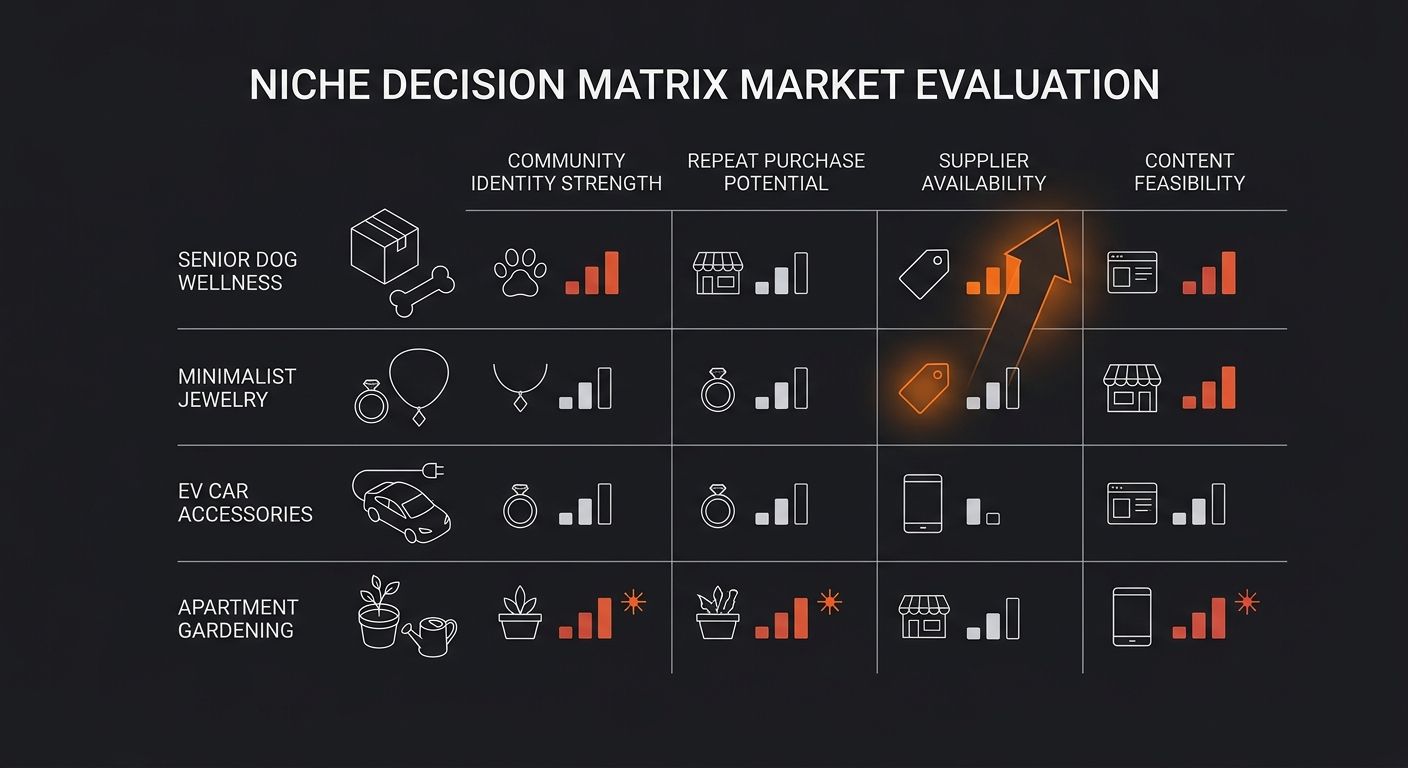
The viral products vs. niche positioning debate often stalls at niche selection. People spend weeks evaluating markets and never launch. Here's the filter that actually matters:
Does the audience self-identify? If people put it in their Instagram bio, wear it on a t-shirt, or join Facebook groups about it, there's community potential. "Dog owner" is too broad. "Greyhound rescue parent" has a real community.
Are there at least 3 consumable or replaceable products? You need repeat purchase potential. Durable goods without accessories or refills create one-time buyers. Beauty, pet, wellness, and hobby niches naturally have consumable product lines.
Can you find multiple reliable suppliers? A single-supplier niche is fragile. The supplier vetting process should confirm at least two backup sources before you commit.
Do you have (or can you quickly develop) credible knowledge? You don't need to be an expert on day one, but if you can't write a useful 500-word blog post about the topic without faking it, your community will sense the gap immediately.
EComposer's research on emerging niches reinforces this: stores that enter specific niches early build trust before larger players move in, creating a defensible position that's hard to replicate with ad spend alone.
Where the Niche-First Model Breaks
This approach has real limitations, and ignoring them will cost you.
Speed to first sale is slower. A viral product store can generate revenue in 48 hours with the right ad and a trending product. A niche-first store typically needs 2-4 weeks of content and audience building before sales become consistent. If you're working with less than $1,000 in starting capital, that lag can be painful. Understanding the full cost structure including shipping and tariffs before launch helps you set realistic runway expectations.
Niche selection mistakes are expensive. Picking the wrong niche means rebuilding from scratch. A product-first operator can pivot daily. A niche-first operator who spent eight weeks building content around a dead-end market has sunk real time. The mitigation is straightforward: validate demand before building, using the filter above.
Scaling has a ceiling. A niche store focused on greyhound rescue accessories might max out at $15,000-$25,000/month in revenue simply because the addressable market is small. You can expand into adjacent niches (all sighthound breeds, then all rescue dogs), but that expansion needs to feel authentic to the community or you'll lose the trust advantage that made the model work in the first place.
Content creation is ongoing labor. The organic acquisition flywheel only spins if you keep feeding it. Two blog posts per week, three TikToks, one email campaign. If you stop, the flywheel decelerates within 60-90 days. Anyone who frames this as passive income is selling you a course.
The niche-first model works because it trades short-term speed for long-term compounding. Every month you operate, your acquisition gets cheaper, your customer base gets stickier, and your product selection gets smarter. The viral model offers the opposite tradeoff: fast starts that reset to zero. For operators willing to invest the upfront time and accept a slower ramp, the compounding math wins decisively by month six and the gap only widens from there.
365 Dropship Editorial
Editorial team writing about E-commerce, dropshipping, and product discovery — reviews of dropshipping suppliers and platforms, trending niche guides (jewelry, beauty, pets, home, fashion), supplier due diligence, ecom operations, shipping & fulfillment strategy, product research, AOV optimization, and profitable dropshipping case studies.
Related Articles
When Spy Tools Become a Liability: How Competitive Intelligence Blinds You to Sustainable Niche Selection
Spy tools trained you to pick niches your competitors already validated, which means every product you launch enters a market where margins are compressing in real time.

The Niche Community Flywheel Is Overrated: Why Most Dropshippers Can't Execute the Brand-Building Playbook They Keep Reading About
Solo Brands filed its S-1 with four outdoor DTC brands and margins that, per Drivepoint's financial analysis, "blow away all other DTC brands." Content marketers cite Solo's trajectory as proof that the niche community flywheel works.

Why I'd Never Launch a Dropshipping Store in a Niche With More Than 3 Dominant Amazon Sellers
Three Amazon sellers with 1,000-plus reviews each, all ranking on page one for the same product keyword at comparable prices, create a pricing floor that no independent dropshipper's margin can survive.
Explore more topics