TikTok Shop, Amazon, and Shopify Deliver Different Profit Profiles for DTC Brands, Avenue Z Analysis Finds
Avenue Z's June 10 platform analysis concludes that no single eCommerce channel delivers universal profitability for DTC brands, positioning TikTok Shop for low-acquisition trendy products, Amazon for high-intent search volume, and Shopify for margin control and customer data ownership, according to

TikTok Shop, Amazon, and Shopify Deliver Different Profit Profiles for DTC Brands, Avenue Z Analysis Finds
Avenue Z's June 10 platform analysis concludes that no single eCommerce channel delivers universal profitability for DTC brands, positioning TikTok Shop for low-acquisition trendy products, Amazon for high-intent search volume, and Shopify for margin control and customer data ownership, according to a comparative report published by the digital agency.
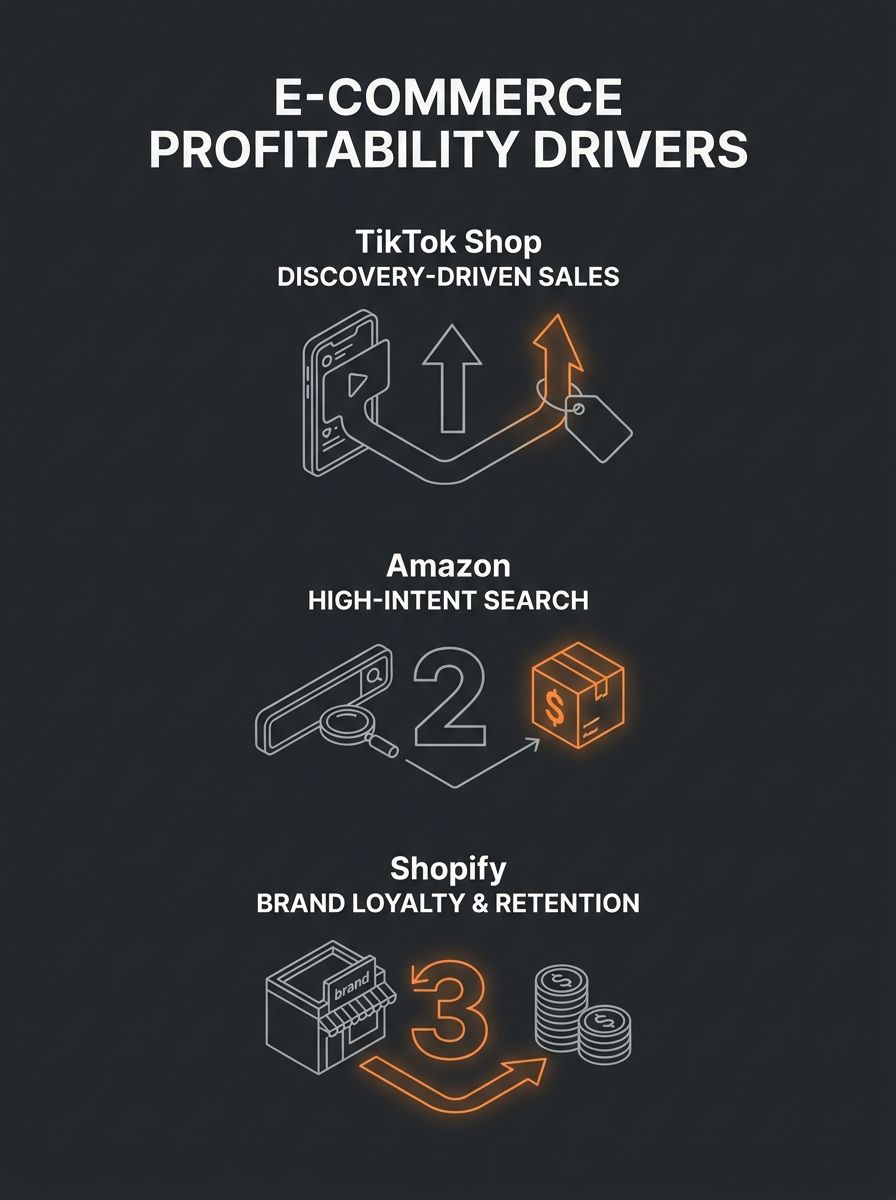
The analysis segments platform performance by business model rather than declaring a single winner. TikTok Shop suits brands selling visually demonstrable or trend-driven products with content production capacity, the report states. Amazon captures purchase-ready shoppers searching for products with recurring interest and proven demand. Shopify serves established brands prioritizing customer data ownership, customized checkout experiences, and full-funnel marketing control.
Three Distinct Discovery and Conversion Models
TikTok Shop operates as a social commerce platform where sales occur impulsively through videos, livestreams, and creator content rather than pre-existing purchase intent, according to the Avenue Z breakdown. The platform requires strong content creation to drive conversions, making it best suited for brands capable of storytelling and collaborating with influencers to build social proof quickly among Gen Z shoppers.
Amazon functions as an intent-driven marketplace where ready buyers directly search for products and compare options across sellers based on price and reviews. The analysis positions Amazon for brands seeking to capture bottom-funnel demand, maximize marketplace exposure to a broad audience, and use high search visibility for high-volume sales of products with established interest.
Shopify delivers a brand-led shopping experience where consumers land directly on a branded website rather than discovering products through algorithmic feeds or marketplace search. Brands on Shopify depend on SEO, paid ads, email marketing, and social media to drive traffic, the report notes, making the platform most suitable for long-term brand building, subscription businesses, and premium positioning requiring full customization and differentiation.
Profitability Breakdown by Platform and Business Type
Low customer acquisition cost brands selling trendy products tend to perform best on TikTok Shop, the analysis states, though revenue consistency depends heavily on content performance and algorithmic distribution. The platform enables rapid product testing and impulse-driven sales without the technical setup and paid ad expertise required by independent storefronts.
High-volume sellers with proven product demand typically see stronger results on Amazon due to the marketplace's heavy traffic and relatively consistent conversion rates, according to the report. Competition intensity and seller fees—including referral fees, fulfillment charges, and advertising costs—compress margins compared to owned channels, but the built-in audience reduces acquisition costs for search-visible products.
Established DTC brands with developed retention strategies and long-term profit potential align with Shopify's ecosystem, which grants maximum control over pricing and margins, the Avenue Z analysis concludes. The platform's lack of built-in audience requires brands to pay for traffic through ads and marketing efforts, raising acquisition costs but preserving customer data ownership and enabling subscription models and customized checkout flows that improve CAC payback periods.
TikTok Shop's Low-Barrier Entry and Validation Speed
TikTok Shop stands out for combining creativity with algorithmic consumer exposure that can keep customer acquisition costs low and accelerate product validation, the report states. The platform's focus on storytelling, creator influence, visual appeal, and virality creates a lower barrier to effective marketing compared to the funnel optimization skills, technical setup, and testing budgets that Shopify requires.
The analysis quotes industry observations that most brands believe TikTok Shop demands large teams, budgets, and plans, when in practice the platform allows smaller operators to test products and build social proof quickly. The entertainment-meets-eCommerce strategy differentiates TikTok Shop from search-driven marketplaces and owned storefronts, making it particularly effective for impulse purchases of visually demonstrable items.
The report notes that TikTok Shop's revenue consistency remains dependent on content performance and platform algorithm changes, creating higher variability than Amazon's search-driven traffic or Shopify's owned audience retention loops. Brands treating TikTok Shop as a validation and acquisition channel rather than a sole revenue source can use the platform's low entry costs while building more stable income streams through owned channels.
Context and Outlook
The three-platform comparison reflects a broader shift in DTC strategy from single-channel dependence to multi-platform portfolio management, where operators match product characteristics and business maturity to platform economics. Brands launching trend-driven products in 2026 face lower barriers to testing on TikTok Shop than in previous years when owned storefronts required upfront investment in traffic acquisition before validating demand. That testing capacity has practical implications for dropshipping operators evaluating niche demand before sourcing inventory, since social commerce platforms compress the time and cost to reach first sales.
The analysis positions Shopify's margin control advantage against the acquisition cost burden of driving cold traffic to an owned domain—a trade-off that favors established brands with retention mechanics and email lists over new entrants testing products. Amazon's middle position captures high-intent shoppers at volume but introduces marketplace competition and fee structures that compress per-unit profit compared to direct sales. The report's "no single winner" conclusion pushes DTC operators toward platform sequencing strategies: validate on TikTok Shop, scale volume on Amazon, build owned retention on Shopify. That sequencing aligns with the operational reality that TikTok Shop and Shopify deliver different margin profiles depending on product lifecycle stage and customer acquisition channel maturity.
Independent operators choosing initial platforms in 2026 should assess whether their products sell through demonstration or search, whether they can produce content at the velocity TikTok Shop requires, and whether their unit economics support the paid traffic costs Shopify demands before organic channels mature. The Avenue Z framework treats platform selection as a product-model fit question rather than a universal ranking, giving dropshippers and DTC founders a decision matrix tied to operational capabilities and margin targets instead of platform popularity or feature sets.

Ryan Torres
Ryan Torres is a former Amazon FBA seller turned dropshipping consultant who has generated over $2.8M in ecommerce revenue across 14 product launches. He specializes in supplier vetting, margin optimization, and scaling DTC operations for sub-$1M brands. Ryan focuses on actionable frameworks that drive measurable results for independent operators.
Related Articles

Avenue Z Breaks Down TikTok Shop Fulfillment Models by Cost and Algorithm Impact
Avenue Z published a TikTok Shop fulfillment model comparison June 18 analyzing cost and speed tradeoffs across three operational paths—Fulfilled by TikTok (FBT), third-party logistics (3PL), and in-house fulfillment—with explicit guidance tying each model to order volume and the platform's algorith
TikTok Shop High-Ticket Sales Surge as Above-Ground Pools Climb 125% Year-Over-Year
Above-ground pools and spas sold through TikTok Shop posted 125% year-over-year growth in the past 12 months, five times the rate of other marketplaces, according to data shared by Spreetail, a multi-brand seller and fulfillment partner on the platform.

TikTok Shop Captures 67% of Product Discovery Traffic as Small Business Sales Jump 66% Year-Over-Year
TikTok Shop captured 67% of consumers seeking product discovery in 2025, according to GlobalData research commissioned by the platform and published May 19, 2026. The finding positions TikTok Shop ahead of Amazon, physical stores, and YouTube as a discovery channel, with small businesses driving 72%
Explore more topics