When Spy Tools Become a Liability: How Competitive Intelligence Blinds You to Sustainable Niche Selection
Spy tools trained you to pick niches your competitors already validated, which means every product you launch enters a market where margins are compressing in real time.
When Spy Tools Become a Liability: How Competitive Intelligence Blinds You to Sustainable Niche Selection
Spy tools trained you to pick niches your competitors already validated, which means every product you launch enters a market where margins are compressing in real time. The standard playbook of scraping competitor stores, tracking their best-sellers, and copying their product mix produces a race to the bottom that rewards speed over sustainability.
Spy Data Shows You Where Competitors Already Are, Not Where Profit Will Be
Why does every spy tool user end up selling the same 200 products? Because the tools are architecturally designed to surface what's already working at scale. They index ads, track store revenues, and rank products by order volume. Every metric points backward.
According to Salsify's ecommerce research guide, companies that skip foundational market analysis risk misallocating resources and missing key growth opportunities. That risk compounds when your entire product selection process depends on what other sellers already proved viable. You aren't discovering demand. You're confirming someone else's bet after the odds have shifted.
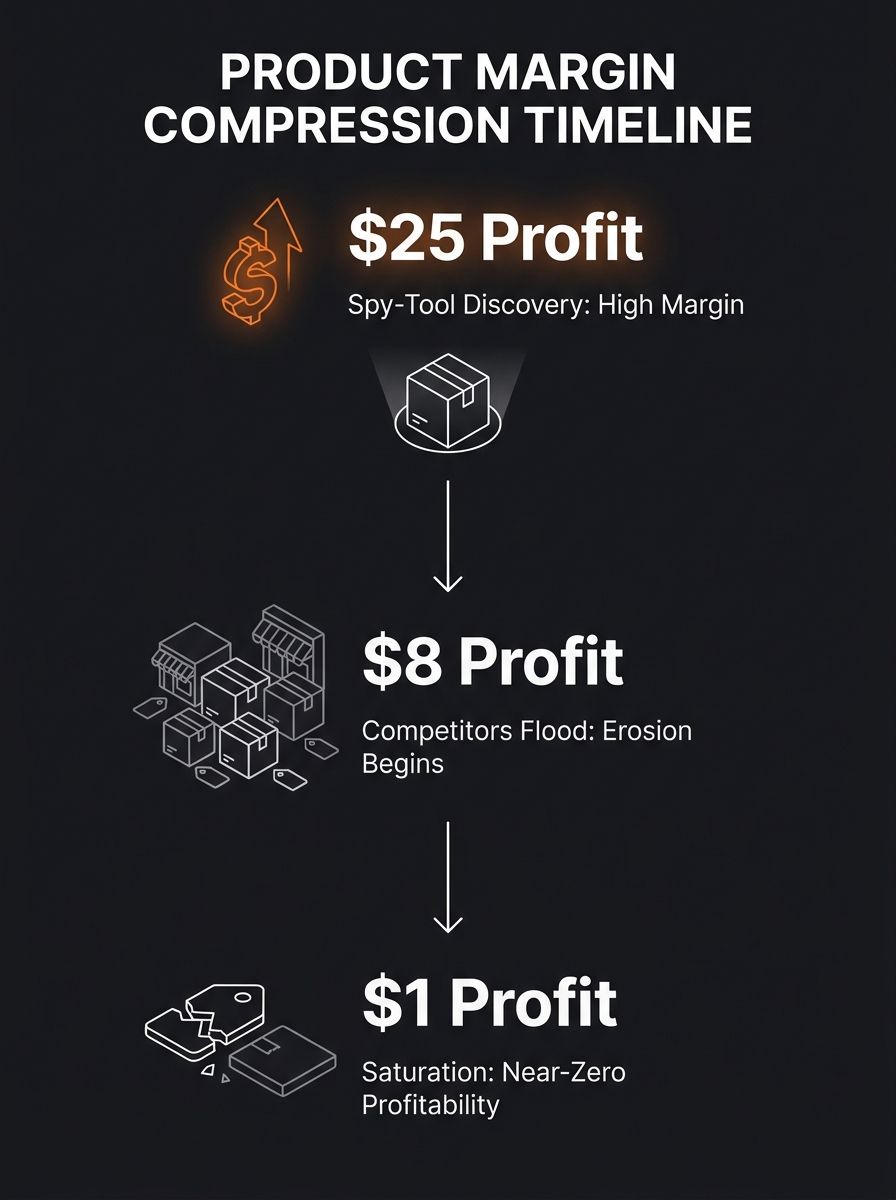
Here's the margin math. A spy tool surfaces a pet grooming glove selling 4,000 units/month across 12 tracked stores. You source it at $2.10 from CJ, sell at $14.99, and run Facebook ads at a $12 CPM. By the time you launch, 30+ other spy tool users have spotted the same product. Ad costs climb because you're all bidding on overlapping audiences. Your blended CPA jumps from $6 to $11 within three weeks. Contribution margin per unit drops from $6.89 to $1.89. The product looked profitable in the spy tool dashboard. It stopped being profitable the moment everyone saw the same dashboard.
Dropified's 2026 niche profitability analysis confirms that sustainable niches require strategic selection based on data-driven research, margin analysis, and understanding micro-audience behavior. The distinction matters here: data-driven research starts with the customer. Spy tools start with the competitor. Those two starting points lead to radically different stores.
Product Research Blind Spots Live in the Gap Between Visibility and Validation
Competitor analysis tools excel at telling you what products exist. They tell you nothing about whether a market segment is growing, stable, or already past peak demand. This creates product research blind spots that cost real money, and the tools themselves obscure the problem because their dashboards look so complete.
Catalant's research on traditional market research blind spots documented how one investment firm solved a parallel problem by building a quarterly survey that established a purchasing baseline, measured changes over time, and captured the reasoning behind buyer shifts. That continuous feedback loop let them adjust strategy before trends fully materialized. Dropshippers can build a stripped-down version of this approach using Google Trends sustained-demand checks (as recommended by Carro's niche research methodology), Reddit community monitoring, and direct customer survey tools like Respondent or Typeform.
Steve Jobs stated the core problem plainly: "You can't look at the competition and say you're going to do it better. You have to look at the competition and say you're going to do it differently." The dropshipping version of this principle is that copying a competitor's winning product puts you in their game on their terms, where they already own the audience relationships, ad data, and supplier pricing tiers you'd need to compete.
Consider the difference between two niche entry strategies. Seller A uses a spy tool, finds that bamboo phone cases are trending, sources them at $1.80, and launches with generic product descriptions. Seller B reads 200 one-star reviews of existing bamboo cases, discovers that buyers complain about cracking at the camera cutout within two months, finds a supplier offering reinforced-corner bamboo cases at $2.60, and writes product descriptions addressing the durability problem directly. Seller B's unit cost is 44% higher. Their return rate is 60% lower. Their repeat purchase rate is 3x Seller A's. After 90 days, Seller B's contribution margin per customer is $22.40 versus Seller A's $4.10.
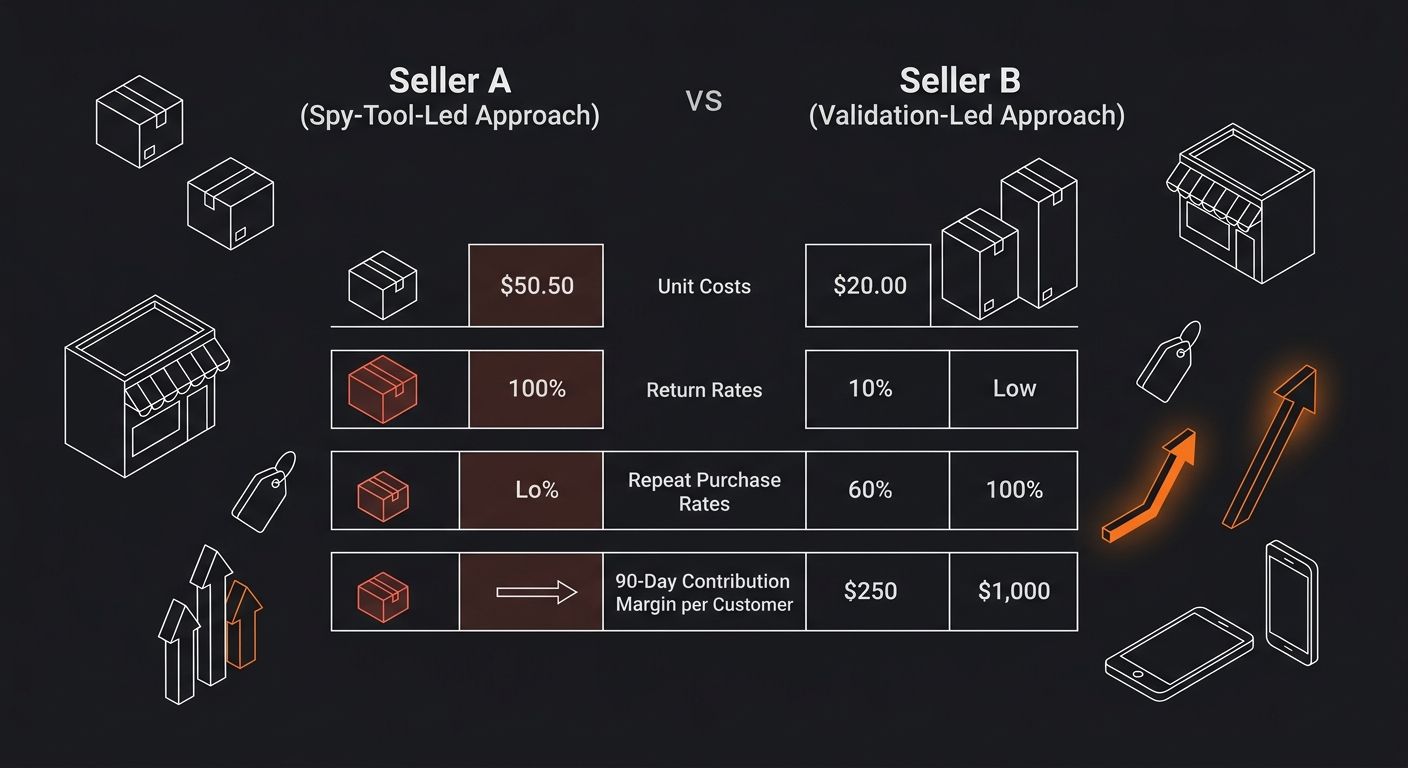
That gap widens over time because Seller B built something a spy tool can't detect: product-market fit informed by actual customer pain points. If you've been auditing your reviews for operational blind spots, you already have the raw material for this kind of research sitting in your inbox.
Market Segmentation for Dropshippers Requires Layers Spy Tools Can't See
The third piece of evidence against spy-tool dependence is structural. Spy tools operate at the product level. Profitable niche selection operates at the segment level. These are different units of analysis, and confusing them leads to stores built around trending items rather than cohesive customer groups.
Optimizely's segmentation guide explains that machine learning now reveals "hidden patterns and more granular customer segments that would otherwise go unnoticed," enabling marketers to "move beyond chunky demographic buckets" into highly specific, actionable groups. For dropshippers, this means the real opportunity sits in micro-audiences: left-handed guitar accessories, postpartum fitness equipment for C-section recovery, or fair-trade coffee blends targeting ethical consumers who also want single-origin varietals.
Finn Partners' research on using segmentation to decode competitor strategy argues that effective market segmentation requires "market mapping, qualitative audits, perception studies, and performance benchmarking." None of these inputs come from a spy tool. They come from direct engagement with the market: reading forums, surveying potential buyers, analyzing review sentiment, and mapping the purchase decision process for a specific customer type.
Niche research beyond competitor analysis follows a different workflow entirely. Instead of "what's selling," the question becomes "who's underserved." Building a store around community rather than viral items is the structural advantage that survives ad cost fluctuations, seasonal demand shifts, and competitor entry. When you've done the work of planning around seasonal demand patterns for a specific audience, you're operating with information no spy tool indexes.
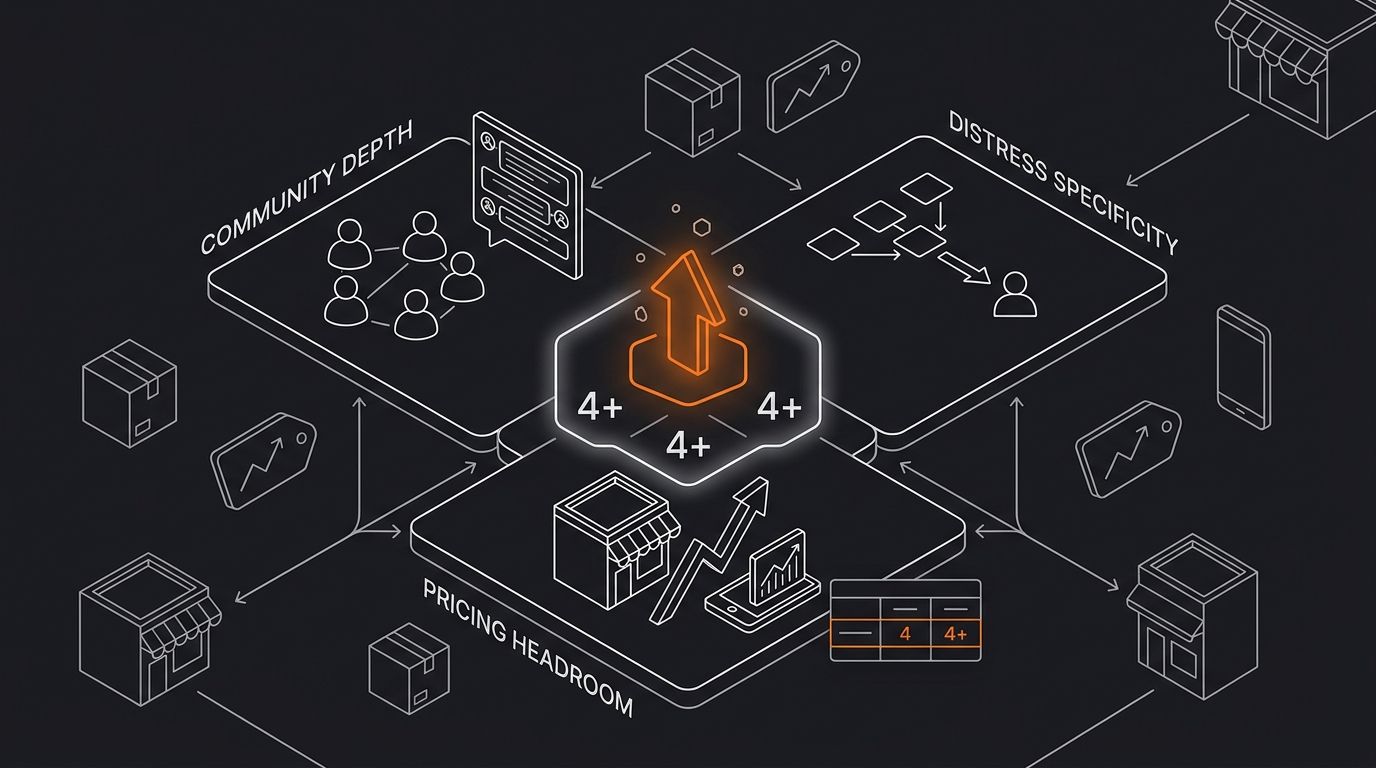
Here's a practical segmentation framework I'll call the CDP Score (Community, Distress, Pricing) for evaluating niche viability without spy tools. Score each potential niche on three axes:
Community depth: Does an active online community exist (50,000+ combined members across Reddit, Facebook groups, Discord servers) where members discuss purchasing decisions? Score 1-5.
Distress specificity: Can you identify 3 or more recurring complaints about existing products in reviews and forums? Score 1-5.
Pricing headroom: Does the category support a 3x+ markup from landed cost (including tariffs, which you can model using a true unit cost calculator) while staying under $50 retail? Score 1-5.
A combined score of 12+ signals a niche worth validating further. A score below 9 means the niche either lacks community demand, has commoditized products, or doesn't support the margins you need.
Evaluation Axis | What It Measures | Data Source | Minimum Threshold |
|---|---|---|---|
Community depth | Active buyer discussions | Reddit, Facebook, Discord | 50,000+ combined members |
Distress specificity | Recurring product complaints | Amazon/Trustpilot reviews | 3+ distinct pain points |
Pricing headroom | Markup from landed cost | Supplier quotes + tariff model | 3x minimum markup |
The Claim, Revisited
Spy tools remain useful for one narrow purpose: confirming that a market exists and that products within it can move volume online. They answer "is anyone buying this?" and nothing more. The moment you use them to answer "what should I sell," you've crossed from market confirmation into competitive imitation.
Promodo's ecommerce competitive analysis research warns that many companies rely on gut feeling or assumptions instead of systematic approaches, creating dangerous blind spots. The irony is that spy tools feel systematic. They produce dashboards, charts, and ranked lists. But the system they reflect is someone else's strategy, already priced into the market by the time you see it.
The dropshipping spy tools limitations are real and quantifiable. Every product surfaced by a popular tool carries an invisible tax: the compressed margins that result from dozens of sellers entering the same space within weeks. Market segmentation for dropshippers built around community depth and distress specificity, honest product research that starts from customer complaints rather than competitor revenues, and validation workflows that test willingness-to-pay before you commit inventory budget: these are the inputs that build stores with staying power. The spy tool shows you the race. It doesn't tell you whether that race is still worth running by the time you lace up.
365 Dropship Editorial
Editorial team writing about E-commerce, dropshipping, and product discovery — reviews of dropshipping suppliers and platforms, trending niche guides (jewelry, beauty, pets, home, fashion), supplier due diligence, ecom operations, shipping & fulfillment strategy, product research, AOV optimization, and profitable dropshipping case studies.
Related Articles
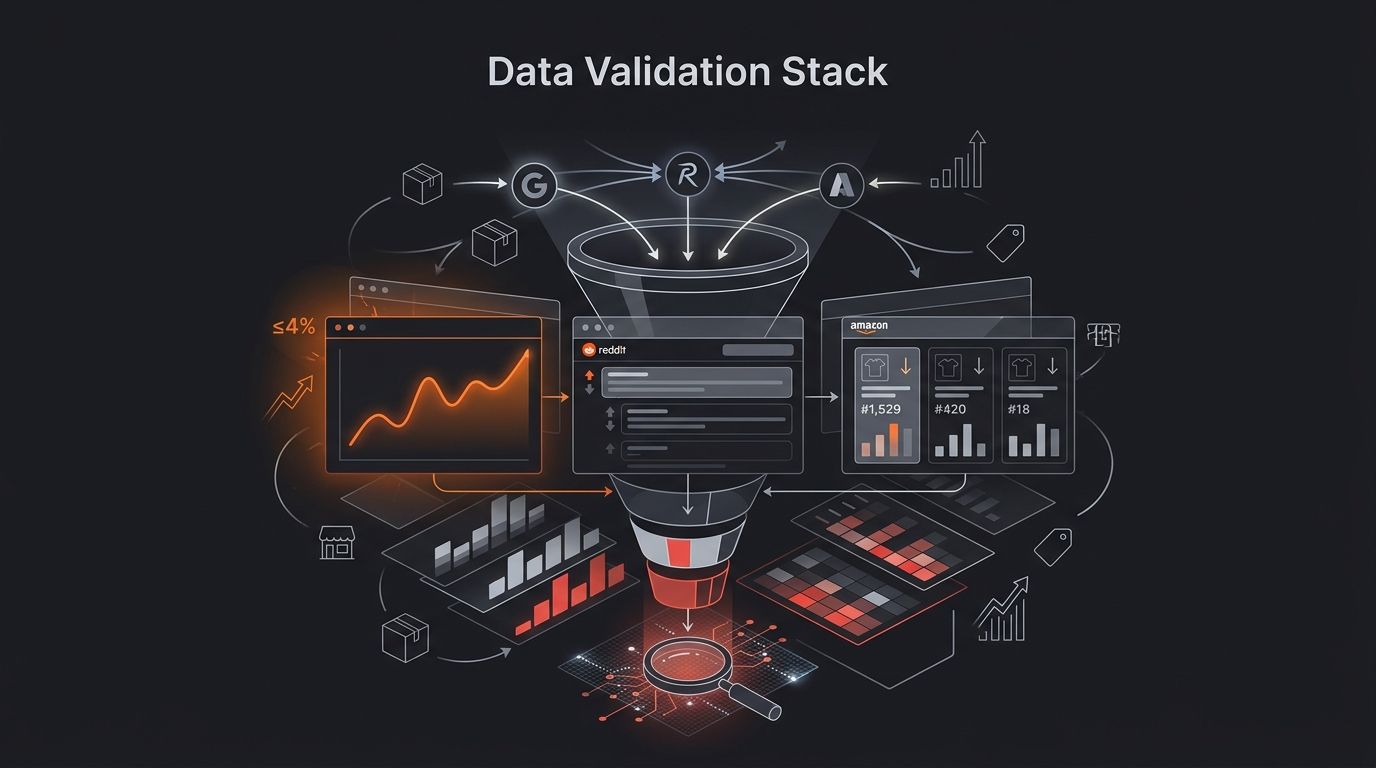
How to Build a Niche Demand Validation Stack Using Google Trends, Reddit, and Amazon BSR Before You Source a Single Product
Novadata's 2026 Amazon BSR guide identifies subcategory rank, not main-category rank, as the actionable metric for niche competitive analysis.

Niche-First Dropshipping vs. Product-First: Why 2026's Winners Are Building Around Community, Not Viral Items
Three stores selling the same viral silicone ice tray, sourced from CJ Dropshipping at $4.20 per unit, can run identical Meta ads to the same broad audience and all three will lose money.
Why Your Product Research Is Producing Low-Margin Losers: 6 Validation Mistakes and How to Correct Them
80/20 Sourcing's product selection analysis names tool-dependent research as the top mistake that sinks ecommerce businesses before they ship a first order.
Explore more topics