Building a Backup Supplier Network: The Insurance Policy Every Dropshipper Overlooks
A backup supplier you've never routed a live order through is functionally identical to having no backup at all. The spreadsheet of "alternative vendors" sitting in your Google Drive doesn't constitute a backup supplier strategy; it's a wish list.
Building a Backup Supplier Network: The Insurance Policy Every Dropshipper Overlooks
A backup supplier you've never routed a live order through is functionally identical to having no backup at all. The spreadsheet of "alternative vendors" sitting in your Google Drive doesn't constitute a backup supplier strategy; it's a wish list. Real supply chain redundancy requires tested, activated relationships where you've verified shipping times, product quality, and fulfillment accuracy before your primary source goes dark.
Untested Backup Lists Collapse Under Actual Pressure
Why do backup supplier lists fail during real disruptions? Because a supplier relationship that's never handled your specific product, your packaging requirements, and your customer expectations carries unknown failure modes you haven't surfaced yet.
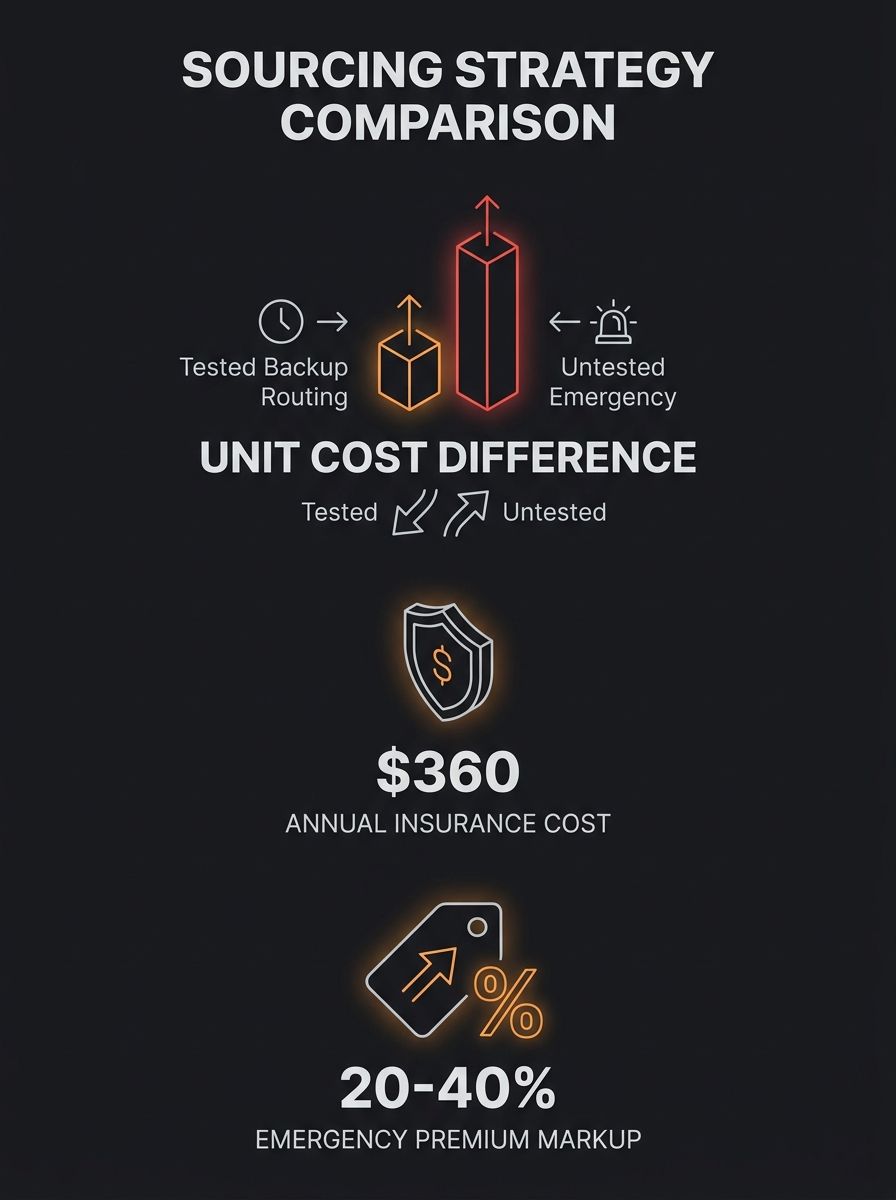
Research on drop-shipping and backup-sourcing strategies under disruption risk models this scenario directly: after the randomness of a supplier's availability is realized, the e-retailer can urgently order units from an "expensive but perfectly reliable outside option." The key word there is expensive. Emergency sourcing from an untested vendor typically costs 20-40% more per unit than your established supplier rate because you have zero negotiating history, no volume commitment, and no quality benchmarks in place.
Here's what "untested" looks like in practice. You have a CJ Dropshipping account as your primary and a Spocket supplier bookmarked as your backup for the same niche. Your CJ supplier goes out of stock on your best-selling SKU during a Q4 push. You activate the Spocket alternative and discover: the product dimensions differ by 15mm (triggering customer complaints about "wrong item"), the shipping origin is Turkey instead of China (adding 6-8 days to delivery), and the unit cost is $3.40 higher than what your margin math assumed. Your "backup" just created three new problems instead of solving one.
The fix is routing 10-15% of your actual order volume through backup suppliers every month. This costs you margin on those orders in the short term. A typical hero SKU selling at $29.99 with $9 COGS from your primary might cost $11.50 from a secondary source. On 100 monthly orders, routing 12 through the backup costs you an extra $30/month. That's $360/year in exchange for a supplier you've actually proven can fulfill at acceptable quality and speed.
The 3-Trigger Activation Protocol
Defining when you switch to a backup is where most dropshipping contingency planning falls apart. Without predetermined triggers, the decision happens under stress, takes too long, and loses you orders during the gap.
As outlined in ShipBob's guide to supply chain redundancy, businesses should "create detailed contingency plans and routing guides for quick adjustments during disruptions" and "negotiate flexible carrier contracts that allow for volume shifts and include service level guarantees." Translating that principle into a dropshipping operation means writing down specific numerical thresholds for three distinct failure types.
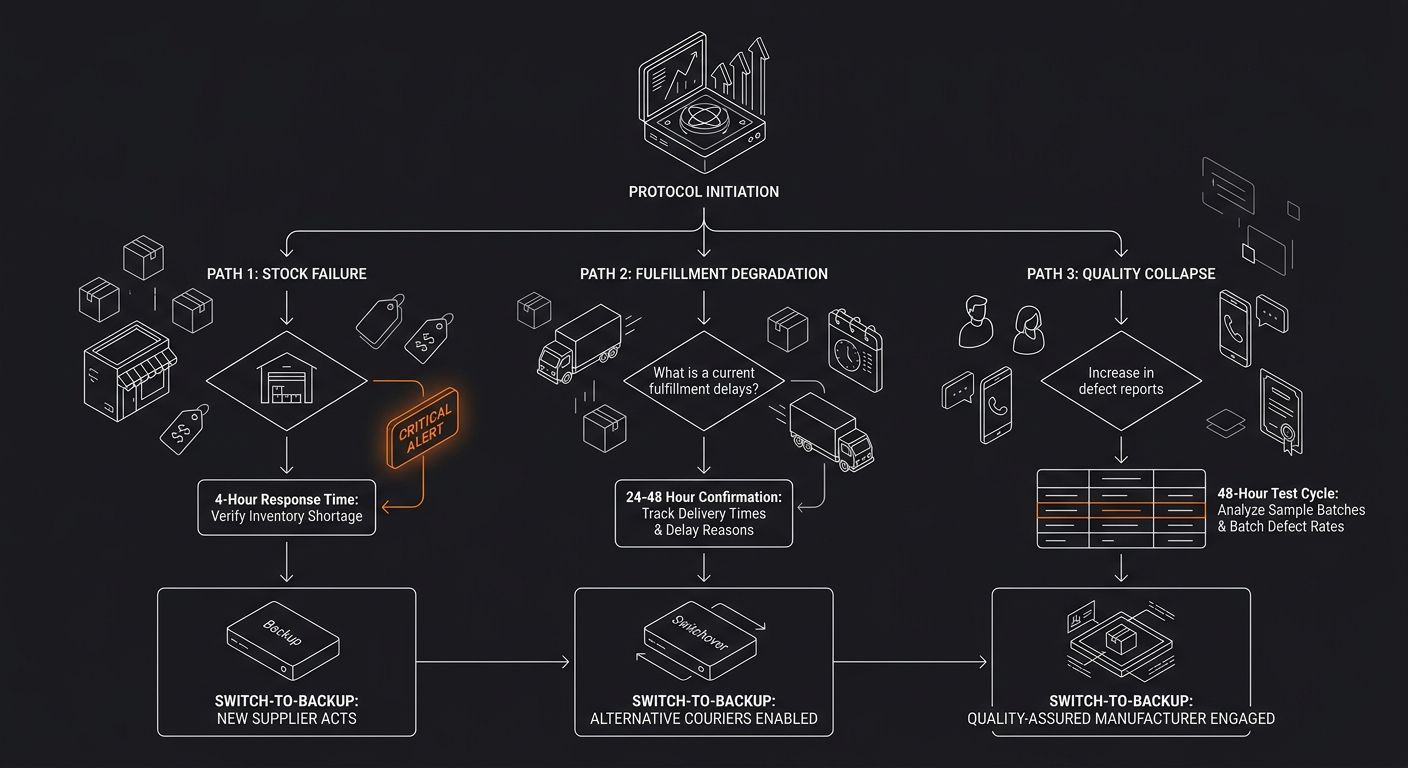
Trigger 1: Stock failure. Your primary supplier shows out-of-stock or "restocking in 7+ days" status. Activation timeline: immediate, within 4 hours. Route all new orders to Backup A. If you're running automated supplier sync systems, this can be semi-automatic with inventory threshold alerts that fire when available quantity drops below your daily order average.
Trigger 2: Fulfillment degradation. Your primary's average processing time exceeds 48 hours for 3+ consecutive days, or tracking upload delays hit 72+ hours. This is harder to catch without active monitoring. Anyone who's experienced tracking sync failures knows how quickly unshipped orders cascade into PayPal disputes and chargebacks. Activation timeline: 24-48 hours to confirm the pattern, then switch.
Trigger 3: Quality collapse. Customer complaint rate on a specific SKU exceeds 8% over a rolling 14-day window. Activation timeline: pause that SKU's routing to primary, send 5 test orders to Backup A, evaluate product quality within 48 hours before committing full volume.
Each trigger demands a different response speed. Stock failures require same-day action. Fulfillment degradation gives you a day or two to confirm the pattern. Quality issues need test orders before you commit volume. Writing these thresholds into a shared document means anyone managing your store can execute the switch without waiting for you to wake up, get back from vacation, or check Slack.
Geographic Separation Makes Supplier Diversification Actually Work
Supplier diversification gets more effective when your backups don't share the same failure risks as your primary. A second supplier based in the same Shenzhen district as your first doesn't protect you against regional port closures, country-specific tariff hikes, or shipping lane disruptions that hit an entire origin zone.
According to Anvyl's analysis of supplier diversification against global disruption, the core goal is "reducing the risk of a single point of failure" in the supply chain. Mark Kohlenberg, CEO of WDM Footwear & Accessories, described his company's approach in a US Chamber of Commerce interview: "We have been vetting new raw material suppliers in different countries of origin to provide a backup for us in case we cannot get materials in time."
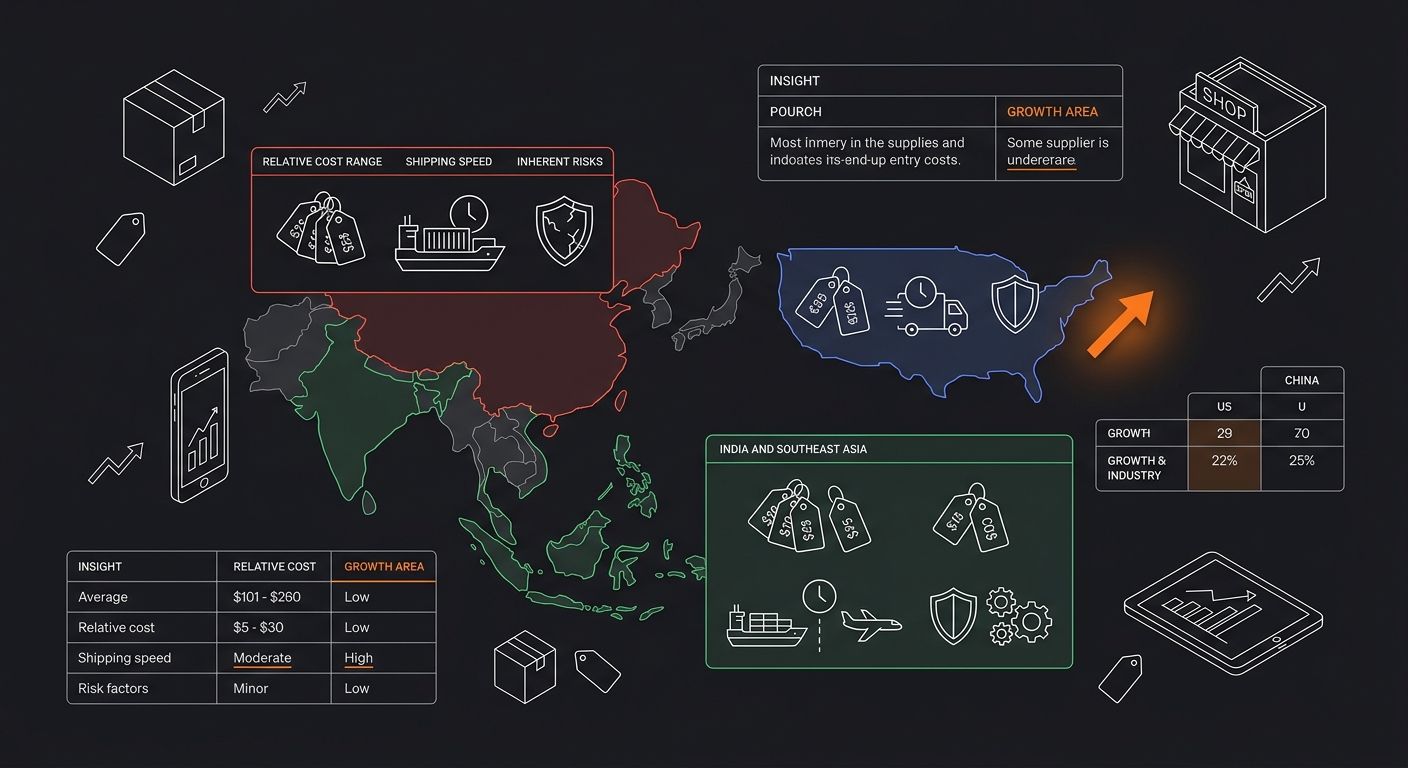
For a typical dropshipping operation, geographic diversification means maintaining suppliers across at least 2 of these 3 zones:
Supplier Zone | Typical Unit Cost | Average Ship-to-US Time | Best For |
|---|---|---|---|
China (AliExpress, CJ, Zendrop) | $4-12 per unit | 7-15 days ePacket, 3-5 days express | Lowest COGS, widest catalog |
US/Domestic (Spocket US, Inventory Source domestic partners) | $8-20 per unit | 2-5 days ground | Speed-sensitive SKUs, tariff-exposed categories |
India/Southeast Asia (emerging suppliers) | $5-14 per unit | 8-18 days | Alternative sourcing when China costs spike |
The concentration risk inherent in single-source dropshipping extends beyond stock availability. When bunker fuel costs spiked in early 2026, stores relying exclusively on China-origin suppliers saw per-unit shipping increase by $1.20-$2.80 depending on weight class. Operators with a US-based domestic backup for their top 3 SKUs shifted volume within days, absorbing a smaller margin hit instead of eating the full increase or raising prices mid-campaign.
Platform diversification matters alongside geography. If all your suppliers operate through one aggregator and that aggregator experiences an API outage or policy change, your entire operation stalls. Running your primary through CJ Dropshipping's direct integration and your backup through Spocket's separate API means a single platform failure doesn't take down both supply lines. Flxpoint's analysis of multi-supplier operations at scale confirms this: "Managing multiple dropship suppliers successfully combines strategic supplier selection, real-time technology, performance management, and continuous improvement."
Before you build this network, make sure your supplier vetting checklist covers backup-specific criteria: minimum order acceptance thresholds (some suppliers won't process fewer than 10 orders/month), return handling procedures for defective items, and whether they'll maintain your account active without consistent high volume.
The Claim, Revisited
The contrarian position holds up under the numbers: your backup supplier spreadsheet, the one with 8 vendor names and website URLs you collected during a research session 4 months ago, provides approximately zero operational continuity when your primary source fails.
A tested backup supplier strategy requires three things that spreadsheet doesn't deliver. First, proven fulfillment quality from live orders routed monthly at 10-15% of your volume, costing roughly $30/month per SKU in slightly higher unit costs. Second, predefined activation triggers written into your operations documentation with specific thresholds (stock failure within 4 hours, fulfillment degradation above 48 hours over 3 days, quality complaint rate above 8% over 14 days). Third, geographic separation so your backup doesn't share the same ports, warehouses, or failure modes as your primary.
The financial case is straightforward. Annual cost of maintaining this network: $1,200-$2,400 for a store doing $15,000/month in revenue. Cost of a single 5-day supplier outage during a peak sales period: $2,000-$5,000+ in lost gross profit, plus the slower-burning damage of negative reviews, chargebacks, and ad spend wasted driving traffic to out-of-stock products. Every store that builds and tests its backup network before the first crisis is the store that's still operating profitably 12 months later. The ones that wait until their primary supplier goes dark to start vetting alternatives are the ones running the math on whether it's cheaper to refund every open order or eat the chargeback fees.
365 Dropship Editorial
Editorial team writing about E-commerce, dropshipping, and product discovery — reviews of dropshipping suppliers and platforms, trending niche guides (jewelry, beauty, pets, home, fashion), supplier due diligence, ecom operations, shipping & fulfillment strategy, product research, AOV optimization, and profitable dropshipping case studies.
Related Articles
The Multi-Supplier Concentration Risk Matrix: Why Single-Source Dropshipping Kills Your Margins When Supply Lines Break
Dropshippers who concentrate 50% or more of total spend with one supplier face margin compression, zero fallback options, and full business exposure the moment that source raises prices or goes offline.
From Pandemic Pivot to Profitable Store: The Untold Operations Lessons Behind 2020-2026 Dropshipping Success Stories
COVID-era ecommerce operators who survived past 2022 share a pattern that has nothing to do with finding the right product or running the right ad. The pattern is operational: supplier onboarding speed, cash flow reinvestment discipline, and fulfillment consolidation.
Why Your Supplier Is Handling More Than You Think: The Hidden Data Flow Between Order and Fulfillment
Between your customer's checkout click and the tracking email that arrives hours later, six to twelve discrete data transfers fire across your store, middleware, supplier systems, and shipping carriers.
Explore more topics