The Pre-Launch Supplier Test Order Audit: What to Measure Beyond Shipping Speed
A pre-launch supplier audit should measure defect rates, packaging accuracy, documentation completeness, tracking validity, and invoice consistency alongside delivery time. Amazon enforces Order Defect Rates below 1% and Valid Tracking Rates above 95% Valid Tracking.

The Pre-Launch Supplier Test Order Audit: What to Measure Beyond Shipping Speed
A pre-launch supplier audit should measure defect rates, packaging accuracy, documentation completeness, tracking validity, and invoice consistency alongside delivery time. Amazon enforces Order Defect Rates below 1% and Valid Tracking Rates above 95% Valid Tracking. Your test order metrics need to match or exceed those baselines before you route a single dollar of ad spend to any new supplier.
September 2024: When Amazon Raised the Floor
Amazon increased its On-Time Delivery Rate requirement above 90% in September 2024, up from prior thresholds that many third-party sellers had treated as suggestions. Walmart already demanded On-Time Delivery above 90%, Valid Tracking above 99%, and Cancellation Rates below 2%. Sellers who had been measuring supplier performance on a single axis (did the package arrive within 7 to 12 days?) suddenly found themselves flagged, throttled, or suspended for failures they'd never tracked.
This enforcement shift matters for dropshippers because it created a documented, public benchmark for what "good enough" looks like across multiple metrics. And most test order workflows still ignore 4 out of 5 of those metrics entirely. If you're building your supplier vetting checklist around transit time alone, you're testing for the one dimension that's easiest to pass while missing every dimension where suppliers actually fail.
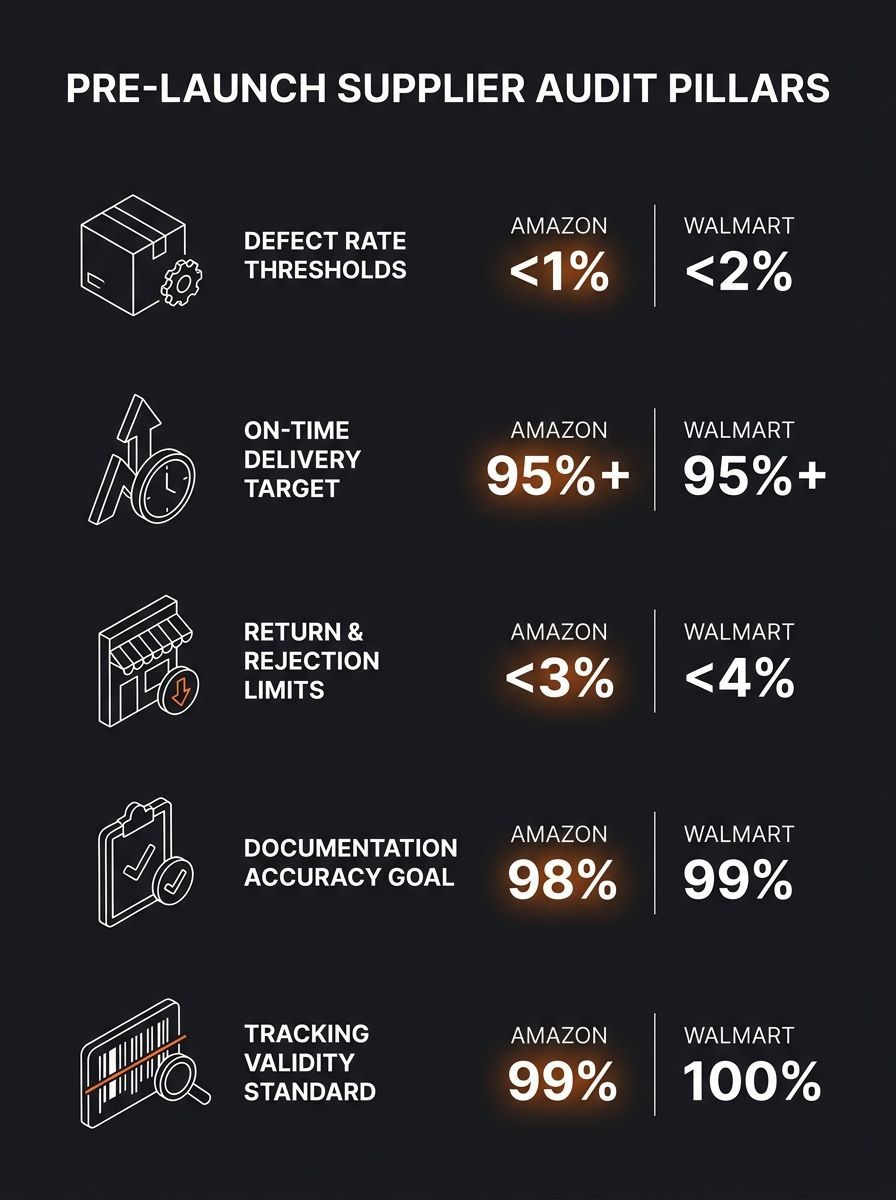
The Carro product quality evaluation framework identifies three core test order metrics every supplier should be scored against: defect rate, on-time delivery rate, and return or rejection rate. GoAudits' supplier quality management guide adds non-compliance issues to that list, bringing the minimum to four distinct measurement categories. Together with documentation accuracy (which both Amazon and Walmart penalize directly through chargebacks), a proper pre-launch supplier audit covers five pillars.
Transit Time Passed, Everything Else Failed
Here's how the typical dropshipping quality control test plays out. You place 3 to 5 orders through your supplier (AliExpress, CJDropshipping, Spocket, Zendrop, whoever). You time how long each order takes to arrive. You open the package, glance at the product, and if it looks roughly like the listing photo and showed up within the promised window, the supplier "passes." You move on to ad creative.
That approach checks 1 metric out of 5. The other 4 are where chargebacks, returns, and margin erosion actually originate.
According to Carro's quality evaluation guide, defect rate alone accounts for a significant share of post-purchase customer complaints that translate directly into refund requests and negative reviews. Amazon's 1% Order Defect Rate ceiling means that out of every 100 orders, more than 1 defective unit triggers account-level consequences. For a dropshipper processing 200 orders per month, that's a maximum of 2 defective shipments before you're in violation.
Walmart's Valid Tracking Rate threshold sits at 99%, which is 4 percentage points higher than Amazon's 95% floor. If your supplier generates tracking numbers that don't scan, update late, or point to the wrong carrier, you'll fail Walmart's standard even while "passing" Amazon's. When you're diagnosing tracking sync failures after launch, you've already absorbed the cost of customer service tickets and replacement shipments.
Your fulfillment diagnostics during the test order phase should capture tracking number accuracy as a binary: did every tracking number provided by the supplier resolve to a valid, updating shipment within 24 hours of order placement? Across 5 test orders, even 1 failure drops you to 80% Valid Tracking, well below both Amazon's 95% and Walmart's 99%.
The Invoice, the Label, and the Missing Insert
Packaging and documentation errors are invisible during a casual unboxing but devastating at scale. The Zycus supplier management research found that companies using structured supplier performance evaluation saw a 28% improvement in supplier scores and a 70% reduction in request cycle time when they added documentation checks to their audit process.
For each of your 3 to 5 test orders, you should record:
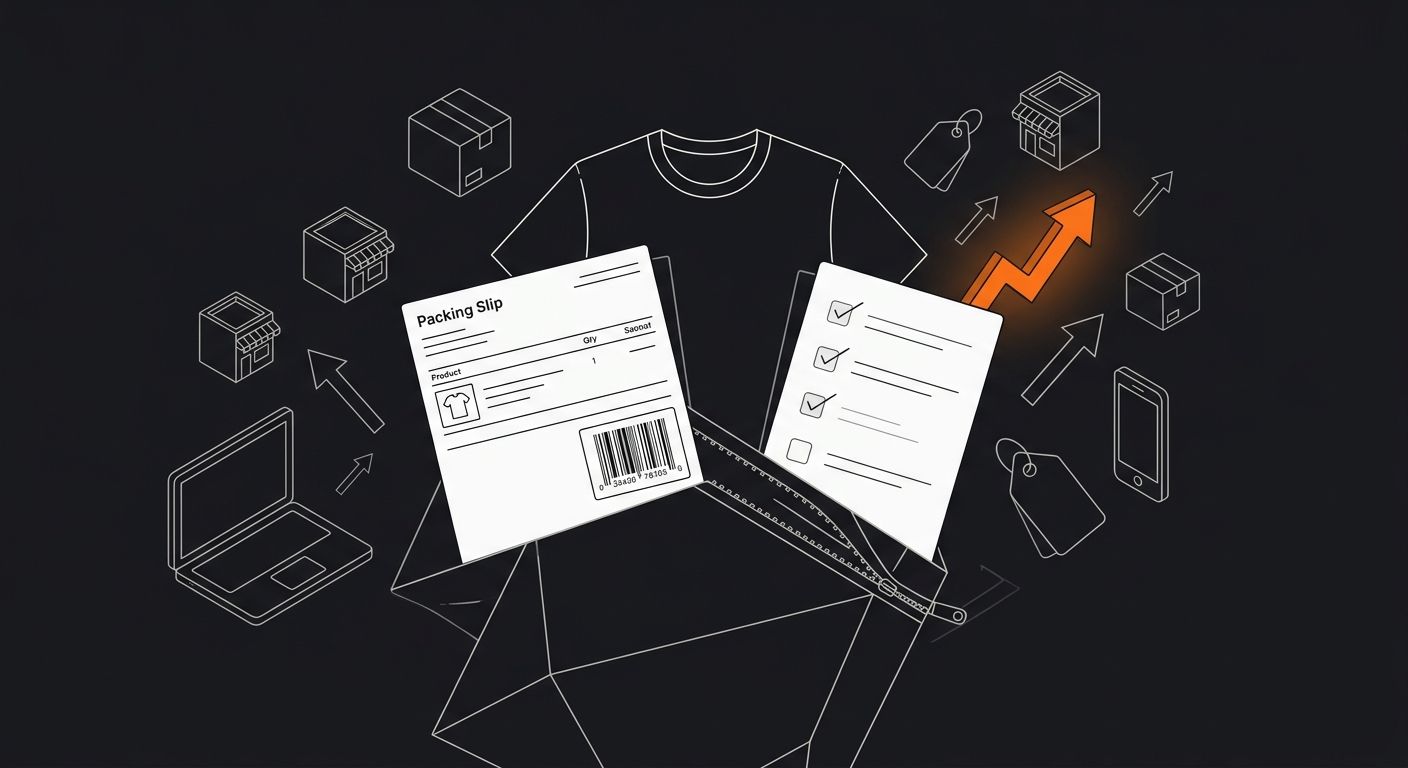
Invoice accuracy: Does the packing slip match your order in quantity, SKU, and pricing? Mismatches here predict bulk order billing disputes. A supplier who ships 4 units when you ordered 5 on a test order will do the same at 500 units.
Label compliance: Are barcodes scannable? Do labels include the correct product description, weight, and handling instructions? For products sold through Amazon FBA or Walmart Marketplace, incorrect labeling generates automatic chargebacks.
Brand consistency: If you're running a branded store, does the packaging match your brand guidelines, or did the supplier default to generic brown poly mailers with Chinese-language customs stickers visible?
Insert presence: Did custom inserts (thank-you cards, care instructions, warranty information) arrive in every order, or only some? Inconsistency across 5 test orders signals process control problems that scale linearly.
GoAudits' supplier quality management framework recommends that audit checklists track defect rates, on-time delivery, and non-compliance issues as distinct categories, each scored separately. Lumping them into a single pass/fail grade hides which specific process is breaking.
Defect Rate Arithmetic on Five Test Units
Running defect rate calculations on a small sample sounds statistically meaningless, and the confidence interval is genuinely wide on 5 units. But the goal of a pre-launch supplier audit isn't to generate publication-grade data. The goal is to catch suppliers who fail badly enough to breach a 1% threshold at scale.
If 1 out of 5 test units arrives with a visible defect (wrong color, broken clasp, scratched surface, misaligned stitching), that's a 20% defect rate on your sample. Even accounting for small-sample noise, a 20% observation rate on test orders predicts a true defect rate well above 1%. The quality metrics framework from IntelyCx defines a supplier with consistently high defect rates as a strategic risk, not an operational inconvenience.
Your target gross margin for curated dropshipping should sit at 80% or higher, according to Financial Models Lab's dropshipping KPI benchmarks. Every defective unit erodes that margin through refund costs ($3 to $8 per return transaction depending on payment processor), replacement shipping ($5 to $15 for ePacket or standard tracked), and customer acquisition waste (if your CAC runs $17 to $25, a single defective order can wipe out 2 to 3 orders worth of profit).
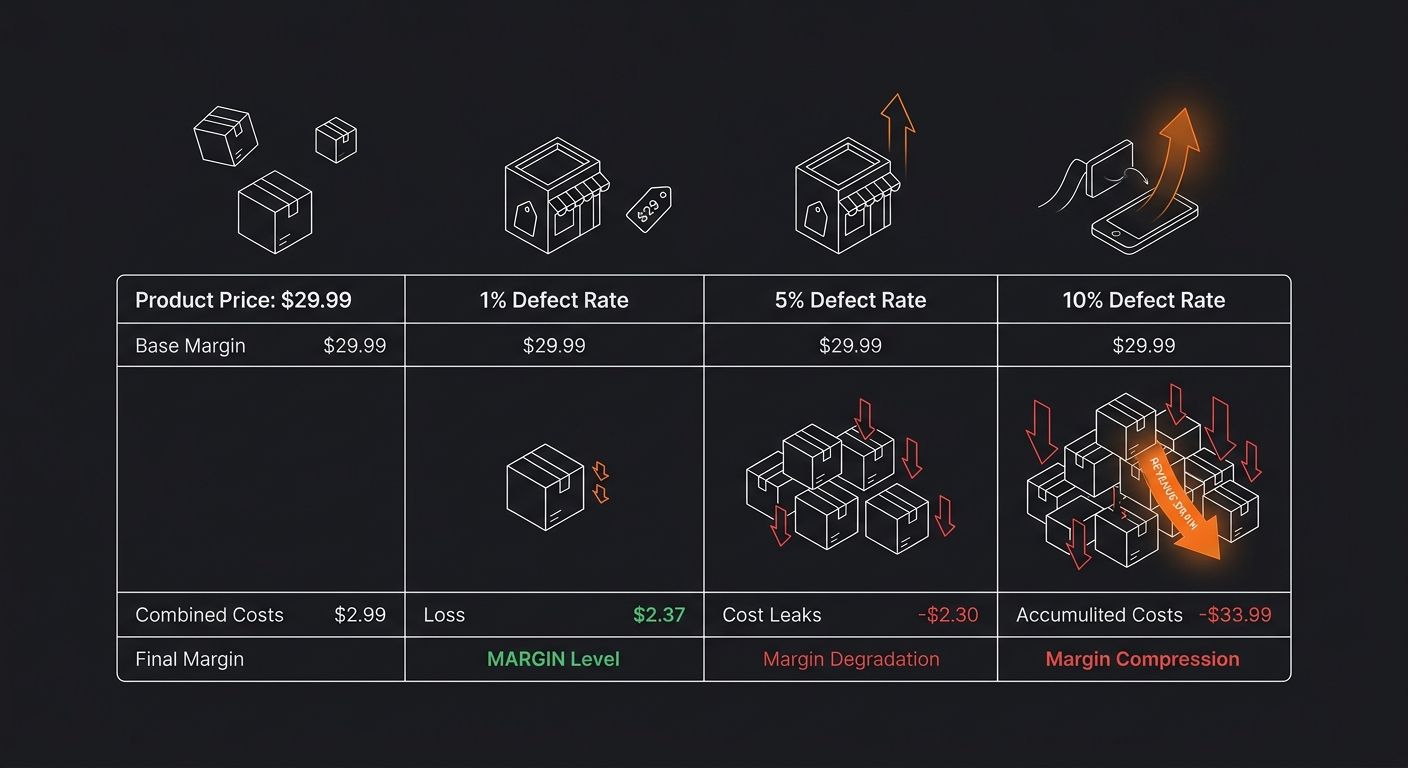
Here's the math on a $29.99 product with a $9.00 landed cost and 70% gross margin:
1 defect per 100 orders costs roughly $28 to $48 in refund plus replacement
5 defects per 100 orders costs $140 to $240, cutting your effective margin from 70% to approximately 62%
10 defects per 100 orders costs $280 to $480, dropping effective margin to 54%
That 16-percentage-point margin swing from a 10% defect rate is the difference between a profitable store and one that bleeds cash after ad spend. If you want to protect those numbers, your customer experience audit needs to begin before the first real customer ever places an order.
Walmart's 99% Tracking Threshold and the Supplier Gap
The 4-percentage-point difference between Amazon's 95% Valid Tracking Rate and Walmart's 99% threshold creates a compliance gap that many suppliers fall into. A supplier generating valid tracking on 96 out of 100 orders passes Amazon and fails Walmart. If you plan to sell across both marketplaces (or expand to Walmart later), your pre-launch test needs to validate tracking at the higher standard.
During your 5 test orders, record the following for each:
Hours between order placement and tracking number generation (target: under 48 hours)
Hours between tracking generation and first carrier scan (target: under 72 hours)
Number of tracking status updates during transit (fewer than 3 updates across a 7 to 14 day delivery window signals a carrier with poor scan infrastructure)
Whether the tracking number resolves on the carrier's own website, not a third-party aggregator that may lag by 24 to 48 hours
Suppliers who use freight forwarders with indirect carrier relationships often generate "pre-transit" tracking numbers that don't receive their first scan for 5 to 7 days. Those numbers technically exist but fail the Valid Tracking definition on both Amazon and Walmart because they don't show movement within the expected window.
Building a backup supplier network only works if your backup suppliers have been through the same test order audit as your primary ones. Over 70% of companies increased the frequency of supplier audits after pandemic-era supply chain disruptions, according to industry survey data from the CSDDD compliance landscape. Dropshippers should be running this same audit cadence, not annually but before every new product launch and every new supplier onboarding.
Your supplier vetting checklist should include financial health indicators (revenue trends, credit ratings, debt levels), compliance verification, and delivery reliability scores. Zycus identifies these as the minimum categories for any supplier onboarding process. For dropshippers, the practical translation is: test the product, test the paperwork, test the tracking, and test the defect rate. Each one independently. Shipping speed is the check you run last, because it's the one that almost never fails badly enough to matter.
365 Dropship Editorial
Editorial team writing about E-commerce, dropshipping, and product discovery — reviews of dropshipping suppliers and platforms, trending niche guides (jewelry, beauty, pets, home, fashion), supplier due diligence, ecom operations, shipping & fulfillment strategy, product research, AOV optimization, and profitable dropshipping case studies.
Related Articles

The Supplier Test Order Audit: Using Real Shipments to Spot Quality Collapse Before It Tanks Your Margins
Industry data from 2025 shows that 72% of businesses experienced at least one major supply chain disruption caused by underperforming suppliers.

The Supplier Scorecard Audit: Building a Quality Matrix That Catches Red Flags Before Your First 100 Orders
Procurement scoring frameworks use a 0-100 scale where any supplier below 60 earns "red" status, meaning business on hold and corrective action required.

Dropshipping Through Amazon: Complete Guide
Amazon allows dropshipping through its Fulfilled by Merchant (FBM) program, but the mechanism works differently than most operators expect. You never touch inventory. Your supplier ships directly to customers.
Explore more topics