The Customer Experience Audit: Mining Your Reviews for Operational Blind Spots Before They Tank Margins
Systematic customer feedback analysis converts raw review text into supplier performance metrics that expose margin erosion weeks before your P&L registers the damage.
The Customer Experience Audit: Mining Your Reviews for Operational Blind Spots Before They Tank Margins
Systematic customer feedback analysis converts raw review text into supplier performance metrics that expose margin erosion weeks before your P&L registers the damage. Defect rates, shipping accuracy, and packaging failure frequency all hide inside your review feed, waiting to be decoded into actionable supplier scorecards.
Reviews Encode Operational Failures, Not Opinions
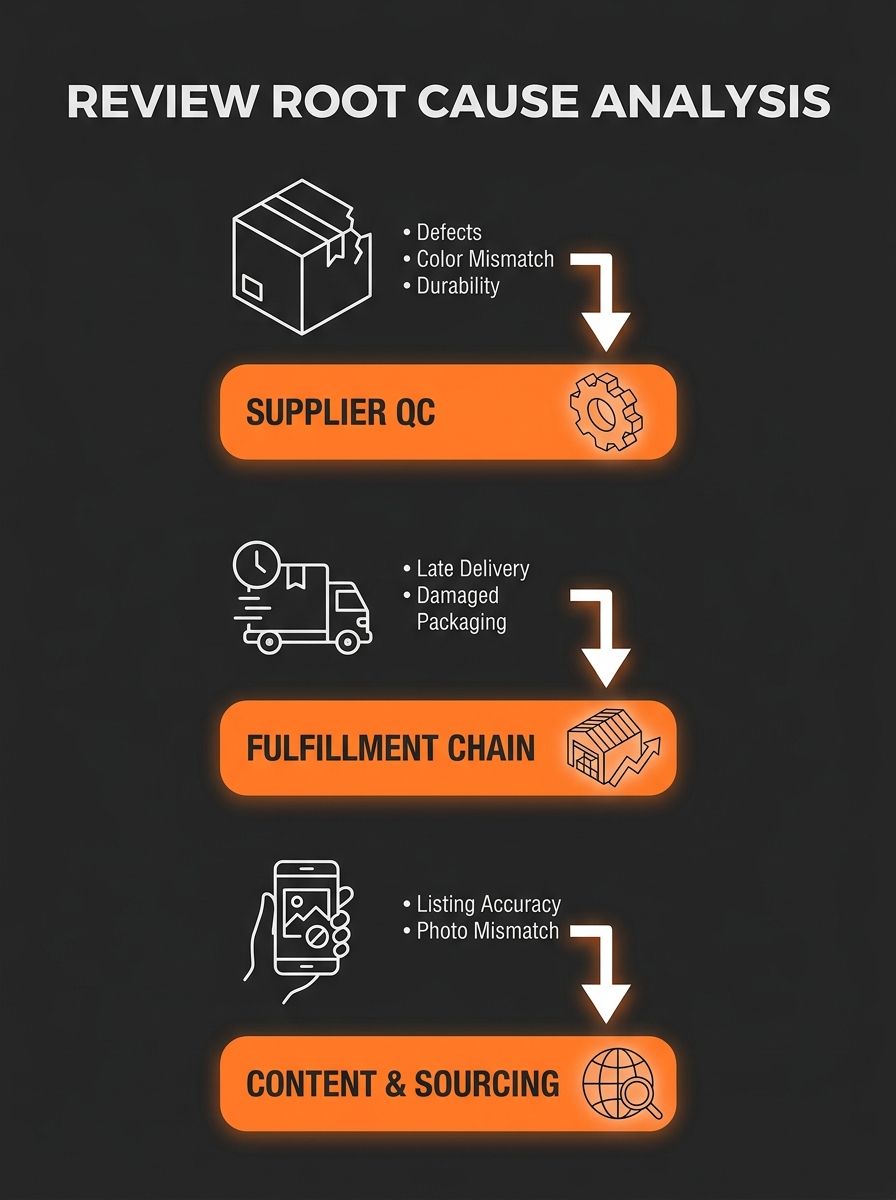
When a customer writes "color doesn't match the photo" or "seams came apart after one wash," they're filing a supplier defect report in plain language. The problem is that most dropshipping operators treat these signals as reputation management tasks, something to respond to politely, rather than what they actually are: granular operational diagnostics for a fulfillment chain you don't physically control. As 42Signals' analysis of ecommerce review data documents, effective root cause analysis means going beyond "customer service is bad" to identify the actual mechanisms: long wait times, unhelpful agents, difficult return processes. Each complaint cluster maps to a different operational fix and a different conversation with your supplier.
The financial stakes of ignoring this distinction are well-quantified. Forrester's 2024 US Customer Experience Index found that customer-obsessed organizations achieve 41% faster revenue growth, 49% better profit gains, and 51% stronger retention than competitors who treat feedback as a marketing afterthought. A 2025 PwC Global Consumer Insights Pulse Survey put the trust dimension in sharper focus: over 70% of consumers say trust in a brand directly influences their purchase decisions, and online reviews are the primary mechanism through which that trust forms or collapses. For a dropshipping operation where you never touch the product, review analytics in dropshipping functions as your only real quality control layer. Your factory floor inspection happens in the comments section.
The real value lies in connecting specific language patterns to specific operational breakdowns. "Arrived damaged" points to packaging. "Took three weeks" points to shipping lane selection or supplier processing delays. "Looks nothing like the picture" points to listing accuracy or supplier bait-and-switch. If you've already invested in building trust signals into your product reviews, the operational integrity behind those reviews determines whether that trust holds or erodes with each new order.
From Complaint Clusters to Supplier Scorecards
Undifferentiated complaint handling is the silent margin killer. You offer a refund for a packaging damage issue, and the refund costs you $15-$40 per incident, but the root cause, your supplier using single-wall corrugated instead of double-wall, costs $0.30 per unit to fix permanently. Multiply that gap across 200 orders per month and you're bleeding margin on a problem with a cheap, permanent solution. The discipline of translating review language into standardized supplier performance metrics is what separates stores that slowly hemorrhage profit from stores that actually fix things.
Ivalua's 2026 supplier performance management guide identifies defect rates, product conformity, on-time delivery, lead time, and order fulfillment accuracy as the core KPIs for supply chain management. CIPS adds order fulfilment score, order visibility score, delivery costs, inventory cost, and response index. These are standard procurement metrics, but dropshippers almost never track them because they don't have procurement departments. Your reviews fill that gap. Every "faded after one wash" is a data point for your defect rate. Every "tracking never updated" feeds your order visibility score. As Forbes' analysis of customer feedback methods notes, effective analysis requires collecting reviews and probing both the quantitative and qualitative data they provide to understand your customer base at a structural level.
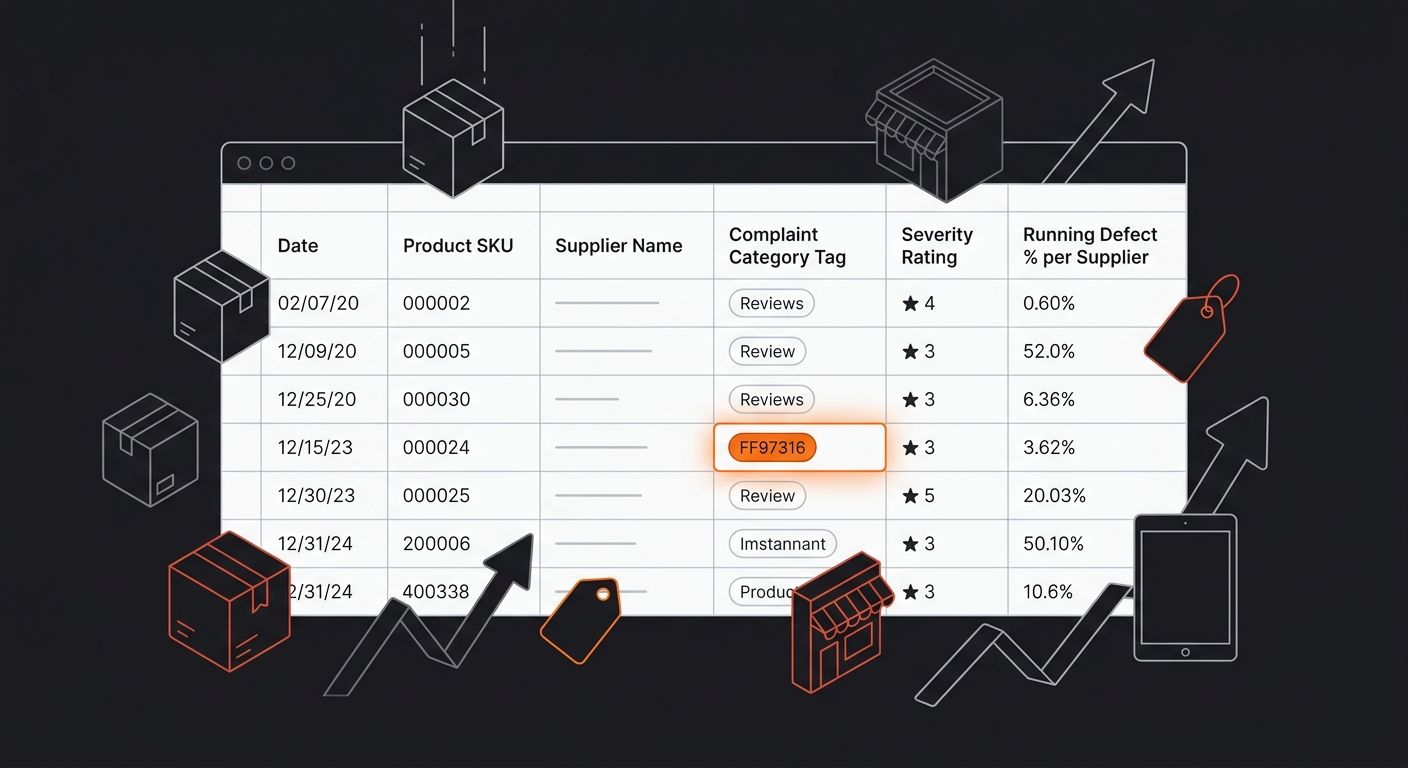
The practical method: export your reviews from Shopify, Judge.me, or whatever platform you use, and tag each complaint by category (product quality, shipping speed, packaging integrity, listing accuracy, customer service). Then calculate the frequency of each category as a percentage of total reviews per supplier, per product, per month. When a supplier's product quality complaints exceed 8-10% of total reviews on a given SKU, you've found a margin leak worth investigating. If you've already built a post-sale audit process for diagnosing margin mistakes, this review tagging process slots directly into that workflow as the customer-facing data layer. The supplier scorecard writes itself over 60-90 days of consistent tagging, and what emerges is a clear picture of which suppliers are costing you money through operational failures rather than pricing.
Closing the Loop Changes the Supplier Relationship
Atom Bank provides a useful case study for what happens when review analysis drives genuine operational change. By running thematic analysis across seven feedback channels, the company achieved a 40% reduction in call center volume and 110% growth in its customer base. They fixed the underlying issues generating complaints, rather than just managing each complaint individually. McKinsey's research on customer satisfaction reinforces the scale of the opportunity: elevating satisfaction from poor to excellent can reduce churn by 75% and nearly triple revenue growth over three years.
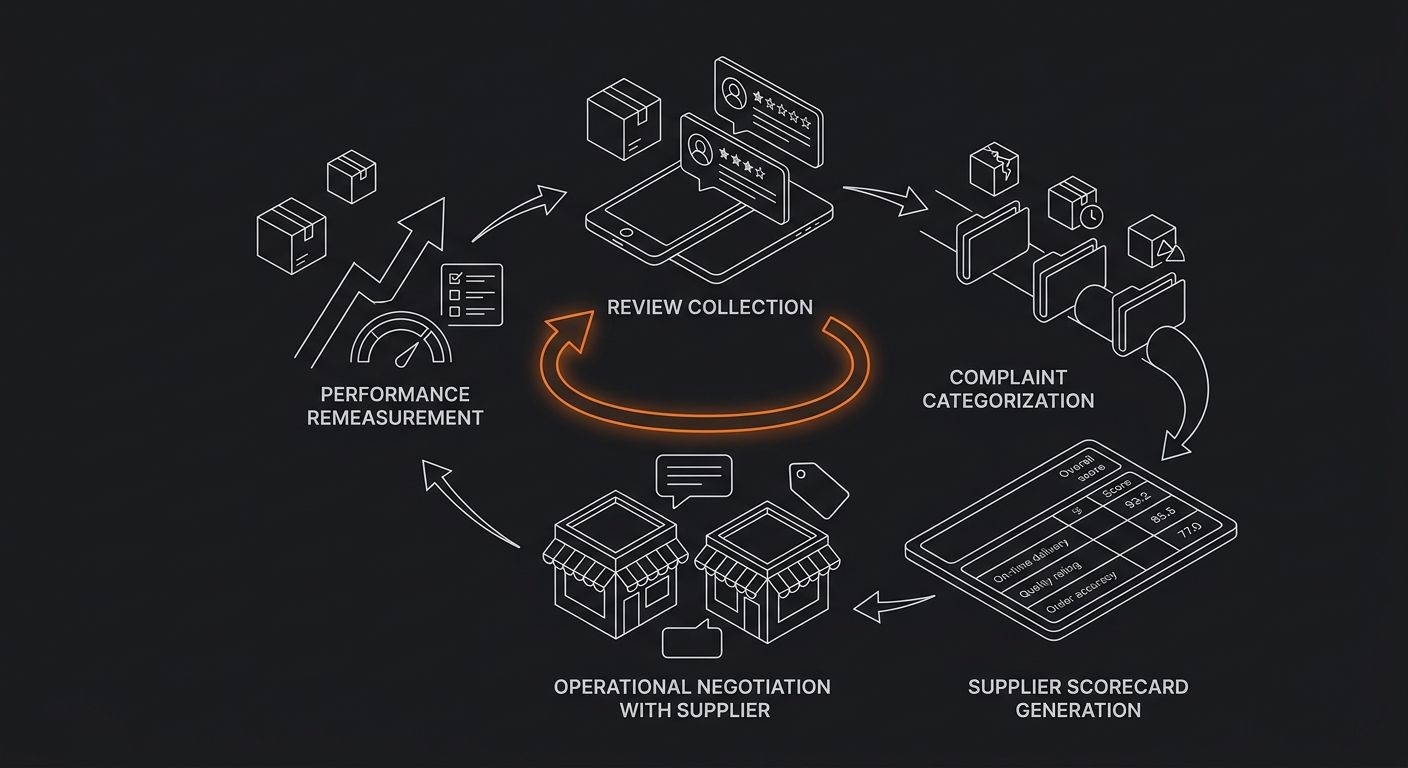
For dropshippers, the closed-loop version looks like this: you take your complaint cluster data, present it to your supplier as structured performance metrics (defect rate by SKU, late delivery percentage, packaging damage frequency), and negotiate specific operational changes with measurable targets. This is where having a clear supplier audit escalation process becomes essential. You need a framework for accountability that your supplier takes seriously, and data-backed scorecards carry more weight than "my customers are unhappy." Gainsight's research shows companies that systematically turn customer insights into action see up to 75% lower churn rates, and the mechanism is straightforward: you're removing the friction that drives customers away.
The financial incentive is concrete. A dropshipping store doing $30,000 per month with a 15% return and refund rate driven by quality and fulfillment issues is losing roughly $4,500 per month in direct refund costs alone. Cut that rate in half by fixing underlying supplier problems and you save $2,250 monthly in refunds, before accounting for saved ad spend on replacement customer acquisition, improved review scores that lift conversion, and reduced customer service labor. That $2,250 flows straight to your bottom line, and it compounds as your review profile improves and your CAC drops. If the operational lessons from successful long-running stores teach anything, it's that this kind of unglamorous process work is what separates stores that survive past year two from stores that don't.
Where the Signal Gets Noisy
The uncomfortable truth about review-based operational diagnostics is that the data carries inherent bias. Customers who leave reviews skew toward the extremes of satisfaction and dissatisfaction, and the specific complaints they articulate are filtered through their own assumptions about what went wrong. A customer who writes "cheap material" might be reacting to a legitimate quality defect, or they might have unrealistic expectations set by your product photography and description copy. Separating marketing failures from genuine supplier problems requires diagnostic nuance that simple complaint categorization can miss, and getting it wrong sends you chasing the wrong fix.
There's also a volume problem that hits small dropshipping stores especially hard. If you're selling fewer than 100 units per month per SKU, your review sample size is too small for reliable pattern detection. A single angry customer can make your defect rate look catastrophic when the actual manufacturing issue affects 1 in 500 units. The statistical rigor that makes supplier performance metrics useful in large-scale procurement, where sample sizes run into the thousands, doesn't translate cleanly to a store doing 30-50 orders per day across 15 SKUs. Small numbers lie, and building supplier scorecards on thin data can lead to firing a good supplier over noise.
And the deepest limitation is temporal. Reviews reflect problems that already happened to real customers who already had a bad experience, who already cost you the refund and the ad spend to acquire them. Predictive analytics for smart supply chains is an active area of development, using review trend data to anticipate problems before they scale, but it requires data volume and analytical tooling that most independent operators don't have access to yet. For now, review-based fulfillment quality auditing remains reactive by nature. The goal is to shorten the reaction time from months to weeks, and from weeks to days. Eliminating the lag entirely requires infrastructure that the dropshipping model, by design, makes hard to build. That tension between the need for real-time quality control and the structural distance from the product itself is the central operational challenge of the model, and honest review analysis is the best imperfect tool we've got for managing it.
365 Dropship Editorial
Editorial team writing about E-commerce, dropshipping, and product discovery — reviews of dropshipping suppliers and platforms, trending niche guides (jewelry, beauty, pets, home, fashion), supplier due diligence, ecom operations, shipping & fulfillment strategy, product research, AOV optimization, and profitable dropshipping case studies.
Related Articles

The Supplier Audit Flowchart: Isolating Root Cause When Your Dropshipping Margins Collapse Mid-Campaign
When a Meta campaign producing $11 contribution margin per unit on day three drops to $3.40 by day fourteen, the instinct is to blame the ad creative or the audience. The ad account gets the autopsy. The supplier rarely does.
The Supplier Audit Trap: Why Automation Tools Hide Quality Red Flags Until Your First 100 Orders
DSers, Spocket, and Zendrop all surface supplier scores built from the same thin data: listing age, order volume, and aggregate star ratings.
Why Review Aggregators Are Actively Misleading Dropshippers About Supplier Quality in 2026
Review aggregators earn subscription and per-order fees from the supplier relationships they're supposed to objectively rate. Platforms like Spocket, Modalyst, and Doba display quality scores as neutral assessments.
Explore more topics