Dropshipping Through Amazon: Complete Guide
Amazon allows dropshipping through its Fulfilled by Merchant (FBM) program, but the mechanism works differently than most operators expect. You never touch inventory. Your supplier ships directly to customers.
Dropshipping Through Amazon: How the Model Actually Works Under the Hood
Amazon allows dropshipping through its Fulfilled by Merchant (FBM) program, but the mechanism works differently than most operators expect. You never touch inventory. Your supplier ships directly to customers. Amazon's rules require you to be the seller of record, strip all third-party branding, and handle every return yourself.
Amazon's Four-Gate Compliance Test
Amazon's dropshipping policy boils down to four simultaneous requirements, and violating any single one triggers account suspension. According to Amazon's documented policy, "you must be the seller of record, remove all third-party branding from shipments, handle returns yourself, and never purchase from another retailer (like Walmart) to ship directly to Amazon customers."
Call it the Four-Gate Compliance Test:
Seller of Record: Your business name appears on every invoice and packing slip.
Unbranded Packaging: No supplier logos, no AliExpress tape, no third-party inserts.
Direct Return Handling: You process refunds and returns, not your supplier.
No Retail Sourcing: Buying from Target.com or Walmart.com to fulfill Amazon orders is explicitly banned.
That last gate gets operators banned constantly. Retail arbitrage through another online marketplace violates the policy even if the customer receives the product on time. Amazon's systems flag mismatched tracking origins and carrier patterns, and the penalty is account suspension with a formal Plan of Action required for reinstatement. The practical requirement: you need a direct relationship with a manufacturer or wholesale supplier who will ship unbranded packages with your documentation. If you're still getting oriented on the broader model, our beginner's guide to dropshipping covers foundational mechanics before the Amazon-specific layer.
How FBM Fulfillment Actually Flows
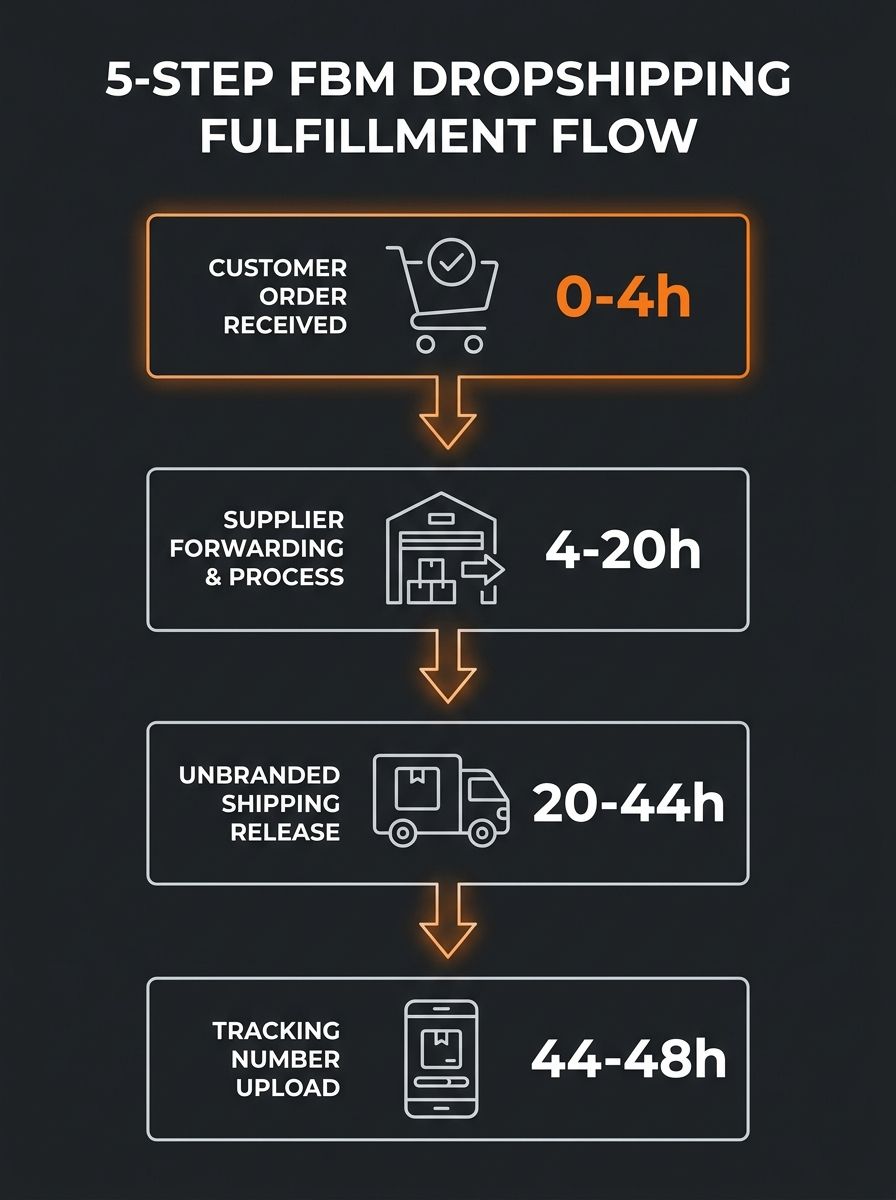
The order-to-delivery chain in Amazon dropshipping involves five handoffs, and a failure at any point damages your Account Health score directly.
The sequence runs like this: a customer places an order on Amazon. Amazon sends you the order notification through Seller Central or your API integration. You forward order details to your supplier with product SKU, shipping address, and quantity. Your supplier ships the product directly to the customer using unbranded packaging. You upload the tracking number to Amazon within 24 hours of the ship-by date.
Each step operates under time constraints. The Valid Tracking Rate (VTR) metric requires 95% or higher compliance on uploaded tracking numbers. Drop below that threshold and Amazon flags your account for review. For sellers running 50+ orders daily, the manual version of this process collapses within a week. Automation tools like AutoDS, DSers, or Inventory Source handle order forwarding and tracking uploads programmatically.
Shipping timelines are where Amazon dropshipping diverges from Shopify dropshipping. Amazon customers expect 3-5 day delivery windows. US-based suppliers can hit this consistently. Chinese suppliers shipping via ePacket or Yanwen typically deliver in 8-15 days, which triggers negative reviews and tanks your Order Defect Rate. As Jungle Scout's guide notes, dropshipping on Amazon "doesn't require as much upfront investment as private label or wholesale," but the tradeoff is that your delivery speed depends entirely on your supplier's location and processing time. If you're weighing domestic suppliers against overseas fulfillment centers, the Amazon channel pushes the math aggressively toward domestic sourcing.
The Fee Stack That Eats Your Margins
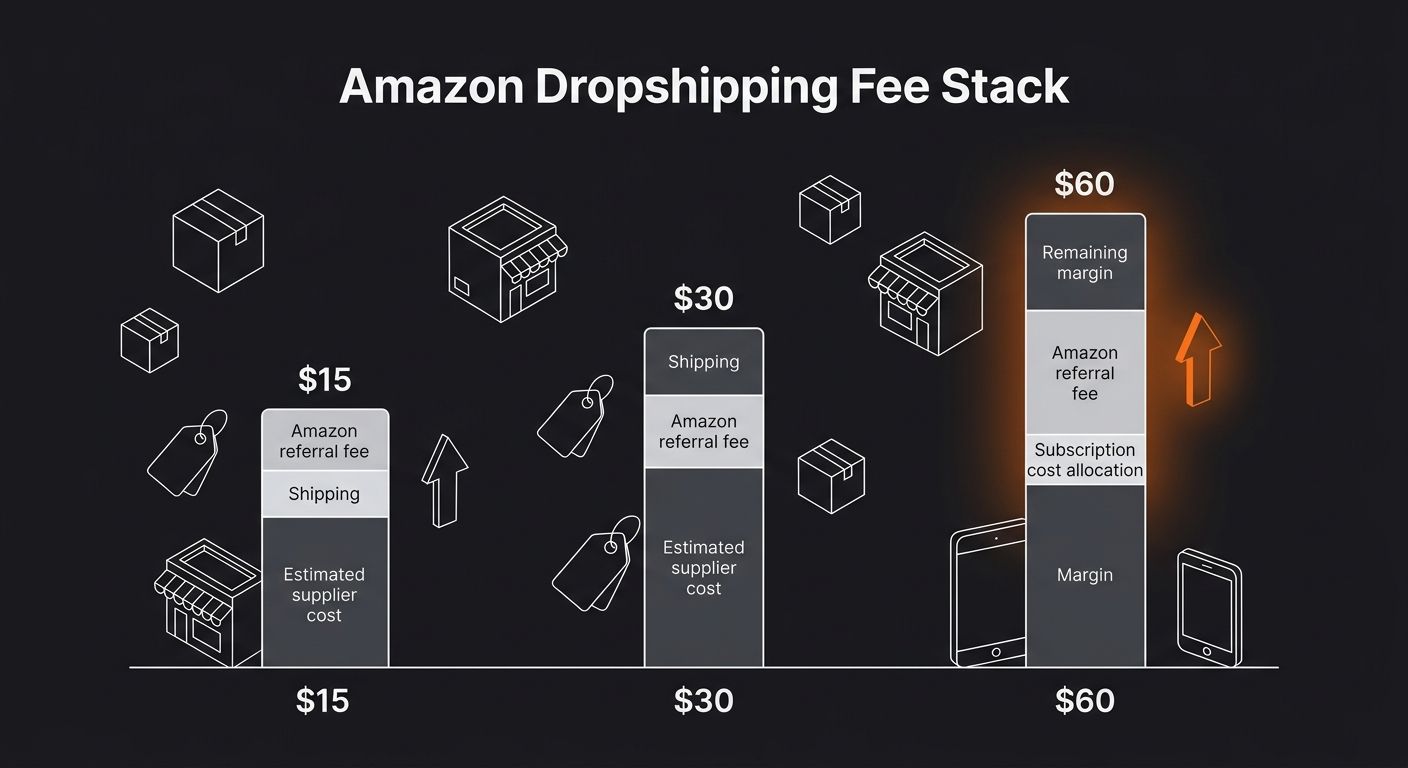
Amazon's fee structure for dropshippers stacks three layers that combine to compress margins well below what most operators model during product research.
Layer 1: Subscription. The Professional Selling Plan costs $39.99/month. The Individual Plan charges $0.99 per item sold. Break-even occurs at roughly 40 units/month.
Layer 2: Referral fees. Amazon takes a category-specific percentage of every sale. Electronics run 8%. Home & Kitchen charges 15%. Fashion and clothing hit 17%. On a $30 item in the Home category, Amazon takes $4.50 before you've accounted for product cost or shipping.
Layer 3: The 2026 de minimis change. The revocation of the $800 de minimis customs exemption means imports previously exempt from duty now incur charges. A $15 product from a Chinese supplier that shipped duty-free in 2024 now carries an additional $2-4 in import costs depending on HTS classification.
Here's the margin math on a realistic kitchen gadget listing. You sell at $29.99. Amazon's 15% referral fee takes $4.50. Your supplier charges $8.00. Shipping from a US-based supplier runs $4.50. Import duty adds $1.50. Your subscription, amortized across 200 orders, adds $0.20. Total cost: $18.70. Gross profit: $11.29, a 37.6% margin before advertising.
That 37.6% sounds strong until you factor in PPC. Amazon's average cost-per-click sits around $0.89-$1.20 across all categories, and conversion rates for new listings average 8-12%. At $1.00 CPC and 10% conversion, you're spending $10.00 to acquire each sale through ads. Your net margin drops to $1.29, or 4.3%.
Run those numbers through a profit margin calculator before listing anything. The gap between a 37% gross margin and a 4% net margin after advertising is the single most common surprise for new Amazon dropshippers.
Account Health Metrics That Control Survival
Why do Amazon dropshipping accounts fail at rates higher than standard FBA accounts? Three metrics tracked in real time by Amazon's systems become significantly harder to control when you don't handle fulfillment yourself.
Order Defect Rate (ODR) measures A-to-Z claims, negative feedback, and chargebacks as a percentage of total orders. Amazon's threshold: below 1%. A dropshipper running 100 orders/month gets exactly one defect before the warning triggers. Since you don't control packing quality, shipping speed, or product inspection, your ODR depends entirely on supplier reliability.
Valid Tracking Rate (VTR) must stay above 95%. Every order needs a working tracking number uploaded within your ship-by date. If your supplier ships without notifying you, or uses a carrier Amazon doesn't recognize, that order counts against your VTR.
Late Shipment Rate (LSR) must remain below 4%. Orders confirmed shipped after the expected ship date count as late. A supplier who takes 3 business days to process when Amazon promised 2-day handling will push you past this threshold fast.
Metric | Threshold | Common Failure Cause | Penalty |
|---|---|---|---|
Order Defect Rate | Below 1% | A-to-Z claims, wrong items, damaged goods | Account suspension |
Valid Tracking Rate | Above 95% | Missing tracking, unrecognized carriers | Listing suppression |
Late Shipment Rate | Below 4% | Supplier processing delays, timezone gaps | Warning, then suspension |
Inventory Sync as the Operational Bottleneck
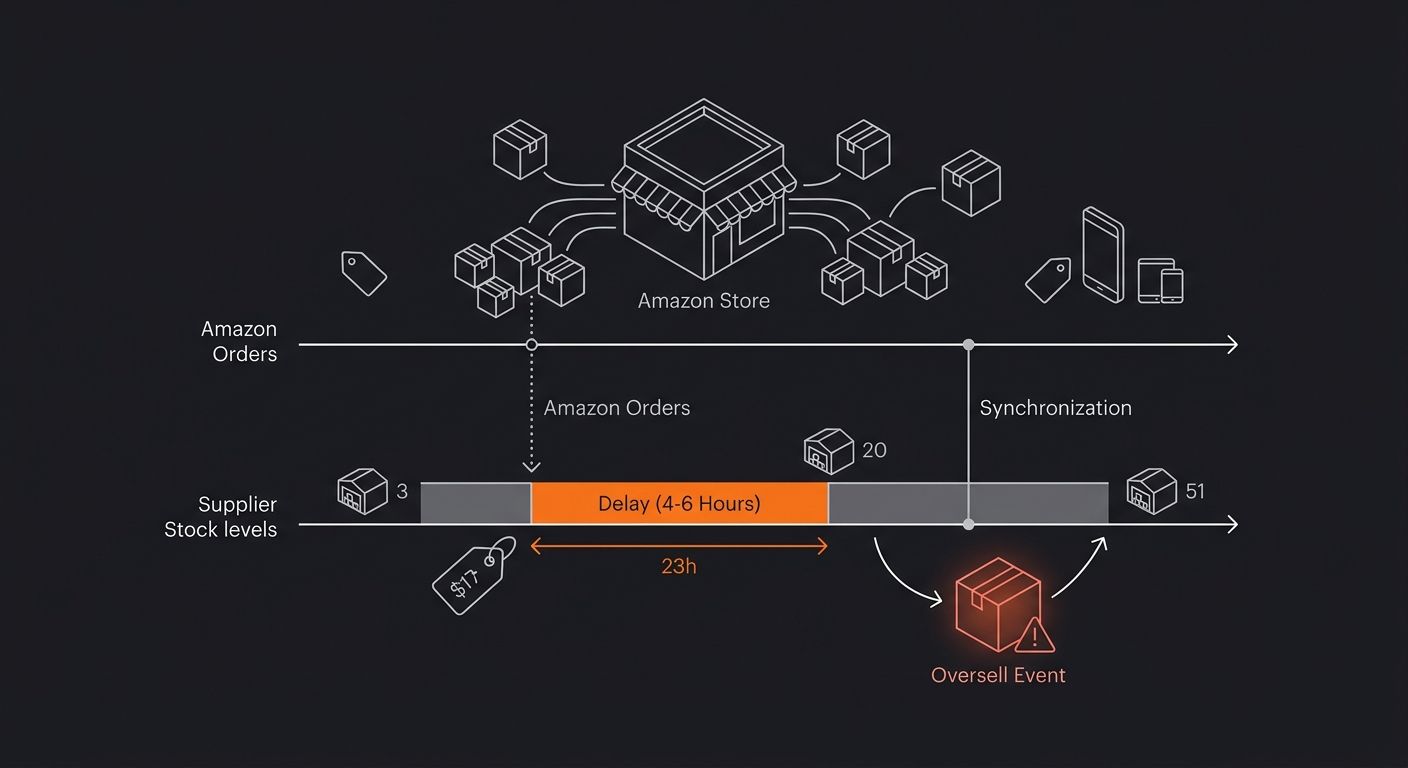
The time gap between a sale on Amazon and a stock-level update from your supplier determines whether your account survives past 100 orders. We've covered in depth how synchronization lag causes inventory failures across channels, and the problem compounds on Amazon because overselling directly damages your ODR.
The scenario plays out like this: your supplier has 12 units. You list the product on Amazon. Three sell in one hour. Your supplier, running on a different inventory system with batch updates every 4-6 hours, hasn't reflected those sales yet. Meanwhile, your supplier also sells 10 units through their own channels. Their actual available stock is now negative. You have an order you cannot fulfill, and cancelling it counts as a defect.
Automation tools like Inventory Source and AutoDS poll supplier stock levels every 15-60 minutes and automatically pause listings when inventory drops below a safety threshold of 3-5 units. Shopify's Amazon dropshipping guide recommends connecting inventory management software before listing your first product, and that's correct advice.
Amazon's 2026 introduction of AI-driven listing tools like Enhance My Listing (EML) has improved listing quality scores by up to 40% for sellers who activate it. But better listings drive more traffic, which amplifies the inventory sync problem. Faster sales velocity without faster sync frequency produces more oversell events, more cancellations, more Account Health damage.
Where the Model Breaks
Amazon dropshipping fails predictably under three conditions, and recognizing them early saves you the multi-week account recovery process.
Your supplier ships branded packaging. One customer complaint about receiving a box with another company's name triggers an investigation. Amazon's automated systems cross-reference your seller identity against packaging details reported in customer feedback. Even one mismatch can result in a "suspected drop shipping from a retail source" flag.
You can't maintain sub-5-day delivery. Amazon's algorithm surfaces listings that promise and deliver fast shipping. FBM sellers already face a conversion disadvantage competing against Prime-eligible FBA listings. If your delivery times stretch past 7 days, organic ranking drops, ad spend increases to compensate, and margins compress further. The cycle feeds itself.
Your product category has thin referral fee margins. Selling a $12 phone case in Electronics Accessories (15% referral fee) leaves $1.80 for Amazon and $10.20 for everything else. At typical supplier costs of $2-3 plus $3-4 in shipping, you're looking at $3-5 gross profit before advertising. One returned unit erases the profit from 3-4 successful sales.
The operators who make dropshipping through Amazon work long-term share a pattern: they sell products priced between $25-$60, source from US or EU-based suppliers with 1-2 day processing, keep category referral fees at 15% or below, and treat Amazon as one channel alongside a dedicated DTC storefront where they control the customer relationship and email list. Amazon provides traffic volume and buyer trust. The margin math that sustains the business gets built on the channels you own.

Ryan Torres
Ryan Torres is a former Amazon FBA seller turned dropshipping consultant who has generated over $2.8M in ecommerce revenue across 14 product launches. He specializes in supplier vetting, margin optimization, and scaling DTC operations for sub-$1M brands. Ryan focuses on actionable frameworks that drive measurable results for independent operators.
Related Articles
Why Your Supplier Is Handling More Than You Think: The Hidden Data Flow Between Order and Fulfillment
Between your customer's checkout click and the tracking email that arrives hours later, six to twelve discrete data transfers fire across your store, middleware, supplier systems, and shipping carriers.
5 Supplier Communication Failures That Collapse Margins Mid-Campaign (And the SOP to Fix Each One)
Sixty percent of dropshipping stores that attempt to scale fail due to supply chain instability—inventory gaps, cost swings, quality drift—according to Spocket's analysis of DSers data.
From Pandemic Pivot to Profitable Store: The Untold Operations Lessons Behind 2020-2026 Dropshipping Success Stories
COVID-era ecommerce operators who survived past 2022 share a pattern that has nothing to do with finding the right product or running the right ad. The pattern is operational: supplier onboarding speed, cash flow reinvestment discipline, and fulfillment consolidation.
Explore more topics