The Supplier Vetting Playbook: Building Your Dropshipping Due Diligence Checklist Before Approval
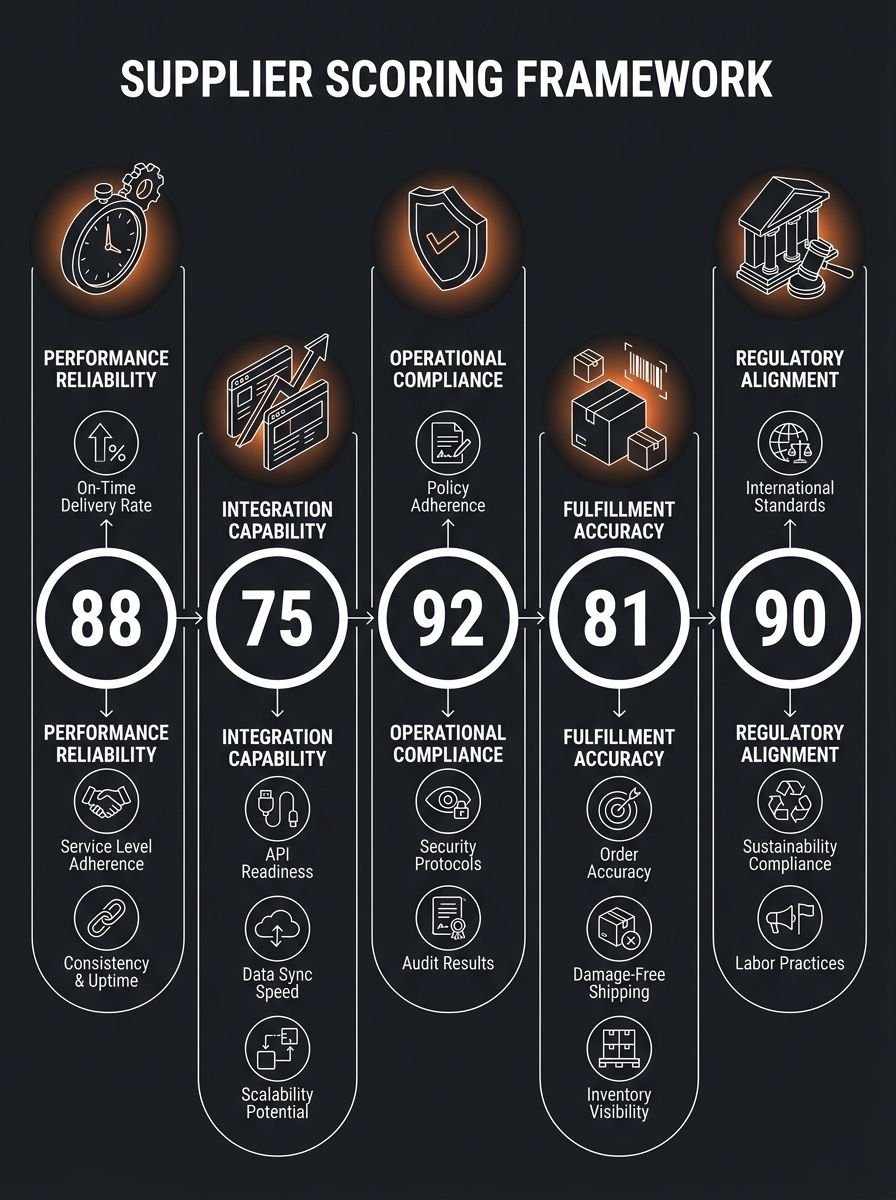
Inventory Source's supplier evaluation framework for high-compliance ecommerce categories tracks five distinct vetting parameters: performance reliability, integration capability, operational compliance, fulfillment accuracy, and category-specific regulatory alignment.

The Supplier Vetting Playbook: Building Your Dropshipping Due Diligence Checklist Before Approval
Inventory Source's supplier evaluation framework for high-compliance ecommerce categories tracks five distinct vetting parameters: performance reliability, integration capability, operational compliance, fulfillment accuracy, and category-specific regulatory alignment. Five parameters, each with sub-metrics, each requiring documentation. Meanwhile, the average dropshipper's manufacturer evaluation criteria consist of "their AliExpress rating is 4.7" and maybe a glance at shipping times. That gap between rigorous supplier capability assessment and gut-feel selection is where margin erosion, chargebacks, and store suspensions live.
This playbook walks through a structured supplier vetting checklist you can actually score, weight, and reuse across every new vendor relationship. No vague advice about "finding good suppliers." Specific criteria, specific thresholds, specific red flags.
Why Scoring Beats Gut Feel
The problem with informal vetting is selection bias. You notice the things that confirm your initial impression and miss the things that don't. A supplier sends you a polite email within two hours? Great communicator, you think. But you haven't checked their inventory sync protocol, their return policy, or whether they dropship for your direct competitors.
DNV's Manufacturer Product Quality Assessment methodology produces an overall score across all important production elements, highlighting both strengths and areas with potential for improvement. That scoring approach works for dropshipping suppliers too, scaled down to the metrics that actually affect your P&L.
A scored checklist does three things a mental checklist can't:
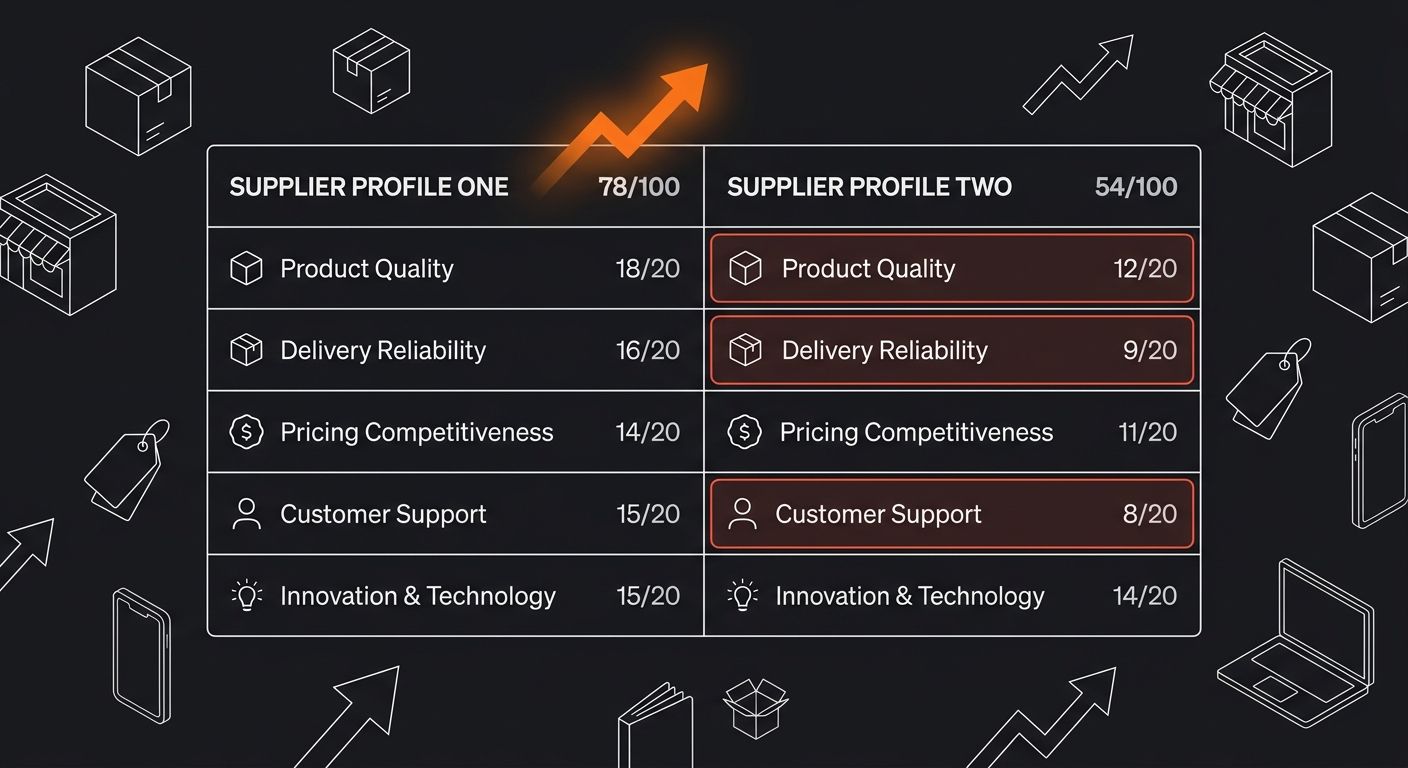
Forces comparison across vendors. Supplier A scores 72/100, Supplier B scores 61/100. You can see exactly where B falls behind.
Surfaces deal-breakers early. If a supplier scores zero on integration capability, a perfect quality score doesn't save the relationship.
Creates a paper trail for reseller approval preparation. When brands ask how you vet your supply chain, a documented process answers the question.
If you've already been rejected by suppliers during the approval process, a scored vetting system also signals to future partners that you operate professionally.
The Five Evaluation Categories (And What to Score in Each)
Performance Reliability
This is the category most dropshippers over-index on, but they measure the wrong things. Star ratings on supplier marketplaces tell you about the average experience across thousands of buyers with different standards. Your dropshipping due diligence needs to be more specific.
Score these sub-metrics on a 1-5 scale:
Order accuracy rate. Request this number directly. Anything below 95% is a problem. Below 92% means you'll be fielding customer complaints on roughly 1 in 12 orders.
Average processing time. Not shipping time. Processing time, meaning how many hours between order placement and the package actually leaving the warehouse. Two days of processing plus five days of shipping equals seven days. Your customer sees seven days.
Stockout frequency. Ask how often their top 20 SKUs go out of stock per quarter. If they can't answer this question, they're not tracking it, which is an answer in itself.
Communication response window. Send a pre-purchase inquiry and time the response. Under 12 hours is solid. Over 48 hours during business days is disqualifying for any supplier you'll depend on during order issues.
Integration Capability
Inventory Source's framework emphasizes integration capability as a core vetting parameter for a reason. Manual order processing doesn't scale, and it introduces error at every step.
Score these:
Platform compatibility. Does the supplier offer native integrations with your ecommerce platform? API access? CSV feed? Each step down from native integration adds labor cost and error risk.
Inventory sync frequency. Real-time sync is ideal. Hourly is workable. Daily sync means you're selling products that went out of stock twelve hours ago. We've covered how inventory syncing failures create overselling crises in detail elsewhere.
Tracking number automation. If you have to manually copy tracking numbers from supplier emails into your store, you're spending 2-3 minutes per order. At 30 orders a day, that's 90 minutes of pure data entry.
Returns process integration. Can returns be initiated through the same system, or does every return require a separate email thread?
Operational Compliance
This is where most dropshippers skip entirely, and it's the category that gets stores shut down.
Business license validity. Verify it. Don't assume.
Product certifications. If you're selling anything that touches skin, goes near food, is used by children, or plugs into an electrical outlet, certifications matter. CE marks, FDA registration, FCC compliance. Ask for documentation and verify it against the issuing body's database.
MAP policy adherence. Does the supplier enforce Minimum Advertised Price policies? If not, you'll race to the bottom against every other reseller.
Competitor disclosure. As Inertia PD notes in their manufacturer evaluation checklist, you should ask whether the manufacturer works with competing brands, and ask by name to be sure. If three of your direct competitors source from the same supplier with no MAP enforcement, your margins are already compressed.
Fulfillment Accuracy
Separate from performance reliability. Reliability measures consistency. Fulfillment accuracy measures whether what shows up matches what was ordered.
Pick-and-pack error rate. Wrong color, wrong size, wrong product entirely. Each error costs you the return shipping, the replacement shipping, and often a discount to retain the customer. A single pick error on a $30 product can cost $15-20 in recovery.
Packaging quality. Does the product arrive undamaged? Is the packaging branded or generic? If you're building a brand, unbranded brown boxes might actually work in your favor. Packaging with the supplier's own branding, or worse, with pricing from another marketplace, kills trust immediately.
Customs documentation accuracy (for cross-border). Incorrect HS codes, undervalued declarations, or missing paperwork causes delays at customs. Your customer doesn't care whose fault it is.
Running test orders before you scale is the only reliable way to measure fulfillment accuracy. Supplier claims about their error rates are aspirational. Test order data is actual.
Regulatory Alignment
This category matters more for certain niches than others, but ignoring it entirely is how stores get suspended.
Platform policy compliance. Shopify, Amazon, and other platforms have prohibited product lists that update regularly. Your supplier might sell products legally that your platform won't allow you to list.
Intellectual property exposure. Counterfeit goods, trademark-infringing packaging, or knockoff designs. If your supplier is selling "inspired by" versions of branded products, you're absorbing the legal risk.
Data handling practices. Your supplier receives your customers' names and shipping addresses. Where does that data go? Is it shared? Sold?
Weighting the Scores
Equal weighting across all five categories is simple but wrong. Your business model determines which categories carry more weight.
If you're selling fashion accessories with 3-5 day domestic shipping through a single Shopify store, integration capability and fulfillment accuracy matter most. Weight them at 25% each, with performance reliability at 20%, operational compliance at 20%, and regulatory alignment at 10%.
If you're selling supplements or beauty products, flip that. Regulatory alignment jumps to 25-30%, and operational compliance (certifications, testing documentation) carries similar weight.
The point of weighting is that a supplier who scores 5/5 on communication speed but 1/5 on product certifications shouldn't come out looking acceptable when you're in a regulated category.
The Reassessment Cycle
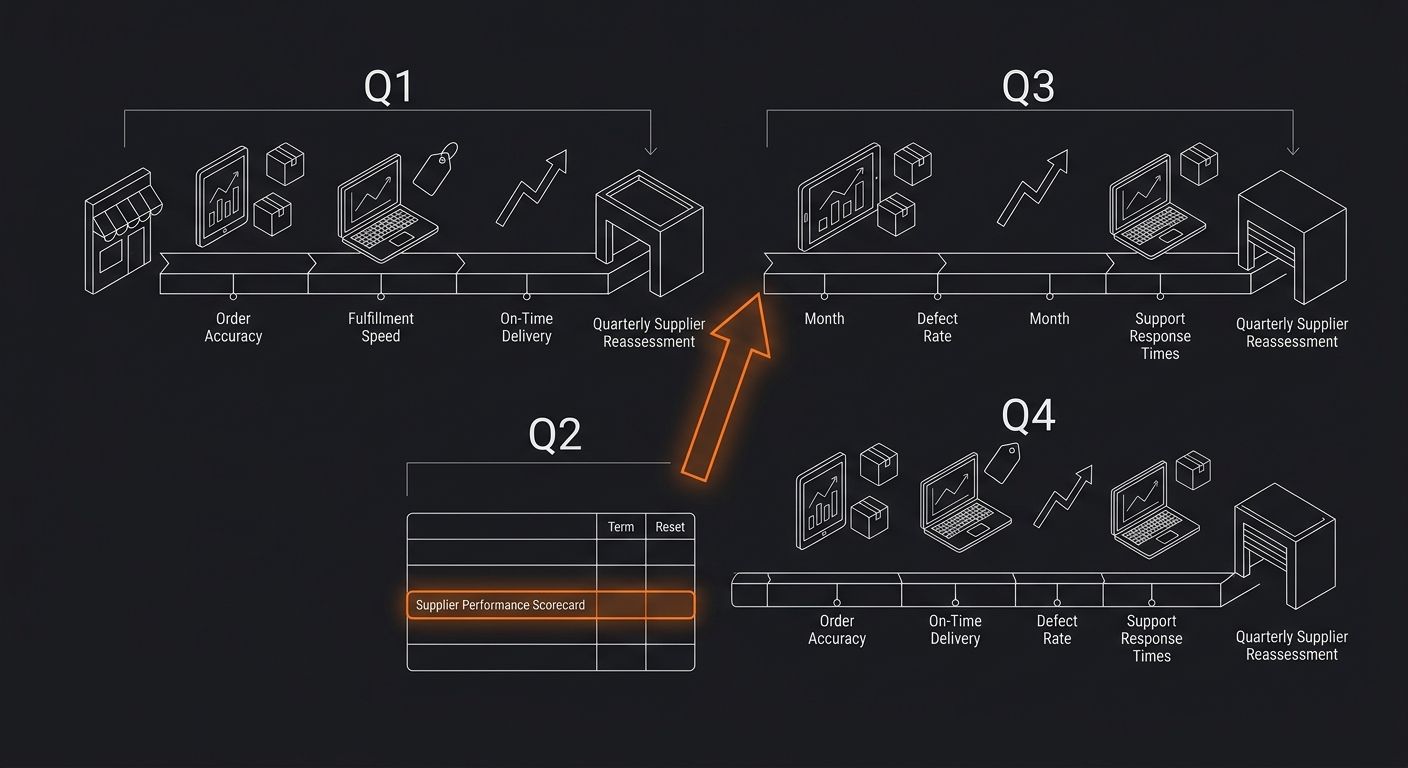
A supplier vetting checklist that runs once is a snapshot. Suppliers change ownership, change warehouses, change quality control staff. Inventory Source's guidance on this is straightforward: review evaluation criteria at predefined intervals, revalidate licenses and certifications, and adjust checklist weightings based on category risk exposure.
For most dropshipping operations, quarterly reassessment of your top suppliers is sufficient. Monthly monitoring of key metrics (processing time, error rate, stockout frequency) catches problems before they cascade. If you're using automated tools, understanding how syncing and supplier risk interact helps you decide which metrics to monitor in real time versus which ones you can batch-review.
The reassessment should also account for whether your supplier relationship has changed. Maybe you started with 10 SKUs and now list 200. The supplier that handled 10 orders a week flawlessly might buckle under 200. Capacity is a variable, and variables need re-measurement.
When evaluating whether to stay with a current supplier or move to direct supplier relationships over platform middlemen, your scored data from reassessment cycles gives you the comparison foundation. You're not guessing whether the new option is better. You're comparing scores.
What The Scores Won't Tell You
No checklist captures relationship quality, responsiveness during a crisis, or willingness to negotiate better terms as your volume grows. A supplier who scores 70/100 but picks up the phone when your shipment gets stuck at customs might outperform a 90/100 supplier whose support team takes 72 hours to respond to urgent issues.
The scored checklist also can't predict supply chain disruptions, tariff changes, or a supplier deciding to go direct-to-consumer and cutting off their reseller channel. Those risks require diversification, which means maintaining scored profiles on backup suppliers you're not currently using.
And the data gets less useful over time if you don't feed it. A checklist you filled out eight months ago and never updated is a historical document, not an operational tool. The whole point of structured dropshipping due diligence is that it compounds. Each reassessment cycle adds data. Each new supplier you score sharpens your sense of what "good" actually looks like in your specific niche. The spreadsheet gets smarter as you do.
365 Dropship Editorial
Editorial team writing about E-commerce, dropshipping, and product discovery — reviews of dropshipping suppliers and platforms, trending niche guides (jewelry, beauty, pets, home, fashion), supplier due diligence, ecom operations, shipping & fulfillment strategy, product research, AOV optimization, and profitable dropshipping case studies.
Explore more topics