The Post-Sale Audit Framework: How to Diagnose Which Dropshipping Mistakes Are Actually Costing You Margin
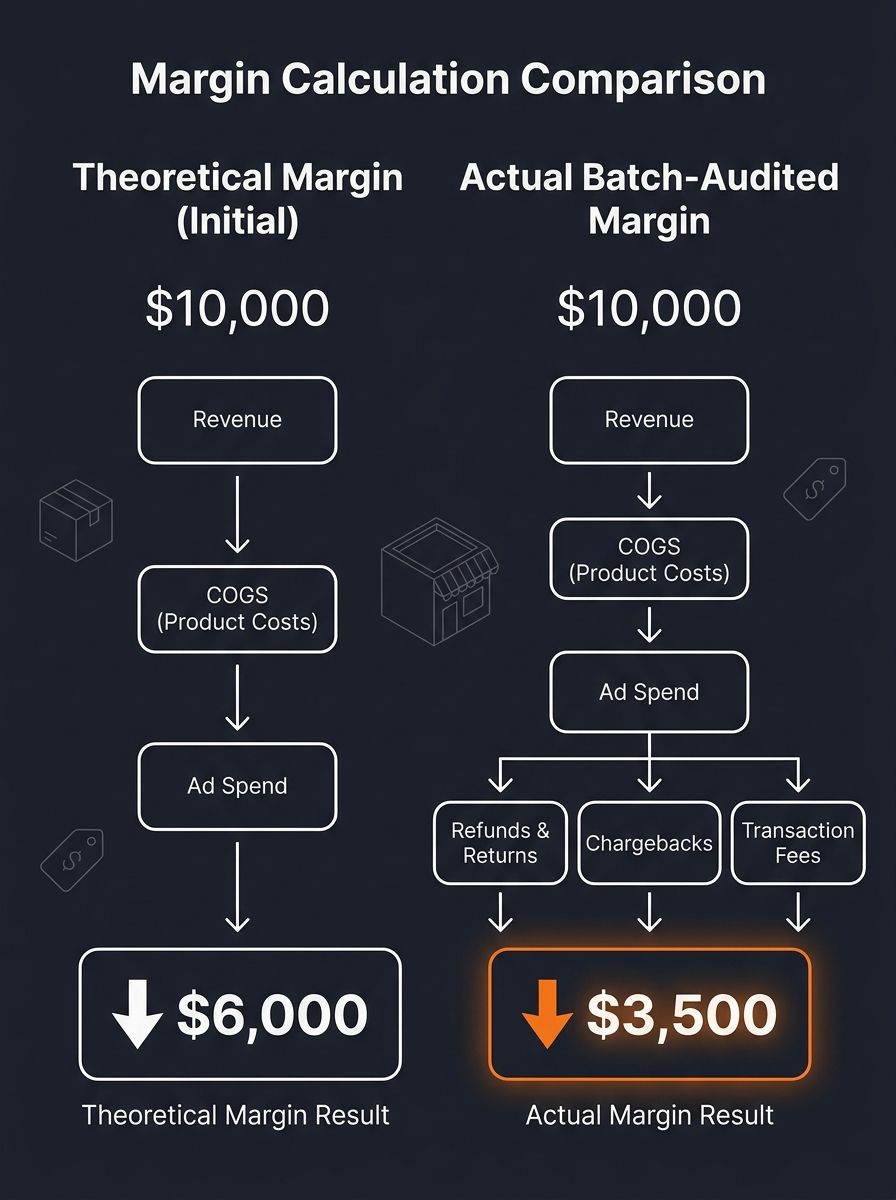
Theoretical margin on a $34.99 pet grooming kit sold through Shopify: 42%. Actual margin after pulling the last 100 fulfilled orders, tallying refund shipping labels, Facebook ad spend allocated per unit, and three chargebacks at $22 each: 19%.
The Post-Sale Audit Framework: How to Diagnose Which Dropshipping Mistakes Are Actually Costing You Margin
Theoretical margin on a $34.99 pet grooming kit sold through Shopify: 42%. Actual margin after pulling the last 100 fulfilled orders, tallying refund shipping labels, Facebook ad spend allocated per unit, and three chargebacks at $22 each: 19%. That 23-point spread shows up in nearly every dropshipping store that hasn't run a structured post-sale audit. The gap between the margin you think you're making and the margin your bank account confirms is where this framework lives. These six rules form a dropshipping audit checklist built around one principle: diagnose after the sale, not before, because that's where real cost data exists.
Always audit fulfilled batches, never dashboard averages
Your Shopify analytics or WooCommerce reports show revenue, gross margin, and maybe COGS if you set it up right. They don't show you the full picture for any specific batch of orders. A batch analysis pulls 50–100 consecutive fulfilled orders and reconstructs every cost line: product cost, transaction fees, shipping paid to supplier, shipping paid to customer (if free shipping eats into margin), payment processor fees, app subscription costs allocated per order, and returns.
The reason batches matter: averages hide spikes. A bad week with a defective product run, a supplier price increase you didn't catch, or a shipping zone surcharge can tank margin on 30 orders while your monthly average still looks okay. Run batch analysis every two weeks on your top five SKUs. Export order data, match it against supplier invoices, and subtract every cost you can verify. If the resulting margin number is more than 3 percentage points below your theoretical margin, you've found a leak worth chasing.
According to a 2026 guide on hidden dropshipping costs, one seller discovered their theoretical margins were 5–8% higher than actual results because of unaccounted shipping fluctuations and supplier price drift. That kind of discrepancy compounds fast across thousands of orders.
Separate ad spend from product margin before you diagnose anything
This is the single most common error in margin leak identification: treating the entire P&L as one number. When ad costs and product costs sit in the same bucket, you can't tell whether your margin problem is a sourcing problem, a marketing efficiency problem, or both.
Split your analysis into two layers. Layer one is contribution margin: selling price minus COGS, minus transaction fees, minus shipping cost. This number tells you whether the product itself is profitable before you spend a dollar on ads. If contribution margin is below 25% on a sub-$50 product, you have a sourcing or pricing problem. No amount of ad optimization will fix that.
Layer two is your blended margin after ad spend. Here's where CAC (customer acquisition cost) enters. If your contribution margin is 35% but your CAC per order is $14 on a $30 AOV, your net margin is around $0.50. The diagnosis changes completely depending on which layer is broken. We've written about how equal-revenue products can deliver wildly different profit depending on their contribution margin structure, and the math applies directly here.
Run both calculations on every SKU in your audit batch. You'll often find that 2–3 SKUs carry the entire store's profit while the rest break even or lose money after ads.
Audit your supplier's shipped quality against your listing photos
Supplier quality diagnostics get skipped because they feel like a pre-sale activity. They're not. Or rather, they shouldn't stop at the pre-sale test order. Product quality drifts. A supplier who shipped excellent units in January might cut costs on materials by March, and you won't know until refund rates climb.
Your post-sale quality audit has three components:
Refund reason coding: Tag every refund with a reason category. "Item not as described" and "defective" are quality signals. "Changed mind" or "too slow" are not. If quality-related refunds exceed 5% of units sold for any SKU, flag that supplier immediately.
Re-ordering your own product: Buy your top sellers from your own store every 60 days. Compare what arrives against your listing photos and the original test order. Checking quality before shipping keeps suppliers honest, because when they know you're watching, defect rates stay low.
Customer photo analysis: If you're collecting review photos (you should be), compare them against product listing images quarterly. Consistent color mismatches, sizing differences, or packaging quality drops are visible in customer photos before they show up in your refund rate.
This is post-order troubleshooting that most stores skip entirely. If you've already built a supplier test order process, extend it into a recurring audit rather than treating it as a one-time gate.

Track refund and chargeback costs per SKU, not per month
Monthly refund totals are useless for diagnosis. A $400/month refund number could mean one problematic SKU generating 80% of returns, or it could mean a baseline 3% return rate spread evenly across your catalog. The fix for each scenario is completely different.
Build a simple spreadsheet (or use your analytics tool if it supports SKU-level refund tracking) that logs:
Refund amount per SKU
Shipping cost on returned/reshipped items
Chargeback fees per SKU (typically $15–25 per incident with most processors)
Customer service time spent per refund (estimate 15 minutes at your hourly rate or your VA's rate)
One seller cited in industry research reduced their chargeback rate from 2.8% to under 0.5% by tightening product descriptions and adding better sizing guides. That's a direct margin recovery, but they only found the fix because they tracked chargebacks per SKU and discovered that one product line generated 70% of all disputes. We've covered the broader pattern of how post-order costs erode profit, and per-SKU tracking is how you move from knowing the problem exists to knowing which product is causing it.
Calculate your real shipping cost after surcharges and zone adjustments
The shipping price your supplier quotes and the shipping cost that actually hits your account are frequently different numbers. Fuel surcharges, dimensional weight adjustments, remote area fees, and tariff and duty costs all add up after the quoted rate. If you're offering "free shipping" and absorbing these costs, every untracked surcharge comes directly out of margin.
Your audit step: pull 50 recent tracking numbers. Match each one against the actual charge on your supplier invoice or fulfillment platform billing page. Calculate the average actual shipping cost per order and compare it to the shipping cost you're using in your margin model. If the real number is more than 10% above your modeled number, update your pricing or switch shipping methods.
For stores using CJ Dropshipping, Zendrop, or similar platforms, check whether ePacket rates have been replaced by higher-cost alternatives on specific routes. Shipping cost per package from China to the US has been volatile, and rising port and fuel costs mean the rate you locked in three months ago might already be outdated.
According to Spark Shipping's margin guide, COGS is usually a dropshipper's biggest cost line. But for many stores, shipping is a close second, and it's the one most likely to have hidden variance because surcharges don't always appear on the initial invoice.
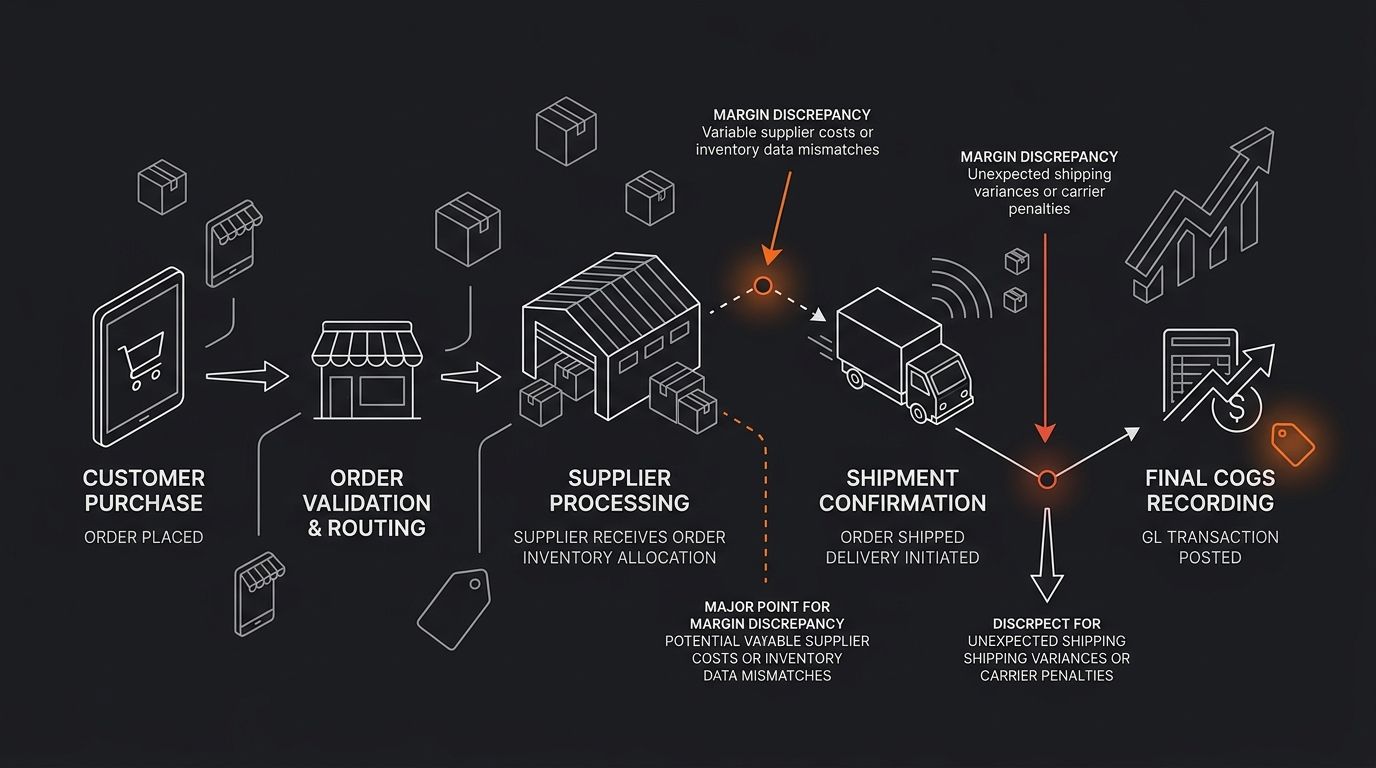
Record COGS at shipment confirmation, not at order placement
This is an accounting hygiene rule that directly affects your profitability root cause analysis. If you record COGS when a customer places an order, you're locking in a cost number before you know the actual fulfillment cost. Supplier prices change. Shipping zones vary. Promotional pricing from suppliers expires mid-batch.
The correct timing: record COGS when the supplier confirms shipment and you have the final invoice amount. This is standard three-way matching (purchase order, supplier bill, shipment confirmation) adapted for dropshipping, where the PO and shipment often happen nearly simultaneously.
Why it matters for audits: if your books show 38% gross margin but that number is based on COGS recorded at order time using a supplier price that increased 6% since then, your real margin is 32%. The brand-readiness supplier audit framework recommends treating every order as a brand touchpoint, and that includes accurate cost tracking per shipment.
If you're using QuickBooks, Xero, or even a spreadsheet, set up a workflow where COGS only gets logged after the fulfillment notification arrives. It adds a small delay to your bookkeeping, but it prevents the slow margin inflation that makes your P&L look better than reality.
When These Rules Fight Each Other
Every rule above takes time. Running batch audits every two weeks, re-ordering your own products every 60 days, tracking refund reasons per SKU, auditing shipping invoices line by line, adjusting COGS timing: if you tried to do all of this simultaneously on day one, you'd spend more time auditing than selling.
The practical sequence: start with the batch audit (rule one) and ad/product margin split (rule two). These two steps alone will surface the biggest leaks within your first analysis session. If the numbers reveal a quality problem, add the supplier quality audit. If shipping variance looks suspicious, pull the invoice-level detail. The per-SKU refund tracking and COGS timing rules are ongoing process changes that you implement once and maintain.
The framework also breaks down at very low order volumes. If you're doing fewer than 100 orders per month, batch analysis won't generate statistically meaningful patterns. At that scale, focus on contribution margin per SKU and test order quality. The audit cadence tightens as volume grows.
And one caveat about automation: tools like TrueProfit and Lifetimely can handle much of this tracking for you, but they're only as good as the data they ingest. If your supplier invoices don't flow into your analytics platform automatically, you're still going to need manual reconciliation on the shipping and COGS lines. The audit framework isn't a replacement for good tooling. It's the set of questions you ask when the tools tell you your margin is 30% and your bank balance says otherwise.
365 Dropship Editorial
Editorial team writing about E-commerce, dropshipping, and product discovery — reviews of dropshipping suppliers and platforms, trending niche guides (jewelry, beauty, pets, home, fashion), supplier due diligence, ecom operations, shipping & fulfillment strategy, product research, AOV optimization, and profitable dropshipping case studies.
Related Articles

How to Audit Your Shopify Store's Checkout Flow for Margin Leaks in Under 2 Hours
Forty-eight percent of Shopify cart abandonment traces to a single trigger: extra costs (shipping, taxes, handling fees) appearing for the first time on the payment screen, according to Baymard Institute research aggregated across dozens of ecommerce usability studies.

The Supplier Audit Flowchart: Isolating Root Cause When Your Dropshipping Margins Collapse Mid-Campaign
When a Meta campaign producing $11 contribution margin per unit on day three drops to $3.40 by day fourteen, the instinct is to blame the ad creative or the audience. The ad account gets the autopsy. The supplier rarely does.

Profit Margin Calculator Guide
Multiplying your product cost by 1.30 does not give you a 30% profit margin. It gives you a 23% margin, and that seven-point gap is where thousands of ecommerce operators silently lose money every month.
Explore more topics