Logistics Platform Publishes Quick Ship Operations Breakdown for Ecom Fulfillment
Racklify published a logistics encyclopedia entry June 17 breaking down Quick Ship fulfillment into six operational components—reserved inventory, priority order routing, pre-configured packing kits, dedicated resources, carrier coordination, and simplified quality checks—that compress order-to-deli

Logistics Platform Publishes Quick Ship Operations Breakdown for Ecom Fulfillment
Racklify published a logistics encyclopedia entry June 17 breaking down Quick Ship fulfillment into six operational components—reserved inventory, priority order routing, pre-configured packing kits, dedicated resources, carrier coordination, and simplified quality checks—that compress order-to-delivery time for ecommerce operators and dropshippers, according to the platform's logistics reference.
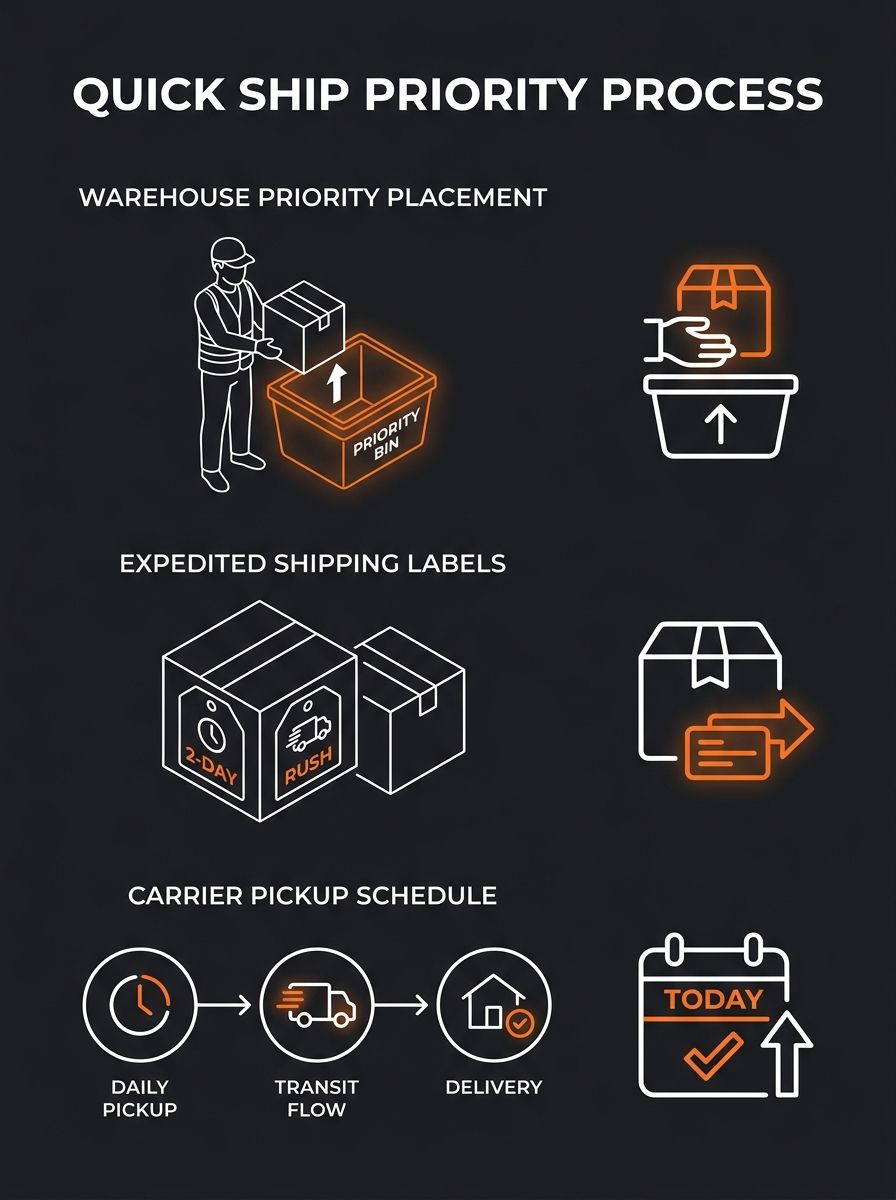
The entry frames Quick Ship as the warehouse-side infrastructure behind next-day and same-day delivery promises. Warehouse management systems flag Quick Ship orders and route them to specialized pick-and-pack stations, bypassing standard fulfillment queues. Fast-moving SKUs eligible for Quick Ship are stored in accessible "fast-pick" zones to minimize picker travel time, while pre-configured packing kits eliminate decision time during the packing phase.
Author Erwin Richmond Echon, writing for Racklify's logistics reference library, describes Quick Ship as "the warehouse equivalent of turning on a fast lane for orders that matter most." The entry was last updated March 19, 2026, and republished June 17.
Core Operational Components
Quick Ship workflows require buffer stock held specifically for eligible SKUs, increasing carrying costs if not managed against velocity data. The entry identifies dedicated resources—a small team or shift focused exclusively on Quick Ship orders—as critical to maintaining consistent throughput and preventing priority orders from mixing into standard workflows.
Carrier coordination forms the third structural requirement. Warehouse operators negotiate frequent pickup windows, optimize cutoff times for express service levels, or contract courier services to enable faster handoffs. The entry cites twice-daily courier pickups as a common implementation for small ecommerce retailers.
Simplified packing protocols reduce error rates on expedited orders. Standard box sizes and pre-printed packing slips remove variability from the packing step. One example in the entry describes a phone charger retailer storing popular models in a fast-pick zone, packing them into pre-sized envelopes, and handing them to an express courier twice daily.
Cost and Margin Implications
Quick Ship increases conversion rates at checkout when advertised as an option, the entry states, but carries three cost trade-offs. Buffer stock for reserved inventory raises carrying costs. Expedited carrier services cost more per shipment than standard ground. Operational discipline requirements mean any breakdown that pushes Quick Ship orders into standard queues eliminates the margin benefit.
The entry recommends monitoring three KPIs: order cycle time from receipt to carrier handoff, ship accuracy rates on expedited orders, and expedited shipping cost as a percentage of order value. B2B suppliers selling time-sensitive replacement parts and ecommerce sellers advertising two-day delivery as a competitive differentiator are identified as the clearest fit for Quick Ship investment.
High-value or perishable products justify the carrying cost and carrier premium, according to the entry. B2B customers facing production downtime without rapid replenishment will pay for Quick Ship access. The margin math hinges on whether faster delivery drives enough incremental conversion or repeat purchase rate to offset the higher per-order cost—a calculation the entry does not provide worked examples for.
Dropshippers evaluating Quick Ship face a structural challenge: most overseas suppliers shipping from China operate on 7-15 day timelines that make express workflows irrelevant. US-based suppliers and domestic fulfillment centers become necessary infrastructure for Quick Ship positioning, changing the landed cost profile.
Implementation Checklist for Operators
The entry provides a six-step implementation sequence. First, identify top-selling or time-sensitive SKUs that justify faster fulfillment through sales velocity analysis. Second, designate easy-access pick locations and set minimum buffer stock levels based on order frequency and reorder lead time. Third, configure the warehouse management system or order management platform to flag Quick Ship orders and route them to dedicated stations.
Fourth, create standard packing kits and pre-printed labels for common order profiles to eliminate decision time. Fifth, coordinate pickup windows and service levels with carriers to meet customer delivery expectations. Sixth, monitor order cycle time, ship accuracy, and expedited shipping cost KPIs to evaluate whether the workflow delivers the expected margin and customer satisfaction return.
Small-to-medium ecommerce operations and online sellers benefit most from Quick Ship implementation, the entry notes, because the workflow boost provides competitive differentiation in crowded marketplaces without requiring the capital investment of robotic fulfillment systems or multi-warehouse networks.

What Happens Next
Dropshippers and solo ecom operators evaluating Quick Ship face a three-part calculus: whether their product mix includes SKUs with high enough velocity to justify reserved inventory, whether their supplier or 3PL partner can execute the dedicated workflow requirements, and whether faster delivery drives measurable conversion lift. The entry provides the operational framework but leaves margin modeling to the operator.
Quick Ship positioning only works if the infrastructure exists to deliver on the promise. For dropshippers sourcing overseas, that means migrating to domestic suppliers or US-based fulfillment centers—a landed cost decision that changes unit economics. For Shopify merchants using 3PLs, it means auditing whether the fulfillment partner offers Quick Ship as a service tier and what the per-order premium costs.
The strategic question is whether "ships in 24 hours" or "next-day delivery" becomes a conversion driver worth the operational investment. In niches where competitors ship standard ground in 5-7 days, Quick Ship creates differentiation. In categories where Amazon Prime has normalized two-day delivery as baseline, Quick Ship becomes table stakes rather than competitive advantage.

Ryan Torres
Ryan Torres is a former Amazon FBA seller turned dropshipping consultant who has generated over $2.8M in ecommerce revenue across 14 product launches. He specializes in supplier vetting, margin optimization, and scaling DTC operations for sub-$1M brands. Ryan focuses on actionable frameworks that drive measurable results for independent operators.
Related Articles
The Hidden Cost of Speed: Why Faster Shipping Is Tanking Your 2026 Margins (And How to Rebalance)
Carrier rate hikes from UPS and FedEx averaged 5.9% for 2026, but surcharges push the real increase to 8–12%. Last-mile delivery absorbs 53% of total shipping costs. Three fulfillment models handle this pressure differently, and choosing wrong erodes margin faster than rising ad costs.

SendFromChina Publishes Six-Step Fulfillment Center Workflow Guide Targeting Ecommerce Operators Evaluating Third-Party Logistics
SendFromChina released a comprehensive fulfillment center guide on July 22, 2026, breaking down warehouse operations into six sequential stages—receiving, storage, order processing, picking and packing, shipping, and returns processing—according to documentation published on the logistics provider's

SendFromChina Publishes Seven-Factor Shipping Cost Framework Targeting Dropshippers Managing Delivery Margins
Package weight, dimensions, shipping zones, carrier selection, delivery speed, product type, and insurance requirements form the seven primary cost drivers for ecommerce shipping, according to a comprehensive guide released by SendFromChina on July 20 targeting dropshippers optimizing delivery margi
Explore more topics