Why Your Product Reviews Are Generating Clicks But Not Sales: The Trust Gap Between Star Ratings and Purchase Intent
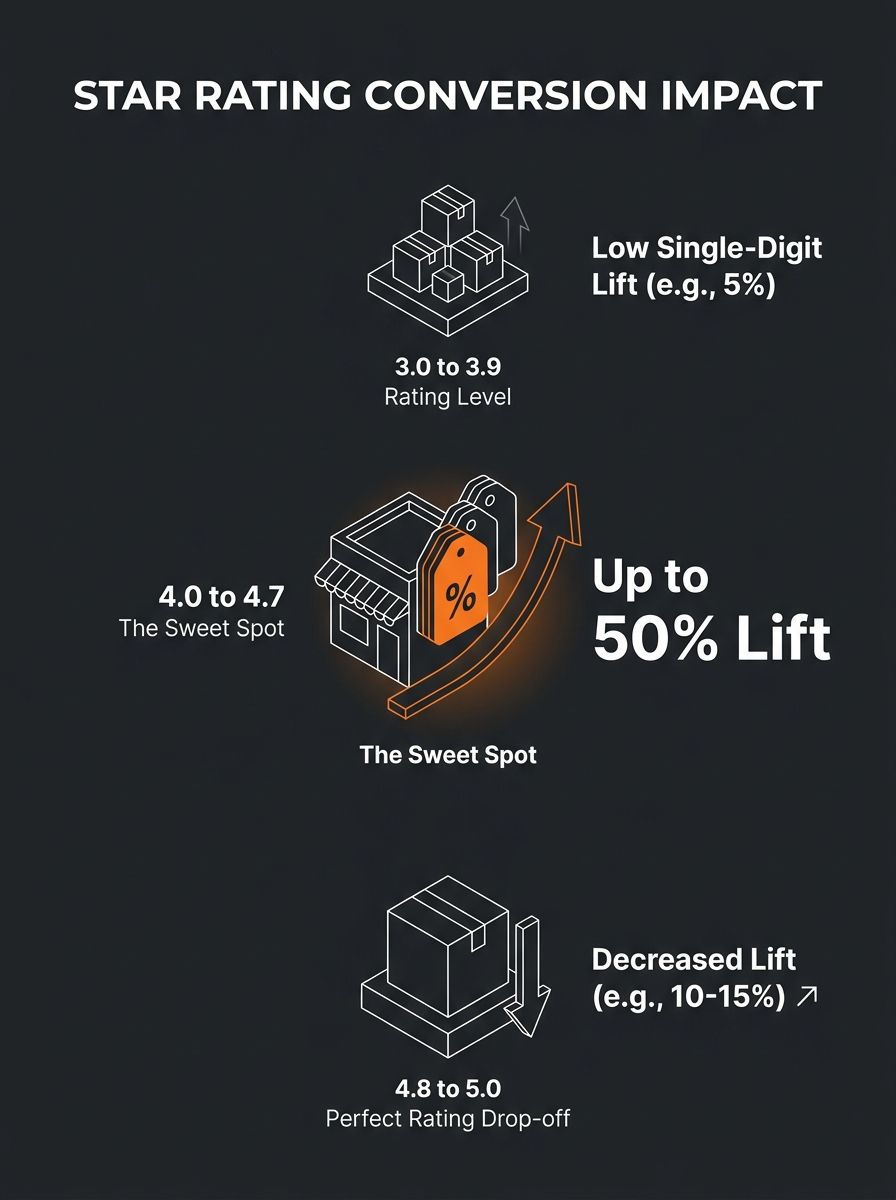
Products with a flawless 5.0-star average convert at lower rates than those rated between 4.0 and 4.7 stars, according to Spiegel Research Center data.
Why Your Product Reviews Are Generating Clicks But Not Sales: The Trust Gap Between Star Ratings and Purchase Intent
Products with a flawless 5.0-star average convert at lower rates than those rated between 4.0 and 4.7 stars, according to Spiegel Research Center data. The review trust gap lives in this zone: star ratings pull clicks from search and category pages, but the texture of written reviews underneath those stars determines whether anyone buys.
The Spiegel Study and the 270% Baseline
Spiegel Research Center's research on an anonymous online retailer established what has become the benchmark number for product review conversion: displaying reviews on a product page lifted conversions by 270% compared to pages without any reviews at all. That number alone justifies installing a review app on day one. But the study's more granular findings reveal where most dropshipping stores miscalculate.
The conversion lift wasn't uniform across price points. For lower-priced products, reviews increased the conversion rate by 190%. For higher-priced products, the lift jumped to 380%. That differential matters enormously for anyone running high-AOV bundles or premium product pages. The more expensive the item, the more psychological risk the buyer carries, and the more work your reviews need to do to close the gap between "interested" and "purchased."
Positive Google reviews alone drive an 18% increase in conversion rates directly within search results, according to WiserReview's compilation of Google review data. And products with 5,000+ reviews see a 292.6% lift in conversion. But here's where the disconnect starts: 46% of shoppers are actively suspicious of a perfect 5-star average. Among Gen Z buyers, that number climbs to 53%.
Your star rating gets the click. Your review content gets the sale. And most review apps are configured to optimize for the former while neglecting the latter.
Why 4.7 Outsells 5.0 on Every Product Page
The data on star rating thresholds is consistent across multiple studies. Moving from 3 stars to 4 stars increases conversions by 25–35%. Hitting 4.5 stars nearly doubles conversion rates compared to products below 4.0. Businesses with a 4.5+ star rating earn up to 3x more clicks than those below 4.0, according to BrightLocal data compiled by GigWise.
But the relationship between stars and conversions isn't linear. Conversion rates drop 30–50% when ratings slide from 5.0 to 4.0, which seems to argue for a perfect score. And yet shoppers don't trust perfection. The optimal range for purchase intent sits between 4.2 and 4.7 stars. Products in this band signal both quality and authenticity, because a few critical reviews mixed in tell the buyer the feedback is real.
This creates a paradox for store owners using review moderation features in apps like Judge.me or Stamped. If you suppress every 3-star review to maintain a 5.0 average, you're removing the friction that makes your review section believable. The 88% of consumers who find written text reviews more trustworthy than star ratings alone are looking at the substance of those reviews, scanning for specifics, checking dates, and reading negative feedback for context about real product limitations.
The National Strategic Group's analysis of review psychology puts it directly: "A recommendation can get customers interested in your product or service, but the online reviews will determine if they go forward and buy." Star rating vs purchase intent is a two-stage funnel, and most stores optimize only the first stage.
The Negativity Asymmetry Starving Your Review Feed
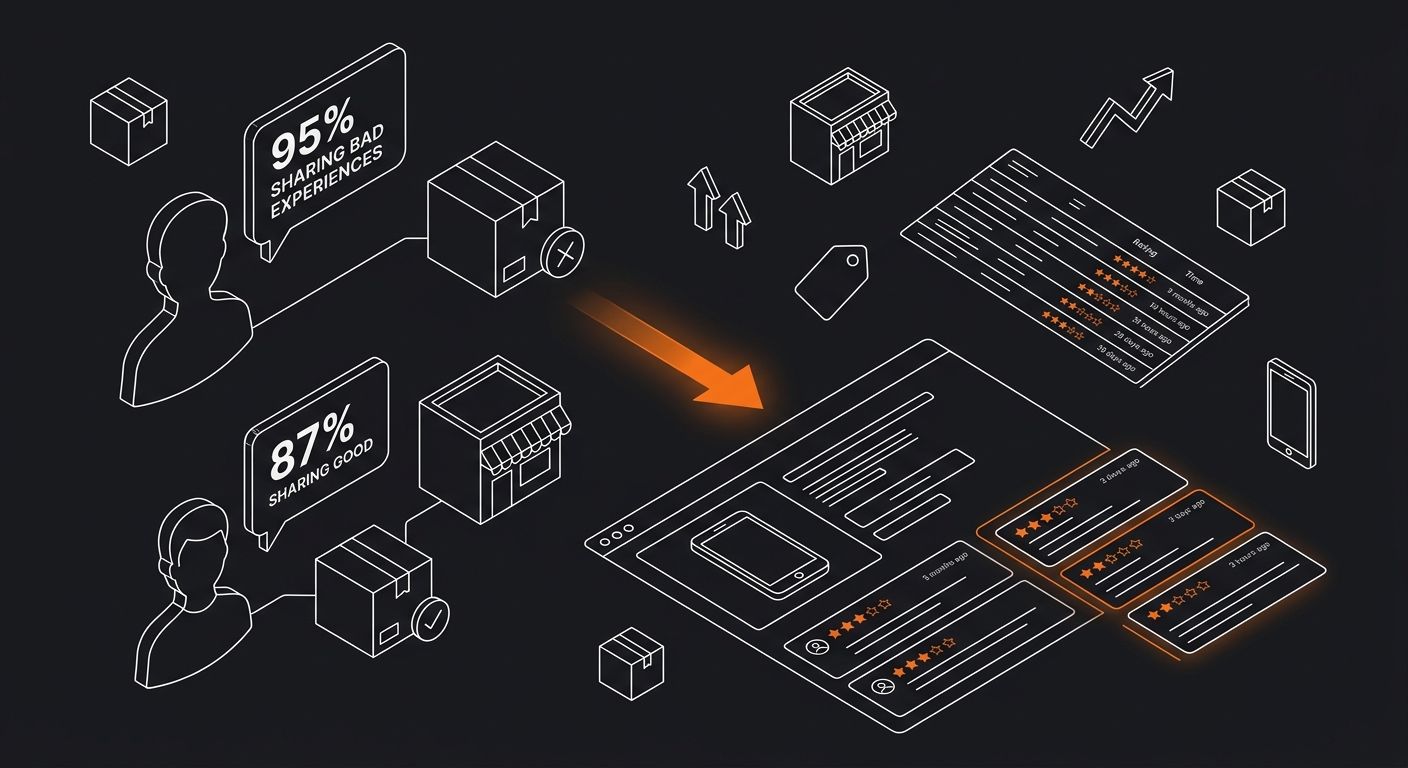
The trust gap gets worse because of a structural imbalance in who actually writes reviews. A Zendesk study found that 95% of users share bad experiences, while only 87% share good ones. The sharing reach is lopsided too: 54% shared negative experiences with more than five people, compared to 33% for positive experiences. And 45% shared negative experiences via social media, versus 30% for positive ones.
This means your happiest customers are disproportionately silent. A small business owner on Reddit's r/smallbusiness captured the frustration: "It makes sense when people don't leave good reviews because it's kind of what they expected when they purchased. It's unfortunate and sucks but it's just the psychology of it."
For dropshipping stores, this asymmetry compounds a separate problem. You're already fighting perception issues around shipping times, product quality consistency, and brand recognition. When the only reviews that land organically are from the 5-8% of customers who had a genuinely bad experience, your review page becomes a curated highlight reel of dissatisfaction.
The fix is operational, not psychological. You need systems that actively solicit reviews from satisfied buyers within a specific window after delivery confirmation. If you're already running post-purchase email sequences for repeat revenue, the review request should be woven into that flow, typically 3-5 days after the tracking shows "delivered." Forbes contributor analysis of social proof found that "reviews, especially those rich in stories with personal detail, tap into buyer empathy, often bridging the gap between skepticism and trust." Your automated review request needs to prompt for that detail, asking customers about their specific use case rather than sending a generic "How'd we do?" email.
How Judge.me and Loox Handle the Gap Differently
The review app you choose determines which side of the trust gap your store lives on. Both Judge.me and Loox are popular Shopify review apps, but their default configurations optimize for different conversion signals.
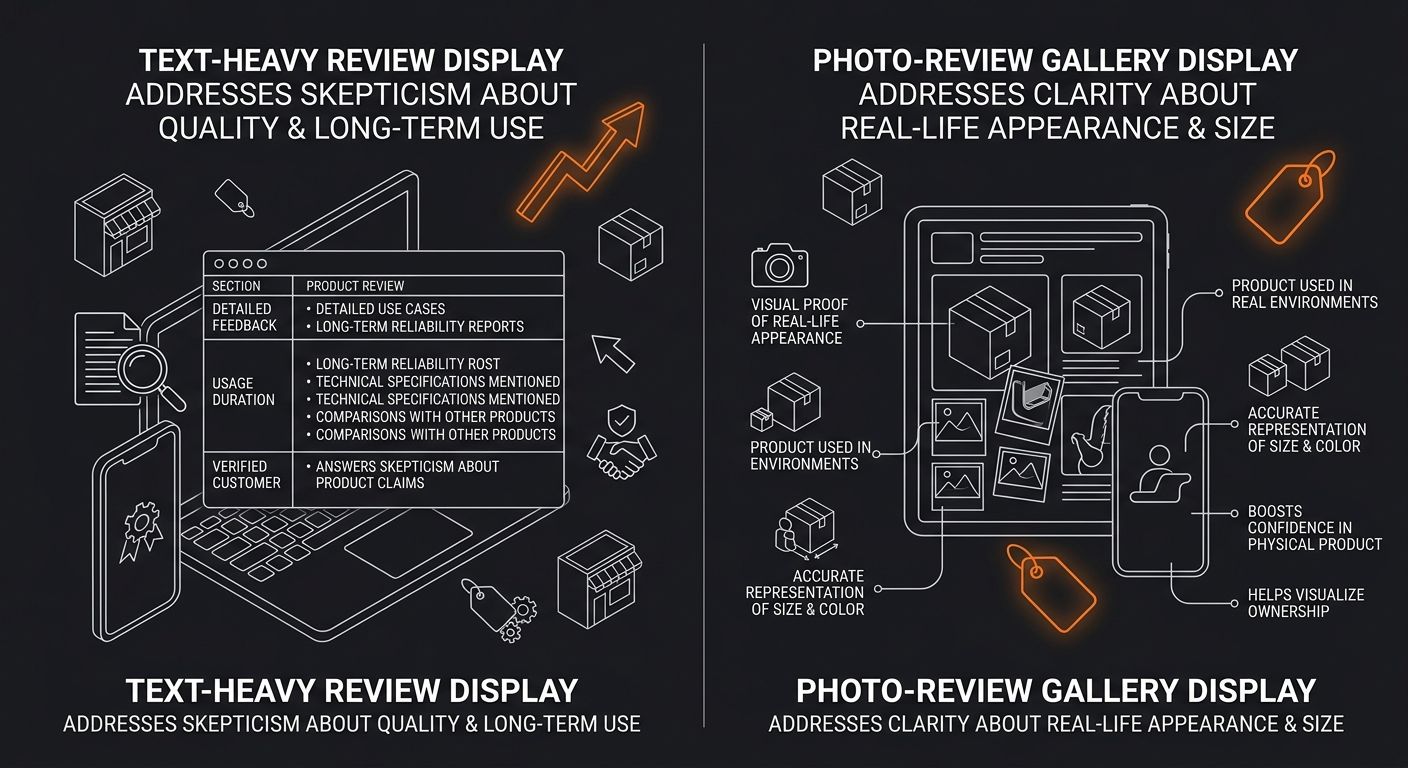
Judge.me's strength sits in text-heavy reviews with Q&A functionality. Its automated email sequences can be customized to prompt customers for specific details, product photos, and context about their purchase. The free tier supports unlimited review requests, which makes it accessible for stores still validating product-market fit. Judge.me also indexes review content for SEO, meaning your review text shows up in Google search results and feeds the dropshipping social proof signals that drive organic click-through.
Loox leans into photo and video reviews as its primary conversion mechanism. Visual UGC provides what text alone cannot: undeniable proof that a real person received and used the product. For dropshipping stores selling physical goods where the "does it actually look like the listing photo?" objection is a consistent conversion blocker, Loox's photo-first approach addresses that specific anxiety. The app offers discount-for-review incentives that can increase review submission rates by 2-4x compared to unprompted requests.
Feature | Judge.me (Free/Pro) | Loox (Basic/Scale) |
|---|---|---|
Text review collection | Unlimited | Unlimited |
Photo/video reviews | Included | Primary focus |
Automated email sequences | Customizable timing + content | Customizable timing |
SEO indexing of review text | Yes (rich snippets) | Limited |
Q&A on product pages | Yes | No |
Review import from AliExpress | Yes (via CSV) | Yes (via CSV) |
Discount-for-review incentive | Manual setup | Built-in |
Starting price | Free / $15/mo | $9.99/mo |
The choice between them maps directly to your product type and price point. If you're selling $15-25 impulse-buy products where the primary objection is "is this legit?", photo reviews from Loox close the gap faster. If you're selling $50+ considered-purchase items where buyers want detailed comparisons and specific performance data, Judge.me's text-heavy approach and Q&A functionality address the review page optimization needs that drive star rating vs purchase intent alignment.
Both apps allow you to import reviews from AliExpress via CSV, but this is where 40% of shoppers' wariness about AI-generated or fake reviews becomes a real liability. Imported reviews with generic text, no photos, and perfect 5-star ratings will trigger exactly the suspicion your review section is supposed to alleviate. If you import, curate ruthlessly: keep only reviews with specific product details, verifiable photos, and a natural range of 3-5 star ratings.
The Spiegel Math on a $45 Dropshipping Product
Apply the Spiegel numbers to a concrete scenario. You're selling a product at $45 with a landed cost of $18 and a 60% gross margin before ad spend. Your product page gets 1,000 visitors per month at a 2% baseline conversion rate: 20 orders, $900 gross profit.
Adding any review display at all, according to the 270% Spiegel baseline, could push that conversion rate toward 5.4%. That's 54 orders and $2,430 in gross profit from the same traffic. The math on calculating your true CAC payback period shifts dramatically when your review section is doing conversion work your ad budget would otherwise need to cover.
But the trust gap erodes that ceiling. If your reviews are all 5.0 stars with generic text, the 46% suspicion rate means nearly half your visitors discount the social proof entirely. If your review feed is dominated by the negative experiences that arrive organically (thanks to the Zendesk asymmetry), shoppers see confirmation of their existing doubts about dropshipping quality.
The operational prescription is specific. Respond to every negative review within 72 hours. Data shows this increases the likelihood of future customers still purchasing by 45%. Display verified buyer badges: they lift conversion by 15%. Prompt for story-rich reviews using targeted questions in your post-purchase email flows, and audit your checkout flow to ensure reviews are visible above the fold on mobile without requiring a scroll past the buy button.
The Spiegel study proved that reviews work. The trust gap research proves that how reviews look, read, and feel to a skeptical shopper determines whether that 270% lift actually lands in your store or evaporates before the Add to Cart click. Every configuration decision inside your review app either narrows or widens that gap, and most stores have never tested which side they're on.
365 Dropship Editorial
Editorial team writing about E-commerce, dropshipping, and product discovery — reviews of dropshipping suppliers and platforms, trending niche guides (jewelry, beauty, pets, home, fashion), supplier due diligence, ecom operations, shipping & fulfillment strategy, product research, AOV optimization, and profitable dropshipping case studies.
Related Articles
Honest Product Reviews for Dropshipping Stores: The Testing Protocol That Builds Customer Trust Without Fake Social Proof
Buying reviews will tank your store's conversion rate faster than having no reviews at all. An estimated 30% of online reviews across ecommerce are fake, and shoppers have learned to spot them. Purchased testimonials signal that your store can't earn real ones, and that inference kills sales.
The Review Generation Trap: Why Fake Social Proof Is Tanking Your Conversion Rate (And How Successful Dropshippers Build Authentic Feedback Loops)
Northwestern University's Spiegel Research Center produced a finding that should have killed the fake-review industry on the spot: products rated between 4.2 and 4.5 stars convert at higher rates than products sitting at a perfect 5.0. The implication was plain. Shoppers don't trust perfection.
Shopee App Reviews: Features & User Ratings
Shopee, Lazada, and Shopify with the Shopee Reviews integration give Southeast Asian sellers three distinct paths to collect, display, and capitalize on buyer feedback. The central tradeoff: marketplace reach versus logistics reliability versus brand ownership.
Explore more topics